
The RentCheck Alternative:
Resident Inspect vs. RentCheck
Looking for a RentCheck alternative? RentCheck is a resident-led inspection app where tenants complete inspections on their own phone. Resident Inspect, on the other hand, puts a trained specialist on a live video call for every walkthrough. Same goal, very different models.
Last reviewed: September 2026
Who Each One Is For
Best for teams comfortable with tenant-led inspections
RentCheck is a low-cost, per-unit app for property managers who are happy to have tenants self-inspect, want PMS integration, and have staff to review what tenants submit.
Best for PMs who want consistent, documented walkthroughs
Resident Inspect is the RentCheck alternative for property managers who can’t afford missed damage or inconsistent photos. Instead of relying on the tenant, a trained specialist handles every inspection, so you get full coverage without adding staff.
RentCheck vs. Resident Inspect: Full Comparison
| RentCheck |  | |
|---|---|---|
| Who does the inspection | Mostly the tenant. RentCheck says about 80% of inspections are completed by tenants | ✓ Trained Resident Inspect specialist, live on every call |
| Inspection method | Tenant takes photos and videos on their phone, guided by the app’s checklist | ✓ Live video walkthrough: specialist-led, resident guides the camera |
| Damage review | AI damage detection flags possible issues for your team to review | ✓ Specialist documents and flags issues in real time |
| Scheduling & coordination | You send the request; the app sends reminders; the tenant completes it on their own schedule | ✓ Fully handled: scheduling, reminders, evening & weekend slots |
| Consistency | Depends on the tenant: photo quality and checklist completion vary | ✓ Same standardized checklist every property, every cycle |
| Report | Built from tenant inputs, then reviewed by your team | ✓ White-labeled, photo-backed, delivered within 1 business day |
| Software for your team | Yes: app setup, templates, integration setup, and reviewing submissions | ✓ None. No app to learn, train on, or maintain |
| Integrations | AppFolio, Buildium, Rent Manager, Rentvine, and Property Meld, plus Zapier | Enterprise plan integrations including AppFolio, Yardi, Propertyware, Rent Manager, Buildium, and TenantCloud, plus Property Meld |
| Pricing model | About $1 to $1.75 per unit per month, depending on plan | Pay-as-you-go Starter plan for smaller portfolios, volume plans for mid-size portfolios. See pricing |
| Try before you buy | 14-day free trial, no credit card | ✓ Free inspections to test the full service |
| Best fit | Teams comfortable with tenant-led inspections and staff time to review them | SFR, scattered-site, and mid-size PM portfolios wanting inspections fully handled |

RentCheck details are based on public information from getrentcheck.com as of September 2026 and may change. Please confirm current features and pricing directly with RentCheck.
How RentCheck Works
RentCheck sends an inspection request to the tenant by text or email. Then the tenant opens the app, follows a guided checklist, takes photos and videos on their phone, and submits the report. Meanwhile, the app sends countdown reminders until the inspection is done.
It’s a clever model, because it hands the inspection to the person already at the property. In fact, RentCheck says that on average 80% of inspections are completed by tenants. In addition, its AI damage detection flags possible issues so your team knows which reports to review first.
The core trade-off
However, when a tenant completes the inspection, the documentation depends on that tenant: their attention to detail, their willingness to photograph damage honestly, and how well they follow the checklist. In short, the app structures the process, but it can’t control what the person holding the phone decides to capture.
How Resident Inspect Works
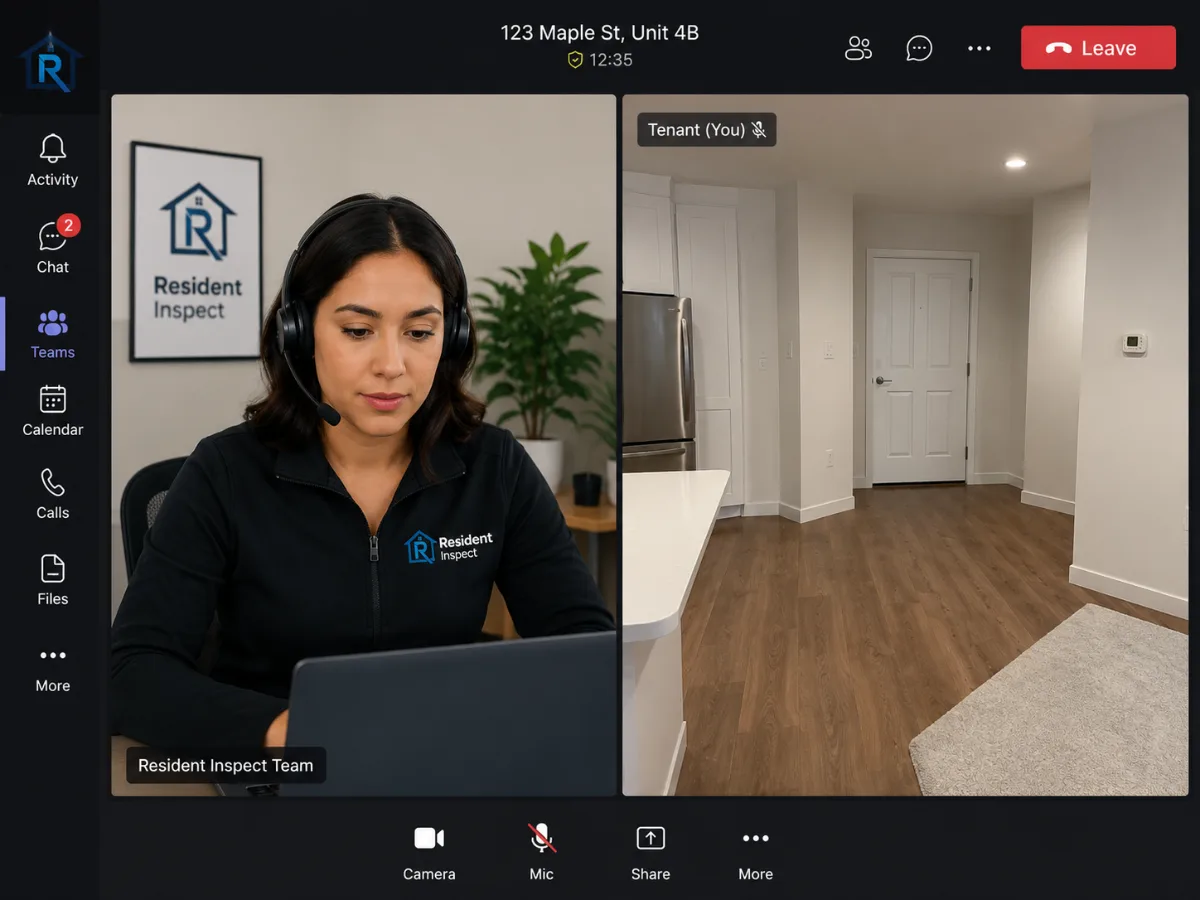
First, Resident Inspect schedules a live video call with your resident. Then a trained specialist joins the call and guides the resident room by room, directing where to aim the camera, what to open, and what to document.
As a result, the specialist controls the inspection in real time. They follow a standardized checklist, capture photos as they go, and flag anything that needs attention. Finally, a white-labeled report arrives within one business day, so your team gets a finished product instead of raw tenant photos to review.
The core difference
The trained specialist on the call is the difference. Because no tenant decides what to document, there are no missed areas, blurry photos of the wrong corner, or reasons to downplay damage. Instead, the same standard applies to every property, every cycle.
Why PMs Look for a RentCheck Alternative
1. Who controls the camera
In RentCheck, the tenant controls what gets documented. For example, they choose the angles, the lighting, and whether to photograph that scuff behind the door. In contrast, with Resident Inspect a trained specialist directs the camera in real time, so the documentation is controlled, not crowd-sourced.
2. Consistency across your portfolio
Self-inspection quality varies by tenant. Some are careful; others submit three blurry photos of the living room and call it done. Resident Inspect, however, applies the same checklist and documentation standard to every property, whether it’s a move-in or move-out or a periodic inspection.
3. Missed damage and dispute risk
The documentation you collect at move-in and during periodic inspections is your main defense in a security deposit dispute. After all, tenants have a natural reason to downplay condition issues. A trained specialist on a live call removes that variable. For more on this, see our piece on virtual inspections vs. tenant self-inspections.

4. Staff time and software overhead
RentCheck still requires your team to set up the tool, configure integrations, prompt tenants, review submissions, and follow up on incomplete inspections. By contrast, Resident Inspect handles scheduling, reminders, and the inspection itself. That’s why it’s a good fit for scattered-site portfolios across the country. New to the different inspection types? Start with Rental Inspections 101.
RentCheck or a RentCheck Alternative: When to Choose Each
RentCheck is the better fit when…
- You want a low-cost, per-unit app and are comfortable with tenant-led inspections
- Your tenants reliably complete tasks on their own
- You use AppFolio, Buildium, Rent Manager, Rentvine, or Property Meld and want native integration
- Your team has time to review tenant submissions and chase incomplete ones
- You want AI help flagging which reports need a closer look
Resident Inspect is the better fit when…
- Documentation quality is critical for deposit disputes and owner reporting
- You’ve had problems with tenant self-inspections: missed damage or incomplete photos
- Your team is stretched and can’t chase incomplete inspections
- You want the same documentation standard across every property
- You want inspections fully handled, from scheduling to the report, without managing software
A Message from Resident Inspect
Hear from the team about how we take inspections off your plate.
Switching to a RentCheck Alternative: How to Get Started
Moving from RentCheck to a done-for-you RentCheck alternative takes about a week. Here’s how it works.
Book a demo
Schedule a short call to walk through your portfolio, inspection types, and reporting needs.
Send your properties
Share the units and inspection type. We contact residents and handle all scheduling and reminders.
Get your reports
White-labeled, photo-backed reports arrive within one business day, backed by our Live Look Guarantee.
Frequently Asked Questions
What is the best RentCheck alternative?
If you want inspections fully handled instead of tenant-led, Resident Inspect is a strong RentCheck alternative. A trained specialist runs every inspection on a live video call and delivers a white-labeled report within one business day. If you want another DIY app, zInspector and SnapInspect are also worth a look.
Is RentCheck free?
No. RentCheck offers a 14-day free trial with no credit card, but it has no permanent free plan. Its plans are billed per unit per month, from about $1 to $1.75 per unit depending on the plan. Resident Inspect lets you claim free inspections so you can see a real walkthrough and report before you commit.
Does RentCheck require the tenant to do the inspection?
RentCheck is built around resident-led inspections. In fact, RentCheck says that on average 80% of inspections are completed by tenants on their phone. The app guides tenants with a checklist and reminders, and its AI flags possible damage for your team to review. However, your team still reviews what the tenant chose to capture.
Can tenant self-inspections miss damage?
Yes, they can. A self-inspection only captures what the tenant chooses to photograph. For example, tenants may skip areas, take blurry photos, or have a reason to downplay damage. A live, guided inspection with a trained specialist reduces these gaps because the specialist decides what gets documented.
Which property management software does each one integrate with?
RentCheck lists integrations with AppFolio, Buildium, Rent Manager, Rentvine, and Property Meld, plus Zapier. Resident Inspect offers integrations on its Enterprise plan, including AppFolio, Yardi, Propertyware, Rent Manager, Buildium, and TenantCloud, plus a Property Meld integration.
What’s the main difference between RentCheck and Resident Inspect?
RentCheck is a self-inspection app, so your tenant usually does the inspection on their phone. Resident Inspect, on the other hand, is a done-for-you service. A trained specialist joins a live video call, guides the walkthrough, controls the documentation, and delivers a white-labeled report within one business day. In short, the key difference is who controls the camera.
Which is better for large portfolios?
For large SFR or scattered-site portfolios where documentation consistency matters, Resident Inspect’s done-for-you model reduces variance and removes the labor burden. RentCheck, by contrast, scales well for teams that are comfortable with tenant-led inspections and have staff to review submissions.