# Resident Inspect
> Live Inspections. Expertly executed, seamlessly delivered
> Generated by All in One SEO Pro v5.0.3, this is an llms-full.txt file, used by LLMs to index the site.
## Posts
### [Rental Inspections Blog](https://residentinspect.com/blog/)
**Published:** October 20, 2024
**Author:** Aaron Cooper
**Content:**
# The Resident Inspect Blog
*Helpful articles that educate, explain and explore*
Welcome to the Resident Inspect Blog! Here, you’ll find helpful articles that educate, explain, and empower you with everything you need to know about rental property inspections. Whether you’re a property manager or landlord, our blog covers a wide range of topics—from streamlining your inspection process to reducing costs and maintaining your properties efficiently. We’ll keep this regularly updated, so make sure to check back soon!
[ ](https://residentinspect.com/blog/hidden-costs-of-property-maintenance/)
[Blog](https://residentinspect.com/blog/)
## [The Hidden Costs of Property Maintenance & How Smart Property Managers Stay Ahead](https://residentinspect.com/blog/hidden-costs-of-property-maintenance/)
February 6, 2025
Learn how to make property maintenance a breeze in our latest article! Property maintenance is…
[Read More](https://residentinspect.com/blog/hidden-costs-of-property-maintenance/)
[ ](https://residentinspect.com/blog/how-to-make-more-money-in-your-property-management-business/)
[Blog](https://residentinspect.com/blog/)
## [How To Make More Money In Your Property Management Business](https://residentinspect.com/blog/how-to-make-more-money-in-your-property-management-business/)
February 19, 2025
Cutting costs ensures maximum profitability, but how can you ensure you’re cutting the RIGHT costs?…
[Read More](https://residentinspect.com/blog/how-to-make-more-money-in-your-property-management-business/)
[ ](https://residentinspect.com/blog/the-future-of-property-inspections/)
[Blog](https://residentinspect.com/blog/)
## [The Future of Rental Property Inspections in 2026](https://residentinspect.com/blog/the-future-of-property-inspections/)
March 24, 2025
Think inspections are just another admin headache? So did Aaron Cooper, until he built Resident…
[Read More](https://residentinspect.com/blog/the-future-of-property-inspections/)
[ ](https://residentinspect.com/blog/managing-difficult-tenants-without-losing-your-mind/)
[Blog](https://residentinspect.com/blog/)
## [Managing Difficult Tenants Without Losing Your Mind](https://residentinspect.com/blog/managing-difficult-tenants-without-losing-your-mind/)
April 7, 2025
Managing difficult tenants doesn’t have to drain your time, energy, or sanity. In this practical…
[Read More](https://residentinspect.com/blog/managing-difficult-tenants-without-losing-your-mind/)
[ ](https://residentinspect.com/blog/virtual-inspections-vs-tenant-self-inspections/)
[Blog](https://residentinspect.com/blog/)
## [Virtual Inspections vs Tenant Self-Inspections: What Property Managers Need to Know](https://residentinspect.com/blog/virtual-inspections-vs-tenant-self-inspections/)
July 25, 2025
In today’s fast-paced property management world, efficiency and reliability go hand in hand. With more…
[Read More](https://residentinspect.com/blog/virtual-inspections-vs-tenant-self-inspections/)
[ ](https://residentinspect.com/blog/virtual-rental-inspections-myths/)
[Blog](https://residentinspect.com/blog/)
## [5 Common Myths About Virtual Rental Inspections – Debunked](https://residentinspect.com/blog/virtual-rental-inspections-myths/)
October 10, 2025
Aaron Cooper Founder & Chief Executive Officer, Resident Inspect 📍 Jacksonville, FL Aaron Cooper is…
[Read More](https://residentinspect.com/blog/virtual-rental-inspections-myths/)
1[2](https://residentinspect.com/plat-cron.php/page/2/)[3](https://residentinspect.com/plat-cron.php/page/3/)[4](https://residentinspect.com/plat-cron.php/page/4/)[5](https://residentinspect.com/plat-cron.php/page/5/)[6](https://residentinspect.com/plat-cron.php/page/6/)[7](https://residentinspect.com/plat-cron.php/page/7/)[Next »](https://residentinspect.com/plat-cron.php/page/2/)
---
### [Why Hiring a Rental Home Inspector Is Essential for Landlords and Tenants](https://residentinspect.com/blog/why-hire-a-rental-home-inspector/)
**Published:** November 11, 2025
**Author:** Aaron Cooper
**Excerpt:** Hiring a rental home inspector is essential for landlords and tenants. It ensures safety, prevents disputes, and protects property value with expert insights.
**Content:**
 Aaron Cooper
Founder & Chief Executive Officer, Resident Inspect
📍 Jacksonville, FL
Aaron Cooper is a seasoned property technology entrepreneur and inspection industry expert. As the **Founder and CEO of Resident Inspect**, and #1 Rental Home Inspector. He leads the development of intelligent inspection platforms that empower landlords, property managers, and investors to streamline digital inspections and ensure compliance.
🌐 [residentinspect.com](https://residentinspect.com)
✉️ <aaron@residentinspect.com>
## Table of Contents
- [Introduction](#introduction)
- [What Is a Rental Home Inspector?](#what-is-a-rental-home-inspector)
- [Top Reasons to Hire a Rental Home Inspector](#reasons-to-hire)
- [What Does a Rental Property Inspection Include?](#inspection-includes)
- [Understanding the Rental Inspection Checklist](#inspection-checklist)
- [How to Choose the Right Rental Home Inspector](#choose-inspector)
- [Common Issues Found During Rental Inspections](#common-issues)
- [How Often Should a Rental Property Be Inspected?](#inspection-frequency)
- [Benefits of Regular Rental Inspections](#inspection-benefits)
- [Voice Search Q&A: People Also Ask](#voice-search-qa)
- [Step-by-Step Rental Inspection Process](#inspection-process)
- [Tips for Landlords and Tenants](#inspection-tips)
- [Conclusion: Protect Your Investment](#conclusion)
- [Frequently Asked Questions (FAQs)](#faqs)
## Introduction
Whether you’re a landlord or a tenant, bringing in a professional rental home inspector before, during or after a tenancy can save you time, money and stress. A certified rental home inspector not only assesses the condition of the property, but also provides a documented report which can serve as a protective tool for both parties. In short, inspections help ensure the property is safe, habitable and clearly understood by all involved.
## What Is a Rental Home Inspector?
A [rental home inspector](https://residentinspect.com/rental-property-inspections/ "Rental Property Inspections Done For You") is a trained professional who evaluates the condition of a rental property — typically before the tenant moves in, periodically during the lease term, or at move‑out. They inspect structural, electrical, plumbing, HVAC systems, and more. Their goal is to identify defects, safety hazards or maintenance issues, providing an unbiased assessment to help property owners maintain their investment and tenants feel secure.
This differs from a standard “home inspection” done at purchase time because it is specifically tailored to the rental‑use context: ongoing occupancy, wear‑and‑tear, landlord/tenant responsibilities.
## Top Reasons to Hire a Rental Home Inspector
### **Ensure Property Safety and Habitability** with Rental Home Inspector
A thorough inspection ensures that the rental property meets basic habitability and safety standards — from wiring and outlets to structural and plumbing integrity. Neglecting these can lead to dangers or legal liabilities.
### **Identify Hidden Issues Before They Escalate**
Many rental‑unit defects aren’t obvious to the untrained eye. A professional inspector uses tools and experience to uncover issues like hidden leaks, improper wiring, ventilation problems, or structural shifts — catching them early saves money. To plan your budget, learn [how much a rental property inspection costs](https://residentinspect.com/blog/how-much-does-a-rental-property-inspection-cost/).
### **Avoid Legal Disputes with Clear Documentation** from Rental Home Inspector
Having a detailed inspection report benefits both landlord and tenant: it provides a clear baseline of the property’s condition, which helps when move‑out damages or deposit disputes arise. It also shows due diligence in the landlord’s maintenance efforts.
### **Meet Local Housing and Safety Codes** With Rental Home Inspector
Owning or managing rental property often comes with legal requirements — like smoke detectors, CO alarms, locks, safe electrical panel, proper egress, etc. A rental inspection helps verify compliance, reducing risk of fines or legal actions.
### **Maintain or Boost Property Value**
Regular inspections and maintenance preserve the rental property’s condition, curb appeal and longevity of major systems. That ultimately protects your investment and supports higher tenant retention and rent potential.
## What Does a Rental Property Inspection Include?
Most inspection services will cover the following areas:
- Structural elements (foundation, walls, roof, visible framing)
- Exterior assessment (siding, windows, doors, gutters, grading)
- Interior systems (electrical wiring, outlets, panel; plumbing, fixtures; HVAC performance)
- Safety features (smoke/CO detectors, handrails, fire extinguishers, GFCI outlets)
- Appliances, finishes, tenant‑responsible areas (for rental condition assessments)
While rental inspections may emphasize [wear and tear](https://www.administerjustice.org/resources/renters-rights/?gad_source=1&gad_campaignid=22829287110&gbraid=0AAAAACUUv51GWwf5Y8myUC_7L40kW89uM&gclid=CjwKCAiAt8bIBhBpEiwAzH1w6bsUHDastr232Zgzmwst2L8LCURLEch-HsUVSm2E05ALB59hQVR3oxoCYaMQAvD_BwE), landlord/tenant responsibilities, they follow many of the same core elements as purchase‑home inspections.
## Understanding the Rental Inspection Checklist
A rental inspection checklist ensures inspections are consistent, comprehensive and repeatable. A few key points:
- Use the same standard walkthrough each time (move‑in, mid‑lease, move‑out).
- Cover rooms, exterior, grounds, systems and safety features.
- Mark each item as “Good / Needs Maintenance / Poor” and attach photos for documentation.
- Include both minor and major issues: e.g., cracked window sill and major structural crack.
- Maintain version history: comparing past inspections helps monitor deterioration or recurring problems.

**Sample mini‑checklist**
- Exterior walls & siding – any cracks, peeling, insect damage
- Roof & gutters – missing shingles, downspout function
- Doors & windows – locks work, no broken panes
- Electrical panel & outlets – ground fault outlets, no exposed wiring
- Plumbing – no visible leaks, water pressure ok, drains working
- HVAC & filters – functioning furnace/AC, filters changed
- Smoke & CO alarms – present and working
- Appliances – fridge, stove, washer/dryer (if provided) working
- Interior finishes – walls, ceilings, floors free of major damage
- Grounds & exterior – walkways safe, fencing intact, landscaping manageable
Using this structure helps landlord and tenant see where attention is needed and maintain transparency.
## How to Choose the Right Rental Home Inspector
Selecting the right professional matters. Here’s what to look for:
- **Certification**: Choose inspectors certified through recognized associations (e.g., InterNACHI, ASHI) and licensed if required in your state.
- **Rental‑property experience**: Rental inspections differ from purchase inspections: wear & tear focus, landlord/tenant dynamics, documentation for deposits.
- **Detailed reporting**: The report should include descriptive findings, photos, actionable recommendations, and be easy to understand.
- **Clear communication**: The inspector should explain findings in plain language, answer questions and walk the property with you and/or the tenant.
- **Local knowledge**: An inspector familiar with local codes, climate issues ([Florida hurricanes](https://www.amgrents.com/kissimmee-property-management-blog/guide-to-hurricane-prep-for-rental-property-in-florida), humidity) is a plus.
- **References & reviews**: Check online ratings, get referrals, ask past clients about reliability, thoroughness and report usability.
## Common Issues Found During Rental Inspections
[During rental inspections](https://residentinspect.com/resident-information/ "What to Expect | Resident Resources"), several issues frequently arise:
- **Water damage and leaks**: Roof leaks, pipe drips, poor drainage leading to mold or structural damage.
- **Mold and mildew growth**: Especially in humid climates, poor ventilation or persistent leaks cause mold — a health risk.
- **Electrical hazards**: Outdated wiring, overloaded outlets, lack of GFCI near water sources.
- **HVAC inefficiencies**: Old units, blocked ducts, dirty filters → higher cost, lower comfort.
- **Structural weaknesses**: Cracks in foundation, sagging floors, deteriorated siding.
- **Tenant‑caused damage or neglect**: Excessive wear, damage to appliances or finishes beyond normal wear and tear.
- **Safety & code violations**: Missing alarms, unsafe railings, non‑functional locks, etc.
Being aware of these common issues helps landlords schedule inspections proactively and tenants understand what to expect.
## How Often Should a Rental Property Be Inspected?
Inspection frequency depends on lease length, property type and local regulations. Here are general guidelines:
- **Move‑in inspection**: Before the tenant takes possession, to document condition.
- **Move‑out inspection**: At lease end, to compare and identify tenant‑responsible damage.
- **Routine inspections**: Every 3–6 months is typical for many landlords. This helps address issues before they escalate.
- **Annual inspection**: For longer‑term tenants or low‑turnover properties, an annual check keeps systems maintained.
- **After major events**: For example, after major storms, flooding, or significant wear periods.
Having a [scheduled inspection](https://residentinspect.com/book-a-demo/ "Resident Inspection Scheduling") routine strengthens maintenance planning and reduces unexpected costly repairs.
## Benefits of Regular Rental Inspections
Consistent inspections unlock several key benefits:
- **Increased tenant satisfaction**: Tenants feel safe and valued when property is well maintained — that helps retention.
- **Reduced emergency repairs**: Early detection of problems avoids costly urgent fixes.
- **Compliance with insurance & legal standards**: Many insurance policies or local regulations favour well‑maintained properties.
- **Improved documentation**: Regular inspection reports build a clear history of property condition and maintenance.
- **Enhanced property value**: Proactive care prevents deterioration and supports long‑term investment ROI.
-
## Step-by-Step Rental Inspection Process
**Pre‑inspection**: Schedule the inspection and [notify the tenant ](https://www.eatonrealty.com/blog/property-management/notice-enter-rental-property-free-template)(if occupied). Clarify who will attend, what access is needed, and timeframe.
**Exterior walkthrough**: Inspect foundation, siding, roof, gutters, walkways, landscaping.
**Interior systems check**: Examine electrical panel/outlets, plumbing and fixtures, HVAC and filters, appliances.
**Interior finishes & safety features**: Walls, ceilings, floors, windows/doors locks, smoke/CO alarms, railings.
**Report preparation**: Inspector compiles findings, photos, recommendations and prioritised repair list.
**Joint review**: Landlord and/or tenant review the report together, discuss next steps and timeline for repairs.
**Follow‑up**: Schedule and document repairs, update checklist findings at next inspection, keep records.
## Tips for Landlords and Tenants to Prepare for an Inspection
**For Landlords**
- Clean and declutter the unit so the inspector can access all areas easily.
- Provide documentation of past maintenance and repairs.
- Give tenants proper notice and invite their participation.
- Prior‑arrange access to attic, crawlspace, mechanical rooms.
**For Tenants**
- Report any known problems ahead of time (leaks, HVAC issues).
- Be present for part of the inspection so you understand the findings.
- Clear pathways, remove obstacles from appliance access.
- Ask for a copy of the inspection report and note any issues you observe.
Collaborative preparation ensures the inspection runs smoothly and builds trust between landlord and tenant.
## Conclusion: Protect Your Investment with the Right Inspector
Hiring a qualified rental home inspector is more than just a formality—it’s a smart business move and a considerate approach to tenant relationships. From identifying hidden problems to clearly documenting property condition, inspections provide a win‑win for both landlords and tenants.
If you’re ready to safeguard your rental property, maintain high living standards, and minimise future disputes, now is the time to engage a **[certified rental home inspector](https://allamericanpropertyinspection.com/)**. Start by making a list of local qualified professionals, schedule your inspection and lay the groundwork for peace of mind and property protection.
## 🔍 Don’t Risk Hidden Issues — Get Your Rental Inspected by Experts
Whether you’re a landlord or tenant, a certified rental home inspection from **Resident Inspect** can save you from expensive surprises.
[ ✅ View our Transparent Pricing ](https://residentinspect.com/pricing/)
## Frequently Asked Questions (FAQs)
### **Who is responsible for the cost of a rental home inspector?**
Typically the landlord covers the cost because the inspection protects their asset and helps maintain compliance and safety.
### **How long does a rental home inspection usually take?**
It depends on the property size and age, but a full inspection often takes a few hours.
### **Can a tenant refuse an inspection?**
Tenants may raise concerns, but in most leases the landlord retains the right to inspect with proper notice. Cooperation is recommended for smooth operation.
### **What happens if problems are found during the inspection?**
The inspection report will detail necessary repairs. As a landlord you prioritise and arrange for them; tenants should cooperate for access and timing.
### **Can I use one inspection for multiple properties?**
Yes — you can inspect multiple units but each unit should be documented individually so you have clear records of condition and responsibility.
### **What does a rental property inspector do?**
They evaluate major systems, safety features and overall condition of a rental unit, produce a documented report and identify required repairs and maintenance tasks.
### **How much does a rental inspection cost?**
Costs vary by region, property size and age. For general home inspections, typical ranges are a few hundred dollars.
### **Should the tenant be present during the inspection?**
Yes — it’s recommended so they understand what is being inspected, ask questions and align expectations.
### **Can a tenant request an inspection?**
Yes — tenants can request that the landlord arrange an inspection or provide documentation of past inspections, especially if issues are present.
### **Who pays for rental inspections?**
Typically the landlord pays as part of property‑management expenses, since the inspection protects the owner’s investment and helps with compliance.
---
## Want to learn more about Resident Inspect?
Complete the form below and one of our team members will contact you.

Aaron Cooper Founder & CEO
After more than 20 years as a landlord and property management company owner-operator, Aaron Cooper built Resident Inspect to solve a problem he experienced firsthand: the inspection process was broken, expensive, and impossible to scale. Resident Inspect is the result — a live virtual inspection service that replaces in-person inspections with a faster, more consistent, and more defensible process. [See Full Bio](https://residentinspect.com/about-us/aaron-cooper/)
[Facebook](https://www.facebook.com/residentinspect/) [Instagram](https://www.instagram.com/residentinspect/) [TikTok](https://www.tiktok.com/@residentinspectofficial) [Pinterest](https://www.pinterest.com/aaron2762/) [YouTube](https://www.youtube.com/@ResidentInspect) [LinkedIn](https://www.linkedin.com/in/resident-inspect-a00b7a376/)
**Categories:** Blog
---
### [What Are Virtual Rental Property Inspections?](https://residentinspect.com/blog/what-are-virtual-rental-property-inspections/)
**Published:** June 21, 2026
**Author:** Aaron Cooper
**Content:**
RESIDENT INSPECT
A faster, more affordable way to complete routine rental inspections without relying on tenant self-inspections or AI-only reporting.
[Schedule a Demo](https://residentinspect.com/book-a-demo/)[Request a Sample Report](#)
Routine rental property inspections are important, but they can be difficult to manage at scale.
Property managers have to coordinate with residents, schedule appointments, drive to properties, document conditions, organize photos, prepare reports, and communicate findings to owners. When you manage a large portfolio, even simple routine inspections can become expensive, time-consuming, and inconsistent.
Virtual rental property inspections offer a better way to complete routine property inspections without sending someone to every home in person.
With Resident Inspect, each inspection is completed through a live, guided video process led by a trained inspection professional. The resident is physically inside the home, but they are not responsible for inspecting the property themselves. Our inspector guides the resident through the property in real time, captures documentation, and delivers a professional inspection report to the property manager.
Resident Inspect gives property managers the efficiency of remote inspections with the accountability of a trained human-led process.
## What Is a Virtual Rental Property Inspection?
A virtual rental property inspection is a live, remote inspection of a rental home conducted using video technology.
Instead of sending an inspector to the property in person, a trained inspection professional connects with the resident by live video. The resident walks through the home while the inspector directs the inspection, documents the property condition, requests specific views, and captures photos for the final report.
### The Key Difference Is Control.
In a **tenant self-inspection**, the resident is asked to inspect the property on their own. They may complete a checklist, take photos, and submit the information back to the property manager.
In an **AI-only inspection process**, software may help analyze photos, organize information, or generate a report, but the quality of the inspection still depends on what information was captured and submitted.
In a **guided virtual inspection**, the resident provides access to the property, but the inspection is led by a trained third-party inspector in real time. That difference matters.
## How Virtual Inspections Work
Resident Inspect makes the process simple for property managers, residents, and owners.
1
#### The property manager sends the inspection request
The property manager provides the properties that need to be inspected. These may include routine periodic inspections, owner-requested condition checks, lease compliance reviews, post-maintenance verification inspections, or other occupied property inspections.
2
#### Resident Inspect coordinates with the resident
Our team contacts the resident and schedules a convenient appointment. Evening and weekend scheduling options can help improve resident participation and reduce delays.
3
#### A trained inspector joins by live video
At the scheduled time, the resident joins a live video inspection from their phone. A Resident Inspect inspection professional explains the process and guides the resident through the home.
4
#### The inspector leads the inspection
The resident does not decide what to inspect. The inspector directs the resident through the property, asks for specific areas to be shown, requests additional views when needed, and makes sure the inspection follows a consistent process.
5
#### Photos and notes are captured during the inspection
The inspector captures documentation in real time, including photos and notes. If an area needs better lighting, a closer view, or another photo, the inspector can request it during the call.
6
#### The property manager receives a professional report
After the inspection, the property manager receives a professional inspection report that can be reviewed internally, shared with owners, and used to document the condition of the property.
[View a Sample Inspection Report](/free-inspection/)
## Are Virtual Inspections as Good as In-Person Inspections?
The honest answer is: it depends on the purpose of the inspection.
Virtual inspections are not designed to replace every in-person visit. There are situations where an in-person inspection is still the right choice, especially when there is major damage, a serious maintenance concern, a safety issue, a legal dispute, or a need to physically test or touch something at the property.
But for routine rental property inspections, guided virtual inspections can be an excellent option.
Most periodic rental inspections are not about physically handling every item in the home. They are about gaining visibility, documenting general property condition, identifying visible concerns, checking for lease compliance issues, and creating a reliable record for the property manager and owner.
For those use cases, a guided virtual inspection can provide the documentation and accountability property managers need while reducing the time, cost, and scheduling challenges of sending someone to the property.
#### ✅ Virtual Inspections Are a Strong Fit For:
- Routine periodic rental inspections
- Occupied property condition checks
- Owner-requested interior updates
- Lease compliance reviews
- Post-maintenance verification
- Move-in or move-out follow-up documentation
- Portfolio-wide inspection programs
- Properties outside your normal service area
- Situations where speed and scheduling flexibility matter
#### ⚠️ In-Person May Still Be Better For:
- Major property damage
- Suspected safety hazards
- Complex maintenance diagnosis
- Legal or eviction-related documentation
- Situations requiring physical testing
- Properties where the resident is unwilling or unable to participate
Virtual inspections and in-person inspections do not have to compete with each other. Many property managers use virtual inspections for routine documentation and reserve in-person visits for higher-risk situations. That creates a more efficient inspection program overall.
## Virtual Inspections vs. Tenant Self-Inspections
One of the biggest misconceptions about virtual inspections is that they are the same as tenant self-inspections. They are not.
A tenant self-inspection asks the resident to complete the inspection on their own. The tenant takes the photos, fills out the checklist, and decides what gets submitted.
That may be inexpensive, but it creates a major problem: **the tenant controls the inspection.**
They decide what to photograph. They decide what to skip. They decide how much effort to put into the inspection. Sometimes they may simply miss important issues. Other times, they may avoid documenting problems they do not want the property manager to see.
#### ❌ Tenant Self-Inspection
- Tenant completes the inspection alone
- Tenant decides what to show
- Photos may be inconsistent
- Property manager may need to follow up for missing information
- Resident controls the process
- Lower accountability
#### ✅ Guided Virtual Inspection
- Trained inspector leads the inspection
- Resident provides access by live video
- Inspector requests specific views and photos
- Documentation is more consistent
- Report is professionally prepared
- Higher accountability
### The difference is not just technology.
The difference is who controls the inspection. Resident Inspect gives property managers the convenience of a remote inspection without leaving the inspection up to the resident.
## What About AI Property Inspections?
AI property inspection tools are becoming more common in the property management industry.
These tools can be useful. AI may help organize photos, identify possible issues, summarize inspection notes, speed up report writing, flag inconsistencies, or make inspection workflows more efficient.
Resident Inspect believes technology should make inspections better.
But AI does not automatically make an inspection complete, accurate, or accountable.
AI can only analyze the information it receives. If the resident skips a room, submits poor photos, avoids showing damage, or misunderstands the instructions, AI may still produce a polished report based on incomplete information.
That is why the most important question is not just whether AI can analyze photos.
The better question is: Who is controlling what gets captured in the first place?
If the process is tenant-led, AI may make the report faster, but it may not solve the accountability issue. The resident may still decide what gets captured, what gets skipped, and how complete the inspection is.
A guided virtual inspection keeps a trained inspector involved in real time. The inspector can direct the resident, request additional views, correct unclear photos, and make sure the inspection follows a consistent process before the report is completed.
### For property managers, the strongest inspection process is not human vs. technology.
It is human-guided technology. Resident Inspect uses technology to make inspections faster, more convenient, and easier to scale, while keeping a trained inspection professional in control of the process.
#### 🤖 AI May Be Useful For:
- Organizing inspection photos
- Helping draft or structure reports
- Flagging possible issues in images
- Speeding up administrative review
- Supporting large-scale documentation workflows
- Reducing repetitive manual tasks
#### ⚠️ AI-Only Inspections May Fall Short When:
- The resident controls what gets submitted
- Photos are incomplete or unclear
- Rooms or problem areas are skipped
- Context is needed to understand what is being shown
- The inspection requires judgment, follow-up questions, or real-time direction
- The property manager needs a third-party professional process, not just automated analysis
AI can support a strong inspection process, but it should not be confused with the inspection process itself.
## Virtual Inspections vs. AI Inspections
AI inspections and guided virtual inspections can both make rental property inspections more efficient, but they solve different problems.
**AI is helpful for reviewing, organizing, summarizing, or flagging information.**
**Guided virtual inspections are helpful for controlling how the information is captured in the first place.**
That distinction is important. If a property manager receives incomplete inspection data, AI may help organize it, but it may not know what was never shown. If a trained inspector is leading the inspection live, they can reduce missing information before the report is created.
#### 🤖 AI Inspection
- Software reviews or organizes submitted information
- May help speed up reporting
- May identify possible issues in photos
- Depends on the quality of submitted data
- May not know what was skipped
- May still require staff review
#### ✅ Guided Virtual Inspection
- Trained inspector leads the inspection live
- Resident provides access through video
- Inspector controls what needs to be shown
- Missing or unclear items can be corrected in real time
- Report is professionally prepared
- Stronger accountability for routine inspections
### The best use of technology is not to remove human judgment from the process.
The best use of technology is to make a trained inspection process faster, more consistent, and easier to scale.
## Virtual Inspections vs. Traditional In-Person Inspections
Traditional in-person inspections have been the standard for years, and they still have an important place in property management. But they are not always the most efficient option for routine inspections.
In-person inspections require travel, scheduling windows, staff availability, mileage, report preparation, and often multiple attempts if the resident is unavailable. For property managers with large portfolios, those small inefficiencies become expensive very quickly.
Virtual inspections reduce much of that friction.
Instead of sending someone across town for a routine check-in, Resident Inspect can complete the inspection remotely through a live, guided process. That allows property managers to complete more inspections, reduce staff workload, and maintain better visibility across their portfolio.
**In-person inspections** are best when physical presence is required.
**Guided virtual inspections** are best when professional documentation, speed, consistency, and cost control matter.
For many property managers, the best inspection program uses both.
## Do Virtual Inspections Save Money?
Yes. Virtual inspections can reduce many of the hidden costs of routine rental property inspections.
The cost of an in-person inspection is not just the time spent inside the home. It also includes:
🚗
Driving to and from the property
🔑
Coordinating access & waiting on residents
📅
Rescheduling missed appointments
📷
Taking and organizing photos
📝
Writing and uploading reports
👥
Managing staff time & mileage costs
Virtual inspections reduce or eliminate many of those costs. Because the inspection is completed remotely, there is no drive time, no mileage, and less scheduling friction. Reports can be completed more efficiently, and property managers can scale routine inspection programs without adding more field staff.
#### 💰 Lower Inspection Costs
Reduce travel, mileage, and staff time significantly.
#### ⚡ Faster Completion
Complete more inspections in less time.
#### 👤 Better Staff Use
Free up your team from routine drive-outs.
#### 📊 Consistent Reporting
Professional reports every time, no exceptions.
#### 🏢 Owner Communication
Improved documentation to share with owners.
#### 🔍 Portfolio Visibility
Monitor more properties without the overhead.
Virtual inspections do not just save money. They help property managers complete inspections more consistently.
## Common Misconceptions About Virtual Property Inspections
Misconception 1
#### “Virtual inspections are just tenant self-inspections.”
A tenant self-inspection is completed by the resident. A guided virtual inspection is completed by a trained inspector using the resident’s phone as the access point. The resident is not responsible for deciding what to inspect. The inspector leads the process.
Misconception 2
#### “AI makes human inspection oversight unnecessary.”
AI can be useful, but it does not automatically solve the accountability problem. AI may help review photos or generate a report, but if the source information is incomplete, the output may be incomplete too. A trained inspector can guide the resident in real time and reduce missing information before the report is created.
Misconception 3
#### “The resident can just hide problems.”
No inspection method is perfect, including in-person inspections. But guided virtual inspections create more accountability than a self-inspection because the inspector directs the resident in real time. The inspector can ask to see specific rooms, walls, ceilings, floors, closets, appliances, exterior areas, or points of concern. If something is unclear, the inspector can request a better view or additional photo during the call.
Misconception 4
#### “The photos will not be good enough.”
Modern phone cameras can produce high-quality photos. During a live guided inspection, the inspector can ask the resident to improve lighting, move closer, slow down, adjust the camera angle, or retake an image if needed. That creates better documentation than a rushed or inconsistent self-inspection.
Misconception 5
#### “Owners will not accept virtual inspections.”
Owners usually care about clear documentation, consistency, and knowing their property is being monitored. A professional inspection report with organized photos and notes can provide the visibility owners need. For many owners, the quality of the report matters more than whether someone physically drove to the property.
Misconception 6
#### “Virtual inspections are complicated.”
They do not have to be. Resident Inspect handles the process, scheduling, inspection, documentation, and report preparation. The property manager gets the benefit of modern inspection technology without having to build the system internally.
## Which Inspection Method Is Right for Your Property Management Company?
There is no single inspection method that is best for every situation. The right method depends on the purpose of the inspection, the risk level, the condition of the property, the availability of the resident, and the amount of documentation needed.
| Inspection Method | Best For | Strengths | Limitations |
|---|---|---|---|
| **In-person inspection** | High-risk issues, major damage, complex situations | Physical presence, hands-on review | Expensive, time-consuming, hard to scale |
| **Tenant self-inspection** | Very basic check-ins | Low cost, easy to send | Tenant controls the process, inconsistent documentation |
| **AI inspection tools** | Organizing, analyzing, or summarizing inspection data | Faster review, report support, issue flagging | Depends on the quality and completeness of submitted data |
| **Guided virtual inspection ⭐** | Routine rental property inspections | Professional, remote, cost-effective, scalable, human-guided | Requires resident participation |
| **Drive-by inspection** | Exterior-only checks | Fast and simple | No interior visibility |
| **Maintenance vendor check** | Repair verification | Useful for specific work orders | Not a full inspection process |
For routine occupied rental inspections, guided virtual inspections offer one of the best balances of cost, convenience, documentation, human oversight, and accountability.
## Why Property Managers Choose Resident Inspect
Resident Inspect was built specifically for property managers who need a better way to complete routine rental inspections.
We understand that inspections are important, but we also understand the operational burden they create. Your team has limited time. Your owners expect documentation. Your residents need convenient scheduling. Your business needs a process that is professional, repeatable, and scalable.
📹
**Live Guided Video**Inspector-led virtual inspections in real time
👨💼
**Trained Professionals**Third-party inspection professionals on every call
📅
**Resident Scheduling**We handle all resident coordination and scheduling
📸
**High-Res Photos**Professional photo documentation every inspection
📋
**Professional Reports**Clean, professional reports ready to share with owners
📈
**Scalable Capacity**Scale your inspection program without adding staff
🤝
**Human-Led Process**More oversight than AI-only inspection workflows
💰
**Lower Cost**More affordable than traditional in-person inspections
We help property managers complete more inspections with less friction.
## A Better Way to Complete Routine Rental Inspections
Virtual inspections are not about replacing professionalism with convenience. They are about using technology to make professional inspections faster, more affordable, and easier to scale.
For property managers, that means better visibility, lower costs, more consistent reporting, and fewer routine inspections getting delayed or skipped.
For residents, it means a more convenient inspection experience. For owners, it means clear documentation that their property is being monitored.
Resident Inspect gives property managers the efficiency of remote inspections without leaving the inspection up to the tenant or relying only on automated analysis.
[Schedule a Demo](https://residentinspect.com/book-a-demo/)[Request a Sample Report](#)
## Frequently Asked Questions About Virtual Rental Property Inspections
Are virtual inspections the same as tenant self-inspections?
No. Tenant self-inspections are completed by the resident on their own. Resident Inspect conducts live guided virtual inspections led by a trained inspection professional. The resident provides access through video, but the inspector controls the inspection process.
Are virtual inspections the same as AI inspections?
No. AI inspection tools may help analyze photos, organize information, or speed up report writing. Guided virtual inspections are live inspections led by trained inspection professionals. AI can support inspection workflows, but it does not replace the value of real-time human guidance during the inspection.
Can virtual inspections replace in-person inspections?
Virtual inspections can replace many routine periodic inspections, but they are not the right fit for every situation. Serious maintenance issues, major damage, safety concerns, or legal matters may still require an in-person visit.
Are virtual inspections good for routine rental property inspections?
Yes. Routine inspections are one of the best uses for guided virtual inspections because they focus on visibility, documentation, general condition, and lease compliance rather than hands-on physical testing.
Can tenants hide things during a virtual inspection?
No inspection method can guarantee that every issue will be discovered. However, guided virtual inspections provide more accountability than tenant self-inspections because a trained inspector directs the resident in real time and requests specific views and documentation.
Do AI inspections solve the problem of incomplete tenant self-inspections?
Not always. AI can help review or organize submitted information, but if the submitted photos or responses are incomplete, the AI output may be incomplete too. A guided virtual inspection helps reduce missing information by having a trained inspector direct the process live.
Do virtual inspections save property managers money?
Yes. Virtual inspections can reduce travel time, mileage, staff workload, scheduling delays, and report preparation time. This makes them a cost-effective option for routine inspection programs.
What types of inspections can be done virtually?
Virtual inspections are commonly used for routine periodic inspections, owner-requested condition checks, post-maintenance verification, lease compliance reviews, move-in follow-ups, move-out follow-ups, and occupied property condition documentation.
Who completes the inspection report?
Resident Inspect completes the inspection report. The resident is not responsible for preparing the report or deciding what should be included.
How do residents participate?
Residents join a scheduled live video inspection from their phone. The inspector guides them through the property and directs what needs to be shown or documented.
Is special equipment required?
No special equipment is usually required. In most cases, the resident only needs a smartphone and an internet connection.
How do I know if virtual inspections are right for my company?
If your team needs to complete routine rental inspections more consistently, reduce inspection costs, improve reporting, or avoid relying on tenant self-inspections or AI-only inspection workflows, guided virtual inspections may be a strong fit.
[Talk to Resident Inspect](/contact-us/)[Request a Sample Report](#)

Aaron Cooper Founder & CEO
After more than 20 years as a landlord and property management company owner-operator, Aaron Cooper built Resident Inspect to solve a problem he experienced firsthand: the inspection process was broken, expensive, and impossible to scale. Resident Inspect is the result — a live virtual inspection service that replaces in-person inspections with a faster, more consistent, and more defensible process. [See Full Bio](https://residentinspect.com/about-us/aaron-cooper/)
[Facebook](https://www.facebook.com/residentinspect/) [Instagram](https://www.instagram.com/residentinspect/) [TikTok](https://www.tiktok.com/@residentinspectofficial) [Pinterest](https://www.pinterest.com/aaron2762/) [YouTube](https://www.youtube.com/@ResidentInspect) [LinkedIn](https://www.linkedin.com/in/resident-inspect-a00b7a376/)
**Categories:** Blog
---
### [Virtual vs. Tenant vs. AI Inspections: What Property Managers Need to Know](https://residentinspect.com/blog/virtual-vs-tenant-vs-self-inspections/)
**Published:** May 20, 2026
**Author:** Aaron Cooper
**Content:**
 Aaron Cooper
Founder & Chief Executive Officer, Resident Inspect
📍 Jacksonville, FL
Aaron Cooper is a seasoned property technology entrepreneur and inspection industry expert. As the **Founder and CEO of Resident Inspect**, and #1 Rental Home Inspector. He leads the development of intelligent inspection platforms that empower landlords, property managers, and investors to streamline digital inspections and ensure compliance.
🌐 [residentinspect.com](https://residentinspect.com)
## Table of Contents
- [What Is a Tenant Self-Inspection?](https://residentinspect.com/blog/virtual-vs-tenant-vs-self-inspections/#what-is-tenant-self-inspection)
- [What Is an AI Property Inspection?](https://residentinspect.com/blog/virtual-vs-tenant-vs-self-inspections/#what-is-ai-inspection)
- [What Is a Guided Virtual Inspection?](https://residentinspect.com/blog/virtual-vs-tenant-vs-self-inspections/#what-is-guided-virtual-inspection)
- [Why the Difference Matters](https://residentinspect.com/blog/virtual-vs-tenant-vs-self-inspections/#why-the-difference-matters)
- [Tenant Self-Inspections: Pros and Cons](#tenant-self-inspections-pros-cons)
- [AI Inspections: Pros and Cons](https://residentinspect.com/blog/virtual-vs-tenant-vs-self-inspections/#ai-inspections-pros-cons)
- [Guided Virtual Inspections: Pros and Cons](https://residentinspect.com/blog/virtual-vs-tenant-vs-self-inspections/#guided-virtual-inspections-pros-cons)
- [Side-by-Side Comparison](https://residentinspect.com/blog/virtual-vs-tenant-vs-self-inspections/#side-by-side-comparison)
- [The Problem with Letting the Tenant or the Data Control the Inspection](https://residentinspect.com/blog/virtual-vs-tenant-vs-self-inspections/#the-problem-with-tenant-control)
- [Why Guided Virtual Inspections Create More Accountability](https://residentinspect.com/blog/virtual-vs-tenant-vs-self-inspections/#why-guided-creates-accountability)
- [Are Guided Virtual Inspections Better Than Tenant Self-Inspections or AI Inspections?](https://residentinspect.com/blog/virtual-vs-tenant-vs-self-inspections/#are-guided-better-than-self)
- [Are Guided Virtual Inspections Better Than In-Person Inspections?](https://residentinspect.com/blog/virtual-vs-tenant-vs-self-inspections/#are-guided-better-than-in-person)
- [When Tenant Self-Inspections May Be Enough](#when-self-enough)
- [When AI Inspections May Be Enough](https://residentinspect.com/blog/virtual-vs-tenant-vs-self-inspections/#when-ai-enough)
- [When Guided Virtual Inspections Make the Most Sense](https://residentinspect.com/blog/virtual-vs-tenant-vs-self-inspections/#when-guided-makes-sense)
- [The Strongest Inspection Process Is Human-Guided Technology](https://residentinspect.com/blog/virtual-vs-tenant-vs-self-inspections/#strongest-inspection-process)
- [Why Property Managers Choose Resident Inspect](https://residentinspect.com/blog/virtual-vs-tenant-vs-self-inspections/#why-choose-resident-inspect)
- [Final Thoughts](https://residentinspect.com/blog/virtual-vs-tenant-vs-self-inspections/#final-thoughts)
Routine rental property inspections are a critical part of protecting rental homes, communicating with owners, and identifying issues before they become larger problems.
But for many property management companies, inspections are also one of the most difficult tasks to complete consistently.
In-person inspections take time. They require scheduling, driving, coordinating access, taking photos, writing reports, and following up with owners or staff. As portfolios grow, the inspection process can become expensive, inconsistent, and hard to scale.
That is why many property managers start looking for more efficient inspection options.
Three of the most common alternatives to traditional in-person inspections are:
- Tenant self-inspections
- AI-assisted inspections
- Guided virtual inspections
At first, these options may sound similar. Each one can help a property manager gather information from inside an occupied rental property without sending someone to the home in person.
But they are very different inspection methods.
The biggest difference is simple:
Tenant self-inspections rely on the resident. AI inspections rely on submitted data. Guided virtual inspections rely on a trained inspector leading the process in real time.
That difference has a major impact on consistency, accountability, report quality, and trust.
## What Is a Tenant Self-Inspection?
A tenant self-inspection is an inspection completed by the resident without a property manager, inspector, or third-party professional guiding the process in real time.
Typically, the property manager sends the tenant a checklist, form, app link, or set of instructions. The tenant is asked to walk through the home, take photos, answer questions, and submit the information back to the management company.
Tenant self-inspections are often used because they are inexpensive and easy to deploy.
They can be useful for very basic check-ins, such as confirming occupancy, collecting a few photos, or asking a resident to provide quick documentation of a specific item.
But tenant self-inspections also have a major limitation: the tenant is responsible for inspecting the property.
That creates several challenges.
The tenant may not understand what to look for. They may miss important details. They may take unclear photos. They may skip areas. They may misunderstand the instructions. In some cases, they may avoid documenting problems they do not want the property manager to see.
Even when the tenant is honest and cooperative, the final result can still be inconsistent.
## What Is an AI Property Inspection?
AI property inspection tools use artificial intelligence to help review, organize, analyze, or generate inspection documentation.
Depending on the platform, AI may help identify possible issues in photos, classify room types, organize images, summarize inspection findings, detect inconsistencies, or speed up report writing.
AI can be a powerful tool in the inspection process.
For property managers, AI may help reduce administrative work, make reports easier to produce, and create more consistent formatting across inspection records.
But AI inspections also have an important limitation: AI can only analyze the information it receives.
If the resident skips a room, submits poor-quality photos, avoids showing damage, or provides incomplete information, AI may still produce a polished report based on incomplete documentation.
That means AI can improve the reporting process, but it does not automatically solve the inspection process.
The key question is not just whether AI can analyze photos.
The better question is: who is controlling what gets captured in the first place?
If the inspection is tenant-led, AI may make the final report faster or cleaner, but the resident may still control what gets submitted.
## What Is a Guided Virtual Inspection?
A guided virtual inspection is a live remote inspection conducted by a trained inspection professional using live video technology. To learn more about how this process works, visit our page on [What Are Virtual Rental Property Inspections](https://residentinspect.com/blog/what-are-virtual-rental-property-inspections/).
The resident is physically inside the property, but they are not performing the inspection on their own. Instead, they join a live video call with an inspector who guides them through the home in real time.
The inspector directs the resident where to go, what to show, what photos are needed, and when additional documentation is required.
With Resident Inspect, the resident provides access through video, but the inspection is led by a trained third-party inspection professional.
This creates a more structured and accountable process than a tenant self-inspection or an AI-only inspection that depends entirely on submitted photos and responses.
The resident is not expected to know what to inspect. They do not decide what should be documented. They simply help provide live access to the property while the inspector controls the inspection.
## Why the Difference Matters
Property managers do not just need photos.
They need reliable documentation.
They need to know that the right areas were reviewed, the inspection followed a consistent process, and the report can be trusted when communicating with owners, residents, vendors, or internal team members.
That is where tenant self-inspections and AI-only inspections can fall short.
A tenant may submit photos, but the property manager still has to wonder:
- Did they show every required area?
- Were the photos taken clearly?
- Did they skip damage or maintenance concerns?
- Did they understand what they were supposed to document?
- Is the report complete enough to share with the owner?
- Will the team need to follow up for more information?
AI may help review or organize the submitted information, but it may not know what was skipped, hidden, rushed, or misunderstood during the inspection.
Guided virtual inspections reduce those concerns because the inspection is not left entirely to the resident or to automated analysis after the fact.
A trained inspector leads the process live and can request better angles, additional photos, closer views, or clarification during the inspection.
That real-time guidance makes a major difference.
## Tenant Self-Inspections: Pros and Cons
Tenant self-inspections can have a place in property management, especially for low-risk situations or quick check-ins.
But property managers should understand both the advantages and the limitations before relying on them for routine rental inspections.
### Pros of tenant self-inspections
Tenant self-inspections can be: low cost, easy to send, convenient for the resident, useful for basic documentation, helpful for simple follow-up questions, faster than scheduling an in-person visit, and simple to deploy across many properties.
For example, if a property manager needs a quick photo of a smoke detector, an HVAC filter, or a minor maintenance item, a tenant-submitted photo may be enough.
### Cons of tenant self-inspections
The problem is that tenant self-inspections are only as good as the tenant’s effort, honesty, attention to detail, and understanding of the instructions.
Common issues include: incomplete photos, poor lighting, blurry images, missing rooms or areas, skipped damage, inconsistent responses, delayed submissions, lack of accountability, and extra follow-up for the property management team.
Tenant self-inspections can also create trust issues. Even if most residents are honest, the property manager is still relying on the person living in the home to document the condition of the home. That is not always the best structure when the goal is objective property documentation.
Trust does not end with the tenant either. The property owner, the ultimate client, may question why the tenant is handling this when they are paying for a property manager. Who is the professional responsible for the property, the tenant or the manager? In many cases tenant self inspections are not fully disclosed to property owners which often leads to distrust and broken relationships. Proper disclosure and full understanding is essential in property management.
## AI Inspections: Pros and Cons
AI inspection tools can be valuable, especially when they are used to support a structured inspection process.
They can help property managers process information faster and create more consistent inspection records.
But AI should not be confused with professional oversight.
AI can assist with the documentation, but it may not control the inspection itself.
### Pros of AI inspections
AI inspection tools may help property managers: organize inspection photos faster, identify possible visible issues in images, classify rooms or inspection categories, speed up report creation, improve report formatting consistency, reduce repetitive administrative work, flag missing or unusual information, support large-scale inspection workflows, and make inspection review more efficient.
AI can be especially useful when there is a large amount of inspection data to sort, label, summarize, or review.
Used properly, AI can make the inspection process more efficient.
### Cons of AI inspections
The biggest limitation of AI inspections is that AI depends on the information submitted into the system.
If the source information is incomplete, the AI output may be incomplete too.
Common limitations include: AI may analyze only the photos it receives, skipped rooms may go unnoticed, poor photos can lead to poor conclusions, context may be missing, the resident may still control what gets submitted, AI may flag issues without understanding the full situation, AI may miss subtle concerns that require human judgment, and a polished AI-generated report can create a false sense of completeness.
AI can make inspection documentation faster, but it does not automatically make an inspection accurate, complete, or accountable.
That is why property managers should ask an important question before relying on AI inspections: Is AI supporting a professional inspection process, or is AI simply organizing whatever the resident submitted? Those are very different things.
## Guided Virtual Inspections: Pros and Cons
Guided virtual inspections are designed to solve many of the problems created by tenant self-inspections and AI-only inspection workflows while still avoiding the cost and travel time of traditional in-person inspections.
### Pros of guided virtual inspections
Guided virtual inspections can provide: real-time inspector control, more consistent documentation, better photo direction, professional inspection reports, less travel time, lower inspection costs, easier scheduling, better scalability, more accountability than tenant self-inspections, and more human oversight than AI-only inspections.
Because the inspection is live, the inspector can address issues immediately. It is also far more personal and a higher level of customer service. Property management is a “people industry” and it should always be that way regardless of our technological advances.
If a photo is unclear, the inspector can ask for another one. If lighting is poor, the inspector can ask the resident to turn on lights or move closer. If an area is missed, the inspector can redirect the resident.
That is a major advantage over reviewing a self-inspection or AI-generated report after the fact and realizing key information is missing.
### Cons of guided virtual inspections
Guided virtual inspections are not perfect for every situation.
They still require resident participation. The resident needs to be available at the scheduled time, have a smartphone, and be able to walk through the property.
They also may not be the best option for serious damage, complex maintenance diagnosis, safety concerns, legal disputes, or situations that require physical testing.
But for routine occupied rental property inspections, guided virtual inspections can offer a strong balance of cost, convenience, documentation, and accountability.
## Side-by-Side Comparison
| Inspection Method | Tenant Self-Inspection | AI Inspection | Guided Virtual Inspection |
|---|---|---|---|
| Who controls the inspection? | Tenant | Usually depends on submitted data | Trained inspector |
| Who decides what to document? | Tenant | Usually tenant, staff, or system prompts | Inspector |
| Is the inspection live? | Usually no | Usually no | Yes |
| Can unclear photos be corrected immediately? | Usually no | Usually no | Yes |
| Can missing areas be redirected in real time? | No | No | Yes |
| Can it speed up reporting? | Sometimes | Yes | Yes |
| Is the report professionally prepared? | Usually no | Sometimes | Yes |
| Is it convenient for the resident? | Yes | Yes | Yes |
| Is it lower cost than in-person? | Yes | Usually yes | Yes |
| Does it provide human judgment? | No | Limited | Yes |
| Is it more accountable than tenant self-inspection? | No | Sometimes | Yes |
| Best use case | Basic check-ins | Organizing and analyzing inspection data | Routine rental property inspections |
| Main limitation | Tenant controls the process | AI depends on the quality and completeness of submitted data | Requires resident participation |
The table shows the key distinction clearly.
Tenant self-inspections may be convenient, but the resident controls the process.
AI inspections may improve speed and organization, but AI depends on the quality and completeness of the information submitted.
Guided virtual inspections provide more structure, consistency, and control because a trained inspector leads the inspection in real time.
## The Problem with Letting the Tenant or the Data Control the Inspection
Most residents are not trying to create problems.
But that does not mean they are qualified to inspect the property.
A resident may not know what property managers need to see. They may not understand the importance of clear photos. They may overlook early warning signs of maintenance issues. They may skip closets, ceilings, floors, exterior areas, or less convenient spaces.
There is also a natural conflict of interest.
The resident lives in the home. If there is damage, unauthorized pets, poor housekeeping, lease compliance issues, or unreported maintenance concerns, the resident may not be eager to document those items.
AI does not fully remove that concern if the AI is reviewing information submitted by the resident.
If the resident controls what gets captured, AI may simply make incomplete documentation look more organized.
This does not mean every tenant self-inspection or AI inspection is unreliable.
But it does mean property managers should be cautious about using tenant-controlled or AI-only processes as a substitute for a professional inspection process.
For routine inspection programs, consistency matters.
Owners expect reliable documentation. Property managers need information they can trust. Internal teams need reports that are complete and easy to review.
A guided virtual inspection gives the resident a role in the process without giving them control over the process.
## Why Guided Virtual Inspections Create More Accountability
Guided virtual inspections create accountability because the resident is not left alone to decide what gets documented, and the inspection is not based only on after-the-fact analysis of submitted photos.
During a live inspection, the inspector can guide the resident through specific areas, including: entry areas, living spaces, kitchens, bathrooms, bedrooms, closets, flooring, walls and ceilings, appliances, plumbing fixtures, HVAC-related areas, exterior areas when applicable, and specific owner or manager concerns.
The inspector can ask follow-up questions, request closer views, and make sure the inspection follows a consistent process.
This creates a better record for the property manager.
It also creates a better experience for the resident because they do not have to figure out what the property manager wants. They simply follow the inspector’s guidance during the appointment.
## Are Guided Virtual Inspections Better Than Tenant Self-Inspections or AI Inspections?
For routine rental property inspections, guided virtual inspections are usually a stronger option than tenant self-inspections or AI-only inspections.
Tenant self-inspections may work for simple, low-risk check-ins.
AI inspections may work well for organizing, analyzing, or speeding up inspection documentation.
But when a property manager needs reliable documentation, consistent reports, and better accountability, a guided virtual inspection is often the better fit.
The reason is simple.
A tenant self-inspection depends heavily on the tenant.
An AI inspection depends heavily on the information submitted.
A guided virtual inspection depends on a trained inspection process.
That distinction is important for property managers who need to protect owner assets, document property condition, and maintain a scalable inspection program.
## Are Guided Virtual Inspections Better Than In-Person Inspections?
Not always.
In-person inspections are still important in certain situations. If there is major damage, a serious maintenance issue, a safety concern, or a legal dispute, an in-person inspection may be necessary.
But not every routine inspection requires someone to drive to the property.
For many occupied rental homes, the purpose of a routine inspection is to document visible condition, identify obvious concerns, check for lease compliance issues, and give owners confidence that the property is being monitored.
Guided virtual inspections can often accomplish those goals more efficiently and at a lower cost than traditional in-person inspections.
The best inspection program may use multiple methods: tenant self-inspections for very basic check-ins, AI tools to help organize and review inspection documentation, guided virtual inspections for routine rental property inspections, and in-person inspections for high-risk or complex situations.
This gives property managers a more flexible and cost-effective inspection strategy.
## When Tenant Self-Inspections May Be Enough
Tenant self-inspections are not always bad.
They can be useful for simple situations where the risk is low and the information needed is limited.
Tenant self-inspections may be enough when you need: a quick photo of one specific item, confirmation that a minor issue was addressed, a simple resident-submitted update, a basic occupancy check, or a low-priority follow-up item.
But they are usually not the best option when you need a complete routine inspection report.
If the inspection will be shared with an owner, used for documentation, or relied on by your team, a guided virtual inspection is usually a better choice.
## When AI Inspections May Be Enough
AI inspection tools can be helpful when the property manager already has good documentation and needs help organizing or reviewing it.
AI inspections may be useful when you need: faster report creation, photo organization, basic issue flagging, consistent report formatting, support reviewing large volumes of inspection data, a second layer of administrative review, or assistance identifying missing or unusual information.
AI is strongest when it supports a good inspection process.
It is weaker when it replaces the inspection process entirely.
If AI is reviewing photos from a tenant-led inspection, the same underlying problem may remain: the tenant still controls what was submitted.
## When Guided Virtual Inspections Make the Most Sense
Guided virtual inspections are especially useful when property managers need a repeatable process for routine occupied inspections.
They are a strong fit for: periodic rental home inspections, owner-requested condition checks, lease compliance reviews, post-maintenance verification, move-in follow-up documentation, move-out follow-up documentation, properties outside your normal service area, large portfolios that need scalable inspection coverage, property managers who want to reduce drive time and staff workload, property managers who want more accountability than tenant self-inspections, and property managers who want human oversight instead of AI-only reporting.
For these use cases, guided virtual inspections can provide the right balance of professionalism, convenience, cost savings, and accountability.
## The Strongest Inspection Process Is Human-Guided Technology
The inspection conversation should not be framed as people versus technology.
Technology is valuable. AI is valuable. Remote inspections are valuable.
The question is how the technology is used.
If technology simply allows a resident to submit photos on their own, the property manager may still be relying on a tenant-controlled inspection.
If AI simply organizes whatever the resident submitted, the final report may look cleaner without solving the underlying accountability problem.
But when technology is combined with trained human guidance, property managers get a stronger process.
That is the value of guided virtual inspections.
A trained inspector leads the inspection in real time, while technology makes the process faster, more convenient, and easier to scale.
For routine rental property inspections, human-guided technology gives property managers a practical middle ground between traditional in-person inspections, tenant self-inspections, and AI-only inspection tools.
## Why Property Managers Choose Resident Inspect
Resident Inspect was built to help property managers complete routine rental inspections more efficiently without relying on tenant self-inspections or AI-only inspection workflows.
Our process combines live video technology, trained inspection professionals, resident scheduling support, high-resolution photo documentation, and professional reporting.
That means your team can complete more inspections without sending staff across town, depending on residents to inspect the property themselves, or relying only on automated analysis after the fact.
Resident Inspect helps property managers: reduce inspection costs, save staff time, improve inspection consistency, avoid tenant-led self-inspections, add human oversight to the remote inspection process, provide owners with professional reports, scale routine inspection programs, and keep better visibility across the portfolio.
The result is a more efficient inspection process with more accountability than tenant self-inspections, more human judgment than AI-only inspections, and less operational burden than traditional in-person inspections.
## Final Thoughts
Tenant self-inspections, AI inspections, and guided virtual inspections may all help property managers gather information remotely, but they are not the same.
Tenant self-inspections put the resident in control.
AI inspections depend on the quality and completeness of the submitted data.
Guided virtual inspections put a trained inspector in control of the process.
For property managers, that difference matters.
If your company needs a simple photo from a resident, a tenant self-inspection may be enough.
If your company needs help organizing inspection data or speeding up report creation, AI tools may be helpful.
But if you need a professional, repeatable, and accountable process for routine rental property inspections, guided virtual inspections are often the stronger option.
Resident Inspect gives property managers the efficiency of remote inspections without leaving the inspection up to the tenant or relying only on automated analysis.
Want to see how a guided virtual inspection works?
[Request a Sample Report](#)
[Schedule a Demo](https://residentinspect.com/book-a-demo/)

Aaron Cooper Founder & CEO
After more than 20 years as a landlord and property management company owner-operator, Aaron Cooper built Resident Inspect to solve a problem he experienced firsthand: the inspection process was broken, expensive, and impossible to scale. Resident Inspect is the result — a live virtual inspection service that replaces in-person inspections with a faster, more consistent, and more defensible process. [See Full Bio](https://residentinspect.com/about-us/aaron-cooper/)
[Facebook](https://www.facebook.com/residentinspect/) [Instagram](https://www.instagram.com/residentinspect/) [TikTok](https://www.tiktok.com/@residentinspectofficial) [Pinterest](https://www.pinterest.com/aaron2762/) [YouTube](https://www.youtube.com/@ResidentInspect) [LinkedIn](https://www.linkedin.com/in/resident-inspect-a00b7a376/)
**Categories:** Blog
---
### [5 Common Myths About Virtual Rental Inspections - Debunked](https://residentinspect.com/blog/virtual-rental-inspections-myths/)
**Published:** October 10, 2025
**Author:** Aaron Cooper
**Content:**
 Aaron Cooper
Founder & Chief Executive Officer, Resident Inspect
📍 Jacksonville, FL
Aaron Cooper is a seasoned property technology entrepreneur and inspection industry expert. As the **Founder and CEO of Resident Inspect**, he leads the development of intelligent inspection platforms that empower landlords, property managers, and investors to streamline digital inspections and ensure compliance.
🌐 [residentinspect.com](https://residentinspect.com)
✉️ <aaron@residentinspect.com>
Table Of Contents
1. [What Are Virtual Rental Inspections?](#what-are-virtual-rental-inspections)
2. [The Growing Importance in Property Management](#the-growing-importance-in-property-management)
3. [Myth 1: Virtual Inspections Aren’t as Thorough as In-Person Visits](#myth-1-virtual-inspections-arent-as-thorough-as-in-person-visits)
4. [Myth 2: They’re Only Useful for Large Properties](#myth-2-theyre-only-useful-for-large-properties)
5. [Myth 3: It’s Complicated and Time-Consuming](#myth-3-its-complicated-and-time-consuming)
6. [Myth 4: Renters Are Uncomfortable with Remote Assessments](#myth-4-renters-are-uncomfortable-with-remote-assessments)
7. [Myth 5: Virtual Inspections Are Just a Fad](#myth-5-virtual-inspections-are-just-a-fad)
8. [Rental Market Trends Supporting Longevity](#rental-market-trends-supporting-longevity)
9. [Integration with Property Management Software](#integration-with-property-management-software)
10. [Conclusion](#conclusion)
11. [Ready to simplify your property inspections?](#ready-to-simplify-your-property-inspections)
12. [FAQs: Virtual Rental Inspections (Resident Inspect Edition)](#faqs-virtual-rental-inspections-resident-inspect-edition)
Virtual rental inspections are transforming the property management landscape. They offer a modern alternative to traditional inspection methods.
Yet, misconceptions about their effectiveness persist. Many believe a virtual rental inspection lacks thoroughness or is too complex.
These myths can deter property managers and landlords from embracing this technology. But the truth is, [virtual inspections are efficient and user-friendly](https://residentinspect.com/rental-property-inspections/ "Rental Property Inspections").
They provide a comprehensive view of properties without the need for physical presence. In this article, we’ll debunk five common myths about virtual rental inspections.
## **What Are Virtual Rental Inspections?**
Virtual rental inspections use technology to remotely assess a property’s condition. This process involves digital tools that let inspectors evaluate spaces from anywhere. Our complete guide explains [what a virtual inspection is](https://residentinspect.com/blog/virtual-property-inspections-guide/) and how it works step by step.
Key components often include:
- High-resolution video tours
- Real-time video calls with property managers
- Detailed virtual walkthroughs
These elements ensure a comprehensive assessment without requiring on-site presence. [Our Virtual Inspection Software](https://residentinspect.com/our-virtual-inspection-software/ "Our Virtual Inspection Software") makes remote property assessment seamless and efficient.
## **The Growing Importance in Property Management**
Property management is evolving rapidly due to digital advances. Virtual inspections play a crucial role in this transformation, offering flexibility and convenience that traditional inspections lack.
Key benefits include:
- Time-saving processes
- Reduced travel and lower environmental impact
- Cost-effective operations
These advantages make virtual inspections indispensable in modern property management. Rental market trends clearly support their growing adoption.
## **Myth 1: Virtual Inspections Aren’t as Thorough as In-Person Visits**
Many believe virtual inspections lack depth. However, with the right tools, they can be equally comprehensive. Advanced rental inspection software enhances each step.
What ensures thoroughness:
- High-resolution imagery and zoom
- Real-time video conferencing with experts
- Detailed digital checklists and photo documentation
Remote assessments can even enable closer scrutiny. Inspectors can zoom into details that might be missed in person. Technology often reveals more—without compromising quality.
### **Comparison of Thoroughness**
In-person inspections provide physical presence, while virtual inspections leverage technology for precise views.
Why virtual can match (or exceed) thoroughness:
- Zoom functionality for close-ups
- Instant expert feedback during live sessions
- Ability to focus on problem areas on demand
These tech-driven elements often lead to highly accurate results.
### **Role of Rental Inspection Software**
Software enhances virtual inspections with tools for accuracy and efficiency. Key features include:
- High-resolution image capture and annotations
- Automatic report generation
- Secure data storage and audit trails
These features streamline the process and support comprehensive, consistent assessments.
## **Myth 2: They’re Only Useful for Large Properties**
Virtual inspections benefit small spaces just as much as large ones. They adapt easily to the constraints and camera angles of compact units without losing detail.
Property types that work well:
- Studios and micro-apartments
- One- and two-bedroom apartments
- Condos and townhomes
- Single-family homes
- Small retail or office suites
### **Size vs. Utility**
Virtual inspections aren’t limited by square footage. What matters is coverage and documentation: capturing fixtures, finishes, safety devices, and wear points consistently.
- Guided room-by-room flows ensure no areas are skipped
- Checklists standardize photo angles and notes
- Zoom and still captures provide close-ups for concerns
### **Case Studies of Small Properties**
Studios, vacation rentals, and tiny homes routinely see faster turnarounds with fewer scheduling conflicts. Documentation quality improves because shots and notes are standardized in-app.
## **Myth 3: It’s Complicated and Time-Consuming**
Modern virtual workflows are built to simplify—not slow down—operations. Clear prompts guide residents or field staff, and standardized outputs reduce manager review time.
Time-savers include:
- Reduced travel and access coordination
- Template-driven data capture
- One-click, branded report generation
### **User-Friendly Mobile Inspection Apps**
Mobile inspection apps emphasize simplicity: clear navigation, auto-saved progress, and prompts for required photos or videos.
- Step-by-step flows anyone can follow
- Automated data entry and field validations
- Instant sharing with owners, residents, or vendors
### **Real-Time Feedback and Efficiency**
Live video, chat, and in-app comments allow managers to direct attention on the spot—speeding decisions and reducing repeat visits.
- Immediate issue reporting and triage
- Faster processing and approvals
- Shorter turn times between tenancies
## **Myth 4: Renters Are Uncomfortable with Remote Assessments**
Contrary to the myth, many renters prefer remote options for convenience and privacy. Scheduled windows and clear data-use policies build trust.
Renter-friendly features:
- Appointment windows that fit busy schedules
- Live support during the inspection if needed
- Secure storage and limited data retention
### **Survey Signals on Renter Preferences**
Surveys consistently highlight convenience, transparency, and flexible scheduling as top tenant preferences for virtual processes, including inspections.
### **Trust Factors in Real Estate Digital Marketing**
Trust grows when platforms are secure, communications are clear, and pricing and processes are transparent—principles that extend to virtual inspections.
- Role-based access and encryption
- Clear status updates and next steps
- Visible SLAs and fee disclosures
## **Myth 5: Virtual Inspections Are Just a Fad**
Adoption has accelerated because virtual inspections lower costs, reduce carbon impact, and integrate with the software managers already use.
Why they’re here to stay:
- Persistent demand for flexible, remote-capable solutions
- Continuous improvements in camera quality and bandwidth
- Portfolio-scale reporting and analytics
## **Rental Market Trends Supporting Longevity**

Market trends favor digital-first operations: remote leasing, self-showings, and virtual inspections streamline experiences for residents and operators.
- Rising demand for digital convenience
- Shift to remote-friendly property management
- Greater focus on sustainability and travel reduction
## **Integration with Property Management Software**
Virtual inspection tools connect with [property management software](https://www.appfolio.com/property-manager "AppFolio Property Manager") to centralize data, automate tasks, and improve auditability.
- Unified resident, unit, and inspection records
- Automated reminders and vendor communications
- Searchable archives and analytics dashboards
## **Conclusion**
Virtual rental inspections are reshaping the property management landscape. Dispelling myths clarifies their benefits—thoroughness, speed, and ease of use. Most importantly it is [**affordable**](https://residentinspect.com/blog/inspections-costs-how-much/).
## Ready to simplify your property inspections?
They offer flexibility and cost savings for all parties. As digital technologies evolve, virtual inspections will be indispensable. Embracing them now helps you stay ahead.
Resident Inspect delivers seamless, secure, and efficient virtual inspections that save you time—without sacrificing quality or compliance.
👉 [**Book a Complimentary Consultation**](https://residentinspect.com/book-a-demo/ "Book a Complimentary Consultation")
Discover how easy it is to transition from traditional walkthroughs to smarter, tech-powered inspections. Have a question? Visit our [FAQ](https://residentinspect.com/faq/ "Resident Inspect FAQ") or [Contact Us](https://residentinspect.com/contact-us/ "Contact Resident Inspect") today.
## **FAQs: Virtual Rental Inspections (Resident Inspect Edition)**
### **What exactly is a virtual rental inspection?**
A virtual rental inspection uses secure live video or recorded walkthroughs to assess a property’s condition. With Resident Inspect, property managers can guide residents in real time, capture high-quality images, and instantly generate inspection reports.
### **Are virtual inspections as reliable as in-person ones?**
Yes. In fact, they often reveal **more detail** than traditional walkthroughs. Resident Inspect’s technology allows zooming, pausing, and annotating specific areas of concern to ensure nothing is overlooked.
### **Are virtual inspections as reliable as in-person ones?**
Yes. In fact, they often reveal **more detail** than traditional walkthroughs. Resident Inspect’s technology allows zooming, pausing, and annotating specific areas of concern to ensure nothing is overlooked.
### **Do tenants feel comfortable during virtual inspections?**
Absolutely. Most renters appreciate the convenience. Resident Inspect’s platform prioritizes privacy and flexibility — residents can schedule inspections at a time that works best for them, reducing disruption to their day.
### **How do property managers benefit from using Resident Inspect?**
Resident Inspect helps property managers save time, streamline reporting, and improve documentation accuracy. Reports are automatically generated, securely stored, and easily shared with owners or tenants.
### **Is any special equipment required?**
No specialized equipment is needed. Tenants simply use a smartphone or tablet, while property managers access the inspection through the Resident Inspect dashboard for real-time viewing and instant feedback.

Aaron Cooper Founder & CEO
After more than 20 years as a landlord and property management company owner-operator, Aaron Cooper built Resident Inspect to solve a problem he experienced firsthand: the inspection process was broken, expensive, and impossible to scale. Resident Inspect is the result — a live virtual inspection service that replaces in-person inspections with a faster, more consistent, and more defensible process. [See Full Bio](https://residentinspect.com/about-us/aaron-cooper/)
[Facebook](https://www.facebook.com/residentinspect/) [Instagram](https://www.instagram.com/residentinspect/) [TikTok](https://www.tiktok.com/@residentinspectofficial) [Pinterest](https://www.pinterest.com/aaron2762/) [YouTube](https://www.youtube.com/@ResidentInspect) [LinkedIn](https://www.linkedin.com/in/resident-inspect-a00b7a376/)
**Categories:** Blog
---
### [Virtual Property Inspections: The Complete Guide for Property Managers](https://residentinspect.com/blog/virtual-property-inspections-guide/)
**Published:** March 19, 2026
**Author:** Aaron Cooper
**Excerpt:** Virtual property inspections represent one of the most impactful operational changes available to property management companies today. They reduce inspection costs by up to 60%, eliminate windshield time, improve documentation consistency, and produce professionally defensible reports — without sacrificing inspection quality.
**Content:**
 Aaron Cooper
Founder & Chief Executive Officer, Resident Inspect
📍 Jacksonville, FL
Aaron Cooper is a seasoned property technology entrepreneur and inspection industry expert. As the **Founder and CEO of Resident Inspect**, he leads the development of intelligent inspection platforms that empower landlords, property managers, and investors to streamline digital inspections and ensure compliance.
🌐 [residentinspect.com](https://residentinspect.com)
✉️ <aaron@residentinspect.com>
## At A Glance
If you’re still driving to every periodic inspection, you’re spending money you don’t need to spend and time you don’t have to give.
[Virtual property inspections](https://residentinspect.com/blog/inspections-costs-how-much/ "Affordable Virtual Property Inspections: The Cost Now!") — conducted via live video call between a trained inspector and the tenant — have become one of the most practical efficiency gains available to property managers today. They eliminate windshield time, reduce no-shows, maintain professional documentation quality, and [cost a fraction of what traditional in-person inspections run](https://residentinspect.com/blog/how-to-cut-labor-with-virtual-inspections/ "How to Cut Labor with Virtual Inspections For PMs").
This guide covers everything: how virtual inspections work, what they can and can’t replace, how they compare to in-person and self-inspection alternatives, what to look for in a provider, and how to implement them across your portfolio.
## Table of Contents
1. [What Is a Virtual Property Inspection?](#what "What Is a Virtual Property Inspection?")
2. [How Virtual Property Inspections Work (Step by Step)](#how "How Virtual Property Inspections Work (Step by Step)")
3. [What Virtual Inspections Can Replace — and What They Can’t](#can-replace "What Virtual Inspections Can Replace — and What They Can’t")
4. [Virtual Inspections vs. In-Person Inspections: The Real Cost Comparison](#cost-comparison "Virtual Inspections vs. In-Person Inspections: The Real Cost Comparison")
5. [The Documentation Advantage](#documentation "The Documentation Advantage")
6. [Legal Defensibility of Virtual Inspections](#legal "Legal Defensibility of Virtual Inspections")
7. [What to Look For in a Virtual Inspection Service](#what-to-look-for "What to Look For in a Virtual Inspection Service")
8. [How to Implement Virtual Inspections in Your Portfolio](#how-to-implement "How to Implement Virtual Inspections in Your Portfolio")
9. [Frequently Asked Questions](#faqs "Frequently Asked Questions")
10. [Summary](#summary "Summary")
## **What Is a Virtual Property Inspection?**
A virtual property inspection is a live, real-time inspection conducted over video call. A [trained property inspector connects ](https://residentinspect.com/faq/ "Virtual Inspections Frequently Asked Questions (FAQs)")with the tenant via their smartphone camera and guides them through the property — directing what to show, when to zoom in, and what areas require closer examination.
Unlike a tenant self-inspection (where the tenant records a video on their own and submits it), a virtual inspection is inspector-led. The tenant is a participant, not the one in control. The inspector determines what gets documented, asks follow-up questions, and captures high-resolution photos in real time.
The result is a comprehensive, time-stamped inspection report — typically with more photos and more consistent documentation than most in-person inspections produce.
Key Distinction
### Inspector-Led vs. Tenant-Led: Why Control Matters
Not all “virtual” inspections are created equal. The difference between a guided inspection and a tenant-submitted video directly impacts documentation quality, consistency, and liability.
Inspector-Led Virtual Inspection
Structured, guided in real time, and controlled by a trained professional. Every key area is documented, and nothing is left to interpretation.
Tenant Self-Inspection
Unstructured and dependent on the tenant. Key details are often missed, angles vary, and documentation can be inconsistent or incomplete.
The value of a virtual inspection is not just the format — it is the **professional control of the process**. That control is what creates reliable, defensible documentation.
Bottom Line:
Virtual does not mean hands-off — the most effective inspections are still led, directed, and verified by a professional.
## **How Virtual Property Inspections Work (Step by Step)**
The process varies slightly by provider, but a professional virtual inspection service follows a structure like this:
**Step 1:** Inspection is requested. The property manager submits the property for inspection — typically through their property management software or a direct request to the service.
**Step 2:** Tenant scheduling. The inspection service contacts the tenant directly, coordinates scheduling around the tenant’s availability, and confirms the appointment. Reminders are sent via email, text, and phone.
**Step 3:** Pre-inspection preparation. The tenant receives clear instructions on what to expect — what areas they’ll walk through, what to have accessible, and what the process looks like. This dramatically reduces incomplete or rushed inspections.
**Step 4:** The live inspection. At the scheduled time, the inspector connects with the tenant via video call. The inspector guides the tenant room by room, directs them to zoom in on specific items, open cabinets, test appliances, and show areas of concern. High-resolution photos are captured throughout.
**Step 5:** Report generation. Immediately after the inspection, the inspector reviews the footage and[ documentation](https://residentinspect.com/blog/better-inspection-documentation-can-reduce-disputes/ "How Better Inspection Documentation Can Significantly Reduce Disputes") and generates a comprehensive, branded report. The report is sent directly to the property manager — typically within 24 hours.
**Step 6:** Follow-up. If issues are identified, the property manager receives recommendations for in-person follow-up where needed (maintenance concerns, significant damage, etc.).
The entire inspection typically takes 20–45 minutes depending on property size, compared to 1–3 hours for a traditional in-person inspection when you factor in travel.
## **What Virtual Property Inspections Can Replace — and What They Can’t**
Virtual inspections are not a universal replacement for every in-person visit. Understanding where they work and where they don’t is important for building a reliable inspection program. It also helps to clear up some [common myths about virtual rental inspections](https://residentinspect.com/blog/virtual-rental-inspections-myths/) before you start.
### **What virtual inspections handle well:**
Periodic routine inspections are the strongest use case. The goal of a [periodic inspection](https://residentinspect.com/free-periodic-inspection-lease-addendum/ "Free Periodic Inspection Lease Addendum form") is lease compliance verification, safety checks, and maintenance identification — all of which a trained inspector can document thoroughly via live video. The majority of property management companies using virtual inspections deploy them almost exclusively for periodic walkthroughs.
Move-out pre-inspections work well virtually when the goal is a general condition assessment before the tenant vacates. A live walk-through gives the property manager early visibility into what to expect at final turnover.
Initial condition documentation for remote properties is an area where virtual inspections add significant value. If you’re acquiring a property in a market you don’t operate in physically, a virtual inspection can establish a baseline condition record before committing to management.
### **Where in-person visits remain necessary:**
Move-in inspections at the start of a tenancy are best conducted in person when possible. This is the single most legally significant inspection in the tenancy — it’s the document you’ll rely on if a security deposit dispute goes to court, and a face-to-face walkthrough with the tenant signing off carries more weight than a video record alone.
Active maintenance and repair follow-up requires physical presence. If a virtual inspection identifies a potential roof issue, plumbing leak, or HVAC problem, an in-person visit for the actual repair and assessment is still necessary.
Complex damage assessment where cost estimation is needed — flooring replacement, countertop damage, structural concerns — is better handled in person.
The practical approach most professional property managers use: virtual inspections for periodic walkthroughs, in-person for move-in, in-person for move-out, and in-person for any maintenance requiring hands-on assessment. Building that mix is easier when your [rental property inspection services](https://residentinspect.com/rental-property-inspections/) cover the full range rather than a single inspection type.
## **Virtual Property Inspections vs. In-Person Inspections: The Real [Cost Comparison](https://residentinspect.com/blog/how-much-does-a-rental-property-inspection-cost/ "Cost Comparison")**
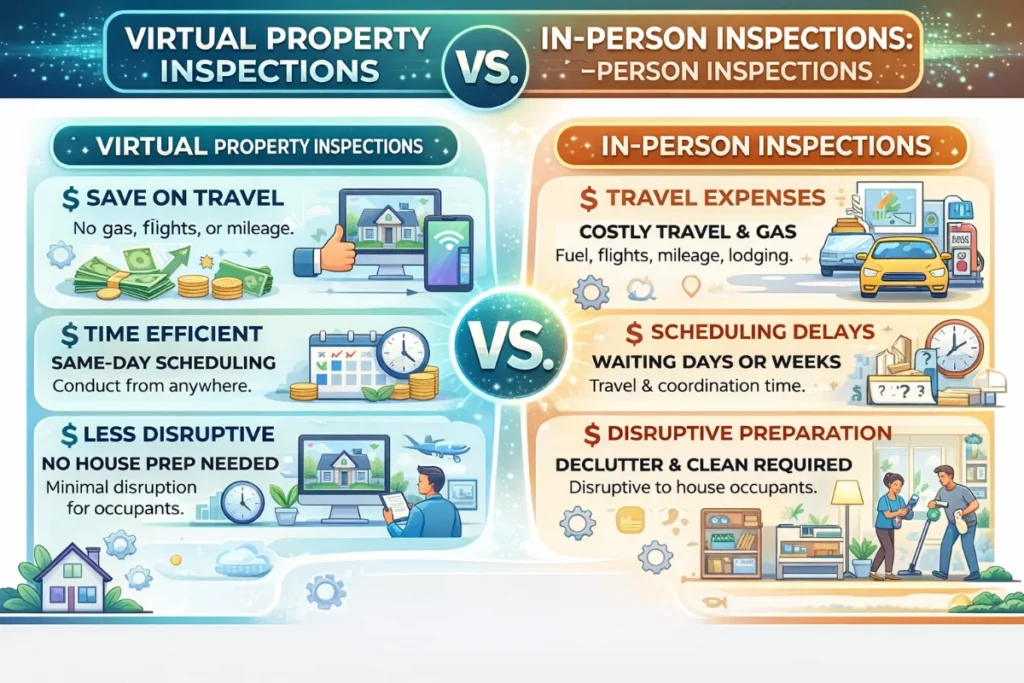
The economics of in-person inspections are worse than most property managers realize until they do the math.
The average in-person inspection, when you factor in drive time, the inspection itself, report completion, and any follow-up coordination, costs property managers upwards of $75 per property. For managers carrying 100 properties and conducting periodic inspections every 6 months, that’s $15,000 per year in inspection overhead — and that assumes no no-shows, no traffic, and no scheduling back-and-forth.
Third-party in-person inspection services typically charge $100–$150 per visit, which doesn’t solve the cost problem — it just shifts the labor.
Virtual inspections through a professional service typically run 60% less than traditional methods. At scale, the savings compound quickly. A 200-property portfolio inspected every 6 months generates 400 periodic inspections per year. The difference between $125 per in-person visit and $50 per virtual inspection is $30,000 annually — enough to hire a part-time staff member or fund a significant marketing budget. Rates vary by portfolio size and inspection volume, so [see current pricing](https://residentinspect.com/pricing/) to run the math against your own numbers.
Beyond direct cost, virtual inspections eliminate the hidden costs: no-show rescheduling, mileage, vehicle wear, and the opportunity cost of a property manager’s time spent in traffic rather than managing owner relationships or growing the portfolio.
Operational Insight
### Where Inspection Time Actually Goes — And Why It Matters
Most inspection costs are not tied to the inspection itself — they are tied to everything surrounding it. Travel, coordination, reporting, and follow-up quietly consume hours that could otherwise be spent on revenue-generating activity.
A single inspection often represents **60–90 minutes of total workload** when accounting for drive time, documentation, and communication — not just the walkthrough itself.
Multiply that across an entire portfolio, and inspections become one of the most time-intensive operational tasks — especially as you scale past 100+ doors.
Virtual inspection models compress that workload significantly, removing travel and reducing coordination — allowing teams to handle more inspections without adding headcount.
The real advantage is not just cost reduction — it is **time reallocation**. Every hour saved can be redirected toward leasing, owner communication, or portfolio growth.
Bottom Line:
As portfolios grow, efficiency becomes more valuable than effort. The teams that scale the fastest are the ones that remove operational drag — not just reduce expenses.
## **Virtual Property Inspections vs. Tenant Self-Inspections: Why the Distinction Matters**
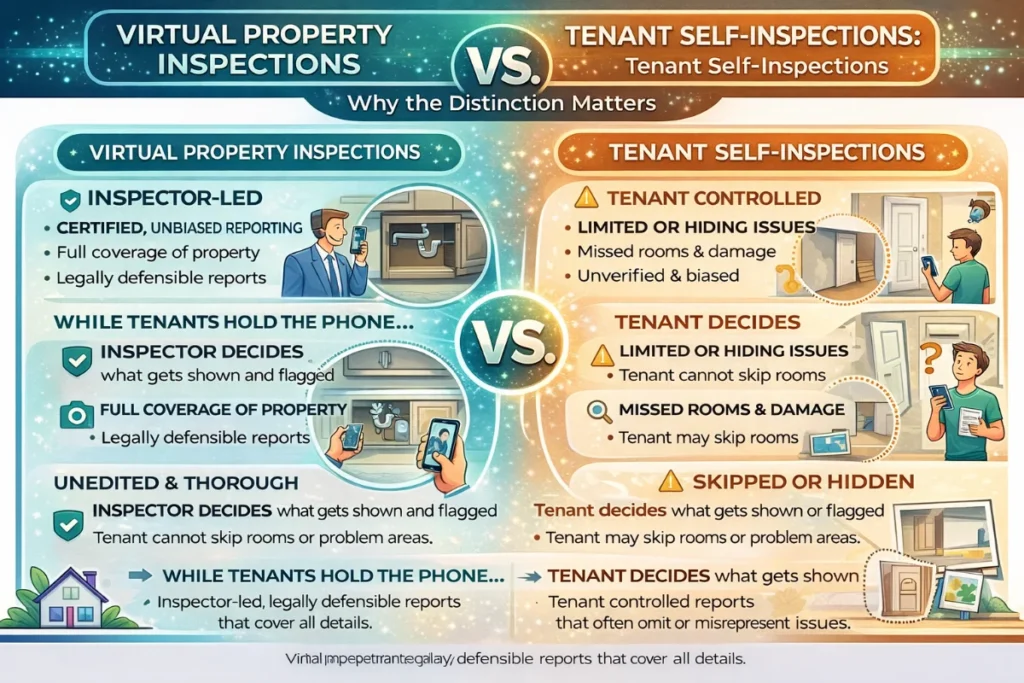
When virtual inspections are mentioned, some property managers confuse them with tenant self-inspections — where the tenant records their own video or fills out a form and submits it independently. These are not the same thing, and the difference matters significantly.
Tenant self-inspections place the tenant in full control of what gets documented. In practice, this means issues get missed — sometimes accidentally, sometimes deliberately. Unauthorized pets, wall damage, missing fixtures, and entire rooms (attics, garages, crawl spaces) are routinely absent from tenant-submitted reports. Photos are sometimes edited. Damage is photographed from unflattering angles or not at all.
A professional virtual inspection is inspector-led. The tenant holds the phone. The inspector decides what gets shown, what gets photographed, and what gets flagged. The tenant cannot skip rooms, avoid problem areas, or control the documentation. The inspector asks them to open the cabinet under the sink. The inspector asks them to run the dishwasher. The inspector asks them to zoom in on the wall behind the door.
This distinction is the reason virtual inspections produce legally defensible reports while tenant self-inspections often don’t. For the full breakdown, see our comparison of [virtual inspections vs. tenant self-inspections](https://residentinspect.com/blog/virtual-inspections-vs-tenant-self-inspections/).
## **The Documentation Advantage** of Virtual Property Inspections
One of the most underappreciated benefits of professional virtual inspections is [documentation consistency.](https://wac.umn.edu/tww-program/teaching-writing-blog/documentation-consistency-or-correctness)
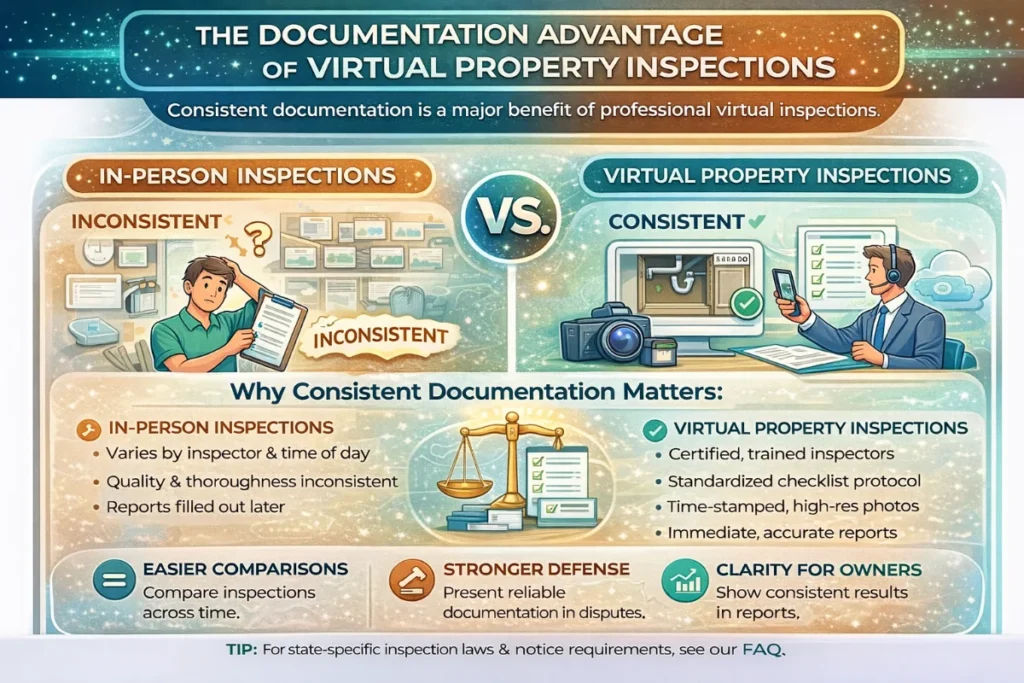
In-person inspections vary enormously in quality depending on who conducts them, how tired they are, how rushed the day is, and whether they’re juggling other tasks. A property manager conducting 8 inspections in a day will document the 8th inspection very differently from the first.
Professional virtual inspectors follow a consistent checklist protocol on every inspection, every time. The same areas are covered. The same photos are taken. The same report format is produced. That consistency matters when you’re comparing inspection reports across time, presenting documentation in a dispute, or reporting to an owner.
High-resolution, time-stamped photos captured during the inspection are part of the record. The live video session itself can serve as additional documentation. The report is completed during or immediately after the inspection, eliminating the memory gaps and documentation shortcuts that happen when reports are filled in hours or days later.
## **Legal Defensibility of Virtual Property Inspections**
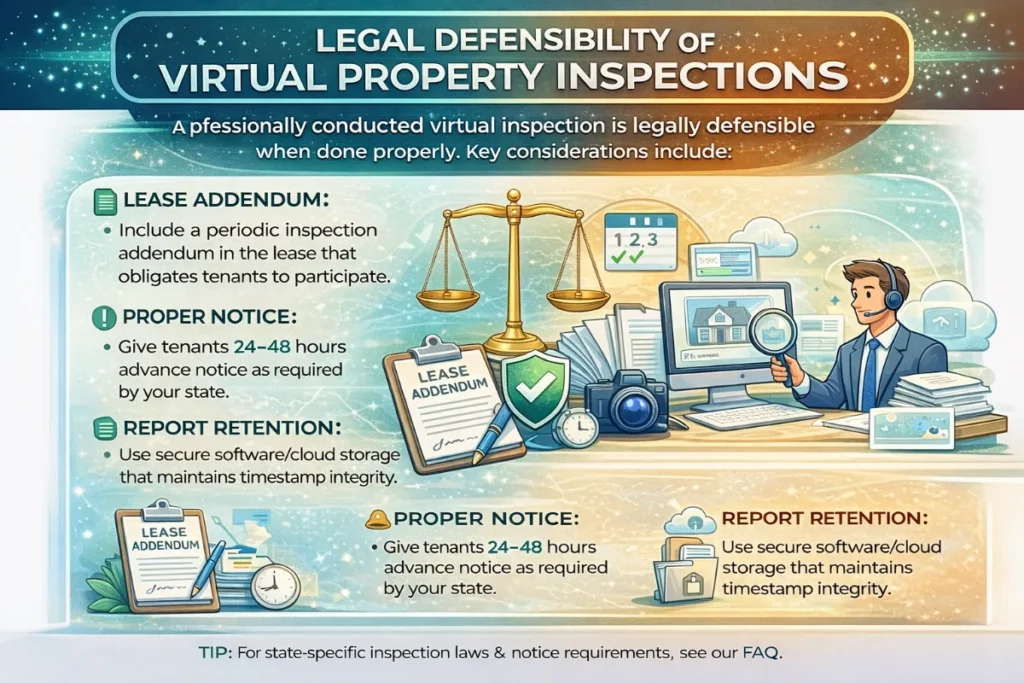
A common question from property managers evaluating virtual inspections: will this hold up?
The short answer is yes — in most jurisdictions, a professionally conducted virtual inspection with a trained third-party inspector, documented with time-stamped photos and a formal report, is legally defensible. In many cases it’s more defensible than an in-person inspection conducted by the property manager themselves, because the third-party inspector has no financial stake in the outcome.
A few considerations to have in order:
[Lease addendum. ](https://residentinspect.com/free-periodic-inspection-lease-addendum/ "Free Periodic Inspection Lease Addendum form")Your lease should include a periodic inspection addendum stating the tenant’s obligation to participate in inspections, including virtual ones, and specifying what happens if they refuse. Resident Inspect provides a recommended lease addendum for this purpose.
Proper notice. Virtual inspections require the same advance notice as in-person inspections — typically 24–48 hours, depending on your state. Notice requirements don’t change because the inspection is conducted remotely.
Report retention. Store inspection reports — including photos — in a system that preserves their timestamp integrity. Reports stored in your property management software or a secure cloud system are far more defensible than PDFs emailed to a folder.
For [state-specific inspection laws](https://residentinspect.com/blog/rental-property-inspection-laws-by-state/ "state-specific inspection laws") and notice requirements, see our FAQ.
Legal Perspective
### Built for Documentation That Holds Up
In disputes, the strength of an inspection is not based on how it was conducted — it is based on how well it was documented. Courts and mediators rely on clear, consistent, and verifiable evidence.
Virtual inspections produce **time-stamped, standardized reports** with consistent photo documentation — reducing gaps that often weaken traditional inspection records.
#### Consistency across every inspection
Because inspections follow a guided workflow, each report captures the same areas, angles, and details — creating uniform records across your entire portfolio.
#### Clear audit trail
Live inspections create a verifiable timeline of events, including when the inspection occurred and what was documented — strengthening your position in any claim or dispute.
#### Reduced subjectivity
Real-time guidance minimizes missed areas and inconsistent reporting, helping ensure that documentation reflects the true condition of the property.
Bottom Line:
The most defensible inspection is the one that is **consistent, complete, and verifiable** — and that is where virtual inspections excel.
## **What to Look For in a Virtual Property Inspection Service**
Not all virtual inspection providers are equal. Here’s what separates a professional service from a basic video call solution:
[Inspector training and accountability. ](https://www.nachi.org/intro-home-inspections-real-estate.htm)The inspection is only as good as the inspector conducting it. Look for a service that employs trained inspectors who follow a defined protocol — not a platform that simply connects you to an unvetted contractor.
[Live, real-time inspection.](https://www.truepic.com/blog/virtual-property-inspections "Live, real-time inspection.") The gold standard is a live video call where the inspector guides the tenant in real time. Asynchronous video submissions (where the tenant records and submits on their own) don’t provide the oversight that makes virtual inspections defensible.
[Customizable templates. ](https://www.figma.com/community/website-templates/real-estate?resource_type=files)Your properties are not all the same. A 1-bedroom condo has different inspection requirements than a 4-bedroom single-family home. Look for a service that allows you to define inspection priorities and customize what gets documented.
[Branded reports.](https://www.nar.realtor/commercial/create/smarter-more-customized-reporting-is-now-the-standard) If you’re providing inspection reports to owners, they should look like they came from your company — not a third-party vendor. Fully branded reports maintain your professional image.
Property management software integration. The inspection workflow should connect to what you’re already using. Services that integrate with [AppFolio](https://www.appfolio.com/ "AppFolio"), Propertyware, [Buildium](https://www.clearleaddigital.com/blog/buildium-review "Buildium"), Rentvine, and Rent Manager eliminate manual report entry and keep your inspection history where it belongs.
[Tenant scheduling and communication.](https://www.landlordstudio.com/blog/tenant-communication-in-property-management) The service should handle all tenant outreach, scheduling, and reminders on your behalf. If you’re still coordinating inspection logistics yourself, you’re not getting the efficiency benefit.
Nationwide coverage. If your portfolio spans multiple markets or you manage properties remotely, your inspection service needs to operate everywhere you do ours is [available nationwide](https://residentinspect.com/nationwide-rental-inspections/), in all 50 states.
[Our virtual inspection software](https://residentinspect.com/our-virtual-inspection-software/) was built specifically around these requirements by a property manager who spent over a decade frustrated by everything the traditional inspection model gets wrong.
## **How to Implement Virtual Property Inspections in Your Portfolio**
Execution Advantage
### Why Virtual Inspections Are Easier to Adopt Than You Think
The biggest misconception about virtual inspections is that they require new systems, new training, or a major operational shift. In reality, most teams integrate them seamlessly into their existing workflows with minimal disruption.
#### No overhaul required
Virtual inspections layer into your current process — not replace it. Leasing, maintenance coordination, and owner communication remain unchanged.
#### Faster team adoption
Most property management teams are fully comfortable with the workflow after just a handful of inspections, especially when reports and documentation are standardized.
#### Immediate operational relief
Removing travel and scheduling friction frees up bandwidth almost instantly — allowing managers to focus on higher-value activities without waiting months to see impact.
Key Takeaway:
The transition is not about changing how you manage properties — it is about removing inefficiencies from a process you are already doing.
Transitioning to virtual periodic inspections doesn’t require a complete overhaul of your inspection program. Most property management companies implement virtual inspections in phases:
**Phase 1:** Start with new leases. For all new tenancies, include the periodic inspection lease addendum and conduct your first periodic inspection virtually at the 3-month mark. Use this phase to get comfortable with the report format and workflow.
**Phase 2:** Roll out to low-complexity properties. Single-family homes and straightforward multi-family units are the easiest to inspect virtually. Build your confidence with these before moving to larger or more complex properties.
**Phase 3:** Convert your full periodic inspection calendar. Once you’ve completed 20–30 virtual inspections and have a feel for the workflow, convert your entire periodic inspection schedule to virtual. Retain in-person visits only for move-in, move-out, and active maintenance.
**Phase 4:** Systemize. Work with your virtual inspection provider to set up automated inspection triggers through your property management software so inspections are requested on schedule without manual intervention.
## See Virtual Inspections in Action
Get a personalized demo to discover how virtual inspections can save time, cut labor hours, and boost property management efficiency.
[Get Your Demo](https://residentinspect.com/book-a-demo/)Prefer to talk? [Call our team](tel:+19042011102).
## **Frequently Asked Questions**
### What do tenants think about virtual inspections?
Most tenants respond positively to virtual inspections once they understand the process. The flexibility of scheduling — including evenings and weekends — removes one of the biggest friction points. Tenants don’t have to take time off work or rearrange their day for a two-hour arrival window. The average virtual inspection takes 20–30 minutes and can be done whenever is convenient for the tenant.
### Does a tenant have to participate in a virtual inspection?
Whether a tenant is legally required to participate depends on your lease terms and local law. A periodic inspection lease addendum that requires participation — and specifies a fee for refusal — is the strongest way to ensure compliance. In practice, when tenants understand the process and have flexible scheduling options, refusals are rare.
### Can virtual inspections be used for move-in documentation?
Yes, though most professional property managers still prefer in-person move-in inspections because of the legal significance of the move-in report. Virtual move-in inspections are a viable option for remote properties where in-person access isn’t practical, provided both the property manager and tenant review and sign the report.
### What happens if there’s no cell service or the internet connection is poor during the inspection?
A reliable cell signal is sufficient for most virtual inspections — full broadband internet is not required. If connectivity is genuinely unavailable (very rural properties, certain basement units), a hybrid approach is used: virtual inspection with the tenant for accessible areas, plus an in-person follow-up for areas that couldn’t be adequately documented.
### How are virtual inspection reports delivered?
Professional virtual inspection services deliver a complete, branded report directly to the property manager — typically within 24 hours of the inspection. Reports include time-stamped photos, condition notes by area, and any flagged maintenance items or lease compliance concerns.
### Are virtual inspections legal everywhere in the United States?
Virtual inspections conducted with proper notice and tenant participation are legal in all 50 states. The legal requirements for inspections — notice period, frequency limits, permissible purposes — apply equally to virtual and in-person inspections. What changes is the logistics, not the legal framework.
## **Summary**
Virtual property inspections represent one of the most impactful operational changes available to property management companies today. They reduce inspection costs by up to 60%, eliminate windshield time, improve documentation consistency, and produce professionally defensible reports — without sacrificing inspection quality.
For periodic inspections specifically, the case for virtual is difficult to argue against. The cost savings are real. The documentation is often better. The tenant experience is smoother. And the time saved compounds across every inspection in your portfolio.
The property managers who will own their markets over the next decade are the ones building scalable, systemized operations today. Virtual inspections are one of the clearest ways to do that.
Resident Inspect handles your periodic inspections via live video — tenant scheduling, reminders, the full walkthrough, and a branded report delivered directly to you. No travel. No no-shows. Available in all 50 states. Get started at residentinspect.com.

Aaron Cooper Founder & CEO
After more than 20 years as a landlord and property management company owner-operator, Aaron Cooper built Resident Inspect to solve a problem he experienced firsthand: the inspection process was broken, expensive, and impossible to scale. Resident Inspect is the result — a live virtual inspection service that replaces in-person inspections with a faster, more consistent, and more defensible process. [See Full Bio](https://residentinspect.com/about-us/aaron-cooper/)
[Facebook](https://www.facebook.com/residentinspect/) [Instagram](https://www.instagram.com/residentinspect/) [TikTok](https://www.tiktok.com/@residentinspectofficial) [Pinterest](https://www.pinterest.com/aaron2762/) [YouTube](https://www.youtube.com/@ResidentInspect) [LinkedIn](https://www.linkedin.com/in/resident-inspect-a00b7a376/)
**Categories:** Blog
---
### [Virtual Inspections vs. AI Inspections: What Property Managers Need to Know](https://residentinspect.com/blog/virtual-inspections-vs-ai-inspections/)
**Published:** May 20, 2026
**Author:** Aaron Cooper
**Content:**
 Aaron Cooper
Founder & Chief Executive Officer, Resident Inspect
📍 Jacksonville, FL
Aaron Cooper is a seasoned property technology entrepreneur and inspection industry expert. As the **Founder and CEO of Resident Inspect**, and #1 Rental Home Inspector. He leads the development of intelligent inspection platforms that empower landlords, property managers, and investors to streamline digital inspections and ensure compliance.
🌐 [residentinspect.com](https://residentinspect.com)
## Table of Contents
- [What Is an AI Property Inspection?](#what-is-an-ai-property-inspection)
- [What Is a Guided Virtual Inspection?](#what-is-a-guided-virtual-inspection)
- [The Main Difference: Analysis vs. Control](#the-main-difference)
- [AI Inspections: Pros and Cons](#ai-inspections-pros-and-cons)
- [Guided Virtual Inspections: Pros and Cons](#guided-virtual-inspections-pros-and-cons)
- [Side-by-Side Comparison](#side-by-side-comparison)
- [Why AI Alone May Not Solve the Accountability Problem](#why-ai-alone-may-not-solve-the-accountability-problem)
- [The Better Question: Who Is Guiding the Inspection?](#the-better-question)
- [The Best Use of AI in Property Inspections](#the-best-use-of-ai)
- [Why Guided Virtual Inspections Work Well for Routine Rental Properties](#why-guided-virtual-inspections-work-well)
- [When AI Inspections May Be Enough](#when-ai-inspections-may-be-enough)
- [When Guided Virtual Inspections Are the Better Fit](#when-guided-virtual-inspections-are-the-better-fit)
- [Human-Guided Technology: The Stronger Inspection Model](#human-guided-technology)
- [Why Property Managers Choose Resident Inspect](#why-property-managers-choose-resident-inspect)
- [Final Thoughts](#final-thoughts)
Artificial intelligence is changing the way many industries collect, organize, and review information. Property management is no exception.
Today, more property managers are seeing tools that promise faster inspection reports, automated photo analysis, AI-generated summaries, and streamlined inspection workflows.
That technology can be helpful.
But when it comes to rental property inspections, there is an important question property managers need to ask:
**Is AI actually inspecting the property, or is it simply analyzing the information someone else submitted?**
That distinction matters.
AI inspection tools and guided virtual inspections can both improve efficiency, but they solve different problems. AI can help review, organize, and summarize inspection information. Guided virtual inspections help control how that information is captured in the first place.
For routine rental property inspections, that difference can have a major impact on accuracy, accountability, and trust.
## **What Is an AI Property Inspection?**
An AI property inspection uses artificial intelligence to assist with some part of the inspection process.
Depending on the platform, AI may help:
- Analyze inspection photos
- Identify possible visible issues
- Organize images by room or category
- Generate inspection summaries
- Flag missing or inconsistent information
- Speed up report writing
- Standardize report formatting
- Reduce manual review time
AI can be especially useful when a property manager has a large number of photos, notes, or reports to process.
Instead of manually sorting every image or writing every summary from scratch, AI can help make the inspection review process faster and more efficient.
That is valuable.
But AI inspections also have a significant limitation.
AI can only analyze the information it receives.
If the photos are incomplete, unclear, misleading, or missing important areas, AI may still produce a polished report based on incomplete information.
## **What Is a Guided Virtual Inspection?**
A guided virtual inspection is a live remote inspection led by a trained inspection professional. To learn more about how this process works, read our complete guide to [virtual property inspections](https://residentinspect.com/blog/virtual-property-inspections-guide/).
The resident is physically inside the rental property and joins the inspection by live video from a smartphone. The inspector is remote, but they guide the resident through the home in real time.
The inspector directs where the resident should go, what areas need to be shown, what photos should be captured, and when additional views are needed.
With Resident Inspect, the resident is not responsible for inspecting the property on their own. The resident provides access through video, while a trained inspector controls the inspection process.
That real-time guidance is the key difference.
A guided virtual inspection does not just help process inspection information after it has been submitted. It helps make sure the right information is captured during the inspection.
## **The Main Difference: Analysis vs. Control**
AI inspections and guided virtual inspections are often discussed as if they are competing versions of the same thing.
But they are not exactly the same.
AI is strongest at analyzing information.
Guided virtual inspections are strongest at controlling the inspection process.
That difference matters because a rental inspection is only as good as the information captured.
If the resident skips a room, avoids showing damage, submits blurry photos, or misunderstands the instructions, AI may not know what was missed. It may analyze the images provided, but it cannot always know what was left out.
A trained inspector on a live virtual inspection can respond in real time.
If something is unclear, the inspector can ask for a closer view. If a room was missed, the inspector can redirect the resident. If a photo is too dark, the inspector can request better lighting. If an issue needs more context, the inspector can ask follow-up questions during the inspection.
That is the difference between reviewing submitted information and guiding the inspection as it happens.
## **AI Inspections: Pros and Cons**
AI inspection tools can be useful, especially when they are used to support a structured inspection process.
They can reduce repetitive work, organize information faster, and help property managers review inspection documentation more efficiently.
But AI should not be confused with professional inspection oversight.
### **Pros of AI inspections**
AI inspection tools may help property managers:
- Speed up report creation
- Organize inspection photos
- Identify possible visible issues
- Improve report consistency
- Flag missing or unusual information
- Reduce administrative workload
- Process large volumes of inspection data
- Create summaries from photos or notes
- Support internal quality control
For property management companies with large portfolios, these benefits can be meaningful. AI can make inspection workflows faster and more scalable.
### **Cons of AI inspections**
The biggest limitation of AI inspections is that AI depends on the quality and completeness of the data it receives.
If the inspection information is incomplete, AI may not be able to fix that problem.
Common limitations include:
- AI may only analyze submitted photos
- Skipped rooms may go unnoticed
- Poor-quality photos can lead to poor conclusions
- Context may be missing
- The resident may still control what gets submitted
- AI may flag issues without understanding the full situation
- A clean AI-generated report may create a false sense of completeness
- Staff may still need to review and verify the results
AI can improve the inspection workflow, but it does not automatically make the inspection complete, accurate, or accountable. That is why property managers should be careful about relying on AI-only inspection workflows for routine property documentation.
## **Guided Virtual Inspections: Pros and Cons**
Guided virtual inspections are designed to give property managers a more accountable remote inspection process.
They use technology to reduce the cost and inconvenience of in-person inspections, but they keep a trained inspection professional involved in real time.
### **Pros of guided virtual inspections**
Guided virtual inspections can help property managers:
- Reduce drive time and mileage
- Lower inspection costs
- Complete routine inspections faster
- Improve scheduling flexibility
- Create more consistent documentation
- Avoid tenant-led self-inspections
- Capture better photos during the inspection
- Ask follow-up questions in real time
- Provide professional inspection reports
- Scale routine inspection programs more efficiently
Because the inspection is live, missing or unclear information can often be corrected before the inspection ends. That is a major advantage over reviewing a report later and realizing key photos or details were never captured. For a full breakdown of how virtual inspections can reduce costs and save staff time, see our guide: [How Virtual Rental Inspections Save Property Managers Time and Money](https://residentinspect.com/blog/how-virtual-rental-inspections-save-property-managers-time-and-money/).
### **Cons of guided virtual inspections**
Guided virtual inspections are not the right fit for every situation.
They still require resident participation. The resident needs to be available, have a smartphone, and be able to walk through the property during the scheduled inspection.
Guided virtual inspections may also not be the best choice for serious damage, complex maintenance diagnosis, safety concerns, legal disputes, or situations that require physical testing. For a closer look at when each method performs best, see: [Are Virtual Rental Property Inspections as Good as In-Person Inspections?](https://residentinspect.com/blog/are-virtual-rental-property-inspections-as-good-as-in-person-inspections/)
But for routine occupied rental property inspections, guided virtual inspections can provide a strong balance of efficiency, cost savings, documentation, and accountability.
## **Side-by-Side Comparison**
| Category | AI Inspection | Guided Virtual Inspection |
|---|---|---|
| Main function | Analyzes, organizes, or summarizes submitted information | Guides the inspection live in real time |
| Who controls what gets captured? | Often resident, staff, or system prompts | Trained inspector |
| Is the inspection live? | Usually no | Yes |
| Can missing areas be corrected in real time? | Usually no | Yes |
| Can unclear photos be corrected immediately? | Usually no | Yes |
| Can it speed up report creation? | Yes | Yes |
| Does it provide human judgment during the inspection? | Limited or no | Yes |
| Does it reduce travel time? | Yes | Yes |
| Does it require resident participation? | Often yes | Yes |
| Main strength | Faster analysis and reporting | More accountable remote inspection process |
| Main limitation | Depends on submitted data | Requires a scheduled live inspection |
| Best use case | Organizing or reviewing inspection data | Routine occupied rental property inspections |
Both methods can create efficiency. But guided virtual inspections provide something AI-only inspections may not: real-time human direction during the inspection itself.
## **Why AI Alone May Not Solve the Accountability Problem**
One of the biggest challenges in rental property inspections is not simply creating a report. It is making sure the report is based on complete and reliable documentation.
AI may help write or organize a report, but it may not know whether the source information was complete.
For example:
- If a resident skips a bedroom, AI may not know what was missed.
- If a closet is never opened, AI may not know it was excluded.
- If damage is outside the frame of the photo, AI may not detect it.
- If a resident submits only the cleanest angles, AI may still generate a professional-looking report.
- If lighting is poor, AI may not accurately interpret the condition.
This does not mean AI is not useful. It means AI should be used carefully.
For property managers, the most important part of an inspection is not just the final report. It is the process used to create that report. A polished report is only valuable if the inspection process behind it is reliable.
## **The Better Question: Who Is Guiding the Inspection?**
When evaluating inspection technology, property managers should not only ask: “Does this tool use AI?”
They should also ask: **Who is guiding the inspection while the property is being documented?**
That question gets to the heart of the issue.
If the resident is guiding themselves, the property manager may still be relying on a tenant-controlled process.
If AI is reviewing only what the resident submitted, the software may be analyzing incomplete information.
If a trained inspector is guiding the resident live, the inspection process becomes more structured, consistent, and accountable.
That is the value of guided virtual inspections. They combine the convenience of remote technology with the oversight of a trained inspection professional.
## **The Best Use of AI in Property Inspections**
AI can be valuable when it supports a strong inspection process.
For example, AI may help:
- Review large volumes of inspection data
- Organize photos after an inspection
- Flag potential concerns for human review
- Speed up report preparation
- Improve internal quality control
- Identify patterns across a portfolio
Those uses can make property management teams more efficient. But AI is strongest when it supports human judgment, not when it replaces the inspection process entirely.
For routine rental inspections, the strongest model is often not AI-only. It is human-guided technology. That means technology helps make the process faster and more scalable, while a trained professional still controls the inspection and applies judgment where needed.
## **Why Guided Virtual Inspections Work Well for Routine Rental Properties**
Routine rental property inspections usually have a clear goal.
Property managers want to:
- Document the general condition of the property
- Identify visible concerns
- Check for lease compliance issues
- Confirm the property is being maintained
- Provide owners with useful documentation
- Catch small issues before they become larger problems
- Maintain visibility across the portfolio
For these goals, guided virtual inspections can be a strong fit. They do not require drive time, they reduce scheduling friction, and they produce professional documentation. To understand what routine inspections actually cost across different delivery models, see: [How Much Does a Rental Property Inspection Cost in 2026](https://residentinspect.com/blog/how-much-does-a-rental-property-inspection-cost/).
At the same time, they avoid one of the biggest weaknesses of tenant-led or AI-only workflows: lack of real-time human oversight.
A trained inspector can guide the inspection, request specific views, and make sure the process follows a consistent standard. That makes guided virtual inspections especially useful for routine occupied rental properties.
## **When AI Inspections May Be Enough**
AI inspection tools may be enough when the property manager already has reliable documentation and needs help organizing, summarizing, or reviewing it.
AI may be useful for:
- Sorting photos
- Drafting report summaries
- Flagging possible issues
- Creating consistent report formats
- Reviewing large amounts of documentation
- Supporting internal quality control
AI may also be helpful when paired with a professional inspection process. But AI-only inspections may not be enough when the property manager needs confidence that the right areas were actually inspected and documented.
If the concern is accountability, control, or completeness, guided virtual inspections are usually stronger.
## **When Guided Virtual Inspections Are the Better Fit**
Guided virtual inspections are usually the better fit when a property manager needs a repeatable process for routine rental inspections.
They are especially useful for:
- Periodic rental home inspections
- Occupied property condition checks
- Owner-requested updates
- Lease compliance reviews
- Post-maintenance verification
- Move-in follow-up documentation
- Move-out follow-up documentation
- Properties outside the normal service area
- Large portfolios that need scalable inspection coverage
- Teams trying to reduce drive time and staff workload
In these situations, the property manager does not just need faster reporting. They need a better inspection process. That is where guided virtual inspections can provide more value than AI-only workflows. For a side-by-side breakdown of how virtual and in-person inspections compare across different scenarios, see: [Are Virtual Rental Property Inspections as Good as In-Person Inspections?](https://residentinspect.com/blog/are-virtual-rental-property-inspections-as-good-as-in-person-inspections/)
## **Human-Guided Technology: The Stronger Inspection Model**
The future of rental property inspections is not simply manual inspections or artificial intelligence. It is a smarter combination of people, process, and technology.
AI can help make inspection workflows more efficient. Virtual inspection technology can remove unnecessary drive time. But trained human oversight still matters.
For property managers, the strongest process is one where technology makes inspections easier to complete, while a trained inspector still guides the documentation and applies judgment during the inspection.
That is the model Resident Inspect was built around. We use technology to make routine inspections faster, more convenient, and easier to scale, but the inspection itself is guided by a trained professional. That gives property managers the efficiency of remote inspections without relying only on automated analysis.
## **Why Property Managers Choose Resident Inspect**
Resident Inspect helps property managers complete routine rental property inspections through a live, guided virtual process.
Our inspections are not tenant self-inspections, and they are not AI-only reports based on whatever information happens to be submitted.
With Resident Inspect, a trained inspection professional leads the inspection in real time. The resident provides access through live video, and the inspector directs the process, captures documentation, and prepares a professional report.
Resident Inspect helps property managers:
- Reduce inspection costs
- Save staff time
- Avoid unnecessary drive time
- Improve inspection consistency
- Add human oversight to remote inspections
- Avoid relying only on tenant-submitted photos
- Provide owners with professional reports
- Scale routine inspection programs
- Maintain better visibility across the portfolio
For property managers who want efficiency without giving up accountability, guided virtual inspections offer a practical solution.
## **Final Thoughts**
AI inspection tools can be helpful. They can organize information, speed up reporting, and support property management teams as they handle more inspection data.
But AI does not automatically make an inspection complete, accurate, or accountable. AI depends on the information it receives. Guided virtual inspections focus on the process used to capture that information.
For routine rental property inspections, that difference matters.
AI may help improve the report. A guided virtual inspection helps improve the inspection.
Resident Inspect gives property managers the efficiency of remote inspection technology with the accountability of a trained human-led process.
Want to see how a guided virtual inspection compares to an AI-only inspection workflow?
[Request a Sample Report](#) [Schedule a Demo](https://residentinspect.com/book-a-demo/)
## **Related Articles**
- [Are Virtual Rental Property Inspections as Good as In-Person Inspections?](https://residentinspect.com/blog/are-virtual-rental-property-inspections-as-good-as-in-person-inspections/)
- [How Virtual Rental Inspections Save Property Managers Time and Money](https://residentinspect.com/blog/how-virtual-rental-inspections-save-property-managers-time-and-money/)
- [How Much Does a Rental Property Inspection Cost in 2026](https://residentinspect.com/blog/how-much-does-a-rental-property-inspection-cost/)

Aaron Cooper Founder & CEO
After more than 20 years as a landlord and property management company owner-operator, Aaron Cooper built Resident Inspect to solve a problem he experienced firsthand: the inspection process was broken, expensive, and impossible to scale. Resident Inspect is the result — a live virtual inspection service that replaces in-person inspections with a faster, more consistent, and more defensible process. [See Full Bio](https://residentinspect.com/about-us/aaron-cooper/)
[Facebook](https://www.facebook.com/residentinspect/) [Instagram](https://www.instagram.com/residentinspect/) [TikTok](https://www.tiktok.com/@residentinspectofficial) [Pinterest](https://www.pinterest.com/aaron2762/) [YouTube](https://www.youtube.com/@ResidentInspect) [LinkedIn](https://www.linkedin.com/in/resident-inspect-a00b7a376/)
**Categories:** Blog
---
### [Top 5 Move-Out Inspections Mistakes Landlords Make (And How to Avoid Them)](https://residentinspect.com/blog/top-landlord-move-out-inspections-mistakes/)
**Published:** October 17, 2025
**Author:** Aaron Cooper
**Excerpt:** Learn the top 5 move-out inspection mistakes landlords make — and how to protect your property, avoid disputes, and streamline the process with Resident Inspect.
**Content:**

Aaron Cooper
Founder & Chief Executive Officer, Resident Inspect
📍 Jacksonville, FL
Aaron Cooper is a seasoned property technology entrepreneur and inspection industry expert. As the **Founder and CEO of Resident Inspect**, he leads the development of intelligent inspection platforms that empower landlords, property managers, and investors to streamline digital inspections and ensure compliance.
🌐 [residentinspect.com](https://residentinspect.com)
✉️ <aaron@residentinspect.com>
A [move-out inspection](https://residentinspect.com/rental-property-inspections/) is crucial for protecting your rental investment and managing security deposit disputes. Unfortunately, many landlords make avoidable mistakes that can cost them time and money. Below are the five most common move-out inspections mistakes, and how to prevent them.
## **Table of Contents**
1. [1. Promising the Full Deposit Before Inspection](#mistake1)
2. [2. Conducting the Inspection With the Tenant Present](#mistake2)
3. [3. Insufficient Documentation](#mistake3)
4. [4. Overlooking Hidden or Less Visible Damage](#mistake4)
5. [5. Failing to Separate Wear & Tear From Damage](#mistake5)
6. [Best Practices Checklist](#best-practices)
7. [Frequently Asked Questions](#faq)
8. [About the Author](#about-author)
## **Top 5 Landlord Move-Out Inspections Mistakes**
Move-out inspections are more than just a formality — they’re your final opportunity to protect your investment and ensure a fair outcome for both you and your tenants. Yet, even experienced landlords can make small oversights that lead to costly disputes or missed damage. By understanding the most common [inspection](https://residentinspect.com/pricing/ "Pricing & Plans") mistakes and following a consistent process, you can save time, reduce conflict, and preserve your property’s value.
### **1. Promising the Full Deposit Before the Inspection**
Never guarantee a full deposit refund before inspecting. This creates false expectations and limits your ability to deduct for legitimate repairs. Always state that the refund depends on the property’s final condition and allowable deductions under your lease and [local law](https://www.amgrents.com/kissimmee-property-management-blog/understanding-florida-statute-83-a-guide).
### **2. Conducting the Inspection With the Tenant Present**
While transparency is important, [performing the inspection](https://residentinspect.com/) with the tenant present can cause tension and incomplete evaluations. It’s best to inspect after the tenant vacates, ensuring privacy and focus. If they attend, clarify that documentation and photography are standard parts of your process.
### **3. Insufficient Documentation (Photos, Videos, Details)**
Without proper documentation, you risk deposit disputes. Use [high-resolution photos or videos](https://residentinspect.com/our-virtual-inspection-software/), take multiple angles, include timestamps, and note specific details like “3-inch crack in baseboard” rather than vague entries like “wall damage.” Compare findings to your move-in report, and use a [landlord inspection checklist](https://residentinspect.com/blog/rental-property-inspection-checklist/) so no room gets skipped.
### **4. Overlooking Hidden or Less Visible Damage**
- Check under sinks and around plumbing for leaks.
- Inspect behind furniture and curtains for scratches or stains.
- Look for mold, mildew, and pet-related damage.
- Test HVAC vents, drains, and window screens.
Hidden issues are easy to miss and expensive to repair later — thoroughness pays off.
### **5. Failing to Separate Normal Wear & Tear From Chargeable Damage**
Landlords must distinguish between [normal aging and tenant-caused damage](https://www.hemlane.com/resources/florida-security-deposit-laws/). Minor carpet fading or small scuffs are wear and tear; broken fixtures or holes are damage. Review your state’s definitions, document everything, and stay consistent to avoid disputes or legal issues.
## **Best Practices Checklist**: Avoiding Move-Out Inspections Mistakes
- Don’t promise a refund before inspection.
- Conduct inspection privately or independently.
- Use dated photos/video and a standardized checklist.
- Check hidden areas for damage or leaks.
- Differentiate wear & tear from damage based on law.
## Let Resident Inspect Assist in Avoiding These Common Move-Out Inspections Mistakes
Avoiding these common move-out inspections mistakes can make all the difference in how smoothly your turnovers go. With [Resident Inspect, ](https://residentinspect.com/rental-property-inspections/)you can streamline every step — from photo documentation to digital reporting — all in one easy-to-use platform. Whether managing one home or hundreds, our [virtual inspection technology ](https://residentinspect.com/our-virtual-inspection-software/)helps you stay compliant, consistent, and confident.
## Simplify Every Property Inspection with Resident Inspect
Save time, reduce costs, and improve accuracy with **virtual rental inspections** built for property managers, landlords, and investors.
[Book a Complimentary Consultation](https://residentinspect.com/book-a-demo/) [See How It Works →](https://residentinspect.com/our-virtual-inspection-software/)
## **Frequently Asked Questions (FAQs)**
### **When should landlords perform a move-out inspection?**
Ideally within 24–48 hours after the tenant has vacated, ensuring full access and accurate assessment without interference.
### **Can tenants attend the move-out inspection?**
Yes, but it’s optional. If present, landlords should still take independent notes and photos to maintain objectivity.
### **How much time should landlords allocate for a move-out inspection?**
A standard single-family property usually takes 45 minutes to 1 hour for a thorough inspection and documentation.
### **What should be included in a move-out inspection report?**
Include room-by-room notes, photos, video links, damage descriptions, repair estimates, and comparisons to move-in conditions.

Aaron Cooper Founder & CEO
After more than 20 years as a landlord and property management company owner-operator, Aaron Cooper built Resident Inspect to solve a problem he experienced firsthand: the inspection process was broken, expensive, and impossible to scale. Resident Inspect is the result — a live virtual inspection service that replaces in-person inspections with a faster, more consistent, and more defensible process. [See Full Bio](https://residentinspect.com/about-us/aaron-cooper/)
[Facebook](https://www.facebook.com/residentinspect/) [Instagram](https://www.instagram.com/residentinspect/) [TikTok](https://www.tiktok.com/@residentinspectofficial) [Pinterest](https://www.pinterest.com/aaron2762/) [YouTube](https://www.youtube.com/@ResidentInspect) [LinkedIn](https://www.linkedin.com/in/resident-inspect-a00b7a376/)
**Categories:** Blog
---
### [The Future of Rental Property Inspections in 2026](https://residentinspect.com/blog/the-future-of-property-inspections/)
**Published:** March 24, 2025
**Author:** Aaron Cooper
**Excerpt:** Think inspections are just another admin headache? So did Aaron Cooper, until he built Resident Inspect, the virtual inspection platform saving property managers thousands in time, money, and stress.
In this article, we break down exactly how Resident Inspect works, why tenants actually prefer it, and how it solves the inspection problems that drive property managers up the wall. If you’ve ever cancelled dinner plans to chase down a no-show tenant, this one’s for you.
**Content:**
If you ask any property manager what they love most about their job, chances are they won’t say “**driving across town for inspections**” Coordinating schedules, dealing with no-shows, and sitting in traffic, it’s a major drain on time and money.
And yet, inspections are non-negotiable. They protect properties, ensure tenants aren’t trashing the place, and keep owners happy. But the traditional inspection model is outdated. It relies on in-house staff (or pricey third-party inspectors) to physically visit properties, creating a logistical nightmare for property managers and a massive expense for property owners. It’s 2026, not 1985, and it’s time we acted like it.
Rental property inspections are changing fast, and property management is following the same wave of AI, drones, and smart home sensors reshaping the rest of real estate. Resident Inspect’s approach sits right at the front of that shift with live, guided virtual inspections built specifically for property managers and landlords.
That’s exactly why [Resident Inspect](https://residentinspect.com/) exists. Founder Aaron Cooper saw the frustration firsthand and built a system that eliminates wasted time, cuts costs, and actually improves the inspection process.
So how does it work? And more importantly, how much time and money can you actually save? Let’s break it down.
Watch the full interview here!
Table Of Contents
1. [Key Takeaways](#key-takeaways)
2. [Where Rental Inspections Are Headed Next?](#where-rental-inspections-are-headed-next)
3. [The Hidden Costs of Traditional Rental Inspections](#the-hidden-costs-of-traditional-rental-inspections)
4. [Virtual Inspections: How It Works ](#virtual-inspections-how-it-works)
5. [How Much Money Can You Really Save? ](#how-much-money-can-you-really-save)
6. [Tenants Actually Prefer Virtual Inspections ](#tenants-actually-prefer-virtual-inspections)
7. [Protecting Property Managers From Risk ](#protecting-property-managers-from-risk)
8. [Common Concerns About Virtual Inspections ](#common-concerns-about-virtual-inspections)
9. [Why Resident Inspect Leads the Future of Rental Inspections?](#why-resident-inspect-leads-the-future-of-rental-inspections)
10. [Frequently Asked Questions](#frequently-asked-questions)
## Key Takeaways
1. **Traditional inspections are outdated, expensive, and a logistical nightmare.**
Property managers waste time and money driving to properties, dealing with no-shows, and handling scheduling headaches. Virtual inspections eliminate travel, reduce costs, and streamline operations.
2. **Hidden inspection costs add up fast.**
Lost time, mileage, insurance, and rescheduling costs make traditional inspections far more expensive than they seem, without even thinking about staff costs or third-party inspectors. Switching to virtual inspections means saving thousands every year.
3. **Resident Inspect makes inspections seamless, consistent, and more reliable.**
Unlike self-guided apps, every virtual inspection is conducted live by a trained professional, ensuring nothing gets missed and tenants can’t “accidentally” skip problem areas.
4. **The financial savings are massive.**
For a property manager handling 300 doors, switching to virtual inspections can save $20,000–$33,000 per year, which is money that can be reinvested into growth, staffing, or better technology.
5. **Virtual inspections aren’t just about saving money – they save time too.**
Traditional inspections waste hundreds of hours per year on travel, admin, and waiting around. Virtual inspections cut the process down from 1.5 hours to 30 minutes, freeing up months of staff time annually.
6. **Tenants actually prefer virtual inspections.**
Ninety-seven percent of tenants say they’d rather do a virtual inspection than have a stranger in their home. Fewer scheduling conflicts, less stress, and more flexibility mean fewer tenant complaints and smoother operations for property managers.
7. **Virtual inspections protect property managers from legal disputes.**
Time-stamped, geo-located, video-documented reports mean no more “he said, she said” arguments over property conditions. If a tenant claims they reported an issue, there’s video proof of exactly what was covered in the inspection.
## ****Where Rental Inspections Are Headed Next****?
Rental inspections are catching up to the rest of PropTech. Across property management, AI adoption has jumped sharply over the past year, and inspections are one of the areas benefiting most.
**AI-assisted reporting** is becoming more common. Instead of an inspector typing up notes after the fact, AI tools can help structure inspection findings into organized reports, flag inconsistencies, and speed up turnaround between the inspection and the report landing in a property manager’s inbox.
**Predictive maintenance flags** are another shift. Rather than treating each inspection as a one-off snapshot, some platforms are starting to compare inspection data over time to flag issues before they become expensive repairs, a leaky fixture that’s been mentioned twice, for example, or wear patterns that tend to precede bigger problems.
**Smart home and IoT sensor data** is also entering the picture. Moisture sensors, smart thermostats, and connected smoke detectors can feed ongoing condition data into a property’s file, supplementing scheduled inspections with a more continuous view of a unit’s condition.
Where does live, guided video fit into all of this? It’s the foundation these tools build on. AI-assisted reporting and predictive maintenance are only as good as the inspection data feeding them, and a trained inspector guiding a tenant through a structured, live process produces more consistent, complete documentation than a self-guided photo dump ever could. As the technology around inspections keeps evolving, that guided, human-verified core is what keeps the data trustworthy.
[See how Resident Inspect’s virtual inspection process works.](https://residentinspect.com/our-virtual-inspection-software/)
## ****The Hidden Costs of Traditional Rental Inspections****
Most property managers factor in the **obvious** inspection costs – paying a staff member or hiring a third-party inspector. But the *real* expense goes much deeper:
### ****Lost tim****e
Every hour spent in traffic is an hour NOT spent on growth, tenant retention, or business development. And not only that, but have you ever cancelled plans with your partner to do an inspection because the tenant said it *had* to be at that time, only for them to not be home? That’s not an easy conversation to have with the tenant *or* your partner…

### ****Mileage & vehicle costs****
Gas isn’t free, and neither is wear and tear on company or personal vehicles. The less time you can spend on the road, the more you’ll save in vehicle maintenance, which for larger teams can add up fast.
### **Locked doors**
When a tenant doesn’t answer the door, you don’t just waste time, you waste money *and energy* rescheduling and driving back. This is particularly bad when you’ve sacrificed an evening or weekend to do an inspection but the tenant refuses to do you the same courtesy.
### ******Insurance & liability risks******
Every mile driven increases the risk of an accident, meaning higher insurance costs for your company. You can’t have an auto accident if you don’t drive anywhere, right?

According to **AAA**, the average cost per mile for a business vehicle is **$0.81**. Multiply that by **dozens of inspections per month**, and it adds up fast, even for small journeys – doing just a 30 mile round trip 20 times a month works out at $486 a month in mileage alone. That’s money that can be better spent elsewhere.
### **Resident Inspect Eliminates These Costs**
With virtual inspections, there’s **zero travel time**. No mileage. No insurance concerns. You don’t need to do anything because we handle it for you. And if a tenant doesn’t show? We’ve lost **a few minutes, not an hour and a half,** so rescheduling is no big deal.
> ***“It’s a no-brainer, why waste an hour driving when you can do an inspection from your office in 20 minutes?”***
>
> Aaron Cooper
[**Learn More**](https://residentinspect.com/)
## ****Virtual Inspections: How It Works****
Resident Inspect isn’t some **self-guided app** where tenants snap a few photos and call it a day. That’s been tried before, and the results are… **inconsistent at best.**
Here’s how it actually works:
### ****Live, guided video inspections****
A trained inspector directs the tenant through the process in real time. They’ll tell them to show the cooker, inside the cupboards, and can ask the tenant to give a closer look.

### **No more tenant excuses**
Tenants can’t “accidentally” forget to show a broken door handle or leaky sink when they’re on live video. We don’t leave a stone unturned.

### ****Set protocols****
The inspection follows a strict checklist that we agree with the property manager to ensure consistency. It’s impossible to miss anything as the inspector is working through a standardized process one step at a time.
### **Real inspectors, not tenants**
Unlike self-guided inspections, the tenant isn’t in control. They’re simply following the inspector’s instructions, which means they can’t hide anywhere or claim they “didn’t know” they had to show the mold problem under the bathroom sink or the lease-breaking above ground pool in the back yard.
This **ensures quality and accountability** without the need for a property manager to physically step foot inside.
**Are virtual rental inspections as accurate as in-person ones?** Yes. Every Resident Inspect inspection follows a live, guided video process with a trained inspector directing the tenant, so nothing gets skipped. Unlike self-guided apps, the tenant isn’t in control of what gets shown, which removes the inconsistency that comes with in-person visits.
> ***“Tenants don’t always know what to look for… That’s why a trained inspector guiding them makes all the difference.”***
>
> Aaron Cooper
**Want to see how it works? Book a free demo with Resident Inspect today.**
[Book Your Demo](https://residentinspect.com/book-a-demo/)
## **How Much Money Can You Really Save?**
Let’s talk numbers. Before launching, we conducted extensive market research to find out exactly how much property managers were spending on inspections – and how much they could save by switching to virtual.
After running the calculations, we found:
- **Traditional in-house inspections** cost **$70–$90** each when you factor in:
- Staff wages
- Payroll taxes & benefits
- Admin time for scheduling & rescheduling
- Travel costs (fuel, mileage reimbursements, wear and tear on company vehicles)
- Unproductive downtime from no-shows and last-minute cancellations
- Third-party inspectors cost even more, typically starting at $100 per visit, with some charging even higher fees for properties in remote locations or urgent inspections.
- Resident Inspect’s virtual inspections are significantly less costly at just $45 per inspection, with no travel, no wasted time, and no overhead staffing costs.
### ****A cost-saving case study****
Based on 2026 pricing, here’s what the numbers look like for a property management company handling 300 doors, with two inspections per year per property, that’s 600 inspections annually.
- At $80 per in-house inspection, that’s **$48,000 per year.**
- At $100 per third-party inspection, that’s **$60,000 per year.**
- At **[$45 per virtual inspection,](https://residentinspect.com/pricing/)** you’d spend **just $27,000 per year.**

That’s a savings of **$20,000–$33,000 per year –** without cutting corners on compliance or quality, and in some cases actually improving inspection quality.
### ******Where Does That Money Go Instead?******
Property managers rarely get the luxury of extra cash sitting around. If you can free up **$20K–$30K annually**, where could you reinvest it?
Maybe you can **hire additional staff to grow your business** as you’re no longer sinking money into travel costs.
Maybe you can **boost your marketing and lead generation** with more resources to attract new property owners, meaning even more doors under management.
**Or you could invest in better technology,** upgrading your property management software, implementing AI tools, or improving customer service processes.

### ********But It’s About Time Too********
Time is money, and traditional inspections **waste hours every week**.
Let’s say your in-house team spends **1.5 hours per inspection**, including:
- Driving to the property
- Conducting the inspection
- Returning to the office
- Logging reports and sending follow-ups

For 600 inspections a year, that’s **900 hours annually – more than five months** of full-time work just spent on inspections.
Virtual inspections eliminate travel and cut the process down to **30 minutes per inspection**, slashing the total time spent to **300 hours per year,** and it’s completely handled by our team. That’s **900 hours saved,** or the equivalent of **a full-time employee gaining five months back every year**.
> ***“We surveyed other management companies and across the board, the biggest frustration was wasted time – whether it was no-shows, traffic, or waiting for tenants. With virtual inspections, none of that happens.”***
>
> Aaron Cooper
### **The Bottom Line**
Cutting costs on inspections doesn’t mean cutting quality. Virtual inspections provide the **same level of documentation, compliance, and oversight, or better,** at a fraction of the price.
And the best part? **You can try it for free.**
**Want to see how much you can save? Get 5 free inspections today.**
[Get Your Free Inspections](https://residentinspect.com/free-inspection/form/)
## **Tenants Actually Prefer Virtual Inspections**
**Tenants hate inspections**. And being real, we kinda understand why…
No one likes the idea of a stranger walking through their home, taking photos, and making notes. It feels invasive. And if you’ve ever had to coordinate an inspection, you know the drill:
- Tenants cancel at the last minute,
- They “forget” and aren’t home, or
- They complain about the timing – because, of course, your 2 p.m. Tuesday slot isn’t exactly convenient for someone with a job, is it?
For property managers, this means **frustration, wasted time, and delays**. Rescheduling inspections, handling tenant complaints, and dealing with access issues make what should be a simple process feel like pulling teeth.
### ********Less Hassle, Happier Tenants********
Resident Inspect eliminates these problems. With live virtual inspections, tenants no longer have to deal with the stress of a stranger in their home, and property managers don’t have to chase them down to get the job done. Here’s why it works better for everyone:
**We have Tenant-Friendly Scheduling** – We don’t offer rigid daytime slots. Evening and weekend inspections are now an option, so tenants don’t have to rearrange their work schedules.
**Our Inspections Are Less Invasive** – Instead of feeling like their personal space is being invaded, tenants can walk through their home with their phone, showing only what’s needed.
**Our Inspections Get Higher Attendance Rates** – With **[virtual inspections,](https://residentinspect.com/rental-property-inspections/)** if the tenant misses their appointment it’s easy to reschedule without wasting anyone’s time.
### **Tenants *Actually Like* This**
There’s a difference between making inspections more convenient and making tenants actually **prefer** them. But the numbers speak for themselves.
According to Resident Inspect’s latest data:
- **97% of tenants say they prefer virtual inspections over in-person ones.**
- **4.85 out of 5 stars** is the average rating from tenants on the inspection process.
And **the remaining 3% weren’t against virtual inspections, they just didn’t have a preference**.
That means **zero** tenants actively disliked our process. That’s pretty outstanding!
### **Happier Tenants Means Fewer Complaints For You**
When tenants are frustrated with inspections, property managers hear about it. Complaints pile up about **unreasonable scheduling, privacy concerns, or just general inconvenience**. And if a tenant feels like they’re being disrupted too often, it can impact their decision to renew their lease, and finding a new tenant is expensive too.

By making inspections **easier and less stressful**, you cut down on unnecessary friction between tenants and your management team. Fewer complaints mean fewer headaches – and fewer headaches mean more time to focus on **profit-building** tasks instead of playing referee.
### **A Better Experience for Everyone**
Switching to [**virtual inspections**](https://residentinspect.com/our-virtual-inspection-software/) improves the tenant experience. And when tenants are happy, property managers benefit from:
- Fewer disputes over inspection timing.
- Less pushback when scheduling inspections.
- Higher tenant retention rates, since the rental process feels less disruptive.
**When tenants win, property managers win.**
**Ready to experience the difference?**
[Find Out More](https://residentinspect.com/rental-property-inspections/)
## ****Protecting Property Managers From Risk****
Let’s talk about worst-case scenarios – the kind that keep property managers awake at night.
A tenant insists they reported a leak months ago, and now there’s water damage. They’re furious. Maybe even taking legal action. Your records? Incomplete. The last inspection? Rushed because your field agent was running behind. Suddenly, you’re in a blame game with no way to prove what actually happened.
This is exactly the kind of headache Resident Inspect was built to eliminate.
### **Why Traditional Inspections Leave You Exposed**
On-site inspections are often **inconsistent**. Maybe an inspector forgets to check under the sink. Maybe they rush through because they’re behind schedule and have a viewing across town in 10 minutes. Maybe they **did** document an issue, but the notes are vague and now you’re left scrambling to explain why nothing was done.
Inconsistent inspections means **compliance risks**.
When inspections aren’t conducted properly, **you’re opening the door to tenant disputes, potential legal trouble, and frustrated property owners who expect you to stay on top of things**.
**Do virtual rental inspections hold up for compliance and legal disputes?** Yes. Every inspection is time-stamped, geo-located, and video-recorded, creating a clear record of exactly what was covered and when. If a tenant claims an issue was never reported, there’s video proof showing whether it was checked and whether it was there to see, which removes the ambiguity that comes with relying on memory or handwritten notes.
### **Virtual Inspections Make Compliance Foolproof**
Resident Inspect solves these issues by turning every inspection into **a time-stamped, geo-located, video-recorded** process that leaves **no room for dispute**.

#### *****Tenants can’t claim “You Never Checked That”*****
Since inspections are conducted live over video, everything is **recorded and time-stamped**, proving exactly what was covered and that the tenant was there to see it.
#### *****Tenants Can’t Play the “I Forgot to Mention It” Card*****
If a tenant walks right past an issue on video, there’s **clear documentation** that it was missed during their inspection. No more debates over whether something was reported or not.
#### ***High Accuracy, Lower Liability***
Virtual inspections are structured and guided by trained professionals, ensuring **nothing gets skipped** due to oversight or distraction. Unlike in-person visits where tenants can steer conversations away from problem areas, Resident Inspect’s process **systematically checks every key location**, reducing the chance of **missed issues leading to major repairs later**.

### ****A Backup Plan for When Things Go Wrong****
Even with the best management practices, **things can still go wrong –** and when they do, documentation is everything.
If a tenant files a complaint or legal dispute, having a **digital inspection record** protects you. Instead of relying on memory or handwritten notes, you have **video proof of the property’s condition** on a specific date. No ambiguity. No missing details. Just **clear, verifiable evidence**.
Aaron sums it up best:
> ***“Property managers hate doing inspections. Nobody enjoys walking through someone else’s home with a clipboard. But compliance matters, and we make sure nothing gets missed.”***
>
> Aaron Cooper
Resident Inspect’s inspections **safeguard property managers from unnecessary liability**.
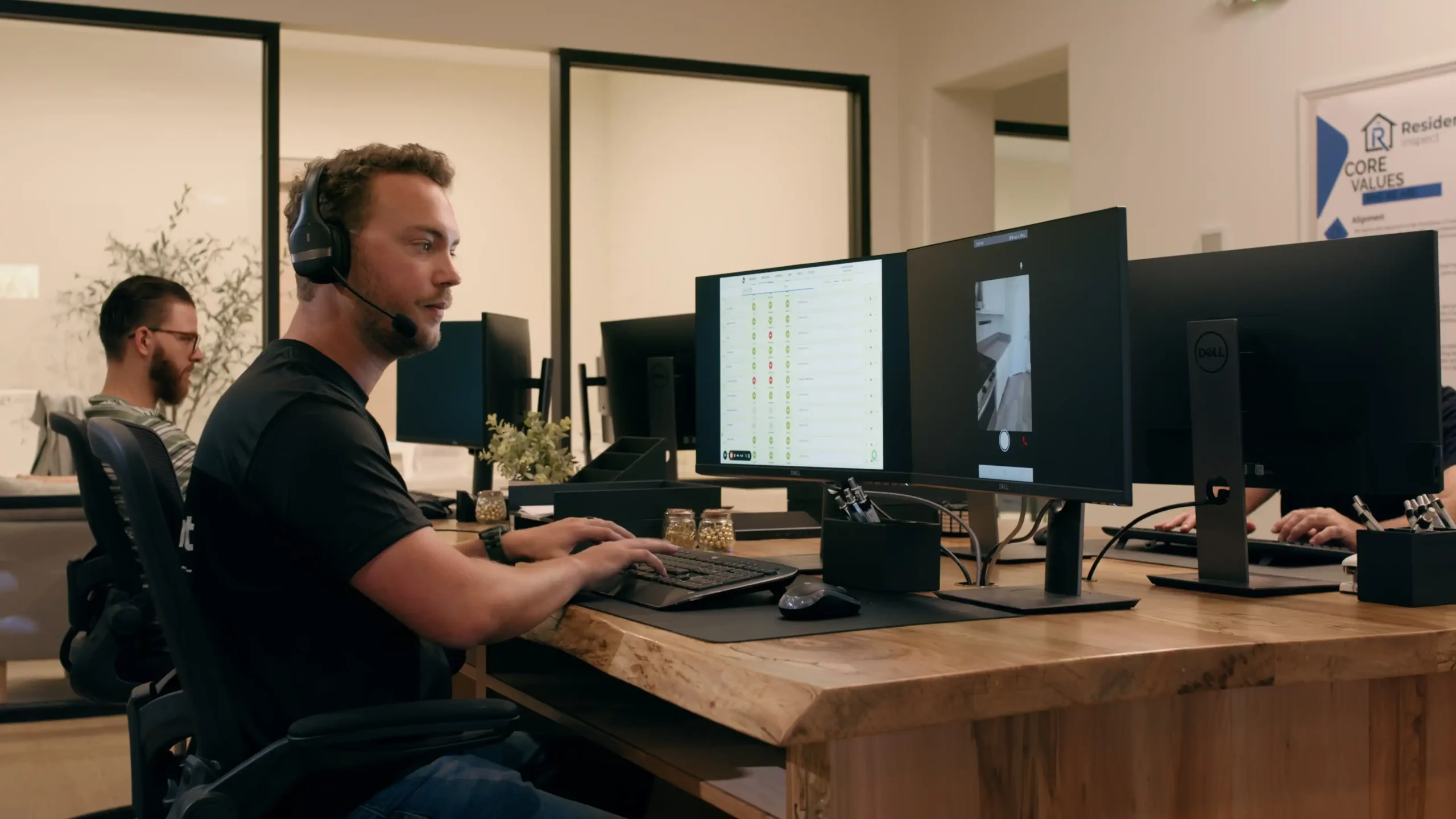[**Save Time. Reduce Risk. Stay Compliant.** ](https://residentinspect.com/)
Skipping an inspection or missing details **can cost you thousands**. Why risk it?
## **Common Concerns About Virtual Inspections**
Change is hard. No one likes stepping away from “the way things have always been done.” But in property management, **clinging to outdated processes costs time, money, and a lot of unnecessary stress**.
Despite the clear benefits of virtual inspections, some property managers hesitate. Let’s break down the most common objections.
### ****Concern #1: “Virtual inspections aren’t as thorough as in-person ones.”****
Some worry that **if no one is physically inside the unit**, things will get missed. Surprisingly, **virtual inspections are often more thorough and consistent than in-person ones.**
**A Standardized Process Means No Missed Steps** – Every Resident Inspect inspection follows the **same structured process**, ensuring that key areas aren’t skipped. **Traditional inspections?** They’re as good as the person doing them. If they’re distracted, rushed, or forgetful, **things get overlooked**.
**Less Tenant Interference** – In-person inspections can be **awkward**. Tenants make small talk, steer conversations away from problem areas, or subtly position themselves to block the view of damage. **Virtual inspections remove these distractions –** inspectors stay on track, ensuring nothing is ignored.
**Video Documentation** – Instead of handwritten notes and hurried photos, **everything is recorded in real-time**. If something looks questionable, **it’s documented instantly**, leaving no room for uncertainty later.
**Bottom line:** **Virtual inspections aren’t just *as good* as in-person ones – they’re often better because they remove human error.**
### ******Concern #2: “What if the tenant hides something?”******
This is a valid concern – but one that applies **just as much to in-person inspections**. If a tenant **wants** to hide damage, they’ll do it whether someone is physically there or not.
But virtual inspections actually **make it harder** for tenants to pull this off.
**Guided Inspections Means No “Accidental” Omissions** – Our inspectors **direct** the tenant exactly where to go and what to show. There’s no casually avoiding the mold spot behind the fridge.
**Consistency vs. Trusting the Tenant’s Lead** – With traditional inspections, the tenant **naturally controls the flow –** leading an inspector where they want them to go first, filling time with chit-chat, and subtly **steering attention away from problem areas**. A **structured virtual process prevents this –** they go where we tell them.
**Field Inspections Aren’t a Magic Wand** – Even in-person inspections **rely on visibility**. If damage is hidden under furniture, behind doors, or stashed in a closet, **a field inspector won’t find it either**. **Virtual inspections don’t create a new problem – they just don’t pretend this problem doesn’t exist.**
**Bottom line:** **If a tenant is going to hide damage, they’ll do it no matter what. Virtual inspections actually make it harder – not easier – to manipulate the process.**
### ********Concern #3: “I just don’t like change.”********
This is the real one, isn’t it? For some, the hesitation **isn’t about logistics –** it’s about **comfort**. Change feels risky. But every major industry shift – from online rent payments to cloud-based management software – was once “new” too.
**Remember When Online Rent Payments Were “Too Risky”?** – Now, 75% of renters **expect** the option to pay online [(National Multifamily Housing Council)](https://www.nmhc.org/). The companies that adapted early got ahead.
**Property Management Is Moving Digital – Like It or Not** – The industry is already shifting to **automated communication, digital leasing, and AI-driven maintenance requests**. Virtual inspections **are part of this natural evolution**.
**The Companies That Adapt Always Come Out Ahead** – The best property managers **don’t resist change – they use it to gain an edge**. Those who switched to online tenant applications, automated lease renewals, and AI-driven maintenance tracking **are now running more efficient, scalable businesses**.
**Bottom line:** **Virtual inspections are where the industry is heading. Getting ahead of the curve now puts you in a stronger position for the future.**
### **Still Unsure? Try It for Free.**
We get it – change takes time. That’s why Resident Inspect offers **5 free inspections**, so you can see the process in action **with zero commitment**.
You have nothing to lose – and **a more efficient, cost-saving system to gain**.
[Claim Your Free Inspections](https://residentinspect.com/free-inspection/form/)
## ****Why Resident Inspect Leads the Future of Rental Inspections****?
Virtual inspections are the logical next step for modern property management. The industry is moving towards digital solutions, and those who adapt will reap the benefits – lower costs, fewer headaches, and a better experience for both property managers and tenants.
Resident Inspect is here to make your inspections effortless. If you’re still spending hours on in-person visits, wasting money on travel, or dealing with tenant no-shows, now is the time to try something different.
As AI, predictive maintenance, and smart home data continue reshaping what’s possible in rental inspections, live guided video remains the reliable foundation all of it builds on, and Resident Inspect is built around that foundation today.
## Frequently Asked Questions
1. **Are virtual rental inspections as accurate as in person ones?** Yes. Every Resident Inspect inspection follows a live, guided video process with a trained inspector directing the tenant, so nothing gets skipped. Unlike self guided apps, the tenant isn’t in control of what gets shown, which removes the inconsistency that comes with in person visits.
2. **Do virtual rental inspections hold up for compliance and legal disputes?**
Yes. Each inspection is time stamped, geo located, and video recorded, creating a clear record of the property’s condition on a specific date. If a tenant claims an issue was never reported, there’s video proof of exactly what was covered during the inspection.
3. **Are virtual inspections less thorough than in person inspections?**
No, they’re often more thorough. A standardized process means no steps get missed regardless of who’s conducting the inspection, and tenants can’t steer the inspector away from problem areas the way they sometimes can in person.
4. **What if a tenant tries to hide damage during a virtual inspection?**
It’s harder to do than in person. The inspector directs the tenant exactly where to go and what to show, so there’s no casually skipping a damaged area. In person inspections face the same risk since anything hidden under furniture or behind doors goes unnoticed either way.
5. **How much can a property management company save by switching to virtual inspections?**
For a company handling 300 doors with two inspections a year, switching from in house or third party inspections to virtual can save between $20,000 and $33,000 annually, based on Resident Inspect’s 2026 pricing.
6. **Do tenants actually prefer virtual inspections?**
Yes. Ninety seven percent of tenants say they prefer virtual inspections over in person ones, with an average rating of 4.85 out of 5 for the process.
**Ready to Stop Wasting Time on Inspections?**
Resident Inspect is offering **5 free inspections –** no commitment, no strings attached.
See how much time and money you can save. **Book your free trial today.**
[Get My Free Inspections](https://residentinspect.com/free-inspection/form/)

Aaron Cooper Founder & CEO
After more than 20 years as a landlord and property management company owner-operator, Aaron Cooper built Resident Inspect to solve a problem he experienced firsthand: the inspection process was broken, expensive, and impossible to scale. Resident Inspect is the result — a live virtual inspection service that replaces in-person inspections with a faster, more consistent, and more defensible process. [See Full Bio](https://residentinspect.com/about-us/aaron-cooper/)
[Facebook](https://www.facebook.com/residentinspect/) [Instagram](https://www.instagram.com/residentinspect/) [TikTok](https://www.tiktok.com/@residentinspectofficial) [Pinterest](https://www.pinterest.com/aaron2762/) [YouTube](https://www.youtube.com/@ResidentInspect) [LinkedIn](https://www.linkedin.com/in/resident-inspect-a00b7a376/)
**Categories:** Blog
---
### [The Section 8 (HUD NSPIRE) Inspection Checklist for Landlords in 2026](https://residentinspect.com/blog/section-8-hud-nspire-inspection-checklist/)
**Published:** June 18, 2026
**Author:** Aaron Cooper
**Excerpt:** The 2026 Section 8 (HUD NSPIRE) inspection checklist for landlords: inspectable areas, deficiency categories, fix-it timelines, and how to prep and pass.
**Content:**
 Aaron Cooper
Founder & Chief Executive Officer, Resident Inspect
📍 Jacksonville, FL
Aaron Cooper is a seasoned property technology entrepreneur and inspection industry expert. As the **Founder and CEO of Resident Inspect**, he leads the development of intelligent inspection platforms that empower landlords, property managers, and investors to streamline digital inspections and ensure compliance.
🌐 [residentinspect.com](https://residentinspect.com)
✉️ <aaron@residentinspect.com>
---
📝 General information, not legal advice
This guide is general information for landlords and is **current as of July 2026**. [HUD’s NSPIRE program](https://www.hud.gov/reac/nspire) and your local public housing agency’s (PHA) procedures can change. Always confirm the current standard, timelines, and forms with HUD and your PHA before an inspection.
If you rent to a Housing Choice Voucher (Section 8) tenant, your unit has to pass a HUD physical inspection — and the rules behind that inspection have changed. HUD has moved from the decades-old Housing Quality Standards (HQS) to a newer model called **NSPIRE** — the National Standards for the Physical Inspection of Real Estate. That means a lot of the “Section 8 checklist” content floating around online is out of date.
This guide walks through what NSPIRE actually inspects, how it scores problems, the timelines you will be held to, and a practical pre-inspection checklist you can run before the inspector arrives.
In this article
- [What changed: from HQS to NSPIRE](#what-changed-from-hqs-to-nspire)
- [The NSPIRE inspectable areas](#the-nspire-inspectable-areas)
- [How NSPIRE scores problems: the four deficiency categories](#how-nspire-scores-problems)
- [The pre-inspection checklist for landlords](#the-pre-inspection-checklist)
- [Life-safety (do these first)](#life-safety)
- [Electrical and mechanical](#electrical-and-mechanical)
- [Plumbing and water](#plumbing-and-water)
- [Interior condition](#interior-condition)
- [Exterior and common areas](#exterior-and-common-areas)
- [Documenting the unit before and after](#documenting-the-unit)
- [What happens if the unit fails](#what-happens-if-the-unit-fails)
- [Bottom line](#bottom-line)
## What changed: from HQS to NSPIRE
For years, HUD used HQS for voucher units and UPCS for larger HUD-assisted properties. NSPIRE consolidates those into a single standard. HUD issued the final NSPIRE rule in May 2023, and NSPIRE became the standard for most HUD programs as of October 1, 2023. You can review the program details on [HUD’s NSPIRE program page](https://www.hud.gov/reac/nspire), the list of [NSPIRE inspectable areas](https://www.hud.gov/reac/nspire-inspectable-areas), and [the full NSPIRE standards](https://www.hud.gov/reac/nspire-standards).
For the voucher programs specifically — Housing Choice Voucher (HCV), Project-Based Voucher, and Moderate Rehabilitation — HUD gave public housing agencies extra time to transition. As of this writing, compliance for those programs is extended **through January 31, 2027**, so some PHAs are already inspecting under NSPIRE while others are mid-transition.
💡 The single most useful step
Call your local PHA and ask one question: “Are you inspecting voucher units under NSPIRE or HQS right now?” The answer tells you exactly which checklist to prep against.
The practical takeaway: NSPIRE cares less about a rigid pass/fail list and more about **how a condition affects the people living there**. A problem inside the unit, where residents spend their time, is weighted more heavily than the same problem in a rarely used outdoor area.
## The NSPIRE inspectable areas
NSPIRE organizes everything into three inspectable areas. For a single voucher unit, the first one matters most, but it helps to understand all three.
- **Unit** — the interior of the individual dwelling: ceilings, walls, floors, doors and windows, the kitchen and bathroom, electrical outlets and switches, HVAC, lighting, and life-safety devices like smoke and carbon monoxide alarms.
- **Inside** — shared interior spaces and building systems: hallways, stairwells, laundry and utility rooms, mechanical rooms, and attached garages.
- **Outside** — the building exterior and site: roofing, siding, walkways, stairs, railings, lighting, and grounds.
A standout feature of NSPIRE is its emphasis on the unit interior. Historically, some inspections were criticized for over-weighting exterior and curb-appeal items. NSPIRE deliberately pushes attention to where residents actually live. If you also manage market-rate units, compare this with [what apartment inspections look for](https://residentinspect.com/blog/what-do-apartment-inspections-look-for/) during routine and city checks.
## How NSPIRE scores problems: the four deficiency categories
Instead of one yes/no result, NSPIRE classifies each finding by severity:
- **Life-Threatening** — an immediate danger (for example, exposed live electrical wiring, gas leaks, or a missing/non-working smoke or CO alarm). Generally must be corrected within **24 hours**.
- **Severe** — a serious hazard that also generally carries a **24-hour** correction window.
- **Moderate** — a real deficiency that affects function or condition, with a longer correction window set by HUD/your PHA.
- **Low** — a minor issue with the longest correction timeframe.
⚠ The 24-hour items will sink you
Life-Threatening and Severe findings carry the tightest deadlines and the biggest consequences. The good news is that most are cheap, fast fixes — test every smoke and CO alarm, confirm GFCI outlets trip and reset, and clear any blocked exit. Catch these before the inspector does.
## The pre-inspection checklist for landlords
Run this walkthrough a few days before your scheduled inspection. It mirrors the conditions NSPIRE inspectors look at most closely inside a unit.
### Life-safety (do these first)
- Working smoke alarms in required locations; replace batteries and test each one
- Working carbon monoxide alarms where required (units with fuel-burning appliances or attached garages)
- GFCI protection near kitchen and bathroom water sources — press test/reset
- Clear, operable egress (windows and doors that open and let someone out)
- Fire extinguisher present and charged if required by your PHA
### Electrical and mechanical
- All outlet and switch cover plates present and intact
- No exposed wiring, no overloaded or improvised connections
- HVAC produces heat and cooling; filters clean
- Water heater properly vented with a working temperature/pressure relief valve
### Plumbing and water
- No active leaks under sinks, around toilets, or at water heaters
- Hot and cold water at every fixture; adequate water pressure
- No signs of water damage, mold, or persistent moisture
### Interior condition
- Doors and windows open, close, and lock properly
- No tripping hazards, damaged flooring, or large holes in walls/ceilings
- Kitchen appliances present and operable; range/oven works
- No evidence of pests or infestation
### Exterior and common areas
- Secure handrails and guardrails on stairs and elevated areas
- No damaged walkways or steps; adequate exterior lighting
- Roof, gutters, and siding in sound condition
For a deeper, room-by-room walkthrough you can reuse on any unit, pair this with our general [rental property inspection checklist](https://residentinspect.com/blog/rental-property-inspection-checklist/). Between voucher inspections, our [seasonal rental property maintenance inspection checklist](https://residentinspect.com/blog/rental-property-inspection-checklist/) helps you catch HVAC, roof, and plumbing issues before they become deficiencies.
## Documenting the unit before and after
Whether the inspector passes or fails the unit, you want a dated record of its real condition — it protects you in disputes and speeds up re-inspections. Photograph life-safety devices, every room, and any area you repaired, and keep the timestamps.
This is also where a documented inspection routine pays for itself between tenants. Catching a worn-out alarm or a slow leak during a routine check means it is fixed long before HUD ever shows up. A standing [periodic rental inspection service](https://residentinspect.com/periodic-rental-inspection-service/) turns “scramble before the inspector” into “already handled.”
## What happens if the unit fails
A failed NSPIRE inspection does not end the tenancy. You will receive a list of deficiencies with correction deadlines tied to their severity. Fix the items, document the repairs, and schedule the re-inspection. Life-Threatening and Severe items move on a 24-hour clock, so address those immediately and notify your PHA when they are resolved.
Habitual or unaddressed failures can affect your Housing Assistance Payments, so treat the correction window seriously and keep your proof of repair.
🚀 Make every inspection a non-event
Resident Inspect helps landlords document unit condition and run consistent, repeatable inspections so NSPIRE day is just another walkthrough. Explore our [rental property inspections](https://residentinspect.com/rental-property-inspections/) to see how documented, photo-backed reports keep you inspection-ready year-round.
## Bottom line
NSPIRE is a real shift from the old HQS checklist, but the fundamentals are landlord-friendly: keep life-safety devices working, fix leaks and electrical issues, maintain the unit interior, and document everything. Confirm with your PHA which standard they are using today, run the checklist above before the inspector arrives, and most units pass on the first try.
## Frequently Asked Questions
What is NSPIRE and how is it different from HQS?
NSPIRE (National Standards for the Physical Inspection of Real Estate) is HUD’s unified inspection model that replaced the older Housing Quality Standards (HQS) and Uniform Physical Condition Standards (UPCS). It scores conditions by how they affect resident **health and safety** rather than running through a single pass/fail list, and it leans heavily on inspecting the inside of the unit where residents spend their time.
When does NSPIRE apply to Section 8 / Housing Choice Voucher units?
NSPIRE became HUD’s standard for most programs as of October 1, 2023. For the Housing Choice Voucher, Project-Based Voucher, and Moderate Rehabilitation programs, HUD allowed public housing agencies (PHAs) extra time to transition, with compliance extended through **January 31, 2027**. Many PHAs are already inspecting under NSPIRE, so confirm the current standard with your local housing authority.
What are the NSPIRE deficiency categories?
NSPIRE classifies findings as **Life-Threatening, Severe, Moderate, or Low**. Life-Threatening and Severe deficiencies generally must be corrected within 24 hours, while Moderate and Low items have longer correction windows defined by HUD and your PHA.
What are the most common reasons a Section 8 unit fails inspection?
Frequent fails include missing or non-working smoke and carbon monoxide alarms, missing GFCI protection near water, blocked or non-operable egress windows, leaks and water damage, broken or missing outlet/switch covers, and infestation. Most are inexpensive to fix before the inspector arrives.
How often does a Section 8 unit get inspected?
Voucher units are typically inspected before a tenant moves in (initial inspection), then on a recurring cycle (often annually or biennially, depending on the PHA), plus any complaint-based or special inspections. Your local PHA sets the exact schedule.
## See Virtual Inspections in Action
Get a personalized demo to discover how virtual inspections can save time, cut labor hours, and boost property management efficiency.
[Get Your Demo](https://residentinspect.com/book-a-demo/)Prefer to talk? [Contact our team](https://residentinspect.com/contact-us/).

Aaron Cooper Founder & CEO
After more than 20 years as a landlord and property management company owner-operator, Aaron Cooper built Resident Inspect to solve a problem he experienced firsthand: the inspection process was broken, expensive, and impossible to scale. Resident Inspect is the result — a live virtual inspection service that replaces in-person inspections with a faster, more consistent, and more defensible process. [See Full Bio](https://residentinspect.com/about-us/aaron-cooper/)
[Facebook](https://www.facebook.com/residentinspect/) [Instagram](https://www.instagram.com/residentinspect/) [TikTok](https://www.tiktok.com/@residentinspectofficial) [Pinterest](https://www.pinterest.com/aaron2762/) [YouTube](https://www.youtube.com/@ResidentInspect) [LinkedIn](https://www.linkedin.com/in/resident-inspect-a00b7a376/)
**Categories:** Blog, Landlord Resources
---
### [How to Scale Property Inspections Without Hiring More Staff (2026 Guide)](https://residentinspect.com/blog/scale-property-inspections-without-hiring/)
**Published:** May 19, 2026
**Author:** Aaron Cooper
**Content:**
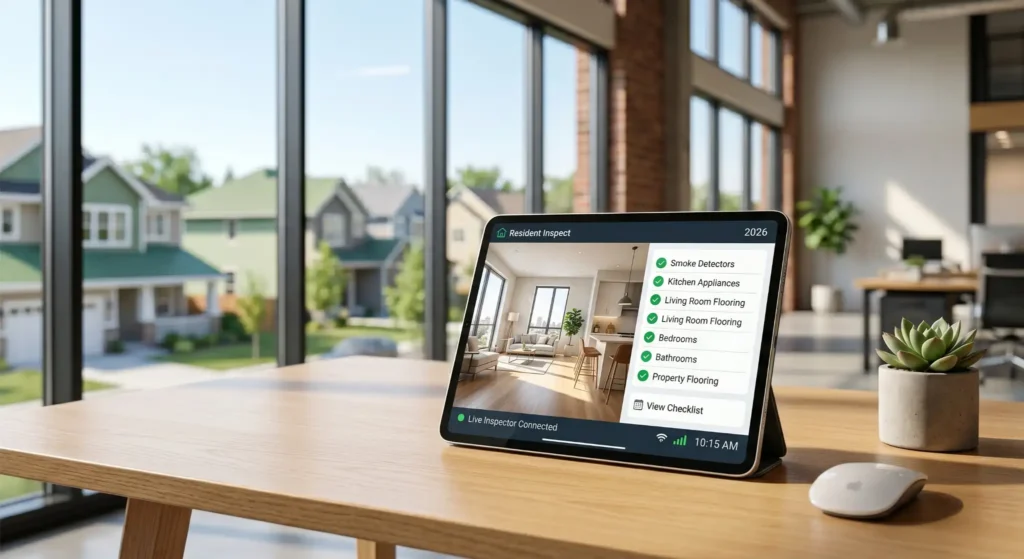
Aaron Cooper
Founder & Chief Executive Officer, Resident Inspect
📍 Jacksonville, FL
Aaron Cooper is a seasoned property technology entrepreneur and inspection industry expert. As the **Founder and CEO of Resident Inspect**, he leads the development of intelligent inspection platforms that empower landlords, property managers, and investors to streamline digital inspections and ensure compliance.
🌐 [residentinspect.com](https://residentinspect.com)
✉️ <aaron@residentinspect.com>
---
## **Snapshot**
Inspections don’t have to be the ceiling that limits how far your property management company can grow. They become the ceiling when the inspection model doesn’t scale, when adding properties means adding proportional inspection hours in a linear relationship that has no leverage.
Breaking that relationship takes four changes: building a systemized process that can be run consistently without depending on any individual, delegating inspection execution off the primary property manager’s plate, automating the trigger, scheduling, and reporting workflow so inspections run without manual intervention at each step, and shifting periodic inspections from in-person to virtual so the format itself doesn’t impose a geographic and time constraint that grows with your portfolio.
The property management companies [growing efficiently past 150, 200, and 300 doors](https://www.secondnature.com/blog/four-keys-to-successfully-scaling-a-property-management-company) are not doing it by working harder or hiring faster. They’re doing it by building inspection operations that scale, and putting that infrastructure in place before they desperately need it.
Table of Contents
1. [How to Scale Property Inspections Without Hiring More Staff](#how-to-scale)
2. [Why Inspections Don’t Scale Under the Traditional Model](#why-inspections-dont-scale)
3. [The Scaling Framework: Four Levers](#scaling-framework)
- [Lever 1: Systemization](#lever-1-systemization)
- [Lever 2: Delegation](#lever-2-delegation)
- [Lever 3: Automation](#lever-3-automation)
- [Lever 4: Format Shift to Virtual](#lever-4-format-shift)
4. [What the Scaled Inspection System Looks Like in Practice](#scaled-system-in-practice)
5. [Implementation Sequence: How to Get There](#implementation-sequence)
6. [Common Objections and Honest Answers](#common-objections)
7. [Frequently Asked Questions](#faqs)
## **How to Scale Property Inspections Without Hiring More Staff**
At some point in the growth of every property management company, inspections become the constraint.
Not leasing. Not maintenance coordination. Not accounting. Inspections, the periodic walkthroughs that need to happen on schedule across every property in the portfolio, become the operational ceiling that slows everything else down.
It usually surfaces around [75 to 100 properties](https://www.buildium.com/resource/2026-property-management-industry-report/). The property manager who was handling everything starts running out of hours. Inspection schedules slip. Reports get filed late or incompletely. No-shows pile up. The periodic inspection program that was running fine at 40 doors is visibly struggling at 90, and there are another 30 in the pipeline.
The instinctive response is to hire. Add a staff member dedicated to inspections. Or promote someone internally and pull them off other work. Either way, headcount goes up, overhead goes up, and the margin on those additional doors shrinks before they’ve made any profit. That is why many growing teams look at [property management outsourcing](https://residentinspect.com/property-management-outsourcing/) before they add another hire.
There is a better path. To scale property inspections in property management without scaling headcount, you have to rethink how inspections are structured, systemized, and delivered. Not just add more people to a broken process. This guide covers exactly how to do that.
---
## **Why Inspections Don’t Scale Under the Traditional Model**
The traditional in-house inspection model has a basic scalability problem: it is almost entirely time-linear. Every additional inspection requires a roughly proportional additional investment of staff time. Double the portfolio and you roughly double the inspection hours required. There is no leverage, no efficiency gain at volume, and no way to grow the portfolio without growing the inspection workload at about the same rate.
Here is what makes the traditional model so resistant to scaling:
Each inspection requires a dedicated travel block. In a 50-property portfolio concentrated in a single market, a property manager might cluster 4 to 5 inspections in a day and keep the travel time manageable. At 150 properties spread across a wider geography, clustering gets harder, drive times between properties go up, and the number of inspections per day actually drops as the portfolio grows. The math works against you.
Scheduling is a labor-intensive process that doesn’t compress at volume. Coordinating 20 inspection appointments a month takes a lot less than half the time of coordinating 200. The back-and-forth with tenants, the rescheduling, the reminder calls, each one takes roughly the same amount of time regardless of how many others are happening at the same time. Scheduling overhead scales linearly with volume.
Report quality drops under volume pressure. A property manager inspecting 3 properties in a day produces better reports than one inspecting 7. Physical exhaustion, time pressure, and the mental load of remembering details across multiple properties all hurt documentation quality. The [documentation that matters most](https://residentinspect.com/blog/documenting-rental-property-condition/), the inspection records that protect you in a security deposit dispute, gets worse exactly as the portfolio grows and the stakes go up.
The model has no leverage points. Unlike leasing, where technology and process improvements can dramatically expand output per staff member, the traditional in-house inspection model offers no natural leverage. You can clean up scheduling, improve reporting tools, and tighten the communication process. But at the end of the day, someone still has to drive to every property.
---
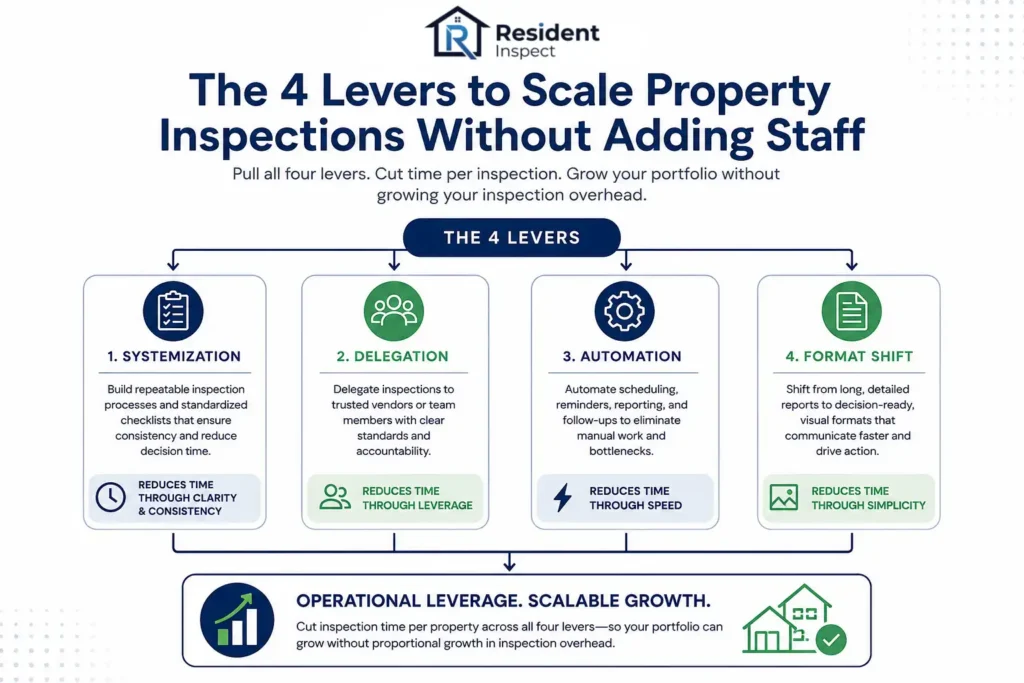
## **The Scaling Framework: Four Levers**
To scale property inspections without adding staff, you have to pull four specific levers, not just one. Property managers who try to solve the scaling problem by pulling only one lever (usually technology) find that the other constraints reassert themselves quickly.
The four levers are: systemization, delegation, automation, and format shift. Each one cuts the time cost of inspections per property. Together they create the operational leverage that lets a portfolio grow without proportional growth in inspection overhead.
---
### **Lever 1: Systemization — Build the Process Once, Run It Everywhere**
The first scaling problem most growing property management companies face is not volume. It is inconsistency. Every inspection happens slightly differently. Different checklists, different photo standards, different report formats, different notice procedures. What works when one person manages the whole process falls apart when a second person gets involved, because the process was never documented. It lived in the original person’s head.
Systemization means building the inspection process into a documented, repeatable standard that anyone can follow and that produces the same results regardless of who runs it.
The components of a systemized property management inspection system:
A standardized inspection checklist. One checklist for periodic inspections. One for move-in. One for move-out. Not “a checklist we use most of the time.” The checklist. Documented, formatted, and used the same way across every property in the portfolio. The checklist is what makes sure an inspector covering for a sick colleague produces the same documentation standard as the inspector who normally handles that area.
A defined photo protocol. How many photos per room. What angles. What specific items need close-up documentation. What pre-existing conditions need extra photos. This doesn’t have to be a 20-page manual. A one-page photo standard with examples is enough. But it needs to exist and be followed.
A standardized notice procedure. What channel. What timing. What language. What the reminder sequence looks like. Not a general policy that each property manager reads differently. A specific, documented sequence that produces the same tenant communication experience on every property.
A defined report format. What the inspection report looks like. How conditions are described. What categories are used. How photos are attached and labeled. A report format that stays consistent across every inspection makes the comparison between move-in and move-out reports easy and makes any dispute documentation clean.
Once these four components are documented, the process can be run by anyone trained on it. That includes inspection-specific staff, third-party contractors, or a [virtual inspection service](https://residentinspect.com/our-virtual-inspection-software/). Without documentation, you are not scaling a system. You are cloning a person, which is slower, more expensive, and less reliable.
---
### **Lever 2: Delegation — Move Inspections Off the Property Manager’s Plate**
In most property management companies below 75 to 100 properties, the property manager runs inspections. They know the properties, they know the tenants, and it’s simply faster to do it themselves than to explain the process to someone else.
This changes at scale. A property manager running their own inspections at 150 properties is burning 25 to 35 percent of their total working hours on inspection logistics and execution alone. That is capacity that could be generating new management agreements, building owner relationships, and handling the leasing and maintenance functions that actually grow the business.
Delegation, moving inspections off the primary property manager’s plate, is the second lever. It has two forms:
Internal delegation means training a junior staff member, an administrative coordinator, or a dedicated inspection specialist to run and document inspections under the standardized system. This adds cost (the staff member’s time) but frees the property manager for higher-leverage work. The key is that the systemization from Lever 1 has to come first. You cannot effectively delegate a process that isn’t documented.
External delegation means [outsourcing property inspections](https://betterwho.com/blog/5-ways-to-scale-property-management-business-efficiently/) to a third-party service. That can be a [traditional in-person inspection](https://residentinspect.com/blog/virtual-inspections-vs-tenant-self-inspections/) company or, more efficiently, a virtual inspection service. External delegation removes the inspection execution from your payroll entirely. You pay per inspection rather than carrying fixed labor cost. You get consistent, professional documentation without using any staff time beyond submitting the inspection request and reviewing the report.
External delegation to a virtual inspection service is the highest-leverage form of delegation available to growing property management companies. The inspection execution, tenant scheduling, communication, and reporting all move off your plate. Your team reviews completed reports. That is the entire interaction.
---
### **Lever 3: Automation – Eliminate the Manual Touchpoints**
In a traditional inspection program, every individual inspection involves multiple manual touchpoints. Identifying that an inspection is due. Scheduling the tenant. Sending the notice. Following up on non-responses. Confirming the appointment. Completing the inspection. Entering the report. Following up on any items identified.
At 50 properties, this is manageable. At 150, the manual coordination overhead is a serious time drain. At 300, it is unsustainable without dedicated staff.
Automation cuts out or dramatically reduces the manual touchpoints by connecting your property management software to an inspection workflow that triggers, schedules, reminds, and follows up without needing staff intervention at each step. If you are still picking a platform, our [property management software guide](https://residentinspect.com/blog/guide-to-property-management-softwares/) compares the top options.
The inspection automation stack for a scaling property management company looks like this:
Inspection triggers in your PMS. Most major property management platforms (AppFolio, Propertyware, [Buildium](https://www.clearleaddigital.com/blog/buildium-review), Rentvine, Rent Manager) can pull a report of properties due for inspection based on the last inspection date. Some can automatically flag properties approaching the inspection interval. This trigger removes the manual process of figuring out which properties need inspections. The system tells you.
Automated inspection requests. When a property is flagged for inspection, the request should flow automatically to the inspection service or the inspection scheduler. It shouldn’t sit in a queue waiting for a property manager to manually start it. This is doable through PMS integrations with inspection services or through [workflow automation tools like LeadSimple ](https://www.propertymanagementconsulting.com/learning-center/how-to-scale-a-property-management-business-in-2025)that connect the trigger to the action.
Automated tenant communication. The scheduling process (initial contact, scheduling options, confirmation, reminders) should run without staff involvement. A virtual inspection service that handles all tenant scheduling removes this entirely. An internal process can be partially automated through your PMS communication tools or a third-party communication platform.
Automated report delivery. When an inspection is complete, the report should land directly in the property manager’s queue. Not emailed to an inbox that someone manually processes and files. Integration between the inspection service and the PMS keeps inspection records in the tenant file where they belong.
The automation goal is to cut the staff touchpoints per inspection from 6 to 8 manual steps down to 1 to 2: submit the request and review the completed report. Everything in between (scheduling, reminders, execution, documentation, delivery) runs without staff intervention.
This is doable today with the right combination of property management software, inspection service, and workflow tools. It is not a future state. It is how the most efficiently run property management companies are operating right now.
Get our [Rental Inspection Checklist](https://residentinspect.com/blog/rental-property-inspection-checklist/).
### **Lever 4: Format Shift – Replace In-Person with Virtual for Periodic Inspections**
The three levers above (systemization, delegation, automation) make inspections more efficient regardless of format. But they still operate inside the constraint of the in-person inspection model for periodic walkthroughs. The fourth lever removes that constraint entirely.
Shifting periodic inspections from in-person to virtual is the single highest-impact change available to a growing property management company. The mechanics of why this matters for property inspection efficiency are specific:
Virtual inspections have no geographic constraint. An in-person inspection in a property 45 minutes away burns 90 minutes of travel time plus the inspection itself. A virtual inspection in a property 45 minutes away takes the same 25 minutes as one across the street. As your portfolio spreads geographically (which it does as you grow) the travel constraint compounds. Virtual inspections make geography irrelevant.
Virtual inspections kill the scheduling window problem. In-person inspections require a property manager’s calendar to be blocked for travel, the inspection, and return. Virtual inspections require the inspector’s time, not the property manager’s. Multiple virtual inspections can run at the same time across different inspectors without any coordination overhead on the property management side.
Virtual inspections scale without headcount. An in-person inspection program scales by adding inspectors, each of whom can physically be in one place at a time. A virtual inspection service scales by routing additional inspection volume through existing inspector capacity. The service absorbs growth without forcing you to hire proportionally.
Virtual inspections kill the no-show rescheduling cycle. As covered in our post on [reducing inspection no-shows](https://residentinspect.com/blog/inspection-no-shows/), virtual inspections produce dramatically higher tenant cooperation rates because scheduling is tenant-friendly and the format is less intrusive. Fewer no-shows mean fewer rescheduling cycles, fewer wasted blocks, and a cleaner inspection calendar.
For a property management company at 100 properties thinking about how to handle growth to 200, the format shift from in-person to virtual for periodic inspections is the decision that changes the trajectory of how inspection overhead scales with portfolio size. At 100 properties with in-person periodic inspections, you’re already feeling the constraint. At 200 properties with virtual periodic inspections and the automation infrastructure described above, you’re running more inspections with roughly the same staff time per inspection as you had at 50 properties.
## **What the Scaled Inspection System Looks Like in Practice**
Pulling all four levers produces an inspection operation that looks fundamentally different from the traditional model. Here is what it looks like for a property management company managing 200 properties:
Inspection triggers: The PMS generates a weekly report of properties approaching their 6-month inspection interval. This report flows automatically to the inspection service queue.
The virtual inspection service receives the request and contacts the tenant directly to schedule the appointment. The property manager is not involved in the scheduling process.
The service sends reminders to the tenant at 7 days, 3 days, 1 day, and the morning of the inspection. No-show rates run below 5 percent.
The inspection is done by a trained inspector via live video call with the tenant. The inspector follows the standardized checklist and photo protocol. The property manager is not involved in the inspection execution.
The completed branded report (with timestamped photos and condition notes) gets delivered to the property manager’s queue within 24 hours. The property manager reviews it in 10 to 15 minutes, flags any action items for the maintenance or leasing team, and files it in the tenant record.
Total property manager time per inspection: 10 to 15 minutes. Total inspection time from trigger to report: 5 to 10 business days. Total inspections completed per month at 200 properties with semi-annual frequency: about 33. Total monthly property manager time for 33 inspections: about 6 to 8 hours, roughly one day per month.
Compare this to the traditional in-house model at 200 properties: 33 inspections per month at 2 to 3 hours per inspection equals 66 to 99 hours per month, two and a half full working weeks, in inspection logistics, travel, execution, and reporting. For a team of two or three property managers, this is a serious operational burden. For a solo operator or small team, it is a ceiling that blocks growth.
The scaled model doesn’t just cut inspection time. It removes inspections as the constraint on growth. With 10 to 15 minutes of property manager involvement per inspection, adding another 50 properties to the portfolio adds roughly 1 to 2 additional hours of monthly inspection-related work. Growth becomes operationally viable in a way it simply isn’t under the traditional model.
---
## **Implementation Sequence: How to Get There**
| Step | Action | What It Does |
|---|---|---|
| 1 | Document your current process | Reveals the time-eating steps and inconsistencies you need to fix. You can’t systemize what you haven’t observed. |
| 2 | Build the standard documents | Create your inspection checklists, photo protocol, notice templates, and report format. Takes 2 to 4 hours and forms the foundation. |
| 3 | Roll out the periodic inspection [lease addendum](https://residentinspect.com/blog/rental-property-inspection-laws-by-state/) | Add to all new leases and renewals. Sets inspection frequency, notice procedure, and acceptance of virtual inspections. |
| 4 | Pilot virtual inspections on 10 to 15 properties | Get comfortable with the report format, scheduling process, and tenant response before full rollout. |
| 5 | Integrate with your PMS | Connect inspection requests and report delivery to your software. Resident Inspect integrates with AppFolio, Propertyware, Buildium, Rentvine, and Rent Manager. |
| 6 | Convert all periodic inspections to virtual | Switch the full periodic calendar to virtual. Keep in-person for move-in, move-out, and situations needing physical presence. |
| 7 | Build the automation triggers | Automate so properties approaching their inspection interval generate a request without manual identification. Inspections become a background process. |
Making the switch from a traditional inspection model to a scaled virtual system doesn’t require doing everything at once. The sequence that works for most property management companies:
**Step 1:** Document your current process. Before changing anything, write down what you’re actually doing, from how you spot properties due for inspection through how you file the completed report. This documentation reveals the specific steps that are eating up time and creating inconsistency. You cannot systemize what you haven’t observed.
**Step 2:** Build the standard documents. Create your standardized inspection checklists, photo protocol, notice templates, and report format. These don’t have to be elaborate. They have to be written down, internally consistent, and actually used. This step usually takes 2 to 4 hours and produces the foundation everything else builds on.
**Step 3:** Roll out the periodic inspection [lease addendum](https://residentinspect.com/blog/rental-property-inspection-laws-by-state/). For all new leases and upcoming renewals, add the periodic inspection addendum that establishes the inspection frequency, notice procedure, and acceptance of virtual inspections. This kicks in gradually as new leases get signed, but it sets the expectation for the tenants who will be part of your scaled inspection program.
**Step 4:** Pilot virtual inspections on 10 to 15 properties. Before flipping the entire periodic inspection calendar, run a pilot with a defined subset of properties. This lets you get comfortable with the report format, the scheduling process, and how tenants respond to the virtual format before rolling it out at scale.
**Step 5:** Integrate with your PMS. Work with your virtual inspection service to connect the inspection request and report delivery workflow to your property management software. Resident Inspect integrates directly with AppFolio, Propertyware, Buildium, Rentvine, and Rent Manager. Getting this integration in place before full rollout makes sure the automation infrastructure is working when volume picks up.
**Step 6:** Convert all periodic inspections to virtual. Once the pilot shows the quality and efficiency of the virtual format, convert the full periodic inspection calendar. Keep in-person visits for move-in, move-out, and any situation that needs physical presence.
**Step 7:** Build the automation triggers. Work with your PMS and workflow tools to automate the inspection trigger, so properties approaching their inspection interval automatically generate a request without manual identification. This is the final piece that pulls inspections out of the active attention of your team and turns them into a background process that runs reliably without intervention.
---
## **Common Objections and Honest Answers**
**“Our [owners expect us to personally inspect](https://www.narpm.org/about/why-use-a-narpm-member/) every property.”**
Some owners do. For those relationships, in-person inspection visits from your team may be part of what you’re delivering, and that’s a legitimate service decision. But for most owners, what they actually want is documentation that their property is being monitored, maintained, and professionally managed. A detailed virtual inspection report with 50 timestamped photos and a condition summary delivered every 6 months meets that expectation better than an in-house inspection that produces a 2-page checklist.
When presenting virtual inspections to owners, frame them around the professionalism of the documentation and the third-party accountability of an independent inspector. Not around the cost savings. The [cost savings are real](https://residentinspect.com/blog/inspections-costs-how-much/), but owner communication should focus on quality and consistency, not on what you’re not spending.
**“What if something is missed that an in-person inspector would catch?”**
A professionally trained virtual inspector following a defined protocol will catch the vast majority of what an in-person inspector catches for routine periodic inspections. There are specific areas where in-person has an advantage: physical access to concealed spaces, hands-on damage assessment, structural evaluation. These are not what periodic inspections are primarily about. They are about lease compliance verification, safety checks, and maintenance identification, all of which virtual handles at a professional standard. Save in-person visits for situations that genuinely require them: move-in, move-out, active maintenance assessment.
**“Our tenants won’t cooperate with virtual inspections.”**
The data says otherwise. Tenant participation rates for virtual inspections run by a professional service with flexible scheduling consistently run above 95 percent, higher than most in-person periodic inspection programs. The format is less intrusive, the scheduling is more convenient, and the communication process managed by the inspection service is more thorough than what most property managers do internally. Tenants who are difficult about in-person inspections are often more cooperative with virtual ones.
**“We’re not big enough to need this yet.”**
The best time to build the scaled inspection system is before you need it. Not after you’re already buried in volume. The property management companies that grow efficiently through 100, 200, and 300 properties are the ones that built scalable operational systems at 50 and 75 properties. The ones that wait until they’re overwhelmed to build those systems spend 12 to 18 months catching up while growth stalls or quality drops.
---
## **[Frequently Asked Questions](https://residentinspect.com/faq/)**
**At what portfolio size does scaling inspections become critical?**
Most property managers feel the inspection constraint hard around 75 to 100 properties. The earliest practical point to put a scaled virtual inspection system in place is around 40 to 50 properties, before the constraint becomes a crisis. Building the systemization, delegation, and [automation](https://www.lessen.com/resources/the-role-of-automation-in-scaling-property-management-operations) infrastructure early makes growth through 100, 200, and beyond a lot smoother.
**How much does transitioning to virtual inspections save at different portfolio sizes?**
At 100 properties with semi-annual periodic inspections, switching from in-house at $80 per inspection to virtual at $55 per inspection saves about $5,000 per year in direct inspection costs, plus 15 to 20 hours of monthly staff time. At 250 properties the direct cost savings approach $12,500 annually and the staff time recovered exceeds 30 hours per month. The staff time recovered is usually worth more than the direct cost savings.
**Can I scale inspections without switching to virtual?**
Yes, but with serious limitations. Delegating in-person inspections to internal staff or a third-party in-person service scales the execution but doesn’t fix the geographic constraint, the scheduling overhead, or the fixed cost per inspection that doesn’t compress at volume. You can build a larger in-person inspection operation, but the cost and complexity grow with the portfolio. Virtual inspections are the format shift that makes inspection operations genuinely scalable.
**How do I handle the transition conversation with existing tenants?**
Frame the virtual inspection as an upgrade to the tenant experience, not a cost-cutting move. “We’re switching to a more flexible inspection process that works around your schedule” is accurate and positive. Give clear information about how the virtual inspection works, what tenants need, and how long it takes. For most tenants, the response is positive. They’re trading a multi-hour in-person window for a 25-minute video call on a schedule they chose. The periodic inspection addendum signed at the next renewal locks in the expectation going forward.
**What if a property requires an in-person follow-up after a virtual inspection?**
This is expected and built into a well-designed hybrid inspection program. Virtual periodic inspections identify issues like maintenance concerns, damage, and lease compliance problems. When a virtual inspection flags something that needs physical assessment, an in-person follow-up gets scheduled. The virtual inspection does not get rid of in-person visits. It cuts their frequency and makes sure in-person visits happen when they’re specifically needed rather than as the default for every routine periodic walkthrough.
---
## See Virtual Inspections in Action
Get a personalized demo to discover how virtual inspections can save time, cut labor hours, and boost property management efficiency.
[Get Your Demo](https://residentinspect.com/book-a-demo/)Prefer to talk? [Call our team](tel:+19042011102).
---

Aaron Cooper Founder & CEO
After more than 20 years as a landlord and property management company owner-operator, Aaron Cooper built Resident Inspect to solve a problem he experienced firsthand: the inspection process was broken, expensive, and impossible to scale. Resident Inspect is the result — a live virtual inspection service that replaces in-person inspections with a faster, more consistent, and more defensible process. [See Full Bio](https://residentinspect.com/about-us/aaron-cooper/)
[Facebook](https://www.facebook.com/residentinspect/) [Instagram](https://www.instagram.com/residentinspect/) [TikTok](https://www.tiktok.com/@residentinspectofficial) [Pinterest](https://www.pinterest.com/aaron2762/) [YouTube](https://www.youtube.com/@ResidentInspect) [LinkedIn](https://www.linkedin.com/in/resident-inspect-a00b7a376/)
**Categories:** Blog
---
### [Rental Property Inspection Laws by State: What Landlords and Property Managers Need to Know in 2026](https://residentinspect.com/blog/rental-property-inspection-laws-by-state/)
**Published:** March 21, 2026
**Author:** Aaron Cooper
**Excerpt:** Move-in, periodic, and pre-move-out inspections each come with different notice requirements and best practices. Understanding when notice is required, how to handle tenant scheduling requests, and how to properly document violations can help property managers stay compliant, reduce disputes, and protect their assets.
**Content:**
 **🕕** **12 min read**
Aaron Cooper
Founder & Chief Executive Officer, Resident Inspect
📍 Jacksonville, FL
Aaron Cooper is a seasoned property technology entrepreneur and inspection industry expert. As the **Founder and CEO of Resident Inspect**, he leads the development of intelligent inspection platforms that empower landlords, property managers, and investors to streamline digital inspections and ensure compliance.
🌐 [residentinspect.com](https://residentinspect.com)
✉️ <aaron@residentinspect.com>
### **At a Glance**
- Rental property inspection laws vary by state — there is no federal standard
- Most states require ~24 hours’ notice, but some require 48 hours or allow less
- Entry must be for a legitimate purpose (inspection, maintenance, showing, emergency)
- Inspections must occur at reasonable times (typically business hours)
- Tenants generally cannot refuse access indefinitely, but can request rescheduling
- Emergency entry is allowed without notice in all states
- Frequent inspections can create legal risk (harassment / quiet enjoyment violations)
- A lease addendum + consistent documentation is your strongest protection
### **Table of Contents**
1. [The Federal Framework: Where Inspection Law Starts](#federal "The Federal Framework: Where Inspection Law Starts")
2. [The Core Legal Elements of Every Inspection](#core "The Core Legal Elements of Every Inspection")
3. [Notice Requirements by State (All 50 States)](#notice "Notice Requirements by State (All 50 States)")
4. [States with the Most Restrictive Entry Laws](#restrictive "States with the Most Restrictive Entry Laws")
5. [How Often Can You Inspect a Rental Property?](#how-often "How Often Can You Inspect a Rental Property?")
6. [What Happens If a Tenant Refuses an Inspection?](#refuse "What Happens If a Tenant Refuses an Inspection?")
7. [The Lease Addendum That Protects You](#lease-addendum "The Lease Addendum That Protects You")
8. [The Emergency Entry Exception](#emergency-entry "The Emergency Entry Exception")
9. [Virtual Inspections and Legal Compliance](#virtual-inspections "Virtual Inspections and Legal Compliance")
10. [Frequently Asked Questions](#faqs "Frequently Asked Questions")
11. [Summary](#summary "Summary")
## Rental Property Inspection Laws
Rental property inspection laws are not uniform across the United States. Every state has its own rules governing when a landlord can enter a rental property, how much notice is required, what constitutes a valid reason for entry, and what happens when those rules are violated.
Most landlords know they need to give notice before an inspection. Far fewer know the specific notice period required in their state, whether oral or written notice is mandated, whether tenants can deny entry, or what penalties apply when the rules aren’t followed.
This guide covers the legal framework that governs [rental property inspections](/rental-property-inspections/ "rental property inspections") nationwide — including notice requirements, permissible entry reasons, frequency limits, tenant rights, and the states with the most restrictive rules. Use it as a reference, but always verify current statutes in your state before entering an occupied property.
Important
This article is for general informational purposes only and does not constitute legal advice. Rental inspection laws vary by state and are subject to change, and local ordinances may impose additional requirements. Always consult a licensed attorney in your jurisdiction for guidance specific to your situation.
**How Resident Inspect Helps:** Resident Inspect supports compliant inspection workflows across all 50 states by standardizing scheduling, notice documentation, and reporting—helping property managers stay consistent with state requirements while maintaining a clear audit trail.
## **The Federal Framework: Where Inspection Law Starts**
There is no federal law that specifically governs how and when landlords can enter rental properties. Inspection and entry rules are governed entirely at the state level, with some cities and counties adding additional local requirements on top of state law.
What [federal fair housing law](https://www.hud.gov/helping-americans/fair-housing-act-overview " federal fair housing law") does govern is how inspection policies are applied. An inspection policy that is applied selectively, more frequently to tenants of a particular race, national origin, familial status, or other protected class, can constitute a fair housing violation regardless of whether the landlord follows proper notice procedures.
Inspection policies must be consistent and documented across the portfolio. Section 8 homes also get federal HUD inspections, and our [Section 8 NSPIRE inspection checklist](https://residentinspect.com/blog/section-8-hud-nspire-inspection-checklist/) can help you prepare.
## ****The Core Legal Elements of Every Inspection****
Regardless of which state a property is located in, every legally valid inspection rests on the same foundational elements:
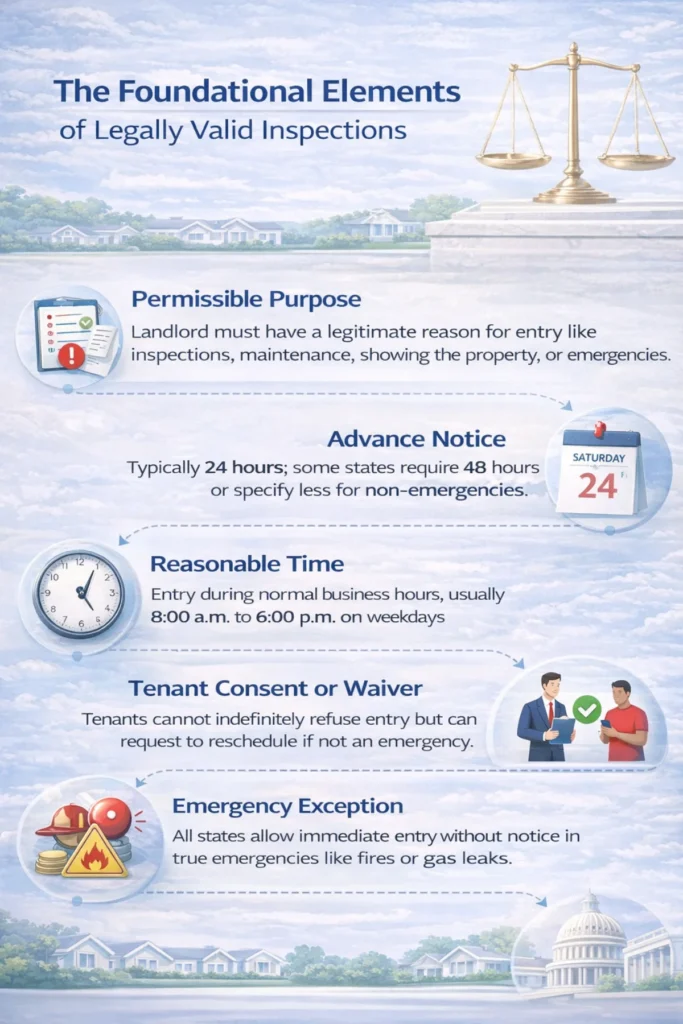
[Permissible purpose.](https://blog.trendsource.com/what-is-permissible-purpose-according-to-the-fcra/) The landlord must have a legitimate reason for entry. Routine inspections, maintenance, showing the property to prospective tenants or buyers, and emergency access are universally accepted. Entering simply to check on a tenant without a stated purpose is generally not permissible and because the stated purpose also frames the scope, it’s worth being clear on [what inspectors look for during an apartment inspection](https://residentinspect.com/blog/what-do-apartment-inspections-look-for/) so the walkthrough stays within what the notice authorized.
[Advance notice.](https://www.grammarly.com/blog/grammar/advance-notice/) Nearly every state requires some form of advance notice before a non-emergency entry. The standard is 24 hours in most states, with some requiring 48 hours and a small number allowing less in certain circumstances. For tips on what to say, see our guide to writing an [inspection notice to tenants](https://residentinspect.com/blog/tenant-inspection-notice/).
[Reasonable time](https://dictionary.law.com/Default.aspx?selected=1734 "Reasonable time"). Entry must occur at a reasonable time — generally understood as normal business hours, though some states define this specifically. Most states set this as between 8:00 a.m. and 6:00 p.m. on weekdays, though some extend to 8:00 p.m.
[Tenant consent or waiver.](https://legal-resources.uslegalforms.com/l/landlord-tenant-waivers) In non-emergency situations, if proper notice is given and the tenant is present, they can consent to entry. If they’re not home, the landlord can generally still enter provided proper notice was given. Tenants cannot indefinitely refuse access for legitimate inspections, though they can request rescheduling.
Emergency exception. All states allow landlords to enter without notice in genuine emergencies — fire, flooding, gas leaks, or other situations where immediate entry is necessary to prevent harm or property damage.
## **Notice Requirements by State**
The following represents the general notice requirements across all 50 states. These are drawn from state landlord-tenant statutes current as of 2026. Always verify with your state’s current law before acting. If you manage homes in Florida, read our full guide to [Florida landlord inspection laws](https://residentinspect.com/blog/guide-to-landlord-inspection-laws-in-florida-in-2026/).
| State | Notice Requirement | Details |
|---|---|---|
| Alabama | No specific statute | 24 hours is the generally accepted standard under common law. Written or oral notice permitted. |
| Alaska | 24 hours required | For non-emergency entry. Entry permitted between 8:00 a.m. and 10:00 p.m. Written notice required. |
| Arizona | 48 hours required | Minimum 2 days notice required for inspections. One of the more tenant-protective states on this requirement. |
| Arkansas | No specific statute | Reasonable notice, generally understood as 24 hours. Entry at reasonable times. |
| California | 24 hours written notice required | Notice must state the purpose, date, and approximate time. Oral notice permitted only in emergencies. |
| Colorado | Reasonable notice | No specific statutory period defined. 24 hours is the accepted standard. Entry at reasonable times. |
| Connecticut | Reasonable notice | Courts have generally interpreted this as 24 hours minimum. |
| Delaware | 48 hours written notice required | Minimum 2 days written notice required for inspections. |
| Florida | 12 hours required | One of the shorter notice requirement states. Notice can be oral or written. |
| Georgia | No specific statute | Reasonable notice is the standard, generally interpreted as 24 hours. |
| Hawaii | 48 hours written notice required | Entry between 8:00 a.m. and 6:00 p.m. |
| Idaho | No specific statutory notice period | Reasonable notice applies; 24 hours is the standard practice. |
| Illinois | No specific statewide statute | Local ordinances may impose specific requirements. 24 hours is the standard. |
| Indiana | Reasonable notice | No specific statutory period; 24 hours is the accepted standard. |
| Iowa | 24 hours required | Entry at reasonable times. Written or oral notice permitted. |
| Kansas | Reasonable notice | Generally interpreted as 24 hours. |
| Kentucky | 48 hours required | Minimum 2 days notice required. |
| Louisiana | No specific statutory notice period | Reasonable notice applies. |
| Maine | 24 hours required | Written notice required except in emergencies. |
| Maryland | No specific statewide statute | Reasonable notice is required; local ordinances may differ. |
| Massachusetts | No specific notice statute | Reasonable notice is required; 24 hours is standard practice. |
| Michigan | Reasonable notice | No specific statutory period. |
| Minnesota | Reasonable notice | Generally interpreted as 24 hours. |
| Mississippi | No specific notice statute | Reasonable notice applies. |
| Missouri | No specific notice statute | Reasonable notice applies. |
| Montana | 24 hours required | Minimum 24 hours notice required. |
| Nebraska | 24 hours required | Minimum 1 day notice required. |
| Nevada | 24 hours required | One of the more detailed state frameworks, with specific provisions for tenant harassment claims. |
| New Hampshire | 24 hours required | Minimum 24 hours notice required. |
| New Jersey | No specific notice statute | Reasonable notice is required; local ordinances may impose additional requirements. |
| New Mexico | 24 hours required | Minimum 24 hours notice required. |
| New York | No specific statewide statute | Reasonable notice is required. New York City has specific local rules. |
| North Carolina | No specific notice statute | Reasonable notice applies; 24 hours is standard. |
| North Dakota | 24 hours required | Minimum 24 hours notice required. |
| Ohio | 24 hours required | One of the clearer state statutes on this requirement. |
| Oklahoma | 24 hours required | Minimum 1 day notice required. |
| Oregon | 24 hours required | One of the more detailed and enforced state frameworks. |
| Pennsylvania | No specific notice statute | Reasonable notice applies. |
| Rhode Island | 48 hours required | Minimum 2 days notice required. |
| South Carolina | 24 hours required | Minimum 24 hours notice required. |
| South Dakota | 24 hours required | Minimum 24 hours notice required. |
| Tennessee | 24 hours required | Minimum 24 hours notice required. |
| Texas | No specific notice statute | Reasonable notice applies; 24 hours is standard. |
| Utah | 24 hours required | Minimum 24 hours notice required. |
| Vermont | 48 hours required | Minimum 48 hours notice required. |
| Virginia | 24 hours required | Minimum 24 hours notice required. |
| Washington | 48 hours required | One of the more detailed and tenant-protective landlord entry frameworks. |
| West Virginia | 24 hours required | Minimum 1 day notice required. |
| Wisconsin | 12 hours required | One of the shorter requirements, alongside Florida. |
| Wyoming | No specific notice statute | Reasonable notice applies. |
## **States with the Most Restrictive Entry Laws**
A handful of states impose requirements beyond standard notice periods that property managers operating in those markets need to understand specifically.
California has the most codified [rental inspection law ](https://bfpminc.com/check-while-they-rent/ "rental inspection law ")in the country. Beyond the 24-hour written notice requirement, California law gives tenants the right to receive a pre-move-out inspection, requires landlords to provide an itemized statement of repairs needed after that inspection, and limits the circumstances under which a landlord can enter to very specific purposes.
California also requires that the notice state the exact purpose, approximate time, and date of the planned entry. Failure to comply with California’s entry statutes gives tenants a cause of action against the landlord.
Washington requires a minimum of 48 hours written notice and has detailed rules about what constitutes a valid reason for entry. Landlords in Washington must be particularly careful about frequency, entering more than once in a 30-day period for non-emergency inspections without tenant consent can be challenged.
Oregon similarly requires 24 hours notice but has detailed provisions around what happens when tenants request rescheduling and how landlords must respond. Oregon law also specifically addresses retaliatory entry — entering after a tenant has complained about habitability — as an unlawful practice. Our [warranty of habitability inspection guide](https://residentinspect.com/blog/warranty-of-habitability-landlord-inspection-guide/) explains what landlords must keep in good working order.
New York City, while governed by state law on the fundamentals, layers on local tenant protection ordinances that go beyond state requirements in terms of tenant rights and remedies.
Hawaii’s 48-hour requirement and its restrictions on entry times (8:00 a.m. to 6:00 p.m.) are more restrictive than many states.
## **How Many Times Can a Landlord Inspect Per Year?**
Most states do not set a specific limit on how many times a landlord can inspect a rental property in a given year, provided proper notice is given each time and the purpose is legitimate.
However, frequent inspections can create legal exposure in several ways. In states like California, Oregon, and Washington, a pattern of repeated inspections can be evidence of tenant harassment, which carries its own legal liability. Courts in multiple states have found that excessive entry — even with proper notice — constitutes a breach of the implied covenant of quiet enjoyment.
The practical standard most property management attorneys recommend is no more than one routine inspection every 3 months, with more frequent entry only when there is a documented maintenance reason or specific lease compliance concern.
If you’re conducting periodic inspections via a virtual inspection service, the documented nature of each inspection and the professional third-party involved generally reduces the risk of a harassment claim because the purpose and findings are clearly recorded.
## **What Happens If a Tenant Refuses an Inspection?**
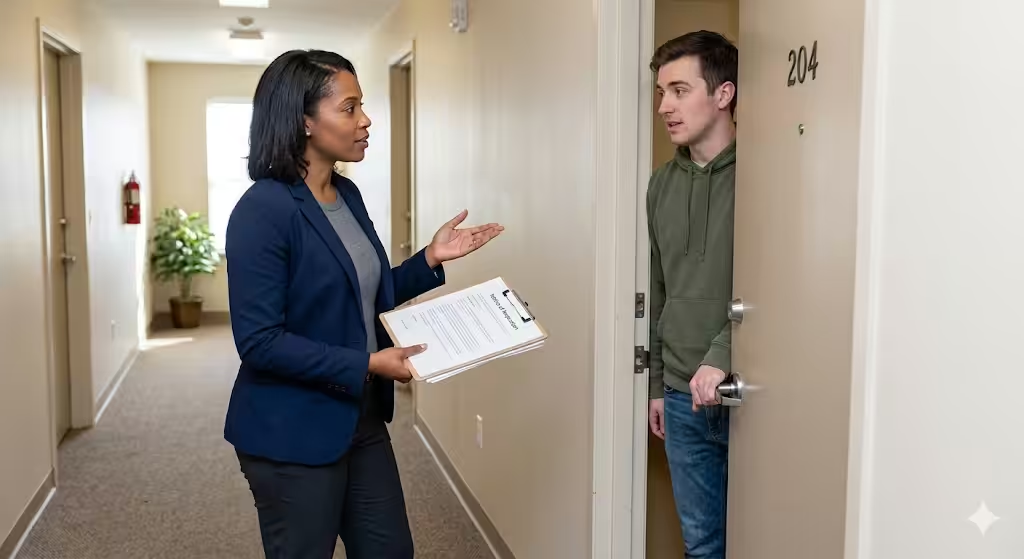Tenants do not have an unlimited right to refuse access for a legitimate, properly noticed inspection. However, how you handle a refusal matters significantly.
If a tenant refuses access after proper notice has been given, the recommended steps are:
Document the refusal in writing immediately after it occurs, including the date, time, and how the refusal was communicated.
Send a written follow-up to the tenant citing the lease provision and applicable state law that establishes your right to entry for inspections. Give a second scheduled date with proper notice.
If refusal continues, consult your lease terms. If the lease includes a periodic inspection addendum specifying that refusal results in a fee (to cover [the cost of scheduling an in-person inspection](https://residentinspect.com/blog/how-much-does-a-rental-property-inspection-cost/ "the cost of scheduling an in-person inspection")), enforce that provision.
As a last resort, depending on your state’s laws, repeated refusal of legitimate inspection requests can constitute a lease violation that may form grounds for a notice to cure. Consult an attorney before pursuing this route.
What you should not do: enter without the tenant’s knowledge after a refusal without following the legal process in your state. Self-help entry after a tenant has explicitly refused access is a significant legal risk in most jurisdictions.
## **The Lease Addendum That Protects You**
The single most effective tool for preventing inspection access problems is a well-drafted periodic [inspection lease addendum](https://residentinspect.com/free-periodic-inspection-lease-addendum/ "Free Periodic Inspection Lease Addendum form"). This is a lease provision — or a separate addendum incorporated into the lease — that establishes:
The tenant’s obligation to participate in periodic inspections, including virtual inspections, as a condition of the lease.
The frequency of inspections (typically every 3 or 6 months).
The notice procedure you will follow (method and timing of notice).
What happens if the tenant refuses or fails to make the property accessible — typically a specific fee amount to cover the cost of an in-person inspection or re-inspection.
The acceptance of virtual inspections as a valid method of conducting the periodic inspection.
Resident Inspect provides a recommended periodic inspection lease addendum that property managers can download and incorporate into their lease agreements. Having this in place before the first inspection eliminates most access disputes before they start.
Free Download
### Download the Free Inspection Lease Addendum
Help prevent access disputes before they start. Get Resident Inspect’s free inspection lease addendum to define inspection frequency, notice procedures, virtual inspection terms, and what happens if a resident refuses access.
[ Download the Free Addendum ](https://residentinspect.com/free-periodic-inspection-lease-addendum/)
## **The Emergency Entry Exception**
Every state allows landlords to enter without notice in genuine emergencies. What constitutes an emergency is broadly consistent across states:
- Active fire, flooding, or gas leak
- Visible structural danger (roof collapse, foundation failure)
- A situation where waiting for notice would result in significant property damage or risk to life
What is not an emergency: a maintenance issue that’s been deferred, a noise complaint from a neighbor, a suspicion that the tenant has a pet. Emergency entry is reserved for situations where waiting for proper notice would create an unreasonable risk of harm.
If you enter under the emergency exception, document everything: why you believed it was an emergency, what you found when you entered, and what actions were taken. Notify the tenant as soon as possible after the emergency entry.
## See Virtual Inspections in Action
Get a personalized demo to see how virtual inspections reduce labor, streamline compliance, and scale your property management operations.
[ Get Your Demo ](https://residentinspect.com/book-a-demo/) Prefer to talk? [Call our team](tel:+19042011102)
## **Virtual Inspections and Legal Compliance**
A common question from property managers implementing virtual inspections: do the same notice requirements apply?
Yes. The legal requirements for property inspections — notice period, permissible purpose, reasonable time — apply to [virtual inspections](https://residentinspect.com/our-virtual-inspection-software/ "Virtual Inspection Software for Rentals") the same way they apply to in-person inspections. What changes is the logistics. The notice you send, the timing of the inspection, and the documentation you produce all follow the same legal framework.
One practical advantage of virtual inspections for compliance purposes: the scheduling process creates a natural documentation trail. When your inspection service sends the tenant a scheduling request, confirmation, and reminders, those communications serve as evidence of proper notice.
The time-stamped inspection report documents the inspection date and findings. The paper trail that compliance requires is built into the process.
## **Frequently Asked Questions**: Rental Property Inspection Laws
### Do I have to give notice for a move-in inspection?
Move-in inspections are typically conducted at the time of key handover, when the tenant is present and participating. In this context, the tenant is consenting to and participating in the inspection, which eliminates the notice concern. However, if you need to access the property before the tenant’s lease start date to document condition, standard entry notice rules apply.
### Can a tenant change the date of a scheduled inspection?
Yes, tenants can request to reschedule an inspection. Whether you’re legally required to accommodate that request depends on your state. In general, a reasonable one-time rescheduling request should be accommodated and documented. If a tenant is repeatedly requesting rescheduling in a pattern that’s preventing inspections from occurring, document each request and consult your lease terms.
### What if I discover a lease violation during an inspection?
Document it thoroughly with photos and written notes. After the inspection, send the tenant a formal written notice of the violation citing the specific lease provision. Give a reasonable cure period as defined by your lease and state law. Follow your state’s process for lease violations — don’t take action before providing proper notice and opportunity to cure.
### Can a landlord inspect a property before move-out?
Yes. A pre-move-out inspection — where the tenant is shown the areas of concern while they still have time to remedy them — is required by law in California and recommended in most states. It gives tenants the opportunity to address issues before their deposit is at risk and reduces disputes. Standard notice requirements apply.
### Does a tenant have the right to be present during an inspection?
Most states do not require the tenant to be present during an inspection, as long as proper notice was given. Some states give tenants the right to request to be present. As a practical matter, tenant-present inspections produce better documentation and reduce disputes about what was or wasn’t found. Resident Inspect’s virtual inspection model requires tenant participation by design — which is one of the reasons the reports are so defensible.
## **Summary**
Rental property inspection law is one of the areas where property managers most frequently create unintentional legal exposure — not because they’re acting in bad faith, but because the rules vary by state and the consequences of getting it wrong are real.
The framework is consistent: give proper written notice, have a legitimate purpose, enter at a reasonable time, and document everything. The specific details — how much notice, what format, what frequency is reasonable — vary by state and should be verified for every market you operate in.
The lease addendum is your best protection. Clear documentation of every inspection is your second best. A consistent, professional inspection program — whether conducted in person or through a virtual inspection service — is what makes both defensible.
Resident Inspect operates in all 50 states and handles inspection scheduling, tenant communication, and documentation in full compliance with state notice requirements. If you’re managing properties across multiple states and want a consistent inspection program that stays on the right side of the law everywhere you operate, get started at residentinspect.com.

Aaron Cooper Founder & CEO
After more than 20 years as a landlord and property management company owner-operator, Aaron Cooper built Resident Inspect to solve a problem he experienced firsthand: the inspection process was broken, expensive, and impossible to scale. Resident Inspect is the result — a live virtual inspection service that replaces in-person inspections with a faster, more consistent, and more defensible process. [See Full Bio](https://residentinspect.com/about-us/aaron-cooper/)
[Facebook](https://www.facebook.com/residentinspect/) [Instagram](https://www.instagram.com/residentinspect/) [TikTok](https://www.tiktok.com/@residentinspectofficial) [Pinterest](https://www.pinterest.com/aaron2762/) [YouTube](https://www.youtube.com/@ResidentInspect) [LinkedIn](https://www.linkedin.com/in/resident-inspect-a00b7a376/)
**Categories:** Blog
---
### [Resident Inspect Integrates with Property Meld to Bring Virtual Property Inspections Inside Every Work Order](https://residentinspect.com/blog/property-meld-integration/)
**Published:** May 7, 2026
**Author:** Aaron Cooper
**Excerpt:** Resident Inspect is now live inside Property Meld's Vendor Nexus Network. Property managers can assign, schedule, and receive professional virtual inspections — complete with a high-resolution report, supporting images, and a finalized invoice — without ever leaving a Meld. No manual coordination. No platform-switching. Just one complete inspection record, delivered automatically.
**Content:**
Aaron Cooper
Founder & Chief Executive Officer, Resident Inspect
📍 Jacksonville, FL
Aaron Cooper is a seasoned property technology entrepreneur and inspection industry expert. As the **Founder and CEO of Resident Inspect**, he leads the development of intelligent inspection platforms that empower landlords, property managers, and investors to streamline digital inspections and ensure compliance.
🌐 [residentinspect.com](https://residentinspect.com) ✉️ <aaron@residentinspect.com>
Property managers spend a lot of time coordinating inspections. Scheduling conflicts, last-minute cancellations, and manual data entry slow everything down — especially when you’re managing dozens or hundreds of properties. That friction ends here.
Resident Inspect, a leader in [virtual property inspection software](https://residentinspect.com/our-virtual-inspection-software/), has launched a live API integration with Property Meld, now available inside the Vendor Nexus Network. Property managers can now assign, schedule, and monitor a professional rental property inspection directly from within any Meld — no extra platform, no manual coordination, no duplicate data entry. See how it works on our [Property Meld integration](https://residentinspect.com/property-meld-integration/) page.
### ⚡ At a Glance
What’s new Resident Inspect is now integrated with Property Meld via the Vendor Nexus Network.
Who benefits All Property Meld users managing rental portfolios of any size.
What you get Professional virtual inspections assigned, tracked, and delivered inside a single Meld.
Who conducts inspections Trained professionals via live, real-time video — not residents.
Availability Live now for all Property Meld Vendor Nexus users.
## 📋 Table of Contents
1. [How the Property Meld Integration Works](#how-it-works)
2. [What Property Managers Receive After Each Inspection](#what-you-receive)
3. [Professional Inspections vs. Resident Photos: Why It Matters](#professional-vs-resident)
4. [Built to Scale With Your Portfolio](#scales-with-your-portfolio)
5. [What Is the Property Meld Vendor Nexus Network?](#vendor-nexus)
6. [What the Leaders Are Saying](#quotes)
7. [How to Get Started](#get-started)
8. [Frequently Asked Questions](#faq)
---
## How the Property Meld Integration Works
The integration lives directly inside your existing Property Meld workflow. No extra logins. No switching between platforms. Here’s the step-by-step process:
1. 1
**Open any Meld (work order)** in your Property Meld account.
2. 2
**Assign a Resident Inspect inspection** from within the Meld — just like assigning any other vendor task.
3. 3
**Schedule the inspection** for a time that works. Evening and weekend slots are available.
4. 4
**Monitor in real time.** Track inspection progress directly inside the Meld.
5. 5
**Receive everything automatically** when the inspection is complete — no follow-up needed.
💡
What Is a Meld?A Meld is Property Meld’s term for a work order — a centralized record that tracks a maintenance or inspection request from start to finish. The Resident Inspect integration attaches directly to this record, so your entire inspection history lives in one place.
---
## What Property Managers Receive After Each Inspection
Once a [virtual property inspection](https://residentinspect.com/faq/) is completed, Resident Inspect automatically delivers three things — all inside the Meld:
📋 **Inspection Report**Detailed, high-resolution documentation of property condition — ready the moment the inspection closes.
📸 **Supporting Images**All photos professionally captured and organized by the trained inspector during the live video session.
🧾 **Finalized Invoice**Automatically attached and submitted inside the Meld — no chasing, no manual entry, no follow-up.
✅
No Manual Work RequiredThere’s no manual coordination, no platform-switching, and no chasing down invoices. The integration handles delivery automatically the moment the inspection is finalized.
---
## Professional Inspections vs. Resident Photos: Why It Matters
Many property technology platforms rely on residents to submit photos or self-report conditions. Resident Inspect takes a different approach — and that difference has a direct impact on the quality and reliability of your rental property inspection data.
| Factor | Resident Inspect (Professional) | Resident Self-Reporting |
|---|---|---|
| Who conducts the inspection | ✔ Trained third-party professional | ✘ Resident (self-reporting) |
| Objectivity of findings | ✔ Third-party, unbiased documentation | ✘ Resident may overlook or avoid flagging issues |
| Report consistency | ✔ Standardized across your full portfolio | ✘ Varies by resident effort and awareness |
| Legal/insurance documentation | ✔ Professionally captured for defensible records | ✘ Resident photos may not meet documentation standards |
🎙 Aaron Cooper — Founder, Resident Inspect
> “By connecting directly with Property Meld, we’re eliminating friction and giving teams a faster, more reliable way to complete inspections — without compromising quality.”
For property management companies navigating resident turnover, lease renewals, or maintenance disputes, having a professional third-party inspection record isn’t just convenient — it’s a layer of documentation that protects the property owner and the management company alike. It is also why Resident Inspect built its [rental inspection software](https://residentinspect.com/) around trained inspectors instead of resident photos.
---
## Built to Scale With Your Portfolio
One of the most common concerns property managers raise about virtual inspection services is whether they can keep up with high inspection volume. The Resident Inspect model is specifically designed to answer that question.
Flexible scheduling — including evenings and weekends — means inspections can happen when it works for your residents and your team. For large property management portfolios, the process doesn’t change. Reports are generated immediately upon completion, every time.
📈
Scale Without Sacrificing AccuracyWhether you manage 50 units or 5,000, Resident Inspect delivers the same quality report from the same trained process. Consistency and accuracy don’t diminish as volume grows — that’s by design.
---
## What Is the Property Meld Vendor Nexus Network?

The **Property Meld Vendor Nexus Network** is a curated marketplace of pre-vetted service providers connected directly into the Property Meld platform. Property managers can access and assign these vendors without leaving their maintenance workflow.
Resident Inspect is now a live member of the Vendor Nexus Network, available to all Property Meld users who need a professional, reliable property inspection partner.
🎙 Liz Greenway — Head of Partnerships, Property Meld
> “Vendor Nexus aims to connect property managers with vetted, quality vendors in their area, including top inspection partners. Resident Inspect offers a reputable, tech-forward virtual inspection solution that will immediately benefit our customers. This partnership removes a barrier for expanding property management companies by connecting a trusted inspection partner directly into Property Meld, elevating the standard for maintenance and inspections.”
Being selected for the Vendor Nexus Network reflects Resident Inspect’s track record of delivering high-quality, consistent inspections at scale — and Property Meld’s commitment to connecting their users with vetted, trustworthy service partners.
---
## What the Leaders Are Saying
This integration reflects a shared commitment to reducing friction for property management teams while maintaining inspection quality.
🎙 Aaron Cooper — Founder, Resident Inspect
> “By connecting directly with Property Meld, we’re eliminating friction and giving teams a faster, more reliable way to complete inspections — without compromising quality.”
🎙 Liz Greenway — Head of Partnerships, Property Meld
> “This partnership removes a barrier for expanding property management companies by connecting a trusted inspection partner directly into Property Meld, elevating the standard for maintenance and inspections.”
---
## How to Get Started
If you’re already a Property Meld user, you can access Resident Inspect today through the Vendor Nexus Network. The integration is live and available now.
Not yet using Property Meld? [Contact the Resident Inspect team](https://residentinspect.com/contact-us/) to learn more about your options for professional virtual inspections — whether or not you’re on Property Meld.
Want to learn more about how the integration works? Visit our [Property Meld Integration page](https://residentinspect.com/property-meld-integration/) for full details.
## Ready to Run Professional Virtual Inspections Without Leaving Property Meld?
Resident Inspect is live in the Vendor Nexus Network right now. Get your first inspection scheduled today.
[Book a Demo](https://residentinspect.com/book-a-demo/)
---
## Frequently Asked Questions
### Q
What is the Resident Inspect and Property Meld integration?
Resident Inspect has built a live API integration within Property Meld’s Vendor Nexus Network. Property managers can now assign, schedule, and monitor professional virtual inspections directly inside a Meld (work order) — without leaving the platform.
### Q
How does a virtual inspection work through Property Meld?
Inside any Meld, a property manager assigns and schedules a Resident Inspect inspection. A trained Resident Inspect professional then conducts a live, guided inspection via real-time video. When complete, the platform automatically delivers a high-resolution inspection report, supporting images, and a finalized invoice — all inside the same Meld.
### Q
Does Resident Inspect use residents to conduct inspections?
No. Resident Inspect uses trained professionals — not residents — to conduct every inspection via live video. This ensures consistent, accurate reports regardless of portfolio size or property type.
### Q
Who is eligible to use the Resident Inspect integration in Property Meld?
The integration is live now for all Property Meld users within the Vendor Nexus Network. If you’re a Property Meld user, you can access Resident Inspect directly from within any Meld today.
### Q
What deliverables does Resident Inspect provide after an inspection?
After each inspection, Resident Inspect automatically delivers three things inside the Meld: a detailed high-resolution inspection report, professionally documented supporting images, and a finalized invoice.
### Q
Can Resident Inspect handle large property management portfolios?
Yes. The Resident Inspect model is built to scale across large portfolios without sacrificing consistency or inspection accuracy. Scheduling is flexible, including evenings and weekends, and reports are generated immediately upon inspection completion.
### Q
Is this integration available immediately?
Yes. The Resident Inspect integration within the [**Property Meld Vendor Nexus Network**](https://propertymeld.com/nexus/) is live now. Existing Property Meld users can access it today without any additional setup.
---
## About the Companies
About Resident Inspect
Resident Inspect is a tech-enabled inspection service specializing in virtual rental property inspections. The platform delivers professional, live-guided inspections via real-time video, producing high-resolution reports immediately upon completion.
[Learn more at residentinspect.com →](https://residentinspect.com)
About Property Meld
Property Meld is a **property maintenance operations platform** designed to automate and optimize maintenance coordination, improving efficiency and communication while reducing repair turnaround times. Its Vendor Nexus Program connects property managers with pre-vetted service partners directly within the platform.
[Learn more at propertymeld.com →](https://propertymeld.com)


Aaron Cooper Founder & CEO
After more than 20 years as a landlord and property management company owner-operator, Aaron Cooper built Resident Inspect to solve a problem he experienced firsthand: the inspection process was broken, expensive, and impossible to scale. Resident Inspect is the result — a live virtual inspection service that replaces in-person inspections with a faster, more consistent, and more defensible process. [See Full Bio](https://residentinspect.com/about-us/aaron-cooper/)
[Facebook](https://www.facebook.com/residentinspect/) [Instagram](https://www.instagram.com/residentinspect/) [TikTok](https://www.tiktok.com/@residentinspectofficial) [Pinterest](https://www.pinterest.com/aaron2762/) [YouTube](https://www.youtube.com/@ResidentInspect) [LinkedIn](https://www.linkedin.com/in/resident-inspect-a00b7a376/)
**Categories:** Blog
---
### [Managing Difficult Tenants Without Losing Your Mind](https://residentinspect.com/blog/managing-difficult-tenants-without-losing-your-mind/)
**Published:** April 7, 2025
**Author:** Aaron Cooper
**Excerpt:** Managing difficult tenants doesn’t have to drain your time, energy, or sanity. In this practical guide, Aaron Cooper of Resident Inspect shares proven strategies to help property managers handle late rent, refused inspections, and full-on ghosting - all without burning bridges or losing control. From setting expectations early to using virtual inspections to cut down conflict, we break down exactly how to stay one step ahead of the chaos.
**Content:**
If you manage properties for a living, you already know this: 95% of tenants are perfectly fine. They pay rent (mostly) on time, take care of the place, and don’t cause drama. But the other 5%? They’ll test your patience, your policies, and your will to live.
We’re talking about the tenants who treat their lease agreement like a rough suggestion. The ones who refuse inspections, ignore communication, and “forget” they were ever told about that leak. The ones who turn “simple repair” into “ongoing battle.” You know the type.
So how do you deal with them? Enforce the lease without starting World War III? Stay professional without burning out?
We sat down with Aaron Cooper, founder of [**Resident Inspect**](https://residentinspect.com/) and a long-time property manager, to talk about exactly that. His company now helps property managers across the country reduce conflict, improve compliance, and deal with tricky tenants without the headache through their unique property inspection service.
Let’s dig into what works – and how to make your job less stressful in the process.
Watch the full interview here!
Table Of Contents
1. [The Two Big Problems: Rent and Compliance](#the-two-big-problems-rent-and-compliance)
2. [How Virtual Walkthroughs Reduce Conflict](#how-virtual-walkthroughs-reduce-conflict)
3. [What If They Still Refuse?](#what-if-they-still-refuse)
4. [Set Expectations Early or Pay for It Later](#set-expectations-early-or-pay-for-it-later)
5. [Technology That Actually Helps (For Once)](#technology-that-actually-helps-for-once)
6. [What to Do When a Tenant Flat-Out Refuses Access](#what-to-do-when-a-tenant-flat-out-refuses-access)
7. [Final Thoughts](#final-thoughts)
## ****The Two Big Problems: Rent and Compliance****
If you ask any seasoned property manager what the *most* frustrating parts of their job are, chances are it’ll come down to two things: rent payments and lease compliance. Everything else – maintenance, owner emails, contractor no-shows – takes a back seat when those two start to wobble.
> **“**It’s always either rent or lease compliance. Ninety percent of tenant issues fall into one of those two buckets.”****
>
> Aaron Cooper
Let’s start with rent.
No one’s surprised when late payments create tension. But what often gets missed is just how much smoother things run when paying rent is easy.
This one change – offering cash payment options through property management software – has made a measurable difference. Anecdotal evidence suggests that the more options tenants have to pay their rent, the more likely it is that they will meet payment deadlines.
> **“The moment you remove friction, tenants are more likely to pay on time.”**
>
> Aaron Cooper
In fact, [60% of US renters now make payments online,](https://www.forbes.com/advisor/renters-insurance/renting-statistics/#:~:text=60%25%20of%20U.S.%20renters%20pay,renters%20using%2010%20or%20more.) highlighting the importance of incorporating online payments as a minimum.
Some managers go a step further by charging a processing fee for paper cheques, nudging tenants toward online or cash-based digital options. And while that might sound a little firm, the goal isn’t punishment – it’s predictability.
Then there’s the second half of the headache: lease compliance.

This covers everything from surprise pets to mystery roommates to damage that no one ever seems to know anything about. You know the drill. A quick mid-term inspection uncovers a broken blind, or a newly installed cat door that definitely wasn’t there last quarter. When you ask, the tenant says, “Oh, that? It’s been like that since we moved in.”
Without regular check-ins, and documented, time-stamped photo evidence, you’ve got no leg to stand on. And Aaron’s clear on this point:
> **“If you want lease compliance, you’ve got to be present – even if it’s virtually. If you’re not looking, things slide.”**
>
> Aaron Cooper
Resident Inspect was built to help with exactly this. By [handling inspections consistently,](https://residentinspect.com/rental-property-inspections/) documenting everything with time-stamped photos, and creating a structure tenants can’t easily wriggle out of, property managers can stay on top of lease compliance without having to go full detective.
**Need more time to handle payments and lease questions instead of playing catch-up with inspections?** Resident Inspect can take inspections off your hands completely – with clean reports delivered straight to your inbox.
[Find Out More](https://residentinspect.com/book-a-demo/)
## ****How Virtual Walkthroughs Reduce Conflict****
Inspections aren’t exactly everyone’s favorite day on the calendar. For tenants, they often feel like a test they didn’t study for. For property managers, it can feel like walking into a room where everyone’s *already* annoyed with you. The tension starts before the door even opens sometimes.
> ****“Tenants think you’re showing up to grill them, and managers think the tenant’s hiding something. And suddenly, everyone’s on edge before anyone’s said a word.”****
>
> Aaron Cooper
Here’s the thing. Most tenants aren’t trying to be difficult. Many have just had bad experiences – either personally or through someone they know. Maybe their last landlord showed up unannounced and nitpicked their furniture. Maybe a previous inspection ended with surprise charges. So, when you knock on the door, you’re already facing that history – even if it’s not yours.
Aaron explains that virtual inspections lower that emotional temperature immediately: “It’s just less personal, and in this situation, that’s a good thing.”
With Resident Inspect, tenants walk through the property with their phone while a trained inspector guides them live. There’s no one physically standing in their space, no awkward silences, and no accusatory glances. It’s just a structured process with clear steps.
It’s also easier to enforce because it doesn’t feel like a big deal. The tenant gets to choose the time. There’s no need to rearrange their schedule, take time off work, or worry about someone poking around in their kitchen.
And from the manager’s perspective, it’s way more consistent.
> **“Every inspection follows a set checklist. We ask them to show under the sink, in the cupboards, the ceiling corners – stuff that can get missed in a casual walkthrough.”**
>
> Aaron Cooper
More importantly, this system means the property manager doesn’t have to be the bad guy. If something’s wrong, the report says it. You can deal with it later. But in the moment, you’re not standing there delivering the verdict in person.
That separation matters. It means tenants are less likely to get defensive, more likely to cooperate, and less likely to see your requests as personal attacks.

> **“**We take on the awkward part so the manager doesn’t have to. If there’s an issue, they handle it later – but they’re not the one calling it out to the tenant’s face.”****
>
> Aaron Cooper
In short: fewer confrontations, better compliance, and no more tense Tuesday afternoons with tenants who’ve already decided you’re the enemy.
Also, regular property inspections play a vital role in maintaining the condition and value of rental properties, which can [enhance tenant satisfaction and retention.](https://www.steadily.com/blog/the-importance-of-regular-property-inspections)
**Want to skip the awkward conversations and still get all the documentation you need?** Resident Inspect handles inspections from start to finish – so you don’t have to.
[Book Your Demo](https://residentinspect.com/book-a-demo/)
## ****What If They Still Refuse?****
Even with clear expectations, kind reminders, and easy options, some tenants still refuse to play ball. They’ll ignore messages, dodge appointments, and act surprised that “you actually still want to do that inspection thing.”
Sound familiar?
> ****“You can have the friendliest tone, the clearest lease clause, the most reasonable request – but some tenants will just keep kicking the can down the road unless you’ve set real consequences.”****
>
> Aaron Cooper
That’s where enforcement meets documentation. At Resident Inspect, Aaron’s team helps property managers tackle non-compliance before it turns into a full-blown problem. It starts with something simple: a lease addendum.
The addendum lays it all out. It tells the tenant what to expect:
- They’ll be asked to do a virtual inspection
- If they refuse, there’s a small fee for arranging an in-person visit
- If they keep refusing, things escalate according to what the law allows
> **“Tenants don’t have to do the virtual inspection. But if they don’t, we’re not eating the cost of sending someone out there.”**
>
> Aaron Cooper
[Save Money On In-Person Inspections](https://residentinspect.com/book-a-demo/)
It’s not about being harsh. It’s about making it easier to comply than to avoid. If the video call is free and the in-person visit isn’t, most tenants will pick the simpler route. And if they still refuse after that? You’ve got the lease, the addendum, and the paper trail to take the next steps – legally, calmly, and with confidence. Some states allow access with notice, and in rare cases, managers have the right to change locks to gain entry for compliance purposes. Aaron’s never had to go that far, but the key thing is this:
> ****“The process works because it’s spelled out. There’s nothing ambiguous. The tenant knows what happens next – and they usually get on with it.”****
>
> Aaron Cooper
And because Resident Inspect handles the scheduling, reminders, and follow-through, the manager doesn’t get stuck playing the enforcer. They stay one step removed from the friction, which preserves the relationship.
This distance is intentional – and it works. When tenants realize the manager isn’t bluffing, and the third-party inspector is just calmly following protocol, most decide it’s not worth the hassle to keep dodging.
**Need help drawing a line in the sand without sounding like a robot?** Resident Inspect gives you the templates, structure, and support to make your inspection policy something tenants actually follow.
[Find Out More](https://residentinspect.com/book-a-demo/)
## ****Set Expectations Early or Pay for It Later****
Most inspection drama could be avoided with one thing: better onboarding.
> **“It’s one thing to bury inspection rules in a ten-page lease, but if you want compliance, you need to actually talk about it.”**
>
> Aaron Cooper
That’s why his team includes a separate inspection addendum with every lease. It explains the process, outlines the timeline, and includes a fee-based opt-out for [virtual inspections.](https://residentinspect.com/our-virtual-inspection-software/) It’s clear, signed, and enforceable.
If a tenant refuses an inspection later, it’s not a debate. It’s already covered. This kind of upfront clarity makes everything easier. Tenants don’t feel ambushed. Property managers don’t have to justify their policies mid-lease. Everyone knows the deal.
## ****Technology That Actually Helps (For Once)****
Tech in property management hasn’t always delivered on its promises. But in this case, it really does make life easier.

With modern mobile-first tools and high-quality video calls, virtual inspections are smooth, clear, and fully documented. Tenants don’t feel judged. Property managers get reliable, timestamped reports. Everyone walks away with what they need.
And we’re not talking about tenants snapping a few blurry photos and saying, “Looks fine.” These are guided, real-time inspections conducted by trained pros. Every item on the checklist is reviewed. Every room is covered.
This is convenient and reliable. And it keeps you out of the weeds.
## ****What to Do When a Tenant Flat-Out Refuses Access****
Sometimes you do everything right. You communicate clearly, you give plenty of notice, you offer flexible scheduling. You’re not being unreasonable – but the tenant still won’t let you in.
They ghost your calls. They dodge emails. They push the appointment back again and again, and suddenly it’s been six months and you still haven’t seen inside the unit.
So what now?
First, it’s worth saying: refusal to grant access can be a serious lease violation. Most tenancy agreements, and the laws in many states, include a clause that gives landlords or property managers the right to enter the property for inspections, as long as proper notice is given (usually 24–48 hours). If the tenant keeps blocking you, you’re often well within your rights to escalate.
### ****But let’s not let things escalate too quickly.****
Legal rights are one thing. Actually getting compliance is another. You don’t want to go nuclear straight away, especially when a bit of strategy might get you there faster and without the drama.

### ****Start with written communication.****
If your previous attempts were verbal, now’s the time to go on record. Send a friendly but firm email explaining their obligation under the lease, the reason for the inspection, and that failure to allow access could result in a formal lease violation.
### ******Try flexibility.******
Offer another couple of time slots. Make it easy for them to cooperate. But don’t let it drag on. If they keep cancelling or ignoring you, don’t keep chasing indefinitely.
### ******Document everything.******
Every email. Every text. Every missed appointment. You’re building a timeline of non-compliance, which may become essential if you need to take further action.

### ********Use your lease terms.********
Most leases include language about what happens when a tenant refuses access. That could mean a lease violation fee, an official warning, or in some cases, termination of the lease. Follow the process carefully. Don’t wing it.

### ****Know your legal options.****
In many U.S. states, if a tenant continues to deny access after being given proper notice, landlords can enter the property anyway, legally. That might involve using a key or, in more extreme cases, arriving with a locksmith. But proceed cautiously here. Always check your local laws and speak to your attorney or legal advisor before taking this step.
The truth is, most tenants don’t want it to get that far. Once they realize you’re following proper procedure and keeping records, they tend to comply. It’s not about being heavy-handed, it’s about showing you won’t be walked over.
And here’s where a service like Resident Inspect becomes incredibly helpful. If a tenant is refusing access because they’re uncomfortable with someone entering their space, offering a virtual inspection can dissolve that tension. A video call often feels less invasive, and it removes a common excuse for refusal.
When that option’s on the table, compliance rates go up. Tenants are more likely to say yes, and you get what you need without having to escalate.
**Still dealing with the tenant who thinks the lease doesn’t apply to them?** Resident Inspect helps property managers reduce non-compliance by making inspections less invasive, more flexible, and easier to schedule.
[Find Out More](https://residentinspect.com/book-a-demo/)
## ****Final Thoughts****
Difficult tenants are part of the job. But with the right approach, the right documentation, and the right tech, you don’t have to dread every inspection or escalate every conflict.
Aaron Cooper and the team at Resident Inspect have helped hundreds of property managers stay on top of compliance, avoid confrontation, and protect their owners’ assets – without losing sleep (or their sanity).
### Top 7 Takeaways:
1. **Rent and lease compliance are the two biggest headaches for property managers – and most tenant issues fall into one of these categories.**
Offering more payment options, including cash-based digital payments at places like Walgreens or CVS, helps reduce late rent. When rent is easier to pay, it’s more likely to be paid on time.
2. **Regular inspections are essential to lease compliance but how you conduct them makes a huge difference.**
Without consistent, documented inspections, damage goes unnoticed and tenants get lax. Resident Inspect helps property managers stay on top of things without having to chase or confront tenants directly.
3. **Virtual inspections lower tension and make tenants more cooperative.**
Many difficult tenants have had bad past experiences. A virtual walkthrough removes the sense of being judged or ambushed. Tenants feel more in control, and managers stay out of the confrontation zone.
4. **A clear, well-communicated inspection policy stops most problems before they start.**
Don’t bury inspection rules in legalese. Use a separate inspection agreement, explain expectations upfront, and offer options like virtual inspections with opt-outs. If it’s easy to follow, tenants are more likely to comply.
5. **If a tenant flat-out refuses an inspection, documentation and legal clarity are key.**
Proper notice, written communication, and detailed records protect property managers when tenants dodge inspections. Offering a virtual option can remove objections and prevent escalation.
6. **Technology has finally made inspections easier for everyone.**
Today’s video tools allow for guided, real-time inspections that are consistent, time-stamped, and fully documented. Tenants don’t feel scrutinized. Managers don’t spend hours on the road. Everyone wins.
7. **Difficult tenants don’t have to derail your business.**
With systems like Resident Inspect, property managers can enforce compliance, keep records, and avoid unnecessary conflict – all without becoming the bad guy.
Want to see how it works?
Try 5 free inspections and find out how much smoother your next tenant interaction could be.
[Claim My Free Inspections](https://residentinspect.com/free-inspection/form/)

Aaron Cooper Founder & CEO
After more than 20 years as a landlord and property management company owner-operator, Aaron Cooper built Resident Inspect to solve a problem he experienced firsthand: the inspection process was broken, expensive, and impossible to scale. Resident Inspect is the result — a live virtual inspection service that replaces in-person inspections with a faster, more consistent, and more defensible process. [See Full Bio](https://residentinspect.com/about-us/aaron-cooper/)
[Facebook](https://www.facebook.com/residentinspect/) [Instagram](https://www.instagram.com/residentinspect/) [TikTok](https://www.tiktok.com/@residentinspectofficial) [Pinterest](https://www.pinterest.com/aaron2762/) [YouTube](https://www.youtube.com/@ResidentInspect) [LinkedIn](https://www.linkedin.com/in/resident-inspect-a00b7a376/)
**Categories:** Blog
---
### [A Guide to Inspection No-Shows: How to Solve a Costly Problem](https://residentinspect.com/blog/inspection-no-shows/)
**Published:** March 28, 2026
**Author:** Aaron Cooper
**Content:**
 Aaron Cooper
Founder & Chief Executive Officer, Resident Inspect
📍 Jacksonville, FL
Aaron Cooper is a seasoned property technology entrepreneur and inspection industry expert. As the **Founder and CEO of Resident Inspect**, he leads the development of intelligent inspection platforms that empower landlords, property managers, and investors to streamline digital inspections and ensure compliance.
🌐 [residentinspect.com](https://residentinspect.com)
✉️ <aaron@residentinspect.com>
## **Table of Contents**
1. [What Are Inspection No-Shows?](#what "What Are Inspection No-Shows?")
2. [Why Inspection No-Shows Are a Serious Problem](#why "Why Inspection No-Shows Are a Serious Problem")
3. [Why Traditional Inspections Lead to No-Shows](#traditional "Why Traditional Inspections Lead to No-Shows")
4. [The Live Video Inspection Solution](#the-solution "The Live Video Inspection Solution")
5. [Compliance Matters: Live Video vs. DIY Video](#compliance "Compliance Matters: Live Video vs. DIY Video")
6. [Legal and Operational Benefits](#legal "Legal and Operational Benefits")
7. [When Live Video Inspections Make the Most Sense](#when "When Live Video Inspections Make the Most Sense")
8. [Final Thoughts: Inspection No-Shows Are a Process Problem](#final-thoughts "Final Thoughts: Inspection No-Shows Are a Process Problem")
9. [FAQs: Live Inspections & No-Show Prevention](#faqs "FAQs: Live Inspections & No-Show Prevention")
Inspection no-shows are one of the most frustrating, and expensive, issues in property management. Missed appointments waste staff time, delay compliance documentation, frustrate owners, and create unnecessary tension with residents. Yet, despite how common inspection no-shows are, many portfolios still treat them as an unavoidable cost of doing business.
They are not.
[Live video inspections](https://residentinspect.com/blog/the-future-of-property-inspections/ "The Future of Property Inspections "), paired with proper compliance documentation, directly address the root causes of inspection no-shows while improving operational efficiency and legal defensibility.
This guide explains why inspection no-shows happen, why they create real risk, and how live video inspections solve the problem without sacrificing compliance.
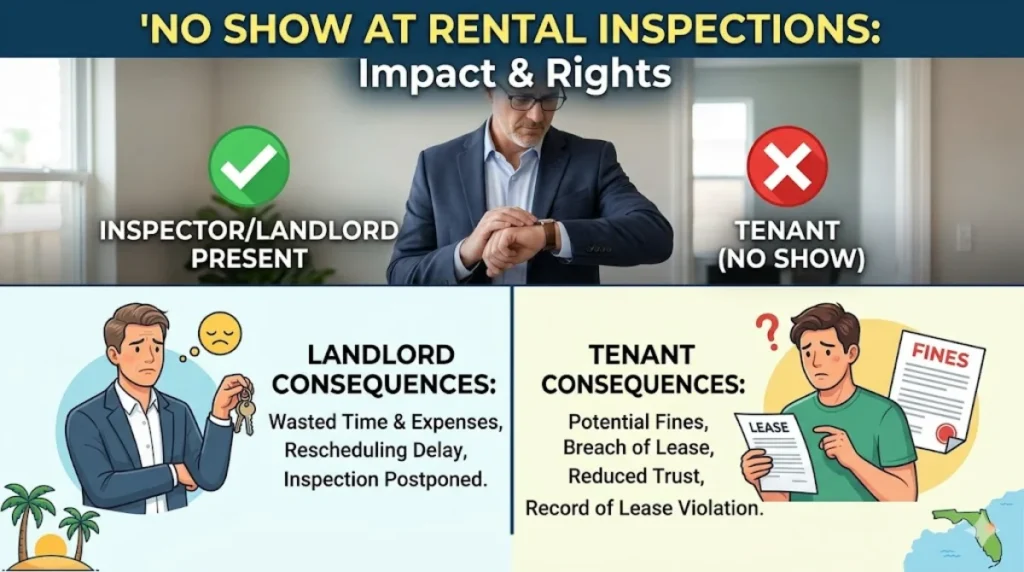## **What Are Inspection No-Shows?**
An inspection no-show occurs when a resident fails to appear or provide access at the scheduled inspection time. This applies to:
- Move-in inspections
- [Move-out inspections](https://residentinspect.com/blog/top-landlord-move-out-inspections-mistakes/ "Top 5 Move-Out Inspections Mistakes Landlords Make (And How to Avoid Them)")
- Routine or periodic inspections
- Maintenance verification inspections
- Lease-required compliance inspections
Even when proper notice is given, no-shows remain common—especially in busy, high-turnover rental portfolios. A clear [tenant inspection notice](https://residentinspect.com/blog/tenant-inspection-notice/) with a set date and time window can help cut down on missed visits.
## **Why Inspection No-Shows Are a Serious Problem**
Inspection no-shows are often dismissed as minor inconveniences. In reality, they create compounding operational and legal issues.
### **1. Lost Time and Labor Costs**
Each missed inspection represents:
- Staff travel time
- Scheduling and rescheduling [labor](https://residentinspect.com/blog/how-to-cut-labor-with-virtual-inspections/ "How to Cut Labor with Virtual Inspections For PMs")
- Opportunity cost for other inspections
Over time, this adds measurable expense to your operations.
### **2. Compliance Gaps**
Many inspections are tied directly to:
- [Habitability standards](https://www.debirumph.com/repairs-habitability/what-is-habitability "Habitability standards")
- Lease requirements
- Local or state regulations
- Risk mitigation for liability claims
When inspections are delayed or skipped due to no-shows, compliance documentation becomes incomplete or outdated.
### **3. Increased Owner Risk**
Owners expect inspections to:
- Protect asset condition
- Reduce disputes
- Support [security deposit](https://specializedpropertymanagementorlando.com/orlando-security-deposit-laws/ "security deposit") decisions
Missed inspections weaken documentation and expose owners to disputes, claims, and revenue loss.
### **4. Strained Resident Relationships**
Repeated rescheduling creates frustration for residents and staff alike—especially when residents feel inspections are inconvenient or disruptive.
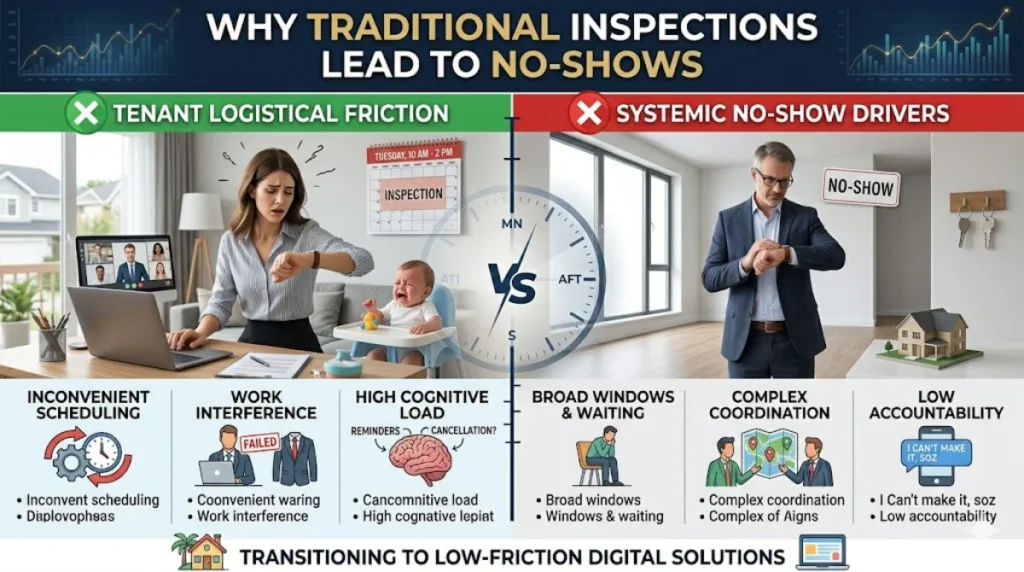## **Why Traditional Inspections Lead to No-Shows**
Inspection no-shows are not random. They are a predictable result of outdated processes.
### **Inflexible Scheduling**
Residents are required to:
- Be physically present
- Coordinate time off work
- Wait for uncertain arrival windows
This creates friction and increases the likelihood of missed appointments.
### **Travel and Access Barriers**
Traffic delays, gated access issues, and parking restrictions all increase failure points in traditional inspections.
### **Lack of Accountability**
When inspections rely on physical presence alone, there is often:
- No clear record of who failed to attend
- No immediate fallback option
- No same-day resolution
## **The Live Video Inspection Solution** to No-Shows
Live video inspections eliminate the single biggest cause of no-shows: physical presence requirements.
### **How Live Video Inspections Work**
- The resident joins a scheduled live video call from their phone
- A trained inspector directs the walkthrough in real time
- Photos, videos, timestamps, and notes are captured instantly
- [Documentation ](https://residentinspect.com/blog/better-inspection-documentation-can-reduce-disputes/ "How Better Inspection Documentation Can Significantly Reduce Disputes")is compiled into a compliant inspection report
If a resident misses the scheduled time, the failure to attend is recorded—without wasted travel or staff time.
## **How Live Video Inspections Prevent No-Shows**
### **1. Remote Access Removes Barriers**
Residents can complete inspections:
- From anywhere
- Without taking time off work
- Without coordinating keys or access
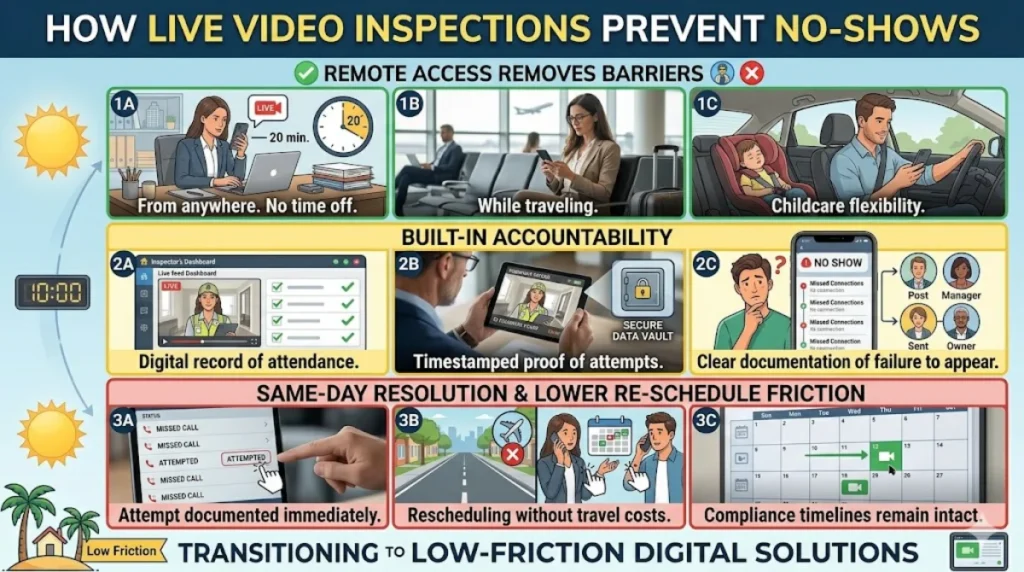This drastically reduces missed appointments.
### **2. Built-In Accountability**
Live video inspections create:
- A digital record of attendance
- Timestamped proof of inspection attempts
- Clear documentation if a resident fails to appear
This protects both the property manager and the owner.
### **3. Same-Day Resolution**
If a resident is late or misses the call:
- The attempt is documented immediately
- Rescheduling can happen without additional travel costs
- Compliance timelines remain intact
## **Compliance Matters: Live Video vs. DIY Video**
Not all video inspections are equal.
### **Why Live Video Is Critical for Compliance**
Live video inspections provide:
- Real-time verification of property condition
- Directed walkthroughs (no skipped areas)
- Objective documentation created by a third party
- Time-stamped photos and video tied to the inspection event
### **Risks of Resident-Submitted Videos**
Pre-recorded or DIY videos:
- Can omit damage
- Lack neutral oversight
- Are difficult to defend in disputes
- Often fail evidentiary standards
Live video ensures inspections remain defensible, consistent, and compliant.
## See Virtual Inspections in Action
Get a personalized demo to discover how virtual inspections can save time, cut labor hours, and boost property management efficiency.
[Get Your Demo](https://residentinspect.com/book-a-demo/)Prefer to talk? [Call our team](tel:+19042011102).
## **Legal and Operational Benefits**
### **Stronger Documentation**
Live video inspections create inspection records that support:
- Security deposit determinations
- Damage claims
- Habitability compliance
- Owner reporting
### **Reduced Disputes**
Clear, timestamped video documentation minimizes disagreements about:
- [Property condition](https://en.wikipedia.org/wiki/Property_condition_assessment "Property condition")
- Responsibility for damage
- Inspection timing
### **Scalable Operations**
Because inspectors are remote:
- More inspections can be completed per day
- Scheduling becomes easier
- Portfolios scale without proportional staffing increases
## **When Live Video Inspections Make the Most Sense**
Live video inspections are particularly effective for:
- High-volume portfolios
- Long-distance or out-of-area properties
- Markets with frequent inspection no-shows
- Teams focused on operational efficiency
- Owners who prioritize documentation and risk reduction
## **Final Thoughts: Inspection No-Shows Are a Process Problem**
Inspection no-shows are not a resident problem—they are a process problem.
Traditional inspection methods create friction, inefficiency, and compliance risk. Live video inspections eliminate those friction points while improving documentation quality, accountability, and operational control.
For modern property management teams, inspection no-shows should no longer be accepted as normal. With [live video inspections](https://residentinspect.com/blog/rental-property-inspection-checklist/ "[2026 EDITION] The Complete Rental Property Inspection Checklist") and proper compliance workflows, they are largely preventable. Which will [save you time and money](https://residentinspect.com/blog/how-virtual-rental-inspections-save-property-managers-time-and-money/ "save you time and money")!
## **FAQs: Live Inspections & No-Shows Prevention**
### **What causes inspection no-shows in property management?**
Inspection no-shows are typically caused by scheduling friction, required in-person attendance, work conflicts, unclear communication, and logistical barriers like travel delays or access issues. These are process-driven problems—not random behavior.
### **How much do inspection no-shows actually cost?**
Inspection no-shows cost more than just time. They include staff labor, travel expenses, rescheduling coordination, delayed compliance documentation, and lost opportunity cost. Across a portfolio, these costs compound quickly and impact overall operational efficiency.
### **Do live video inspections eliminate no-shows completely?**
While no system eliminates no-shows entirely, live video inspections drastically reduce them by removing the need for physical presence. Even if a resident fails to attend, the missed appointment is documented instantly—without wasted travel or labor.
### **Are live video inspections legally compliant?**
Yes—when done correctly. Live video inspections provide real-time, timestamped documentation, guided walkthroughs, and third-party oversight. This creates a defensible record that supports compliance, disputes, and legal claims.
### **What is the difference between live video inspections and DIY inspections?**
Live video inspections are conducted in real time with a trained inspector directing the process. DIY or pre-recorded inspections rely on the resident, which introduces risk—missed details, lack of verification, and weak documentation that may not hold up in disputes.
### **Can live video inspections replace in-person inspections?**
In many cases, yes. Live video inspections can handle move-ins, move-outs, routine inspections, and compliance checks. Some situations—like major damage assessments or legal escalations—may still require in-person follow-up.
### **How do live video inspections improve documentation?**
They generate structured reports with:
- Timestamped photos and video
- Inspector-led verification
- Consistent coverage of all required areas
- Immediate digital records
This level of documentation is significantly stronger than traditional or DIY methods.
### **Are residents more likely to comply with video inspections?**
Yes. Video inspections are more convenient, flexible, and less disruptive. Residents can join from anywhere, which removes the biggest barriers that typically lead to missed appointments.
### **How do live inspections help reduce disputes?**
Clear, time-stamped visual evidence minimizes ambiguity around property condition. This reduces disagreements over damages, security deposits, and responsibility—protecting both property managers and owners.

Aaron Cooper Founder & CEO
After more than 20 years as a landlord and property management company owner-operator, Aaron Cooper built Resident Inspect to solve a problem he experienced firsthand: the inspection process was broken, expensive, and impossible to scale. Resident Inspect is the result — a live virtual inspection service that replaces in-person inspections with a faster, more consistent, and more defensible process. [See Full Bio](https://residentinspect.com/about-us/aaron-cooper/)
[Facebook](https://www.facebook.com/residentinspect/) [Instagram](https://www.instagram.com/residentinspect/) [TikTok](https://www.tiktok.com/@residentinspectofficial) [Pinterest](https://www.pinterest.com/aaron2762/) [YouTube](https://www.youtube.com/@ResidentInspect) [LinkedIn](https://www.linkedin.com/in/resident-inspect-a00b7a376/)
**Categories:** Blog
---
### [How Virtual Rental Inspections Save Property Managers Time and Money](https://residentinspect.com/blog/how-virtual-rental-inspections-save-property-managers-time-and-money/)
**Published:** May 20, 2026
**Author:** Aaron Cooper
**Content:**
 Aaron Cooper
Founder & Chief Executive Officer, Resident Inspect
📍 Jacksonville, FL
Aaron Cooper is a seasoned property technology entrepreneur and inspection industry expert. As the **Founder and CEO of Resident Inspect**, and #1 Rental Home Inspector. He leads the development of intelligent inspection platforms that empower landlords, property managers, and investors to streamline digital inspections and ensure compliance.
🌐 [residentinspect.com](https://residentinspect.com)
## Table of Contents
- [What Is a Virtual Rental Inspection?](#what-is-a-virtual-rental-inspection)
- [The Hidden Cost of Traditional In-Person Inspections](#the-hidden-cost-of-traditional-inspections)
- [Why Routine Inspections Become Hard to Scale](#why-routine-inspections-become-hard-to-scale)
- [How Virtual Rental Inspections Save Time](#how-virtual-inspections-save-time)
- [How Virtual Rental Inspections Save Money](#how-virtual-inspections-save-money)
- [Virtual Inspections vs. In-Person Inspections: Cost and Time Comparison](#cost-and-time-comparison)
- [The Value of Reducing Drive Time](#the-value-of-reducing-drive-time)
- [How Virtual Inspections Improve Owner Communication](#how-virtual-inspections-improve-owner-communication)
- [How Virtual Inspections Improve the Resident Experience](#how-virtual-inspections-improve-resident-experience)
- [Why Guided Virtual Inspections Are More Efficient Than Tenant Self-Inspections](#why-guided-virtual-inspections-are-more-efficient)
- [Why Guided Virtual Inspections Are Efficient Without Losing Professionalism](#efficient-without-losing-professionalism)
- [When Virtual Inspections Make the Most Sense](#when-virtual-inspections-make-the-most-sense)
- [When In-Person Inspections May Still Be Needed](#when-in-person-inspections-may-still-be-needed)
- [How Virtual Inspections Help Property Managers Grow](#how-virtual-inspections-help-property-managers-grow)
- [Why Property Managers Choose Resident Inspect](#why-property-managers-choose-resident-inspect)
- [Final Thoughts](#final-thoughts)
Routine rental property inspections are necessary, but they can also be one of the most time-consuming parts of property management.
Property managers need inspections to protect owner assets, document property condition, identify visible concerns, verify lease compliance, and maintain consistent visibility across the portfolio. [Property Management Outsourcing](https://residentinspect.com/property-management-outsourcing/ "Property Management Outsourcing") is becoming more common as companies grow.
But the traditional inspection process can quickly become expensive. The cost is not just the time spent inside the property. It is the scheduling, driving, waiting, coordinating access, taking photos, organizing documentation, preparing reports, following up with residents, and communicating findings to owners.
For one property, that may not seem like much. Across hundreds of properties, it becomes a major operational burden.
That is why more property management companies are using guided virtual rental inspections to complete routine inspections more efficiently. Virtual inspections can help property managers save time, reduce costs, improve scheduling, complete more inspections, and keep owners better informed without sending staff to every property in person.
## **What Is a Virtual Rental Inspection?**
A virtual rental inspection is a remote inspection of a rental property completed using live video technology. To understand exactly how this works, read our complete [guide to virtual property inspections](https://residentinspect.com/blog/virtual-property-inspections-guide/).
With a guided virtual inspection, the resident is physically inside the home and joins the appointment from a smartphone. A trained inspection professional connects by live video and guides the resident through the property in real time.
The resident provides access to the property, but they are not responsible for inspecting the property on their own. The inspector leads the process. They direct the resident where to go, what areas to show, when closer views are needed, and what documentation should be captured.
This makes guided virtual inspections different from tenant self-inspections. A tenant self-inspection places the responsibility on the resident. A guided virtual inspection keeps a trained inspection professional in control while still avoiding the travel time and cost of an in-person visit.
For more details on how this process works compared to other inspection methods, see our guide: [Virtual Inspections vs. Tenant Self-Inspections: What Property Managers Need to Know](https://residentinspect.com/blog/virtual-inspections-vs-tenant-self-inspections/).
## **The Hidden Cost of Traditional In-Person Inspections**
When property managers think about inspection costs, they often focus on the inspection appointment itself. But the real cost of in-person inspections includes much more than the walkthrough.
A typical in-person inspection may include:
- Scheduling the appointment
- Confirming access with the resident
- Driving to the property
- Parking or gaining entry
- Waiting on the resident
- Rescheduling if the appointment is missed
- Walking the property
- Taking photos
- Uploading and organizing images
- Writing notes
- Preparing the report
- Communicating findings to the owner or internal team
- Creating follow-up tasks for maintenance or lease concerns
Even if the onsite inspection only takes 20 or 30 minutes, the total time involved can be much higher. Travel time alone can turn a short inspection into a major time commitment.
For a detailed breakdown of what inspections actually cost across different models, see our guide: [How Much Does a Rental Property Inspection Cost in 2026](https://residentinspect.com/blog/how-much-does-a-rental-property-inspection-cost/).
## **Why Routine Inspections Become Hard to Scale**
[Property management companies](https://www.clearleaddigital.com/blog/property-management-companies-you-should-know) grow by building repeatable systems. But traditional in-person inspections are difficult to scale because they depend heavily on geography, staff availability, resident access, and drive time.
As the portfolio grows, routine inspections can start to fall behind. That can lead to several problems:
- Properties may go too long without being inspected
- Owners may not receive regular condition updates
- Small issues may go unnoticed
- Staff may become overwhelmed
- Inspection quality may vary from person to person
- Reports may be delayed or inconsistent
- Teams may avoid scheduling inspections because they take too much time
Virtual inspections help solve this problem by making routine inspections easier to schedule, complete, document, and scale. For a deeper look at scaling inspection programs efficiently, read: [How to Scale Property Inspections Without Hiring More Staff](https://residentinspect.com/blog/scale-property-inspections-without-hiring/).
## **How Virtual Rental Inspections Save Time**
Virtual inspections save time by removing much of the logistical work that makes traditional inspections inefficient. They do not eliminate the need for professional oversight. Instead, they remove the unnecessary travel and coordination burden from routine inspection work.
### **1. Less time spent driving**
Drive time is one of the biggest hidden costs of in-person inspections. A property manager or inspector may spend more time driving between properties than actually inspecting them. Even a short drive adds up when multiplied across dozens or hundreds of inspections.
Guided virtual inspections eliminate drive time for routine inspections. Instead of sending someone across town, the inspector connects remotely by live video. The resident provides access through their smartphone, and the inspection can be completed without anyone traveling to the property. This allows more inspections to be completed in less time.
### **2. Faster scheduling**
Scheduling in-person inspections can be difficult because it requires coordinating staff availability, resident availability, travel routes, and access windows. Virtual inspections simplify the scheduling process. Because the inspection is remote, there is more flexibility in appointment times. Residents may also find the process easier because they do not have to coordinate with someone physically arriving at the property.
### **3. Fewer wasted trips**
Missed appointments are costly. If a resident forgets an appointment or is unavailable when the inspector arrives, the property manager may lose the appointment time, drive time, mileage, and the opportunity to inspect another property. A missed virtual inspection is still inconvenient, but the wasted cost is much lower because no one traveled to the property. For tips on reducing inspection no-shows, see: [Inspection No-Shows: How to Reduce Missed Appointments](https://residentinspect.com/blog/inspection-no-shows/).
### **4. More efficient documentation**
Traditional inspections often require the inspector to take photos onsite, return to the office or log into software, upload images, organize them, write notes, and prepare the report. With a structured virtual inspection process, the documentation can be captured more efficiently during the appointment. The inspector knows what needs to be documented and can request specific views in real time.
### **5. Less follow-up after the inspection**
Incomplete inspection documentation creates more work. If photos are missing, blurry, or unclear, the property manager may need to contact the resident again, request additional images, or schedule another visit. Guided virtual inspections reduce that problem because a trained inspector is directing the process live. The inspector can identify missing information during the appointment and correct it immediately. That saves time for the property management team after the inspection is complete.
## **How Virtual Rental Inspections Save Money**
Saving time is only part of the benefit. For property managers, time savings often translate directly into cost savings. When routine inspections require less staff time, less travel, less mileage, and less follow-up, the overall cost of the inspection program decreases.
### **1. Lower labor costs**
In-person inspections are labor-intensive. Staff time is spent coordinating, traveling, inspecting, documenting, reporting, and following up. Guided virtual inspections reduce the labor burden by removing much of the travel and onsite coordination from routine inspections. This allows internal teams to spend less time on low-value logistics and more time on higher-value work.
### **2. Reduced mileage and travel expenses**
Every in-person inspection creates travel costs. Those costs may include fuel, [mileage reimbursement](https://www.driversnote.com/irs-mileage-guide), vehicle wear, route planning, and lost productivity while staff are on the road. Virtual inspections reduce or eliminate those costs for routine inspection work. This is especially valuable for property managers who cover a wide geographic area or manage properties that are spread out across multiple neighborhoods, cities, or markets.
### **3. Better use of staff time**
Property management teams are often stretched thin. When staff members spend hours driving to routine inspections, they have less time for owner communication, resident service, maintenance coordination, leasing, renewals, and business development. Virtual inspections help free up staff capacity. That does not mean inspections become less important. It means the inspection process becomes more efficient so the team can focus on work that requires their attention most.
### **4. Fewer delayed inspections**
When inspections are expensive or inconvenient, they are easier to postpone. Postponed inspections can create risk. Small maintenance issues may become larger problems. Owners may feel uninformed. Residents may assume no one is checking on the property. Lease compliance concerns may go unnoticed. By making routine inspections easier and more cost-effective, virtual inspections help property managers maintain a more consistent inspection schedule. Consistency can reduce risk and improve owner confidence.
### **5. Increased inspection capacity without adding field staff**
As a property management company grows, inspection volume increases. With a traditional in-person model, growth may require additional field staff, more vendors, or more time from already busy team members. Virtual inspections can increase inspection capacity without immediately adding more field personnel. Because inspections are completed remotely, a trained inspector can complete more routine inspections with less wasted time between appointments. This makes the inspection program easier to scale.
## **Virtual Inspections vs. In-Person Inspections: Cost and Time Comparison**
In-person inspections still have an important place in property management. They are often the right choice for serious damage, safety concerns, complex maintenance diagnosis, legal issues, or situations where physical testing is required.
But not every routine inspection requires someone to physically drive to the property. For a full comparison of how virtual and in-person inspections stack up, see: [Are Virtual Rental Property Inspections as Good as In-Person Inspections?](https://residentinspect.com/blog/are-virtual-rental-property-inspections-as-good-as-in-person-inspections/)
| Category | Traditional In-Person Inspection | Guided Virtual Inspection |
|---|---|---|
| Drive time | Required | Not required |
| Mileage cost | Usually required | Usually eliminated |
| Scheduling flexibility | More limited | More flexible |
| Missed appointment cost | Higher because of travel time | Lower because no travel occurred |
| Staff capacity | Limited by geography and travel | Easier to scale remotely |
| Best use case | Complex or high-risk issues | Routine occupied inspections |
| Cost efficiency | Often expensive for routine checks | Strong for routine inspections |
| Resident convenience | Varies | Often easier to coordinate |
| Report consistency | Depends on inspector and process | More standardized with a guided process |
The best inspection strategy is not always virtual or in-person. The best strategy is using each method where it makes the most sense. Virtual inspections are ideal for routine inspections. In-person inspections should be reserved for situations where physical presence is truly needed.
## **The Value of Reducing Drive Time**
[Drive time](https://app.traveltime.com/) may be the single biggest reason virtual inspections save money. Consider how much time is lost when a staff member has to drive between properties throughout the day.
Even if each inspection is close by, time is still spent: planning routes, driving between appointments, dealing with traffic, finding parking, waiting for access, and returning to the office or moving to the next property. This time does not create value for the owner, resident, or property management company. It is simply the cost of getting someone physically to the property.
Virtual inspections remove that wasted time for routine inspection work. That allows property managers to spend more time on documentation, communication, and issue resolution instead of travel.
## **How Virtual Inspections Improve Owner Communication**
Owners want to know their property is being monitored. They want clear documentation, organized reports, and confidence that their property manager is staying ahead of issues.
Virtual inspections can improve owner communication by helping property managers complete inspections more consistently and provide professional reports more efficiently. When inspections are easier to complete, owners can receive more timely updates. That can strengthen trust.
Instead of saying inspections are delayed because the team is busy, property managers can maintain a consistent inspection schedule and provide owners with the visibility they expect. For many owners, the quality and consistency of the report matter more than whether someone physically drove to the property for a routine inspection.
## **How Virtual Inspections Improve the Resident Experience**
Residents are an important part of the inspection process. A difficult inspection process can create frustration, delays, and missed appointments. Guided virtual inspections can make the process more convenient for residents because they participate from their phone during a scheduled appointment.
They do not have to wait for someone to arrive during a long window. They do not have to coordinate physical access in the same way. They can be guided through the inspection step by step by a trained professional. A better resident experience can lead to better participation, fewer delays, and more completed inspections.
For tips on preparing residents for inspections, see: [How to Prepare Tenants for a Property Inspection](https://residentinspect.com/blog/how-to-prepare-tenants-for-inspection/).
## **Why Guided Virtual Inspections Are More Efficient Than Tenant Self-Inspections**
Tenant self-inspections may appear inexpensive, but they can create hidden costs. When tenants are asked to inspect the property themselves, they may submit incomplete photos, miss important areas, misunderstand the instructions, or delay completing the task. That creates more follow-up for the property manager.
The team may need to review the submission, identify missing information, contact the resident, request additional photos, and piece together a report. Guided virtual inspections reduce those issues by keeping a trained inspector in control of the process. The resident provides access, but the inspector leads the inspection.
This improves consistency, reduces missing information, and helps create a more professional report. That is why guided virtual inspections can save more time than tenant self-inspections, even if self-inspections seem cheaper upfront. You can also read our full comparison of [virtual inspections vs. AI inspections](https://residentinspect.com/blog/virtual-inspections-vs-ai-inspections/).
## **Why Guided Virtual Inspections Are Efficient Without Losing Professionalism**
The best inspection process is not just the cheapest process. Property managers need efficiency, but they also need professionalism. They need documentation that owners can trust. They need a process residents can understand. They need reports that are useful to the team.
Guided virtual inspections provide a practical balance. They use technology to remove unnecessary travel and reduce inspection costs, but they keep a trained inspection professional involved in the process. That human guidance helps maintain quality while still improving efficiency.
This is especially important because property management is a service business. The goal is not just to collect data from a property. The goal is to protect the property, serve the owner, communicate clearly with the resident, and give the property management team reliable information.
## **When Virtual Inspections Make the Most Sense**
Virtual rental inspections are especially useful for routine occupied inspections. They are a strong fit for:
- Routine periodic rental inspections
- Occupied property condition checks
- Owner-requested updates
- Lease compliance reviews
- Post-maintenance verification
- Move-in follow-up documentation
- Move-out follow-up documentation
- Properties outside your normal service area
- Large portfolios that need scalable inspection coverage
- Teams trying to reduce drive time and staff workload
These are the types of inspections where property managers often need reliable visibility, not necessarily hands-on testing. For those situations, guided virtual inspections can save significant time and money.
## **When In-Person Inspections May Still Be Needed**
Virtual inspections are not the answer for every situation. In-person inspections may still be needed for:
- Major property damage
- Serious safety concerns
- Complex maintenance diagnosis
- Legal or eviction-related issues
- Physical testing
- Insurance-related documentation
- Situations where the resident cannot participate
- High-risk properties that require onsite review
A strong inspection program uses both methods. Virtual inspections are used for routine documentation. In-person inspections are reserved for situations where physical presence is necessary. This allows property managers to reduce unnecessary field visits while still responding properly to serious concerns.
## **How Virtual Inspections Help Property Managers Grow**
Growth creates complexity. As a property management company adds more doors, the inspection workload increases. If the company relies only on in-person inspections, growth can create pressure to hire more staff, add vendors, or delay inspection programs.
Virtual inspections help property managers grow more efficiently by making routine inspections easier to scale. They allow teams to maintain visibility across the portfolio without multiplying drive time and field workload at the same rate. This can support growth while keeping operations leaner and more consistent.
For property managers who want to increase door count without overwhelming their team, guided virtual inspections can be a valuable operational tool. For more on scaling your inspection program, read: [How to Scale Property Inspections Without Hiring More Staff](https://residentinspect.com/blog/scale-property-inspections-without-hiring/).
## **Why Property Managers Choose Resident Inspect**
Resident Inspect helps property managers complete routine rental property inspections through a live, guided virtual process. Our inspections are not tenant self-inspections.
With Resident Inspect, a trained inspection professional leads the inspection in real time. The resident provides access through live video, and the inspector directs the process, captures documentation, and prepares a professional report.
Resident Inspect helps property managers:
- Save time on routine inspections
- Reduce unnecessary drive time
- Lower inspection costs
- Improve inspection consistency
- Avoid tenant-led self-inspections
- Increase inspection capacity
- Provide owners with professional reports
- Improve resident convenience
- Maintain better visibility across the portfolio
- Scale inspection programs more efficiently
For property managers who want to complete routine inspections without draining staff time or increasing field workload, guided virtual inspections offer a practical solution.
## **Final Thoughts**
Virtual rental inspections save property managers time and money by reducing drive time, improving scheduling, lowering routine inspection costs, and making documentation more efficient. They help property managers complete more inspections with less operational friction.
They also help teams preserve staff capacity, improve owner communication, create a better resident experience, and scale inspection programs more consistently. In-person inspections still matter, especially for high-risk or complex situations.
But routine inspections do not always require someone to physically drive to the property. Guided virtual inspections give property managers a more efficient way to complete routine rental inspections while maintaining professional oversight and reliable documentation.
Want to see how guided virtual inspections can help your team save time and reduce inspection costs?
[Request a Sample Report](#) [Schedule a Demo](https://residentinspect.com/book-a-demo/)
### Related Articles
- [Are Virtual Rental Property Inspections as Good as In-Person Inspections?](https://residentinspect.com/blog/are-virtual-rental-property-inspections-as-good-as-in-person-inspections/)
- [Virtual Inspections vs. AI Inspections: What Property Managers Need to Know](https://residentinspect.com/blog/virtual-inspections-vs-ai-inspections/)
- [How to Scale Property Inspections Without Hiring More Staff](https://residentinspect.com/blog/scale-property-inspections-without-hiring/)
- [How Much Does a Rental Property Inspection Cost in 2026](https://residentinspect.com/blog/how-much-does-a-rental-property-inspection-cost/)
- [How to Prepare Tenants for a Property Inspection](https://residentinspect.com/blog/how-to-prepare-tenants-for-inspection/)

Aaron Cooper Founder & CEO
After more than 20 years as a landlord and property management company owner-operator, Aaron Cooper built Resident Inspect to solve a problem he experienced firsthand: the inspection process was broken, expensive, and impossible to scale. Resident Inspect is the result — a live virtual inspection service that replaces in-person inspections with a faster, more consistent, and more defensible process. [See Full Bio](https://residentinspect.com/about-us/aaron-cooper/)
[Facebook](https://www.facebook.com/residentinspect/) [Instagram](https://www.instagram.com/residentinspect/) [TikTok](https://www.tiktok.com/@residentinspectofficial) [Pinterest](https://www.pinterest.com/aaron2762/) [YouTube](https://www.youtube.com/@ResidentInspect) [LinkedIn](https://www.linkedin.com/in/resident-inspect-a00b7a376/)
**Categories:** Blog
---
### [Prepare Tenants for Inspection's (Free Scripts & Templates)](https://residentinspect.com/blog/how-to-prepare-tenants-for-inspection/)
**Published:** May 9, 2026
**Author:** Aaron Cooper
**Excerpt:** How you communicate before an inspection determines how it goes. Here are the scripts, templates, and preparation strategies that get tenants ready and cooperative every time.
**Content:**
 Aaron Cooper
Founder & Chief Executive Officer, Resident Inspect
📍 Jacksonville, FL
Aaron Cooper is a seasoned property technology entrepreneur and inspection industry expert. As the **Founder and CEO of Resident Inspect**, he leads the development of intelligent inspection platforms that empower landlords, property managers, and investors to streamline digital inspections and ensure compliance.
🌐 [residentinspect.com](https://residentinspect.com) ✉️ <aaron@residentinspect.com>
The difference between a smooth inspection and a frustrating one is almost always decided *before* the inspector arrives — or before the video call connects.
Tenants who don’t know what to expect feel anxious about it. Anxious tenants avoid it, resist it, or participate reluctantly. Tenants who understand exactly what’s happening — why it’s happening, how long it will take, and what they need to do — are cooperative, prepared, and far easier to work with.
Preparing tenants for inspections isn’t complicated. It takes the right communication, through the right channels, at the right times. Language that informs without threatening. Expectations set without creating resistance. And enough specificity that the tenant knows exactly what to do.
This guide covers what tenant inspection preparation actually looks like in practice — including word-for-word scripts and templates you can adapt today for in-person inspections, virtual inspections, move-in walkthroughs, move-out inspections, and follow-up after a missed appointment.
### 📋 Table of Contents
1. [Why Tenant Preparation Is an Operational Investment](#why-preparation-matters)
2. [The Preparation Framework: Four Communication Points](#four-communication-points)
3. [Scripts and Templates for Every Inspection Type](#scripts-and-templates)
1. [Periodic Inspection (In-Person)](#template-periodic-inperson)
2. [Periodic Inspection (Virtual — Live Video)](#template-periodic-virtual)
3. [Move-In Walkthrough](#template-movein)
4. [Move-Out Inspection](#template-moveout)
5. [Follow-Up After a Missed Inspection](#template-missed)
4. [What to Say at the Start of an Inspection](#what-to-say)
5. [What Not to Say](#what-not-to-say)
6. [Adapting Communication for Different Tenant Situations](#adapting-communication)
7. [Frequently Asked Questions](#faq)
---
## Why Tenant Preparation Is an Operational Investment, Not a Courtesy
Property managers who treat tenant preparation as optional are leaving real operational value on the table.
A **prepared tenant** shows up on time or is home at the scheduled time. An unprepared tenant forgets, is unavailable, or hasn’t thought about what they need to do to allow access. That difference is the difference between a completed inspection and a no-show.
A prepared tenant has cleared access to all areas before the inspection starts. An unprepared tenant doesn’t know to move the furniture blocking the closet or find the key to the storage room. The inspector arrives and spends 15 minutes on logistics that a two-sentence pre-inspection email could have resolved.
A prepared tenant understands the *purpose* of the inspection. An unprepared tenant assumes it’s punitive — that someone is coming to look for reasons to penalize them. That assumption leads to defensiveness, requests to reschedule, and sometimes outright refusal. (If you’ve dealt with that situation, here’s guidance on what to do when a tenant refuses a property inspection. A clear, factual explanation of why the inspection is happening — maintenance, safety, routine condition documentation — eliminates that assumption before it can take root.
A prepared tenant for a virtual inspection has their phone charged, knows how to click the link, has the lights on in every room, and knows they’ll be walking the inspector through the property. An unprepared tenant answers the video call in a dark apartment with a dying phone and no idea what to do next.
The preparation you put into [tenant communication](https://www.doorloop.com/hub/tenant-communication) before each inspection directly determines the quality of the inspection itself. It is not a courtesy. It is an operational input that affects output quality.
---
## The Preparation Framework: Four Communication Points
Effective tenant inspection preparation uses four communication points spread across the days before the inspection. Each one serves a specific purpose and builds on the previous.
- 1
7–10 Days Before **The formal inspection notice** This is the legal notice — it meets your state’s minimum notice requirement and formally establishes the inspection date and time. Send it through a channel that creates a timestamp (email, PMS messaging, text). Include: inspection date, time window, inspection type, who will conduct it, estimated duration, and contact info for rescheduling. (See: [how to write a proper tenant inspection notice](https://residentinspect.com/blog/tenant-inspection-notice/).)
- 2
3–5 Days Before **The preparation guide** This is the communication most property managers skip — and the one that makes the biggest difference in inspection quality. The preparation guide explains what to expect, what the tenant needs to do to get ready, and what the inspection will cover. It’s not a legal notice. It’s practical information that converts the tenant from someone who received a scheduling notice into someone who is actively ready to participate. To decide what to include, start from our [rental property inspection checklist](https://residentinspect.com/blog/rental-property-inspection-checklist/).
- 3
1 Day Before **The confirmation reminder** A brief message confirming the inspection is tomorrow, restating the time, and giving the tenant one more chance to flag a conflict before the inspector is already on the way. For virtual inspections, include the video call link here.
- 4
Morning of Inspection **The day-of touchpoint** A short message — “Your inspection is today at [time]” — with the relevant access information or video call link. This catches tenants who missed earlier reminders and anyone who forgot despite having confirmed.
💡 **Why the four-point framework works** Property managers running this sequence consistently report higher tenant cooperation — not because their tenants are more compliant, but because their tenants are more prepared.
---

## Scripts and Templates for Every Inspection Type
The following are ready-to-use property inspection communication templates for each communication point and inspection type. Adapt the language to match your company’s voice and replace bracketed fields with the appropriate information.
### Template Set 1: Periodic Inspection (In-Person)
📋 Point 1 — Formal Notice · 7–10 Days Before
Subject Scheduled Property Inspection — \[Property Address\]
Hi \[Tenant name\],
This notice is to inform you that a routine property inspection has been scheduled for your home at \[address\].
**Inspection date:** \[Date\]
**Inspection time:** \[Start time\] to \[End time\]
**Inspector:** \[Name or “a member of our property management team”\]
**Estimated duration:** 30–45 minutes
This is a standard periodic inspection we conduct every \[3/6\] months to check on maintenance needs and confirm the property is in good condition. It is not a lease audit or cause for concern — it is a routine part of how we professionally manage your home.
You do not need to be present during the inspection, but you are welcome to be. If you need to reschedule, please contact us by \[date\] so we can arrange an alternative time.
\[Name\] \| \[Phone\] \| \[Email\]
\[Company name\]
📝 Point 2 — Preparation Guide · 3–5 Days Before
Subject Your Inspection Is Coming Up — Here’s What to Expect
Hi \[Tenant name\],
Your property inspection is coming up on \[date\] at \[time\]. We wanted to send a quick note so you know exactly what to expect and can make sure everything is ready.
**What happens during the inspection:**
Our inspector will walk through each room [documenting condition](https://rentredi.com/blog/best-practices-for-documenting-property-conditions-before-moving/) and checking for any maintenance needs. The inspection follows a standard checklist and typically takes 30 to 45 minutes.
**What we will check:**
All rooms, including walls, ceilings, floors, and windows. Kitchen appliances and fixtures. Bathrooms including plumbing and ventilation. Smoke and CO detectors. HVAC filter and major mechanical systems. Exterior areas accessible from the property.
**What you can do to make it go smoothly:**
Make sure all areas of the property are accessible — including closets, the garage, the laundry area, and any storage spaces. Clear any items blocking access to utility panels, the HVAC unit, or under-sink areas. Confirm that all smoke detectors are present (we will test them during the inspection). If you have any maintenance concerns you would like us to address, please reply to this message and we will make sure the inspector notes them.
You are welcome to be present during the inspection. If you cannot be present, please ensure the property is accessible at the scheduled time.
If anything has come up and you need to reschedule, please contact us by \[date\].
\[Name\] \| \[Phone\] \| \[Email\]
🔔 Point 3 — Confirmation Reminder · 1 Day Before
Subject Reminder — Your Inspection Is Tomorrow
Hi \[Tenant name\],
Just a reminder that your property inspection is scheduled for tomorrow, \[date\], between \[start time\] and \[end time\].
If anything has come up and you are unable to keep this appointment, please reach out today so we can reschedule. Otherwise, we look forward to seeing you tomorrow.
\[Name\] \| \[Phone\] \| \[Email\]
💬 Point 4 — Day-Of Text Message
Hi [Tenant name], your property inspection is today between [start time] and [end time]. If you have any questions, reach us at [phone]. Thank you for your cooperation.
---
### Template Set 2: Periodic Inspection (Virtual — Live Video)
For a deeper look at the virtual format, see our guides on [how live video property inspections work](https://youtu.be/DKAuy6_Q1HA?si=t05rLTmysARw4r7p&t=468) and the [complete virtual property inspection guide](https://residentinspect.com/blog/virtual-property-inspections-guide/).
📋 Point 1 — Formal Notice · 7–10 Days Before
Subject Upcoming Virtual Property Inspection — \[Property Address\]
Hi \[Tenant name\],
This notice is to inform you that your upcoming periodic property inspection will be conducted as a virtual inspection via live video call.
**Inspection date:** \[Date\]
**Inspection time:** \[Time\]
**Format:** Live video call — no travel required on your part
**Estimated duration:** 20–30 minutes
**Inspector:** A trained Resident Inspect inspector will conduct the inspection
This is a routine periodic inspection we conduct every \[3/6\] months. The virtual format means the inspection happens over a short video call — you walk through the property with our inspector on the phone, and we handle everything from there.
If you have questions about the virtual inspection process or need to reschedule, please contact us by \[date\].
\[Name\] \| \[Phone\] \| \[Email\]
\[Company name\]
📝 Point 2 — Virtual Preparation Guide · 3–5 Days Before
Subject Your Virtual Inspection Is Coming Up — Here’s How It Works
Hi \[Tenant name\],
Your virtual property inspection is scheduled for \[date\] at \[time\]. We want to make sure you know exactly what to expect so the inspection goes smoothly.
**How the virtual inspection works:**
At the scheduled time, you will receive a text message or email with a secure video call link. Click the link on your smartphone — no app download required. You will connect directly with a trained property inspector. The inspector will guide you through the property room by room via your phone camera. The entire process takes about 20 to 30 minutes.
**What you will need:**
A smartphone with a working camera. Cellular service or Wi-Fi at the property. A charged phone — please make sure your battery is at least 50% before the call. Access to all areas of the property.
**How to prepare:**
Walk through the property before the call and make sure all rooms and areas are accessible. This includes closets, the garage, laundry area, utility spaces, and any storage areas. Turn on lights in every room so the inspector can see clearly. Have the HVAC filter accessible — the inspector will ask you to show it. Make sure smoke detectors are present in each room — the inspector will ask you to test them.
**During the inspection:**
The inspector will direct every step. You hold the phone and follow their instructions — where to go, what to show, when to zoom in. You do not need to know what to look for. That is the inspector’s job. Just follow the directions and the inspection will be complete before you know it.
If you have any maintenance concerns, reply to this message before the inspection and we will make sure the inspector notes them.
If you need to reschedule, please contact us by \[date\].
\[Name\] \| \[Phone\] \| \[Email\]
🔔 Point 3 — Confirmation Reminder With Link · 1 Day Before
Subject Your Virtual Inspection Is Tomorrow — Here’s Your Link
Hi \[Tenant name\],
Your virtual property inspection is tomorrow, \[date\], at \[time\].
**Your inspection link:** \[Link\]
At the scheduled time, click the link above on your smartphone. Your inspector will be ready to connect. The inspection takes about 20 to 30 minutes.
Please make sure your phone is charged and all areas of the property are accessible before the call. If you need to reschedule, please contact us today.
\[Name\] \| \[Phone\] \| \[Email\]
💬 Point 4 — Day-Of Text Message
Hi [Tenant name], your virtual inspection is today at [time]. Click this link when you’re ready: [Link]. Questions? Call or text [phone]. Thank you.
---
### Template Set 3: Move-In Walkthrough
🏠 Pre-Move-In Inspection Preparation · 3–5 Days Before Key Handover
Subject Your Move-In Walkthrough — What to Expect
Hi \[Tenant name\],
Welcome to \[address\]. We are looking forward to having you as a resident.
As part of our move-in process, we conduct a property walkthrough at the time of key handover. This walkthrough is one of the most important steps in your tenancy — it documents the condition of the property before you move in and protects you from being charged at move-out for any damage that was already present.
**Here is what to expect:**
The walkthrough will take approximately 45 to 60 minutes. We will go through the property together room by room. We will document the condition of every area — walls, floors, fixtures, appliances, and systems — with photos and written notes. You will have the opportunity to note any pre-existing conditions or concerns you observe. At the end of the walkthrough, we will provide you with a copy of the signed inspection report.
**What we ask of you:**
Please plan to attend the walkthrough. If you observe anything during the walkthrough that should be noted, tell us immediately. Do not move any belongings into the property before the walkthrough is complete.
If you have questions about the move-in process, please contact us before your scheduled date.
\[Name\] \| \[Phone\] \| \[Email\]
\[Company name\]
---
### Template Set 4: Move-Out Inspection
📦 Move-Out Inspection Notice
Subject Your Move-Out Inspection — Date, Process, and How to Prepare
Hi \[Tenant name\],
As your tenancy at \[address\] is ending on \[move-out date\], your move-out inspection has been scheduled for:
**Date:** \[Inspection date\]
**Time:** \[Time\]
**Inspector:** \[Name\]
**Duration:** Approximately 45 to 60 minutes
The move-out inspection documents the condition of the property at the end of your tenancy and will be compared against your move-in inspection report from \[move-in date\]. This comparison determines whether any portion of your security deposit is retained for damage beyond normal wear and tear.
You are welcome to be present. Many tenants find it helpful to be there to address any questions in real time. If you would like to be present, please confirm by \[date\].
**How to prepare for your move-out inspection:**
Remove all personal belongings from the property before the inspection. Do not begin any cleaning or repairs until after the inspection is complete — the inspection documents the as-vacated condition. Return all keys, garage door openers, mailbox keys, and any other access items. Ensure all areas of the property are accessible — including closets, the garage, attic access if applicable, and utility areas.
**After the inspection:**
Professional cleaning and any repairs can begin after the inspection is complete. Your security deposit accounting will be sent to you within \[X\] days of your move-out date as required by \[state\] law.
If you have questions about the move-out process, please contact us before the inspection date.
\[Name\] \| \[Phone\] \| \[Email\]
\[Company name\]
---
### Template Set 5: Follow-Up After a Missed Inspection
🕐 First Follow-Up — Same Day as Missed Inspection
Subject We Missed You Today — Rescheduling Your Property Inspection
Hi \[Tenant name\],
We were not able to complete your property inspection today at \[time\]. We understand things come up — we would like to reschedule at a time that works better for you.
I have availability on the following dates:
\[Option 1: Date and time\]
\[Option 2: Date and time\]
\[Option 3: Date and time\]
Please reply with your preferred option, or let me know another time that works. If the virtual inspection format would be more convenient for your schedule, I am happy to arrange that instead — the process takes about 20 minutes and works around your availability including evenings and weekends.
Please respond by \[date\] so we can get the inspection scheduled promptly.
\[Name\] \| \[Phone\] \| \[Email\]
⚠️ Second Follow-Up — Formal Notice After Second Missed Appointment
Subject Second Inspection Notice — \[Property Address\]
Hi \[Tenant name\],
This notice follows our previous communications regarding the property inspection at \[address\], originally scheduled for \[date 1\] and rescheduled for \[date 2\]. We were not able to complete the inspection on either occasion.
As noted in your lease agreement, periodic property inspections are a standard condition of your tenancy. We are required to complete this inspection and have made multiple attempts to do so at times convenient for your schedule.
Please reply to this message by \[date\] to confirm a rescheduled inspection date. If we do not hear from you by \[date\], we will schedule the inspection for \[specific date\] at \[specific time\] and proceed as scheduled with proper notice.
If the inspection is not completed after proper notice has been given, a re-inspection fee of $\[amount\] may be assessed as provided in your lease agreement.
If you have concerns about the inspection process or would prefer the virtual inspection format, please let us know and we will make every effort to accommodate you.
\[Name\] \| \[Phone\] \| \[Email\]
\[Company name\]
---
## What to Say at the Start of an Inspection
Beyond written communication, what you say in the first 60 seconds of an inspection — in-person or virtual — shapes the entire interaction. A professional, warm opening reduces tension and sets a cooperative tone.
**For in-person inspections:**
> “Hi \[tenant name\], good to see you. This should take about 30 minutes — we’ll just go through each room and document the condition. If you see anything you want us to note as pre-existing or anything you’d like us to address for maintenance, just let me know and I’ll make sure it gets in the report. No big deal, just a routine check.”
**For virtual inspections:**
> “Hi \[tenant name\], thanks for getting on the call. I’m \[name\], your inspector today. We’re going to walk through the property together — I’ll direct you where to go and what to show me, and I’ll take photos along the way. It should take about 20 to 25 minutes. If anything comes up that you want me to note — a maintenance concern, something you want on record — just mention it and I’ll document it. Ready to get started?”
The key elements of an effective inspection opening: introduce yourself by name, state the duration, explain that you’ll be guiding the process, invite the tenant to raise maintenance concerns, and project calm confidence. An inspector who seems rushed or businesslike to the point of coldness produces a defensive tenant. An inspector who is professional, clear, and slightly warm produces a cooperative one.
---
## What Not to Say
Several communication patterns consistently increase tenant resistance and should be avoided in all inspection notice scripts:
- ✕
**Don’t lead with lease violation language.** Starting the preparation guide with “we will be checking for lease violations including unauthorized pets, subletting, and unauthorized modifications” tells the tenant the inspection is adversarial. Lead with maintenance and safety framing instead — it’s more accurate and more effective.
- ✕
**Don’t be vague about what will be inspected.** “We will be looking at everything” is more anxiety-inducing than a specific list. Specific is less threatening, not more.
- ✕
**Don’t threaten consequences in the initial notice.** Consequences for non-cooperation belong in follow-up communications after non-cooperation has been demonstrated, not in the initial outreach.
- ✕
**Don’t use language that implies the tenant is suspected of wrongdoing.** “We will be checking to confirm the property is being maintained as required under the terms of your lease” is more confrontational than “we conduct routine inspections to document property condition and check for maintenance needs.” Both are accurate. One generates resistance. The other does not.
- ✕
**Don’t skip the explanation of why the inspection is happening.** “We are coming to inspect your unit” tells the tenant nothing about purpose. “This is a routine semi-annual inspection we conduct on all properties to document condition and make sure maintenance needs are addressed” answers the question every tenant is silently asking.
---
## Adapting Communication for Different Tenant Situations
Not every tenant needs the same communication approach. Your strategy should match the tenant’s history with your company.
**🆕 New Tenants (First Inspection)** Use the full preparation guide with the most complete explanation of the process. This communication shapes their understanding of how inspections work for the entire duration of their tenancy.
**✅ Cooperative Long-Term Tenants** A lighter-touch approach is appropriate. A brief formal notice and a reminder are often enough. Over-communicating with cooperative tenants who have done this before can feel unnecessary and slightly bureaucratic.
**⚡ Previously Difficult Tenants** Reach out earlier — 10 to 14 days before the inspection rather than 7. This gives more time for scheduling issues to surface and resolve. Consider a direct phone call in addition to written communication to establish personal contact.
**📱 Technology-Anxious Tenants (Virtual)** Offer a test call before the inspection date. “We can do a quick 2-minute test call before the inspection to make sure the link works for you” removes the technology barrier before the inspection itself is at stake.
---
## Frequently Asked Questions
Q
Should I tell tenants what specifically we are looking for during the inspection?
Providing a general overview of what the inspection covers — rooms, appliances, safety devices, mechanical systems — is helpful and reduces anxiety. You do not need to provide a complete checklist of every item inspected. The goal of the preparation communication is to help the tenant be ready to participate, not to give them a map of what to conceal.
Q
How much notice should I give before sending the preparation guide?
The preparation guide is most effective when sent 3 to 5 days before the inspection — after the formal legal notice has been received and processed, but far enough in advance for the tenant to act on the preparation instructions. Sending it the day before the inspection gives the tenant insufficient time to prepare.
Q
What if a tenant replies to the preparation guide with maintenance concerns?
Document every maintenance concern the tenant raises in pre-inspection communication and flag it for the inspector. A tenant who uses the inspection as an opportunity to raise maintenance concerns is participating in exactly the way a well-prepared tenant should. Address the concerns promptly after the inspection — the tenant’s experience of the process as a two-way communication tool improves their cooperation with future inspections.
Q
Should I send inspection preparation communication via text or email?
Both. Email for the formal notice and preparation guide — these contain more information and benefit from the email format. Text for the day-before reminder and day-of touchpoint — these are brief and benefit from the immediacy and open rate of text messages. Using both channels across the four-point communication sequence ensures the tenant received the information through at least one channel they actively use.
Q
Do these templates work for virtual inspections conducted by a third-party service?
Yes, with one adjustment. If the inspection is being conducted by [Resident Inspect](https://residentinspect.com/rental-property-inspections/) rather than your own staff, the preparation communication should identify who the inspector is — either by name if known in advance, or as “a trained inspector from Resident Inspect.” Tenants who know a third-party inspector is conducting the call are less surprised and more cooperative when an unfamiliar person appears on the video. Have questions about the process? Visit our [FAQ page](https://residentinspect.com/faq/).
---
## See Virtual Inspections in Action
Get a personalized demo to discover how virtual inspections can save time, cut labor hours, and boost property management efficiency.
[Get Your Demo](https://residentinspect.com/book-a-demo/)Prefer to talk? [Call our team](tel:+19042011102).
---
## Summary
Tenant preparation is the operational input that determines inspection output quality. Tenants who are prepared participate. Tenants who are informed cooperate. Tenants who know what to expect don’t resist.
The four-point communication framework — formal notice, preparation guide, confirmation reminder, day-of touchpoint — converts a single scheduling notice into a preparation experience that produces the inspection cooperation your program depends on.
The inspection notice scripts and templates in this guide are starting points. Adapt the language to match your company’s voice, your tenants’ communication preferences, and the specific inspection type. Then run the same sequence consistently across every inspection in your portfolio.
Inspection quality is not primarily about what happens during the inspection. It is about what happens in the days before it. Get the preparation right and the inspection takes care of itself.
**Resident Inspect handles all tenant scheduling, reminders, and pre-inspection communication for virtual periodic inspections** — so your team sends the formal notice and Resident Inspect manages everything else. [Learn more and get started](https://residentinspect.com/rental-property-inspections/).
---

Aaron Cooper Founder & CEO
After more than 20 years as a landlord and property management company owner-operator, Aaron Cooper built Resident Inspect to solve a problem he experienced firsthand: the inspection process was broken, expensive, and impossible to scale. Resident Inspect is the result — a live virtual inspection service that replaces in-person inspections with a faster, more consistent, and more defensible process. [See Full Bio](https://residentinspect.com/about-us/aaron-cooper/)
[Facebook](https://www.facebook.com/residentinspect/) [Instagram](https://www.instagram.com/residentinspect/) [TikTok](https://www.tiktok.com/@residentinspectofficial) [Pinterest](https://www.pinterest.com/aaron2762/) [YouTube](https://www.youtube.com/@ResidentInspect) [LinkedIn](https://www.linkedin.com/in/resident-inspect-a00b7a376/)
**Categories:** Blog
---
### [How To Make More Money In Your Property Management Business](https://residentinspect.com/blog/how-to-make-more-money-in-your-property-management-business/)
**Published:** February 19, 2025
**Author:** Aaron Cooper
**Excerpt:** Cutting costs ensures maximum profitability, but how can you ensure you're cutting the RIGHT costs? Find out how in our latest article! Property management is all about balance - keeping properties in top shape, ensuring tenants are happy, and keeping owners from questioning why they hired you in the first place. But behind the scenes, the numbers have to stack up if you’re going to make your operation what you want it to be. And while you’re rightly focusing on getting more clients and increasing revenue, the moment your expenses start creeping too high profitability shrinks and margins become razor-thin.
**Content:**
**Property management is all about balance** – keeping properties in top shape, ensuring tenants are happy, and keeping owners from questioning why they hired you in the first place. But behind the scenes, **the numbers have to stack up** if you’re going to make your operation what you want it to be. And while you’re rightly focusing on getting more clients and increasing revenue, the moment your expenses start creeping too high **profitability shrinks** and **margins become razor-thin.**
Then comes the stress as you try to do more with less, client satisfaction starts to suffer and **all the problems in your business get compounded.** Suddenly you’re spending your days fielding calls from dissatisfied clients and residents instead of working out how to make your business more profitable.
**Labor, maintenance, and administrative costs** quietly eat away at revenue, and before you know it, you’re not spending any time in your week **actually growing your business** – you’re stuck. The worst part? Many of these costs feel unavoidable – like rent for an office nobody visits or hours spent on-site for inspections that could be done remotely.
We sat down with **Aaron Cooper, founder of** [**Resident Inspect,**](https://residentinspect.com/) to discuss the smartest ways property managers can **cut costs without sacrificing service quality**. From **remote staffing and automation** to **reducing maintenance expenses and streamlining inspections**, we’ll break down where you’re overspending – **and how to fix it.**
Saving money isn’t about cutting corners – it’s about **making every dollar work for you.** Let’s dive in.
Watch the full interview here!
Table Of Contents
1. [Rethinking Labor Costs Without Losing Quality ](#rethinking-labor-costs-without-losing-quality)
2. [The Hidden Office Costs You Can (And Should) Slash ](#the-hidden-office-costs-you-can-and-should-slash)
3. [How Smart Property Managers Stay Ahead of Maintenance Issues](#how-smart-property-managers-stay-ahead-of-maintenance-issues)
4. [Cutting Maintenance Costs Without Cutting Corners](#cutting-maintenance-costs-without-cutting-corners)
5. [Process Automation: Do More With Less ](#process-automation-do-more-with-less)
6. [Why You Should Stop Doing Free Work (And Start Charging for Your Time)](#why-you-should-stop-doing-free-work-and-start-charging-for-your-time)
7. [Scaling Your Property Management Business Without Increasing Costs](#scaling-your-property-management-business-without-increasing-costs)
8. [Final Thoughts](#final-thoughts)
## **Rethinking Labor Costs Without Losing Quality**
Labor is one of the biggest expenses in property management, and we’ll spend quite a lot of time discussing labor costs, but most property management companies still approach it the old-fashioned way – full-time, in-house teams handling every little task. While that works for some, for most, it’s an expensive way to operate.
**Believe it or not, you don’t actually *need* a large in-house team.**
### **Leverage Remote Employees**
Many property management companies are still hesitant to bring in remote staff, but **outsourcing non-location-dependent roles** – like leasing coordinators, maintenance schedulers, or administrative assistants – can significantly reduce costs. A report from Global Workplace Analytics found that [companies can save **$11,000 per employee per year**](https://globalworkplaceanalytics.com/cut-oil) by shifting to remote work, and the figure can often exceed $25,000!
**Remote employees **cost less in salary, benefits, and office overhead** while often providing equal or better service.**
> **“You don’t need someone sitting in an office answering phones when that same job can be done remotely for a fraction of the cost.”**
>
> Aaron Cooper
### **Focus On High-Value Tasks**
Your in-house team should be focusing on **high-value, revenue-generating work** – not scheduling maintenance or answering routine tenant inquiries. If your staff is bogged down with admin tasks, it might be time to reassess their roles. **Automating and outsourcing $2 tasks frees them up to focus on growing your business.** And once your core team is spending their time doing the work that *actually matters* (rather than driving 45 minutes to do an inspection only to find the tenant isn’t home), they’ll feel more fulfilled at work, and the knock-on effects of that are huge!
The benefits flood in once your team focuses on the right tasks: increased employee satisfaction, less staff turnover, lower training costs, and your team providing better quality of service for your clients.

### **Staff Burnout**
Property management is a high-pressure industry, and **when teams are stretched too thin, burnout isn’t far behind**. Juggling maintenance requests, tenant issues, lease renewals, and emergency calls – often after hours – takes a toll. Burnout leads to higher turnover, more mistakes, and a drop in service quality, all of which hurt your bottom line.
A study by Gallup found that [**76% of employees experience burnout at least sometimes,**](https://www.gallup.com/workplace/288539/employee-burnout-biggest-myth.aspx) with excessive workload and lack of efficiency being the top contributors. If your team is drowning in low-value admin tasks instead of having the time to focus on strategic work, they’re more likely to disengage and leave.
Looking to free up your staff’s time? **Resident Inspect’s virtual inspections** cut down on unnecessary travel, letting your team focus on what really matters.
[Find Out More](https://residentinspect.com/rental-property-inspections/)
### **The cost of remote employees vs local employees**
Shifting to a remote workforce is a direct path to cutting overhead costs. According to [Global Workplace Analytics](https://globalworkplaceanalytics.com/resources/costs-benefits#toggle-id-5), nearly 60% of employers cite cost savings as a major benefit of telecommuting. And it makes sense.
**Office rent, utilities, equipment, and in-office perks add up fast.** A remote team eliminates much of this overhead, allowing property management companies to **save thousands per employee per year.** Remote roles like leasing coordination, maintenance scheduling, and tenant communication can be handled just as efficiently – if not more – without requiring a physical office presence.

Beyond direct savings, **remote work also reduces turnover and absenteeism, boosting productivity and employee satisfaction.** When staff can work flexibly, they’re more engaged, and engaged employees deliver better service.
### What tasks should be handled by your in-house team?
It can be hard to know exactly what tasks to outsource, so we’ve provided some of the top areas your in-house team should be handling vs. your remote team below:
| **Tasks That Can Be Outsourced** | **Tasks That Should Stay In-House** |
|---|---|
| Tenant screening and background checks | Property showings and in-person tenant interactions |
| Lease processing and document management | Owner relationship management and client retention |
| Maintenance coordination and vendor scheduling | Handling complex legal issues and disputes |
| Rent collection and delinquency follow-ups | On-site emergency response and property oversight |
| Marketing and property listing management | High-value financial planning and business strategy |

### **The Cost-Benefit Analysis**
If you still need help deciding whether a core employee’s time is best spent on a task, you can perform a **cost benefit analysis.** Here’s how:
Take the **average annual salary** for one of your employees and **number of hours per week worked,** then perform this calculation:
(Annual Salary / 52) / No. hours per week worked.
E.g. ($104,000 annual salary / 52 weeks in the year) / 40 hours per week = $50 per hour.
That gives you a rough hourly rate for your employees. Let’s say the average is $50 per hour (we’re picking a nice round figure to keep things simple). **That’s what an hour of your team’s time is worth.** Now you can decide if there is a more effective way to spend that time (and money), or if there is a cheaper way to complete that same task.
For example, let’s say you send a team member to inspect 5 properties on Monday. You know that to inspect each property, taking into account travel time, on-site time and time completing the report, it’ll take your employee around 2 hours per inspection. **That’s 10 hours spent on those inspections,** **or $500.** Now you can decide if it’s worth spending $500 to complete those inspections, or if there are cheaper options out there (hint, there are!), and whether that $500 can be better spent on revenue-generating tasks.
[Resident Inspect’s pricing](https://residentinspect.com/pricing/) begins at only **$45 per inspection,** and because all inspections are completed by experienced property managers remotely, there’s no travel time. That means to complete those same 5 inspections, it could cost as little as $225 – **that’s a saving of 55%!** – with the added benefit of flexible scheduling for the resident, plus it frees that team member’s time up to focus on other more profitable areas.
## **The Hidden Office Costs You Can (And Should) Slash**
Traditional property management businesses operate out of brick-and-mortar offices, but ask yourself – **how often do clients actually walk in?** With digital lease signing, online portals, and virtual inspections, the need for a physical office has dwindled.
### **Do You Really Need That Office?**
Office rent, utilities, insurance, and maintenance add up fast. According to Market Watch, [the average office costs $5,000–$10,000 per employee per year](https://www.marketwatch.com/story/heres-how-much-your-company-pays-to-rent-office-space-2015-05-27). Many mid-sized property management companies could **eliminate or downsize their office space** and shift to remote operations.

> **“We realized we were paying thousands every month for an office that barely got used. Now we operate virtually, and it’s one of the best financial decisions we made.”**
>
> Aaron Cooper
### ****How to make a Hybrid model work****
**Not every property management company is ready to go fully remote** – and that’s okay. A hybrid model allows you to keep essential staff on-site while outsourcing or transitioning other roles to remote work. The key is identifying **which tasks require a local presence and which can be handled virtually.**
Start by keeping boots-on-the-ground roles in-house, like **property showings, in-person maintenance coordination, and on-site inspections** **for high-priority properties.**

Meanwhile, shift administrative, leasing, and tenant communication tasks to remote staff. Leasing agents, maintenance coordinators, and rent collection specialists can all work effectively from anywhere with the right property management software.
For a hybrid model to succeed, set **clear communication guidelines** between remote and in-office staff. Use **cloud-based tools** to centralize workflows, ensure seamless handoffs, and eliminate bottlenecks. [**Virtual inspections**](https://residentinspect.com/rental-property-inspections/) can also help reduce travel time for in-house teams, letting them focus on higher-value tasks.
By striking the right balance, property managers can reduce costs while keeping critical operations running smoothly.
Office dependency is a profit-killer. **Resident Inspect’s virtual inspection service** means fewer trips, less wasted time, and a lower need for office-based staff.
[Find Out More](https://residentinspect.com/)
## **How Smart Property Managers Stay Ahead of Maintenance Issues**
**Proactive maintenance is all about preventing problems before they become the stuff of nightmares.** Here’s how top property managers stay ahead.
### **Schedule Preventative Maintenance During Off-Seasons**
Most property managers **react** to maintenance issues instead of **preventing** them. For example, scheduling **annual HVAC servicing in the fall or winter** ensures you’re not scrambling when summer heatwaves hit. Nobody wants to have their phone ringing with tenant complaints when the 15-year-old HVAC system goes kaput. The same goes for **roof maintenance –** cleaning gutters before spring rains can **prevent thousands in water damage,** keeping tenants and owners happy.
### **Implement a System for Maintenance Tracking**

Using **property management software** that allows for **recurring work orders** can save **countless hours**. Even **simple hacks –** like scheduling **auto-email reminders for future maintenance –** can make a big difference for those on a budget.
And this speaks to a wider point for property managers – **the more you can systematize and automate or delegate in your business, the more you stand to earn in the long run** as you stop spending your valuable time on $2 tasks.
### **Embrace Virtual Inspections**
Instead of **driving to 500 properties** every year, **virtual inspections** allow property managers to **monitor homes remotely**. Tenants walk the inspector through the property via live video, ensuring **every issue is documented –** without wasted time or travel expenses.
> **“We’ve seen property managers cut their inspection costs by 60% using virtual inspections,** **and they’re actually more thorough than in-person visits.”**
>
> Aaron Cooper
[Book Your Consultation](https://residentinspect.com/book-a-demo/)
## **Cutting Maintenance Costs Without Cutting Corners**
Maintenance is unavoidable, but how you **manage it determines whether it’s a controllable expense or a runaway budget-burner**. The trick is to prioritize **preventative maintenance, vendor partnerships, and leveraging technology** before any emergency repairs are needed.
### **Bundle & Negotiate Vendor Services**
Instead of hiring contractors on a case-by-case basis, **bundle services** (like HVAC maintenance) across multiple properties to negotiate bulk discounts. Research shows that [**bundling services can cut maintenance costs by 15–30%**](https://propertymanagerinsider.com/blog/)**.**

> **“We negotiated with an HVAC company for discounted seasonal servicing across our properties. It reduced costs and prevented costly emergency repairs.”**
>
> Aaron Cooper
### **Preventative Maintenance Saves Thousands**
Neglecting minor repairs leads to **bigger, more expensive problems down the line**. A slow drip under a sink today could mean **a $10,000 mold remediation project six months from now**. Regular inspections catch these issues early. We went into [**the importance of preventative maintenance**](https://residentinspect.com/blog/hidden-costs-of-property-maintenance/) at length in our previous blog.
Virtual inspections from **Resident Inspect** help spot maintenance problems before they become costly disasters. Book a demo today.
[Find Out More](https://residentinspect.com/our-virtual-inspection-software/)
## **Process Automation: Do More With Less**
Too many property managers spend **hours on admin work** that could be automated. If your team is still manually tracking lease renewals, rent collection, or maintenance requests, you’re throwing time (and money) away.
### **Automate Your Lease Renewal & Rent Collection Processes**
Property management software like [**Buildium**](https://www.buildium.com/)**,** [**AppFolio**](https://www.appfolio.com/)**, or** [**LeadSimple**](https://www.leadsimple.com/) can automate **rent reminders, late fee notices, and lease renewals**, cutting down hours of manual work. To compare your options, see our list of the [best property management software](https://residentinspect.com/blog/guide-to-property-management-softwares/).
> **“One of the biggest game-changers for us was automating tenant communication. We cut down 50% of admin time by using templates and scheduled messages.”**
>
> Aaron Cooper
### **AI-driven property management tools**
Artificial intelligence is making serious waves in property management, helping companies **cut costs, automate tedious processes, and improve tenant satisfaction.** If you’re still manually handling maintenance requests, lease renewals, or rent collection, you’re spending time (and money) on tasks AI can streamline for you.

#### ***AI-Powered Maintenance Requests***
Instead of tenants calling in for every minor issue, **AI chatbots can troubleshoot problems before a work order is even created.** A tenant with a broken A/C might be guided through basic troubleshooting steps, potentially solving the issue without requiring a service call. This alone reduces unnecessary maintenance dispatches, saving on vendor costs.
#### ***Automated Lease Renewals & Tenant Communication***
AI-powered property management systems can **automatically generate lease renewal offers, send pre-written emails, and flag tenants at risk of non-renewal** based on past behavior. AI also enhances communication by sending automated rent reminders and following up with late-paying tenants – freeing your team from chasing payments.
#### ***Predictive Analytics for Smarter Decision-Making***
AI tools can **analyze historical data to predict maintenance needs** before they turn into costly emergencies. For example, software can track HVAC system performance across multiple units, flagging systems likely to fail soon so property managers can schedule preventative maintenance rather than waiting for a breakdown.

AI isn’t here to replace property managers but by integrating AI-driven tools property management companies can reduce manual workloads, cut operational costs, and improve efficiency without sacrificing quality.
[**Virtual Inspections: A Low-Cost, High-Impact Time Saver**](https://residentinspect.com/)
Traditional inspections take up **a massive amount of time**. Virtual inspections **reduce travel, increase efficiency, and cut costs**, all while keeping maintenance in check.
Stop wasting hours on in-person inspections. **Resident Inspect can cut your inspection costs by up to 60%.**
## **Why You Should Stop Doing Free Work (And Start Charging for Your Time)**
Property managers are notorious for taking on work **they aren’t actually getting paid for**. It starts small – an owner calls to ask a “quick question” about market trends, a tenant wants advice on home repairs, or you find yourself chasing late rent payments for free. Before you know it, your time is stretched thin, and your bottom line is suffering.
The truth is, **every minute of unpaid work is money lost – it’s a preventable cost**. If you want to increase profitability without increasing workload, **you need to stop doing free work and start charging for the services you’re already providing**.
### **Break Down What You’re Giving Away for Free**
Many property managers **don’t even realize how much unpaid work they’re doing**. If you’re not charging for these tasks, you’re leaving money on the table:
- **Tenant placement & screening fees**: Are you charging owners for tenant placement, or is this just “included” in your standard fee? Many property managers increase revenue by **charging a flat or percentage-based tenant placement fee**.
- **Maintenance coordination**: If you’re spending time finding contractors, scheduling work, and following up, that’s billable time. Some property managers charge an **admin fee for vendor coordination** or build it into their lease agreements.
- **Lease renewal fees**: A lease renewal requires rent evaluations, paperwork updates, and compliance checks, all of which take time. Charging a **small renewal fee** is standard in many markets.
- **Late rent enforcement**: Spending your time following up on late payments, sending notices, and filing eviction paperwork? Many property managers charge a **late rent processing fee** to cover administrative costs.
### **How to Implement Paid Services Without Losing Clients**
If you’re worried about pushback, introduce fees gradually:
- Start by charging for **one or two new services** and monitor client reactions.
- Offer **tiered service levels**, with premium packages including additional services at a higher rate.
- Bundle fees into **an all-inclusive package** for owners who prefer flat-rate pricing.
The goal is to **align your fees with the real value of the work you’re doing**. When property owners see **how much time and stress you’re saving them**, they’ll happily pay for quality service.
## **Scaling Your Property Management Business Without Increasing Costs**
Growing a property management business usually means **hiring more staff, adding office space, and increasing expenses**. But if you can work out how to scale without dramatically increasing costs, the world is your oyster. The key is **leveraging technology, outsourcing wisely, and optimizing existing workflows**.
### **Leverage Virtual Inspections to Manage More Properties Without More Staff**
One of the biggest bottlenecks in scaling a property management business is **the time it takes to handle inspections**. If your team is spending hours driving to properties, completing reports, and scheduling follow-ups, growth will always be limited by **how much manpower you have**.
With [**virtual inspections**,](https://residentinspect.com/our-virtual-inspection-software/) a single team member can conduct **twice as many** inspections per day, **eliminating travel time and reducing operational costs**. It’s a simple shift that allows property managers to **take on more units without hiring additional staff**.

### **Automate Your Operations for Efficiency**
Technology is a property manager’s best friend when it comes to scaling without added costs. The right software can:
- **Automate tenant communication**, reducing the time spent responding to emails and calls.
- **Track maintenance requests**, ensuring faster response times and fewer delays.
- **Streamline lease renewals**, so tenants receive reminders automatically, reducing vacancies.
With AI-driven property management software, **your team can handle more properties with less effort**.
> ****“We don’t just use virtual inspections for routine check-ins. We also use them to verify work was done properly.”****
>
> Aaron Cooper
### **Outsource Admin Work to Free Up Core Staff**
Instead of **hiring in-house for every role**, consider outsourcing:
- **Accounting & bookkeeping** (virtual accountants often cost less than in-house staff)
- **Maintenance coordination** (third-party services handle work orders without extra overhead)
- **After-hours tenant support** (remote teams provide 24/7 service at a lower cost than full-time staff)
Outsourcing allows you to **scale your business while keeping payroll expenses under control**. [Outsourced property management services](https://residentinspect.com/property-management-outsourcing/) like inspections work the same way.
### Prioritize Profitability Over Growth for Growth’s Sake
Many property managers fall into the trap of **scaling too fast without ensuring profitability**. More doors under management **doesn’t always mean more revenue** – especially if expenses increase at the same rate, which means more work for proportionally less money.
Instead of chasing rapid expansion, focus on:
- **Improving efficiency per property**
- **Increasing revenue per unit through premium services**
- **Eliminating wasteful expenses**

Scaling smart means **growing revenue while keeping costs in check**—and **Resident Inspect’s virtual inspections help property managers expand without adding overhead**.
## **Final Thoughts**
Property management is a tough business, but **you don’t have to choose between profitability and service quality**. Here are the top 7 takeaways from this article:
1. **Remote Teams Cut Costs Without Sacrificing Quality** Hiring remote staff for administrative tasks, maintenance coordination, and tenant communication can save thousands per employee per year. Remote employees reduce salary, benefits, and office overhead while often providing equal or better service.
2. **Burnout is a Hidden Profit Killer**
Overworked property management teams suffer from high turnover, increased mistakes, and lower service quality. Automating administrative tasks and **outsourcing low-value work** prevents staff burnout and improves overall efficiency.
3. **Office Space is an Unnecessary Expense for Many Property Managers**
The average office costs **$5,000** **– $10,000 per employee per year** in rent, utilities, and upkeep. Many companies can **downsize or eliminate their office entirely** by shifting to virtual operations, reducing a major overhead cost.
4. **Maintenance Costs Can Be Controlled With Smart Strategies**
Preventative maintenance and **bundling vendor services** can cut repair costs by **15 – 30%**. Virtual inspections also help catch small issues before they turn into expensive repairs, **saving thousands in the long run**.
5. **AI and Automation Save Time and Reduce Administrative Costs**
AI-powered property management tools streamline **maintenance requests, lease renewals, and rent collection**, reducing labor costs and improving efficiency. Automating repetitive tasks allows staff to focus on higher-value work.
6. **Stop Doing Free Work** **– Charge for the Services You Provide**
Many property managers offer services like **tenant placement, maintenance coordination, and lease renewals** for free without realizing the financial impact. Implementing **clear service fees** increases profitability without adding extra workload.
7. **Scaling Smart Means Growing Without Increasing Overhead**
Expanding a property management business doesn’t have to mean hiring more staff and increasing costs. **Leveraging virtual inspections, outsourcing admin work, and automating processes** allows companies to **scale efficiently without blowing their budget**.
**Resident Inspect helps property managers save time and money** while maintaining top-tier service. [**Book a consultation today.**](https://residentinspect.com/book-a-demo/)
[Find Out More](https://residentinspect.com/)

Aaron Cooper Founder & CEO
After more than 20 years as a landlord and property management company owner-operator, Aaron Cooper built Resident Inspect to solve a problem he experienced firsthand: the inspection process was broken, expensive, and impossible to scale. Resident Inspect is the result — a live virtual inspection service that replaces in-person inspections with a faster, more consistent, and more defensible process. [See Full Bio](https://residentinspect.com/about-us/aaron-cooper/)
[Facebook](https://www.facebook.com/residentinspect/) [Instagram](https://www.instagram.com/residentinspect/) [TikTok](https://www.tiktok.com/@residentinspectofficial) [Pinterest](https://www.pinterest.com/aaron2762/) [YouTube](https://www.youtube.com/@ResidentInspect) [LinkedIn](https://www.linkedin.com/in/resident-inspect-a00b7a376/)
**Categories:** Blog
---
### [How to Cut Labor with Virtual Inspections For Property Managers](https://residentinspect.com/blog/how-to-cut-labor-with-virtual-inspections/)
**Published:** December 4, 2025
**Author:** Aaron Cooper
**Excerpt:** Looking for how to cut labor hours in property management? Virtual inspections offer a powerful solution. By replacing on-site visits with remote technology, property managers can reduce time spent on travel, scheduling, and documentation—streamlining operations and boosting productivity.
**Content:**
 Aaron Cooper
Founder & Chief Executive Officer, Resident Inspect
📍 Jacksonville, FL
Aaron Cooper is a seasoned property technology entrepreneur and inspection industry expert. As the **Founder and CEO of Resident Inspect**, he leads the development of intelligent inspection platforms that empower landlords, property managers, and investors to streamline digital inspections and ensure compliance.
🌐 [residentinspect.com](https://residentinspect.com)
✉️ <aaron@residentinspect.com>
This blog explains how to cut labor in property management using virtual inspections. It highlights how remote walkthroughs, faster scheduling, and cloud-based documentation help reduce workloads, lower operational costs, and improve scalability. It also covers key benefits, limitations, and best practices to ensure successful implementation.
## **Table of Contents**
1. [**Introduction** **How to Cut Labor with Virtual Inspections**](#introduction)
2. **[What Are Virtual Inspections?](#what-are)**
3. **[Why Virtual Inspections Cut Labor Hours](#why)**
4. **[Other Benefits That Complement Labor Savings](#other-benefits)**
5. **[Potential Limitations & Considerations](#potential-limitations "Potential Limitations & Considerations")**
6. **[How to Cut Labor Cost and Implement Virtual Inspections](#how-to)**
7. **[Conclusion](#conclusion)**
8. **[FAQs](#faqs)**
## How to Cut Labor with Virtual Inspections
Managing multiple properties involves a constant balancing act: scheduling inspections, [handling maintenance requests](https://american-apartment-owners-association.org/property-management/latest-news/10-things-landlords-need-to-know-about-handling-repair-requests/?srsltid=AfmBOoriWDfWtAlZ3AsZRQM0O01oV7hZz277mBaLJhTO7jnUnEjmKRvt), meeting with tenants, and documenting everything accurately. These tasks can demand extensive labor hours and logistical effort.
Virtual inspections are transforming the way property managers operate. By leveraging digital tools and remote technologies, managers can now conduct inspections without physically being onsite—cutting down on time, costs, and coordination headaches. This article explores [how virtual inspections streamline operations ](https://residentinspect.com/blog/training-your-team-for-virtual-inspections/)and significantly reduce labor hours for property managers.
## **What Are Virtual Inspections?**
[Virtual inspections](https://residentinspect.com/blog/virtual-property-inspections-guide/) allow property managers or inspectors to assess property conditions using video conferencing, 360-degree virtual tours, photos, or digital walkthroughs—completely online. These inspections use tools like:

- Live video calls with tenants through Resident Inspect
- Recorded walkthroughs (photos or video)
- 360-degree interactive tours using platforms like Matterport
- Property inspection apps with checklists and cloud-based documentation
The goal is to [evaluate the property’s condition ](https://rimkus.com/article/property-condition-assessment/)remotely and efficiently.
## **Why Virtual Inspections Cut Labor Hours**
### **No Travel Time or Commute**
Traditional inspections involve time-consuming travel to and from properties. Virtual inspections eliminate this, removing delays caused by traffic, weather, or distance—saving hours every week, especially for managers overseeing multiple sites.
### **Faster Scheduling & Flexible Timing**
Coordinating in-person visits can be a [scheduling](https://residentinspect.com/book-a-demo/ "Resident Inspection Scheduling") nightmare. Virtual inspections remove the need to align physical availability, enabling quicker appointments—even on short notice. This flexibility leads to faster task execution and fewer bottlenecks.
### **Increased Productivity – More Inspections Per Day**
Without physical travel and in-person coordination, property managers can complete multiple inspections back-to-back. Digital checklists and automated reporting tools also reduce paperwork, allowing teams to focus on higher-priority issues.
### **Streamlined Documentation and Maintenance Tracking**
Videos, photos, and cloud-based reports are easier to organize, retrieve, and archive. This digital trail supports compliance, maintenance planning, and dispute resolution—without multiple site visits for documentation.
### **Scalability for Multi-Property Management**
For property managers handling multiple buildings—or even properties across different cities—virtual inspections enable efficient oversight. With the right system, one manager can inspect and document dozens of units remotely, saving substantial labor hours.
## **Other Benefits That Complement Labor Savings**
- Reduced Operational Costs: Less travel, printing, and admin hours equal significant savings.
- Faster Lease Turnovers: Move-in/out inspections can happen sooner, speeding up the rental cycle.
- Improved Tenant Experience: Tenants face fewer disruptions, shorter wait times, and more flexibility.
- Transparent Reporting: Timestamped and geotagged media increases trust and reduces legal exposure.
## **Potential Limitations & Considerations**
While virtual inspections are powerful, they’re not a full replacement for physical inspections in every case. Key considerations include:
- Some issues require hands-on evaluation (e.g., [water damage](https://unitedwaterrestoration.com/blog/water-damage-restoration-for-walls-ceilings/), pest control).
- Reliable tech access is essential—both internet and devices.
- Training or guidance for tenants may be needed to ensure quality virtual walkthroughs.
- Privacy and consent protocols must be followed, especially when recording video or images inside occupied units.
## **How to Cut Labor Costs and Implement Virtual Inspections**
Some teams cut labor costs even more when they [outsource inspections](https://residentinspect.com/property-management-outsourcing/) to a trained team. To maximize the benefits of virtual inspections, property managers should:
1. Use Inspection Software — Platforms like Resident Inspect or Matterport offer robust virtual tools.
2. Create Standardized Checklists — Guide tenants on what areas to record and how to capture footage properly.
3. [Educate Tenants](https://residentinspect.com/resident-information/ "What to Expect | Resident Resources") — Provide simple instructions or even short training videos.
4. Maintain Cloud-Based Records — Store all inspection files in an organized, searchable system.
5. Combine Virtual and Onsite Methods — Use hybrid models when physical checks are necessary.
## **Conclusion**
Virtual inspections offer a powerful path forward for property managers looking to reduce labor hours while maintaining high-quality service. By eliminating travel, speeding up scheduling, streamlining documentation, and improving scalability, these tools transform property management into a more efficient, responsive, and tenant-friendly operation.
As property portfolios grow and tenant expectations evolve, virtual inspections are no longer optional—they’re essential.
## See Virtual Inspections in Action
Get a personalized demo to discover how virtual inspections can save time, cut labor hours, and boost property management efficiency.
[Get Your Demo](https://residentinspect.com/book-a-demo/)Prefer to talk? [Call our team](tel:+19042011102).
## How to Cut Labor with Virtual Inspections: FAQs
### **Are virtual inspections legally recognized?**
Yes, many jurisdictions accept virtual inspections, especially for move-in/out reviews and maintenance. Always check local compliance requirements.
### **What do tenants need for a virtual inspection?**
A smartphone or tablet with a camera and internet access is usually sufficient. Some platforms allow uploading pre-recorded footage.
### **Can virtual inspections replace all physical inspections?**
No. Certain repairs or structural assessments still require physical presence, but many routine inspections can be virtual.
### **What’s the best virtual inspection software?**
A popular option is Resident Inspect.
### **How secure is tenant data in virtual inspections?**
Reputable software providers offer encrypted, secure storage and comply with data privacy laws. Always inform tenants and obtain consent.
### **Are virtual inspections cheaper?**
Yes, they save money by cutting down on travel, paper usage, and administrative labor.
### **What types of properties benefit most?**
Multi-unit complexes, short-term rentals, and geographically dispersed properties gain the most from virtual inspections.
### **Can virtual inspections help with insurance claims?**
Absolutely. Timestamped videos and geotagged images provide verifiable proof of property condition.
### **How often should you conduct virtual inspections?**
At least once per lease cycle and after major repairs or move-outs. Adjust based on local laws and property conditions.
### **Do tenants like virtual inspections?**
Many do. They find it faster, more flexible, and less intrusive than having an inspector on site.

Aaron Cooper Founder & CEO
After more than 20 years as a landlord and property management company owner-operator, Aaron Cooper built Resident Inspect to solve a problem he experienced firsthand: the inspection process was broken, expensive, and impossible to scale. Resident Inspect is the result — a live virtual inspection service that replaces in-person inspections with a faster, more consistent, and more defensible process. [See Full Bio](https://residentinspect.com/about-us/aaron-cooper/)
[Facebook](https://www.facebook.com/residentinspect/) [Instagram](https://www.instagram.com/residentinspect/) [TikTok](https://www.tiktok.com/@residentinspectofficial) [Pinterest](https://www.pinterest.com/aaron2762/) [YouTube](https://www.youtube.com/@ResidentInspect) [LinkedIn](https://www.linkedin.com/in/resident-inspect-a00b7a376/)
**Categories:** Blog
---
### [Determining Your Rental Property Inspection Cost in 2026](https://residentinspect.com/blog/how-much-does-a-rental-property-inspection-cost/)
**Published:** March 24, 2026
**Author:** Aaron Cooper
**Excerpt:** Most property managers underestimate what their inspections actually cost—not because they’re careless, but because the true cost is fragmented across labor, mileage, no-shows, and reporting time. When you add it all together, in-house inspections are often far more expensive than they appear. This guide breaks down the real costs across in-house, third-party, and virtual inspection models so you can make a smarter decision for your portfolio.
**Content:**
Aaron Cooper
Founder & Chief Executive Officer, Resident Inspect
📍 Jacksonville, FL
Aaron Cooper is a seasoned property technology entrepreneur and inspection industry expert. As the **Founder and CEO of Resident Inspect**, he leads the development of intelligent inspection platforms that empower landlords, property managers, and investors to streamline digital inspections and ensure compliance.
🌐 [residentinspect.com](https://residentinspect.com)
## In This Guide
- [How Much Does a Rental Property Inspection Cost? In-House vs. Third-Party vs. Virtual](#how-much "How Much Does a Rental Property Inspection Cost? In-House vs. Third-Party vs. Virtual")
- [Why Inspection Costs Are Harder to Calculate Than They Look](#why "Why Inspection Costs Are Harder to Calculate Than They Look")
- [In-House Inspection Cost Breakdown](#breakdown "In-House Inspection Cost Breakdown")
- [Third-Party In-Person Inspection Service Cost](#third-party "Third-Party In-Person Inspection Service Cost")
- [Virtual Inspection Service Cost](#cost)
- [The Full Cost Comparison at Scale](#comparison)
- [What You Get for the Cost Difference](#difference)
- [When In-House Inspections Still Make Sense](#when "When In-House Inspections Still Make Sense")
- [How to Calculate Your Current Inspection Cost](#calculate "How to Calculate Your Current Inspection Cost")
- [Frequently Asked Questions](#faqs "Frequently Asked Questions")
- [Summary](#summary "Summary")
Inspection Types Explained
### In-House vs. Third-Party vs. Virtual Inspections
#### In-House Inspections
Inspections performed by your internal team — typically property managers or maintenance staff. While this gives you full control, it also carries the highest hidden cost due to labor, scheduling, drive time, and opportunity cost. Every inspection pulls your team away from revenue-generating activities.
#### Third-Party In-Person Inspections
Inspections outsourced to a vendor who physically visits the property. This removes the burden from your team but comes at a higher per-inspection cost. Scheduling constraints, availability, and geographic coverage can also impact efficiency and turnaround time.
#### Virtual Inspections
Inspector-led inspections conducted over a live video call, where the tenant walks the property while a trained professional directs the process. This eliminates travel time, reduces cost per inspection, and increases scheduling flexibility — while still delivering consistent, time-stamped documentation and reporting.
**Key takeaway:** The difference is not just cost — it is how efficiently your team operates. The more time your team spends driving and inspecting, the less time they spend leasing, managing, and growing your portfolio.
## **How Much Does a Rental Property Inspection Cost? In-House vs. Third-Party vs. Virtual**
Most property managers underestimate what their inspections actually cost. Not because they’re careless with money — but because the real cost of an in-house inspection is spread across categories that don’t show up together on any single line item.
When you add it up honestly — labor, mileage, no-shows, rescheduling, report time, and the opportunity cost of pulling a skilled property manager off revenue-generating work for half a day — the number is consistently higher than most operators expect.
This post breaks down what [rental property inspections](https://residentinspect.com/rental-property-inspections/ " rental property inspections") actually cost across three delivery models: in-house inspections conducted by your own staff, third-party in-person inspection services, and virtual inspection services. The goal is to give you a clear-eyed picture of the numbers so you can make the right decision for your portfolio.
## **Why Rental Property Inspection Costs Are Harder to Calculate Than They Look**
A property manager who drives to a property, spends 45 minutes walking through it, takes photos, and writes a report doesn’t hand you an invoice at the end. That makes it easy to mentally classify the inspection as “free” — it was just part of the job.
But it wasn’t free. The labor, the vehicle, the fuel, the time blocked on the calendar, and every other inspection that didn’t get done while that one was happening all have real costs. The only question is whether you’re measuring them.
This matters especially at scale. A property manager overseeing 100 properties who conducts periodic inspections twice a year is running 200 inspections annually. At a realistic all-in cost of $75 to $100 per in-house inspection, that’s $15,000 to $20,000 per year in inspection overhead — most of which is invisible on the books.
## **In-House Rental Property Inspection Cost Breakdown**
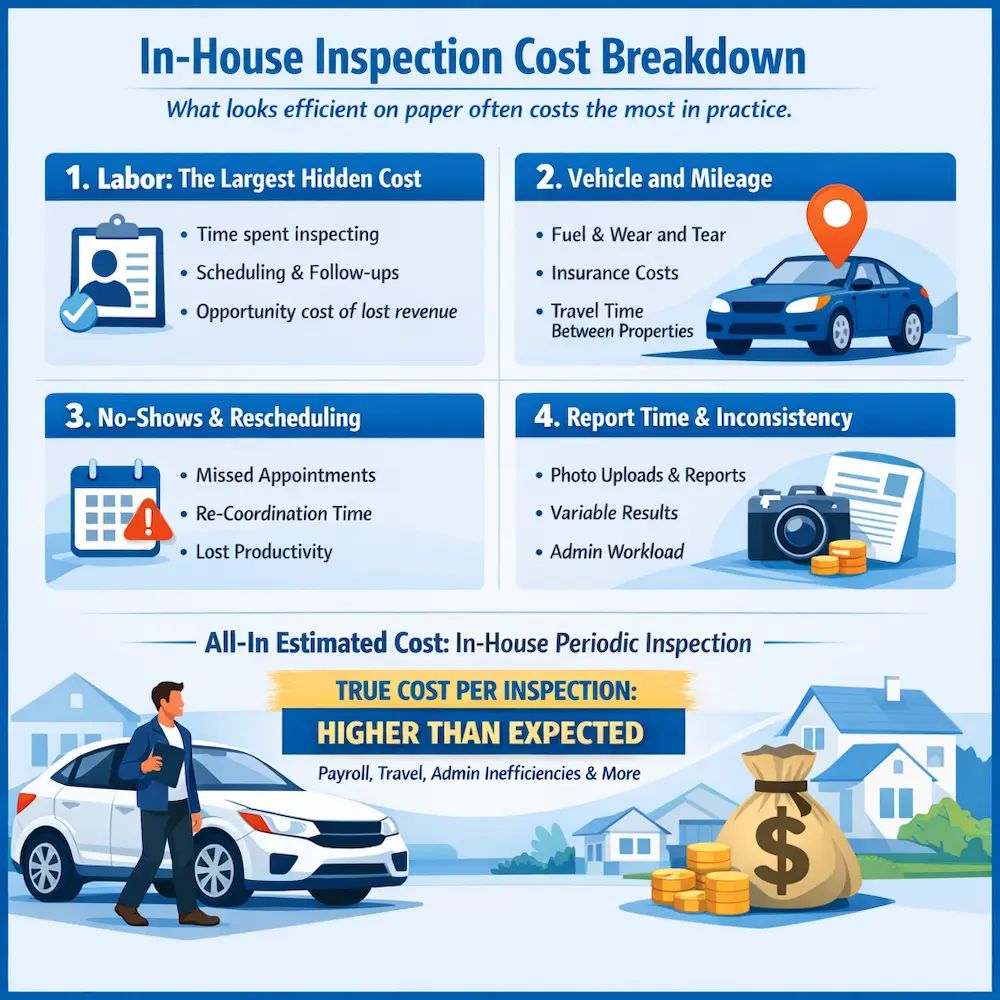In-house inspections are the default model for most smaller and mid-size property management companies. A staff member — often the property manager themselves — handles the scheduling, drives to the property, conducts the inspection, and generates the report.
Here is what that actually costs, broken down:
### **Labor: The Largest Hidden Cost**
A property manager earning $50,000 per year costs roughly $24 per hour in direct compensation before benefits, payroll taxes, or overhead. A senior property manager or operations lead earning $65,000 costs approximately $31 per hour.
A single in-house periodic inspection typically consumes:
- 15–30 minutes of scheduling and pre-inspection coordination
- 20–45 minutes of drive time each way (varies significantly by market and property density)
- 30–60 minutes for the inspection itself
- 20–40 minutes for report completion and photo organization
Total time per inspection: 1.5 to 3.5 hours, with 2 hours being a reasonable average for a well-run operation in a mid-density market.
At $24–$31 per hour, the labor cost alone is $48 to $108 per inspection — before a single other expense is added.
### **Vehicle and Mileage**
The [IRS standard mileage rate for 2025](https://www.irs.gov/tax-professionals/standard-mileage-rates "IRS standard mileage rate for 2025") is $0.70 per mile. A round trip of 20 miles (not unusual in suburban or rural markets) adds $14 per inspection. For property managers averaging 30-mile round trips across a mixed portfolio, mileage alone adds $21 per inspection.
Annual vehicle wear, insurance, and depreciation allocated to inspection-related mileage add meaningful additional cost that most operators don’t track.
### **No-Shows and Rescheduling**
Industry data consistently shows that tenant no-show rates for in-person inspections run between 15% and 25% for portfolios without a formal tenant communication and reminder process. A 20% no-show rate means that for every 5 inspections scheduled, 1 results in a wasted trip.
If the average in-house inspection costs $75 in time and mileage, a 20% no-show rate effectively adds $15 to the average cost of every inspection that does get completed — because the cost of the failed trip gets distributed across the successful ones.
### **Report Time and Quality Inconsistency**
Reports completed in the field or immediately after an inspection are generally more thorough than reports filled in at the end of a long inspection day. But the reality for most in-house inspection programs is that report completion is deferred — photos are organized later, notes are filled in from memory, and the quality of [documentation](https://residentinspect.com/blog/better-inspection-documentation-can-reduce-disputes/ "How Better Inspection Documentation Can Significantly Reduce Disputes") degrades as the volume of inspections per day increases.
This isn’t a criticism of property managers. It’s an acknowledgment that in-house inspections don’t have a dedicated documentation workflow — and the cost shows up later, when a [security deposit dispute ](https://www.thelopezlawgroup.com/security-deposit-disputes/ "security deposit dispute ")has weak documentation supporting it.
### **All-In Estimated Cost: In-House Periodic Inspection**
Conservative estimate (urban market, dense portfolio, experienced staff): $55–$75 per inspection Realistic estimate (suburban market, average driving, 2 staff hours): $75–$100 per inspection High estimate (rural or dispersed portfolio, longer drives, frequent no-shows): $100–$150+ per inspection
## **Third-Party In-Person Rental Property Inspection Service Cost**
Some property management companies outsource inspections to third-party in-person inspection services — typically contractors or inspection firms that conduct walkthroughs on their behalf. This is usually to reduce liability and [stay compliant with state law](https://residentinspect.com/blog/rental-property-inspection-laws-by-state/ "Rental Property Inspection Laws by State: What You Need to Know in 2026").

The benefit is that the property manager’s time is freed from the inspection itself. The drawbacks are cost and quality control.
Typical third-party in-person inspection rates in 2025 range from $100 to $175 per inspection for a standard single-family home. Multi-family units and larger properties command higher rates. Some markets with limited inspection service availability push rates even higher.
These fees typically cover the inspection and a basic report. Fully branded reports, [customized checklists](/blog/rental-property-inspection-checklist/ "customized checklists"), and integration with property management software are often add-on services or not available at all.
At $125 per inspection as a midpoint estimate, a 100-property portfolio conducting semi-annual periodic inspections spends $25,000 per year on inspection services — plus the coordination overhead that still falls on the property manager’s plate.
Third-party in-person inspection services solve the time problem. They don’t solve the cost problem.
## **Virtual Inspection Service Cost**
[Professional virtual inspection services](https://residentinspect.com/our-virtual-inspection-software/ "Professional virtual inspection services") — where a trained inspector conducts the walkthrough via live video call with the tenant — represent a fundamentally different cost structure.
[See Our Complete Virtual Property Inspection Guide](https://residentinspect.com/blog/virtual-property-inspections-guide/ "Complete Virtual Property Inspection Guide")
Because there is no travel involved and inspectors can conduct significantly more inspections per day than in-person inspectors, the economics of virtual inspection services are dramatically more favorable.
[Resident Inspect’s pricing is transparent](https://residentinspect.com/pricing/ "Pricing & Plans") and significantly below both in-house and third-party in-person alternatives. Property managers using virtual inspection services typically spend 60% less per inspection compared to in-house costs and 50–60% less compared to third-party in-person rates.
At a representative rate of $45–$65 per virtual inspection:
A 100-property portfolio conducting semi-annual inspections: $9,000–$13,000 per year Compared to in-house at $75 per inspection: $15,000 per year — a savings of $2,000–$6,000 Compared to third-party in-person at $125 per inspection: $25,000 per year — a savings of $12,000–$16,000
At 200 properties, those savings double. At 300 properties, they become significant enough to fund additional staff, marketing, or owner-facing services.
Beyond the direct per-inspection savings, virtual inspections eliminate the indirect costs that in-house inspections carry: no mileage, no vehicle wear, no no-show wasted trips, and no report-quality degradation from inspection fatigue.
## See Virtual Inspections in Action
Get a personalized demo to discover how virtual inspections can save time, cut labor hours, and boost property management efficiency.
[Get Your Demo](https://residentinspect.com/book-a-demo/)Prefer to talk? [Call our team](tel:+19042011102).
## **The Full Cost Comparison at Scale**
Here’s what the numbers look like across three portfolio sizes at semi-annual periodic inspection frequency:
### **50-Property Portfolio (100 inspections/year)**
In-house at $80/inspection: $8,000/year Third-party in-person at $125/inspection: $12,500/year Virtual at $55/inspection: $5,500/year Annual savings vs. in-house: $2,500 Annual savings vs. third-party: $7,000
### **100-Property Portfolio (200 inspections/year)**
In-house at $80/inspection: $16,000/year Third-party in-person at $125/inspection: $25,000/year Virtual at $55/inspection: $11,000/year Annual savings vs. in-house: $5,000 Annual savings vs. third-party: $14,000
### **250-Property Portfolio (500 inspections/year)**
In-house at $80/inspection: $40,000/year Third-party in-person at $125/inspection: $62,500/year Virtual at $55/inspection: $27,500/year Annual savings vs. in-house: $12,500 Annual savings vs. third-party: $35,000
At 250 properties, the difference between virtual and third-party in-person inspection services is $35,000 per year. That is a full-time staff salary. It is a significant marketing budget. It is the difference between a company that is operationally constrained and one that has room to grow.
Cost Comparison
### The Full Cost Comparison at Scale
Here’s what the numbers look like across three portfolio sizes at semi-annual periodic inspection frequency:
| Portfolio Size | Inspections/Year | In-House Cost | Third-Party In-Person | Virtual Inspection Cost | Savings vs. In-House | Savings vs. Third-Party |
|---|---|---|---|---|---|---|
| **50 Properties** | 100 | $8,000/year ($80/inspection) | $12,500/year ($125/inspection) | $5,500/year ($55/inspection) | $2,500/year | $7,000/year |
| **100 Properties** | 200 | $16,000/year ($80/inspection) | $25,000/year ($125/inspection) | $11,000/year ($55/inspection) | $5,000/year | $14,000/year |
| **250 Properties** | 500 | $40,000/year ($80/inspection) | $62,500/year ($125/inspection) | $27,500/year ($55/inspection) | $12,500/year | $35,000/year |
At 250 properties, the difference between virtual and third-party in-person inspection services is $35,000 per year.
That is a full-time staff salary. It is a significant marketing budget. It is the difference between a company that is operationally constrained and one that has room to grow.
## **What You Get for the Cost Difference**
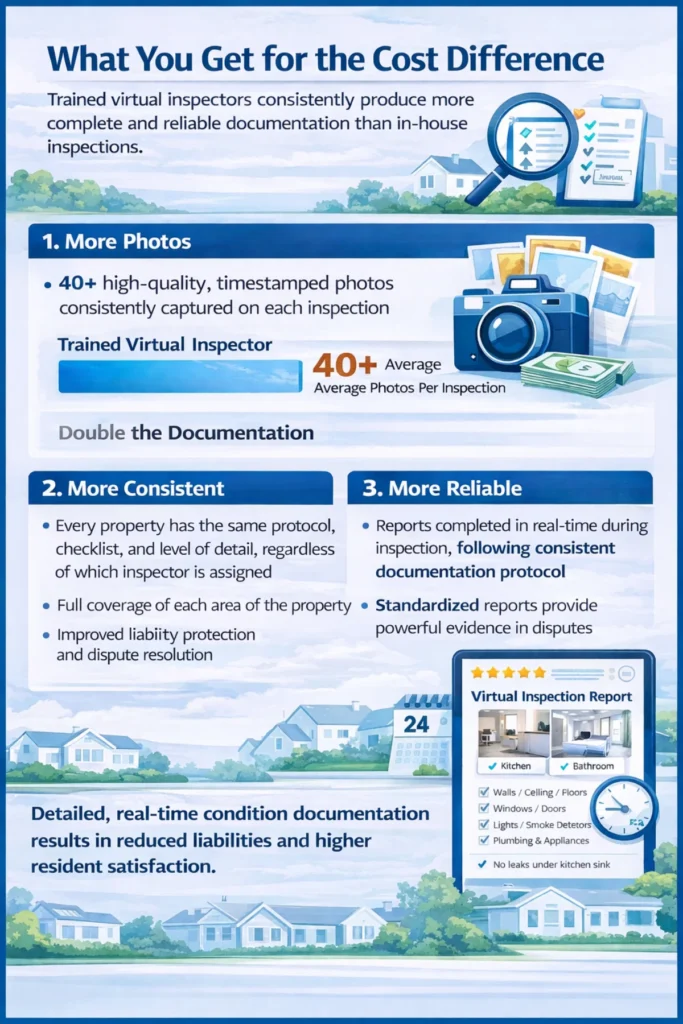
The cost comparison above would be straightforward if virtual inspections produced lower-quality documentation than in-person alternatives. But that isn’t what the data shows.
Professional virtual inspections conducted by a trained, third-party inspector with a defined protocol consistently produce more photos, more consistent documentation, and more reliable coverage than in-house inspections conducted by property managers juggling a full schedule. The inspector’s only job during the inspection is the inspection.
Reports are completed during or immediately after the inspection — not at the end of an 8-inspection day. Photos are captured in real time with a consistent standard. The same areas are covered on every property. The same checklist is followed every time, [what an apartment inspection actually covers](https://residentinspect.com/blog/what-do-apartment-inspections-look-for/) doesn’t change because the inspector is having a slow week.
This documentation consistency has direct financial value beyond the per-inspection cost. When a [security deposit dispute](https://residentinspect.com/blog/better-inspection-documentation-can-reduce-disputes/ "How Better Inspection Documentation Can Significantly Reduce Disputes") arises, and you have a detailed, timestamped virtual inspection report with 40 photos — compared to a sparse in-house report completed from memory — the quality of documentation is not equivalent, and the outcome of the dispute often reflects that.
## **When In-House Inspections Still Make Sense**
In-house inspections are not always the wrong choice. There are situations where keeping inspections internal is the right call:
Move-in inspections for high-value properties where owner relationships require direct staff involvement. Some owners expect their property manager to personally conduct the move-in walkthrough, and that relationship value is real.
Move-out inspections where security deposit deductions are anticipated. When you expect a contentious move-out, having your own staff conduct the inspection — with the tenant present where possible — gives you direct control over the documentation process.
Small portfolios where the volume of inspections doesn’t justify a formal third-party system. If you manage 15 properties, the operational overhead of setting up a virtual inspection workflow may not be worth it compared to doing inspections yourself.
Properties with documented access or compliance history that requires a more hands-on approach.
The practical model most property management companies land on: virtual inspections for periodic walkthroughs across the standard portfolio, in-house or in-person for move-in, move-out, and high-complexity situations.
## Rental Property Inspection Cost Calculator
## Property Inspection Cost Calculator
Find out what your inspections are actually costing you per year.
1
Total Inspections Per Year
Include periodic, move-in, and move-out inspections.
Periodic Inspections
Move-In Inspections
Move-Out Inspections
Total inspections: 0
2
Average Time Per Inspection (hours)
Scheduling + drive time (both ways) + inspection + report. Be honest!
Scheduling & Admin hrs
Drive Time (round trip) hrs
Inspection Itself hrs
Report Completion hrs
Total time per inspection: 0 hrs
3
Effective Hourly Labor Cost
Total compensation (salary + benefits + payroll taxes) ÷ annual hours worked.
Total Annual Compensation ($) $
Annual Hours Worked hrs
Effective hourly rate: $0.00/hr
4
Mileage Cost Per Inspection
IRS mileage rate is $0.70/mile for 2025.
Avg Round-Trip Miles mi
IRS Mileage Rate ($/mi) $
Mileage cost per inspection: $0.00
5
No-Show Cost Factor
A 20% no-show rate multiplies your per-inspection cost by 1.25 to account for wasted trips.
Estimated No-Show Rate %
No-show multiplier: 1.00×
6
Direct Annual Costs
Software subscriptions, report tools, admin support, etc.
Total Annual Direct Costs ($) $
## Your Results
Cost Per Inspection
$0
Total Inspections / Year
0
Annual Labor Cost
$0
Annual Mileage Cost
$0
Total Annual Inspection Cost
$0
↺ Reset Calculator
Results are estimates. Actual costs may vary based on your specific operation.
## **How to Calculate Your Current Rental Property Inspection Cost**
If you want to know what your inspections are actually costing before making any changes, here is a straightforward calculation:
**Step 1:** Count your total inspections per year. Include all periodic inspections, [move-in inspections, and move-out inspections](https://www.apartments.com/rental-manager/resources/leases/everything-you-need-know-about-move-inmove-out-inspections "move-in inspections, and move-out inspections").
**Step 2:** Estimate average time per inspection. Include scheduling time, drive time both ways, the inspection itself, and report completion. Be honest — most property managers underestimate this.
**Step 3:** Multiply by your effective hourly labor cost. Use total compensation including benefits and payroll taxes, divided by annual hours worked. Don’t use base salary alone.
**Step 4:** Add mileage cost. Multiply average round-trip miles per inspection by the IRS mileage rate ($0.70 for 2025).
**Step 5**: Add a no-show cost factor. If your no-show rate is 20%, multiply your per-inspection cost by 1.25 to account for the wasted trips that are built into your average.
**Step 6:** Add any direct costs. Inspection software subscriptions, report tools, or administrative support time.
Total annual inspection cost divided by total inspections completed equals your true cost per inspection. For most property management companies running this calculation for the first time, the result is higher than expected.
Cost Analysis
### How to Calculate Your Current Inspection Cost
If you want to know what your inspections are actually costing before making any changes, here is a straightforward calculation:
**Step 1: Count your total inspections per year.** Include all periodic inspections, move-in inspections, and move-out inspections.
**Step 2: Estimate average time per inspection.** Include scheduling time, drive time both ways, the inspection itself, and report completion. Be honest — most property managers underestimate this.
**Step 3: Multiply by your effective hourly labor cost.** Use total compensation including benefits and payroll taxes, divided by annual hours worked. Don’t use base salary alone.
**Step 4: Add mileage cost.** Multiply average round-trip miles per inspection by the IRS mileage rate **($0.70 for 2025)**.
**Step 5: Add a no-show cost factor.** If your no-show rate is 20%, multiply your per-inspection cost by **1.25** to account for the wasted trips built into your average.
**Step 6: Add any direct costs.** Include inspection software subscriptions, report tools, or administrative support time.
**Formula:** Total annual inspection cost divided by total inspections completed equals your true cost per inspection.
For most property management companies running this calculation for the first time, the result is higher than expected.
## **Frequently Asked Questions**
### How much does a move-in inspection cost compared to a periodic inspection?
Move-in inspections are typically more involved than periodic inspections — more items to document, the tenant is present and signing off, and the stakes of the documentation are higher. In-house move-in inspections cost more in time than periodic inspections for the same property. Third-party in-person services often charge a premium for move-in inspections. Virtual inspection services can conduct move-in inspections at a rate comparable to periodic inspections, though many property managers still prefer in-person move-ins for high-value properties.
### Is the cheapest inspection option always the best one?
No. The right inspection option is the one that delivers defensible documentation at a cost that makes operational sense for your portfolio. A $25 tenant self-inspection that produces unusable documentation is not cheaper than a $55 virtual inspection that produces a legally defensible report — it’s more expensive, because the cost of a security deposit dispute you can’t win is far higher than the inspection itself.
### Do virtual inspections cost less because they’re lower quality?
No. The cost advantage of virtual inspections comes from the elimination of travel — not from reduced inspection quality or shorter inspection time. A professional virtual inspection conducted by a trained inspector following a defined protocol produces more consistent documentation than most in-house inspections, at significantly lower cost.
### What is included in a virtual inspection service fee?
A professional virtual inspection service fee typically includes tenant scheduling and all communications, inspection reminders, the live video inspection itself, photo capture, report generation, and delivery of the completed branded report to the property manager. Resident Inspect includes all of these in a single flat fee with no hidden add-ons.
### Can I negotiate lower rates for high-volume inspection programs?
Yes. If your portfolio generates a consistent volume of inspections, most professional virtual inspection services including Resident Inspect are willing to discuss volume pricing. The operational predictability of a high-volume client is valuable, and that value is often reflected in the pricing.
See our other [Frequently Asked Questions](https://residentinspect.com/faq/ "Frequently Asked Questions")
## **Summary** of Rental Property Inspection Cost
The real cost of rental property inspections is higher than most property managers think — and the gap between in-house, third-party, and virtual inspection models is larger than most realize.
At $75–$100 per in-house inspection and $100–$175 per third-party in-person inspection, the annual inspection overhead for a 100-property portfolio runs $15,000 to $25,000 per year. Virtual inspection services cut that cost by 50–60% while producing more consistent, more defensible documentation.
The math is not complicated. The question is whether your current inspection program is built around what’s always been done — or around what actually makes operational and financial sense for the portfolio you’re running today.
Resident Inspect handles periodic inspections via live video at a fraction of the cost of in-person alternatives. Tenant scheduling, reminders, the inspection, and a branded report delivered directly to you. No travel. No no-shows. Available in all 50 states. Get your inspection cost quote at residentinspect.com.

Aaron Cooper Founder & CEO
After more than 20 years as a landlord and property management company owner-operator, Aaron Cooper built Resident Inspect to solve a problem he experienced firsthand: the inspection process was broken, expensive, and impossible to scale. Resident Inspect is the result — a live virtual inspection service that replaces in-person inspections with a faster, more consistent, and more defensible process. [See Full Bio](https://residentinspect.com/about-us/aaron-cooper/)
[Facebook](https://www.facebook.com/residentinspect/) [Instagram](https://www.instagram.com/residentinspect/) [TikTok](https://www.tiktok.com/@residentinspectofficial) [Pinterest](https://www.pinterest.com/aaron2762/) [YouTube](https://www.youtube.com/@ResidentInspect) [LinkedIn](https://www.linkedin.com/in/resident-inspect-a00b7a376/)
**Categories:** Blog
---
### [The Hidden Costs of Property Maintenance & How Smart Property Managers Stay Ahead](https://residentinspect.com/blog/hidden-costs-of-property-maintenance/)
**Published:** February 6, 2025
**Author:** Aaron Cooper
**Excerpt:** Learn how to make property maintenance a breeze in our latest article! Property maintenance is the resident evil of property management. It’s the part of the job that keeps tenants and owners happy, properties in good shape, and legal headaches at bay. But it’s also a money pit, and a massive time drain, and nobody really wants to be spending their days chasing contractors to fix problems on houses they don’t even own.
**Content:**
Property maintenance is the resident evil of property management. It’s the part of the job that keeps tenants and owners happy, properties in good shape, and legal headaches at bay. But it’s also a **money pit**, and a massive **time drain,** and nobody really wants to be spending their days chasing contractors to fix problems on houses they don’t even own.
If you’ve been in property management (or even just owned your home) for more than five minutes, you already know that a small maintenance issue can quickly spiral into a costly repair. Even a minor leak under the sink will turn into a **$10,000 mold remediation** project in a few months if not identified and quickly fixed. And if a tenant’s stove stops working and you’re not on top of the repair, they might take matters into their own hands and wheel a **gas grill into the kitchen** (yes, this actually happened).
We sat down with **Aaron Cooper, property management veteran and founder of** [**Resident Inspect,**](https://residentinspect.com/) to discuss how maintenance eats into your budget, why inspections matter, and how technology is making it easier than ever to stay ahead of costly problems. Whether you’re managing **20 properties or 500**, this guide will help you **protect your bottom line, reduce stress, and keep both tenants and owners happy**.
Watch the full interview here!
Table Of Contents
1. [The True Cost of Property Maintenance (And Why It’s More Expensive Than You Think)](#the-true-cost-of-property-maintenance-and-why-its-more-expensive-than-you-think)
2. [Real-World Maintenance Nightmares (And How to Avoid Them)](#real-world-maintenance-nightmares-and-how-to-avoid-them)
3. [How Smart Property Managers Stay Ahead of Maintenance Issues](#how-smart-property-managers-stay-ahead-of-maintenance-issues)
4. [The Psychology of Maintenance](#the-psychology-of-maintenance)
5. [Handling Maintenance Emergencies Like a Pro](#handling-maintenance-emergencies-like-a-pro)
6. [Legal & Compliance Risks in Property Maintenance: What Property Managers Need to Know](#legal-compliance-risks-in-property-maintenance-what-property-managers-need-to-know)
7. [The Future of Property Maintenance: AI, Automation & Smarter Tech](#the-future-of-property-maintenance-ai-automation-smarter-tech)
8. [Final Thoughts](#final-thoughts)
## **The True Cost of Property Maintenance (And Why It’s More Expensive Than You Think)**
Maintenance isn’t a **budget line item –** it’s a **full-time job** for most property managers. According to [**Buildium’s 2023 Industry Report**,](https://www.buildium.com/resource/2023-property-management-industry-report/) property managers spend **46% of their time** dealing with maintenance-related tasks. That’s nearly **half the workweek spent chasing repairs, coordinating vendors, and handling tenant complaints**. That is why many firms look at [outsourcing property management tasks](https://residentinspect.com/property-management-outsourcing/) to free up staff time.
**And the costs** **add up fast**.
### **Breaking Down the Expense**
Property maintenance expenses typically fall into three categories:
- **Routine Repairs** – Fixing leaky faucets, HVAC servicing, patching drywall. These are the predictable (but still costly) jobs that keep properties livable.
- **Emergency Maintenance** – Flooded basements, electrical failures, HVAC breakdowns in peak summer. These come with **hefty vendor charges** and (as you know) are major headaches.
- **Deferred Maintenance** – The “I’ll get to it later” category that often results in **five-figure repair bills** down the road simply because you don’t have the time in the day to sweat the minor repair jobs.
> **“Maintenance is one of the biggest time and cost burdens on property managers – It’s not a revenue generator, but how you handle it determines whether owners see you as an asset or a liability.”**
>
> Aaron Cooper
In other words, **efficient maintenance isn’t just about protecting your properties – it’s also about protecting your reputation**.
If you’re serious about property management, **you need to treat your clients’ properties as your own,** and that means keeping on top of maintenance. The client experience needs to be firmly in your crosshairs if you want to *keep* them as clients. Showing that you’re fixing small problems before they become big problems demonstrates to your client that you’re at the top of your game and that they’re in good hands.
### **The Hidden Costs of Property Maintenance**
When property managers think about maintenance expenses, they usually focus on **labor, materials, and vendor fees**. But the **real** financial drain comes from **hidden costs –** the ones that don’t show up on an invoice but can eat into your profits just as fast.

#### **Tenant Dissatisfaction & Turnover**
Delayed or poorly handled maintenance **frustrates tenants**, leading to **higher vacancy rates**. Studies show that [**70% of tenants cite slow repairs as a reason for moving out**](https://www.nmhc.org/research-insight/research-report/). Every turnover means **advertising costs, unit prep, and lost rent**, which can easily total **$2,500+ per vacant unit**.
#### **Lease Violations & Property Damage**
Ignoring small repairs often leads to **bigger problems**. A tenant with a broken HVAC system might bring in **unauthorized space heaters**, increasing **fire risk**. If plumbing leaks are left unchecked you can expect **water damage, mold growth, and costly remediation**. Without **routine inspections**, lease violations (like unauthorized pets or subletting) go unnoticed – until it’s too late, the damage is done, and the property owner is left to foot the bill while cursing your name.
#### **Legal Liabilities & Compliance Risks**
Every state has **habitability laws** requiring landlords to maintain **safe, livable conditions**. If a neglected repair leads to **injury, illness, or property damage**, you could be facing **legal action**. Mold exposure, broken stair railings, and unaddressed electrical issues are **lawsuits waiting to happen**.

#### **The Cost of Emergency Repairs**
When maintenance isn’t **proactive**, it becomes **reactive –** which means **higher costs**. Emergency repairs often come with **high rates**, and scrambling for last-minute contractors means you’ll **pay whatever they charge**.
**The solution? Preventative maintenance and regular inspections.** By catching issues early, property managers save money, reduce risk, and keep tenants happy. But conducting regular inspections has its own ungodly time and cost impacts for property managers, which is exactly why Resident Inspect is changing the face of [**property inspections.**](https://residentinspect.com/rental-property-inspections/) To see the numbers, read our breakdown of [rental property inspection cost](https://residentinspect.com/blog/how-much-does-a-rental-property-inspection-cost/).
[Find Out More](https://residentinspect.com/rental-property-inspections/)
## **Real-World Maintenance Nightmares (And How to Avoid Them)**
We often hear the same stories over and over again from property managers, but every now and then one stands out as particularly bad. Here are some of the worst **maintenance issues that keep us up at night**.
### **The Hidden Plumbing Disaster**
A **slow drip** under the sink isn’t exactly a 911 situation, but as discussed **left unchecked, minor leaks turn into wood rot, cabinet damage, and eventually mold.** Aaron recalls one case where a property manager **didn’t catch a leak for years**, and by the time they did, the **remediation cost was over $10,000**. If they had properly inspected their property, they would have been able to fix the leak for under $200.
And the problem with mold is that once it’s colonized, it’s **nearly impossible to get rid of,** even when paying that hefty price tag for professional remediation. Many property managers and landlords are tempted to do a rough patch-up job to hide the problem and avoid the expense, but the health effects of living in mold (and the potential legal liability as a result) can and should scare you off this path.
You don’t want to see surprises like this!
**How to prevent it:** Routine **inspections catch leaks before they escalate**. A quick check under sinks and around toilets during inspections can **save thousands** in future repairs. Don’t cut corners on your inspections!
### ****The Tenant Who Bypassed a Broken Stove****
In one of the more extreme cases, **a tenant whose stove had been broken for two years** decided to take matters into their own hands by **bringing a gas grill inside the house and disabling the smoke and carbon monoxide detectors.**
Now this is dangerous on multiple fronts: Not only could the house have burned down, but the resident could have become seriously ill from carbon monoxide poisoning, and all because the property manager was unresponsive and didn’t schedule the repair promptly.
Imagine if your resident brought one of these into their rental…
**How to prevent it:** **Regular mid-lease inspections** ensure tenants aren’t living with (or creating) hazardous conditions. **[Virtual inspections](https://residentinspect.com/our-virtual-inspection-software/)** make it even easier to check in without physically visiting the property, but you can’t leave it up to the tenant to do their own inspection – it’s better to leave it to the professionals.
### **Lease Violations That Could Cost You Thousands**
Unauthorized pets, illegal sublets, backyard trampolines – these **violations can lead to liability issues, extra wear and tear, and even legal trouble**.
And this is why routine inspections are a must. Back in 2021, a $1.5m home in a gated prestigious neighborhood was rented out. After a random inspection, numerous beds were found throughout the house. Lots of questions were being asked which **quickly turned into a police raid** of the property: it was found that the home was being used a brothel, and could have landed the property manager and landlord in hot water. [**You can read more about that story here.**](https://www.news4jax.com/news/local/2021/01/21/deerwood-home-used-as-luxury-brothel-jacksonville-police-say/)
> ****“One of the biggest benefits of routine inspections is catching these issues early**. **You don’t want to find out about a 100-pound Rottweiler in the unit when the lease clearly states no pets, or worse.”****
>
> Aaron Cooper
## **How Smart Property Managers Stay Ahead of Maintenance Issues**
**Proactive maintenance is all about preventing problems before they become the stuff of nightmares.** Here’s how top property managers stay ahead.
### **Schedule Preventative Maintenance During Off-Seasons**
Most property managers **react** to maintenance issues instead of **preventing** them. For example, scheduling **annual HVAC servicing in the fall or winter** ensures you’re not scrambling when summer heatwaves hit. Nobody wants to have their phone ringing with tenant complaints when the 15-year-old HVAC system goes kaput. The same goes for **roof maintenance –** cleaning gutters before spring rains can **prevent thousands in water damage,** keeping tenants and owners happy.
### **Implement a System for Maintenance Tracking**
Using **property management software** that allows for **recurring work orders** can save **countless hours**. Even **simple hacks –** like scheduling **auto-email reminders for future maintenance –** can make a big difference for those on a budget.
And this speaks to a wider point for property managers – **the more you can systematize and automate or delegate in your business, the more you stand to earn in the long run** as you stop spending your valuable time on $2 tasks.
### **Embrace Virtual Inspections**
Instead of **driving to 500 properties** every year, **virtual inspections** allow property managers to **monitor homes remotely**. Tenants walk the inspector through the property via live video, ensuring **every issue is documented –** without wasted time or travel expenses.
> **“We’ve seen property managers cut their inspection costs by 60% using virtual inspections,** **and they’re actually more thorough than in-person visits.”**
>
> Aaron Cooper
[Book Your Consultation](https://residentinspect.com/book-a-demo/)
## **The Psychology of Maintenance**
There are lots of reasons why a property manager might defer repairs – you’re pretty busy, right? But avoiding these maintenance tasks actually has a negative psychological effect on your tenant, which can lead to worse problems in future.
### **How Maintenance Affects Lease Renewals**
Tenants expect repairs within **24–48 hours – a slow** response **damages trust, which increases turnover** and increases your costs. If you want to maximize profitability you want to keep your tenants in your property for as long as possible, and that means showing your tenants that you care about their living conditions. If your tenant feels you care about the small stuff, they’ll feel looked after and be more likely to renew their lease.

### **The “Broken Window” Theory in Property Management**
The Broken Window Theory is used in criminology to suggest that visible signs of neglect and disorder, like broken windows, can lead to higher crime rates in those areas. In the same way, neglecting small property repairs can snowball into bigger problems. If tenants see **cracked walls, broken locks, or neglected landscaping**, they assume **management doesn’t care,** resulting in:
- More **lease violations** (because tenants stop caring for the unit).
- **Delayed rent payments** (because if management is unresponsive, tenants follow suit).
- **Higher vacancy rates** (because tenants leave for better-managed buildings).
### **How to Prevent This**
- Schedule **quarterly maintenance check-ins and inspections**.
- Encourage tenants to report small issues **before they escalate**.
- Use **virtual inspections** to check problem areas without in-person visits, saving you time and money.
[Find Out More](https://residentinspect.com/)
## **Handling Maintenance Emergencies Like a Pro**
### **Set Up an Emergency Response Plan**
There’s never a good reason your phone rings at 3am. Emergency maintenance calls always happen at **the worst possible time**. To avoid **middle-of-the-night panic**, property managers need:
- A **designated on-call team** for after-hours emergencies
- A **clear emergency protocol** tenants can follow (remember systematizing everything? This is part of that)
- **Pre-established vendor relationships** with 24/7 service providers
If any one of those three things is missing, the emergency can quickly deteriorate into a disaster and a potential lawsuit. We’ll have some specific tips for you in some of these areas coming up.
### **Educate Tenants on What Qualifies as an Emergency**
Not every issue requires **immediate intervention**. If tenants **understand what actually counts as urgent**, property managers **get fewer unnecessary calls**. Tenants also appreciate clear guidance around what they can and can’t contact you for – clear communication will build trust with tenants too!
### **Have Reliable Contractors on Speed Dial**
Finding **trustworthy vendors** *before* you need them is key. **“We keep relationships with both small contractors and big companies,”** Aaron explains. **“Small vendors are cost-effective, but larger firms can guarantee 24/7 service.”**
## **Legal & Compliance Risks in Property Maintenance: What Property Managers Need to Know**
Regular property maintenance helps to **avoid costly legal battles** and ensures compliance with state and federal regulations. When repairs are neglected, **landlords and property managers** don’t just risk financial losses from tenant turnover; they open themselves up to lawsuits, government fines, and reputational damage. Here we’ll discuss the **key legal risks** in property maintenance and how to stay compliant.
### **Negligence & Liability: When Delayed Maintenance Becomes a Lawsuit**
Ignoring maintenance requests is plain **bad business practice,** but it can be considered **negligence** in court. If a tenant **slips and falls on a broken step**, suffers **health issues from mold**, or **gets injured due to faulty wiring**, the landlord or property manager **can be held legally responsible**. And trust us, you don’t want that on your already full plate.
**For example:** You could face a **$50,000 lawsuit** after ignoring a tenant’s repeated complaints about mold. If the tenant develops **severe respiratory issues,** and if you **fail to document any attempt to fix the issue**, the court will likely rule in the tenant’s favor. Cases like this happen **every year**, and settlements or judgments **can easily exceed six figures**.
To avoid these risks, property managers must **act promptly on maintenance requests** and **keep thorough records** of all repairs, inspections, and tenant communications.
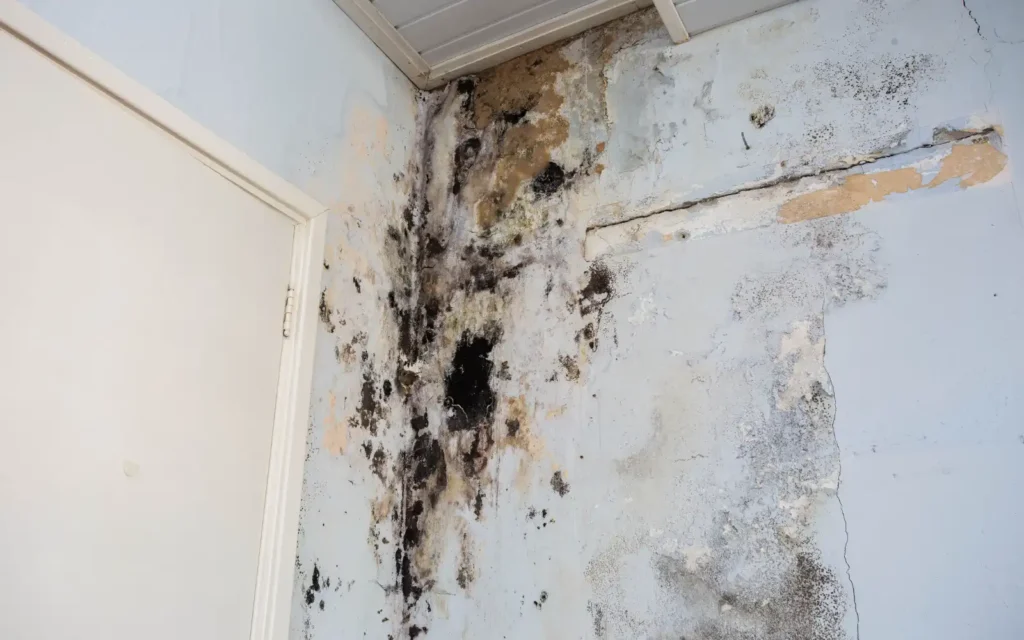
### **State & Federal Compliance: What Property Managers Must Provide**
Property managers must **comply with state habitability laws**, which outline the **minimum living standards** landlords are required to provide. While laws vary by state, some fundamental requirements apply **nationwide**:
- **Heating & Cooling:** Landlords must provide adequate heating in colder months. Some states also require **working air conditioning**.
- **Running Water & Sanitation:** Access to **clean water, functioning plumbing, and proper waste disposal** is non-negotiable.
- **Structurally Sound Living Conditions:** Properties must be **safe and livable**, with **no serious electrical, foundation, or roofing hazards**.
- **Pest-Free Units:** Infestations of **mice, roaches, or bedbugs** must be addressed, as they pose **health and safety concerns**.
- **Smoke & Carbon Monoxide Detectors:** Many states require landlords to install and maintain these life-saving devices.
Some states have **even stricter regulations**. For example,
- **California:** Landlords must provide **heating**, ensure **sewage systems function properly**, and fix any issues affecting **tenant health and safety**.
- **New York:** Tenants have a right to **safe, sanitary, and properly maintained housing**, with landlords required to provide **hot water year-round** and **heat from October to May**.
Failing to comply can result in **government fines, lawsuits, and even eviction bans** until repairs are made.
### **How Virtual Inspections Help Property Managers Stay Compliant**
One of the biggest challenges property managers face is **proving they responded to maintenance issues in a timely manner**. This is where **virtual inspections** can transform your bottom line, providing:
- **Timestamped Photo & Video Reports:** Virtual inspections provide **documented proof** of property conditions, making it easy to defend against **false tenant claims**.
- **Efficient Issue Tracking:** Reports ensure that **no maintenance request slips through the cracks**, reducing the risk of **lawsuits for negligence**.
- **Improved Record-Keeping:** Property managers can **store digital reports indefinitely**, making it easier to **prove compliance** with state laws.
By implementing **proactive inspections and digital documentation**, property managers **reduce liability risks, improve response times, and avoid costly legal battles**.
[Protect Yourself With Live Virtual Inspections](https://residentinspect.com/)
## **The Future of Property Maintenance: AI, Automation & Smarter Tech**
Historically, change has been slow in property management. It usually takes a long time, years or even decades, for advances in technology to filter through and become widely adopted. Property maintenance however is changing **fast,** with some incredible tools about to come online. Here’s what’s coming next.
### **AI-Driven Maintenance Requests**
AI-powered software can **troubleshoot tenant issues before assigning a vendor**. That means fewer unnecessary service calls, faster fixes for common issues and reduced maintenance expenses.
This may look like tenants chatting with an AI chatbot hosted on your website to diagnose and potentially fix the issue, **before the issue is escalated to a human.** AI could even look at past data, e.g. previous maintenance logs, to foresee potential problems and schedule inspections before problems arise. Smart home technology can also be leveraged to inform AI troubleshooting.

### **Remote Inspections for Work Order Follow-Ups**
Instead of relying on vendors to send blurry photos, property managers can **jump on a five-minute virtual inspection with tenants** to confirm the repair. Or they can even outsource these inspection tasks to trusted third parties, allowing them to focus on more profitable activity.
> ****“We don’t just use virtual inspections for routine check-ins. We also use them to verify work was done properly.”****
>
> Aaron Cooper
### **Automated Work Orders & Scheduling**
**Automated maintenance systems are expected to be standard in property management software** within the next year. This way property managers won’t need to remember to schedule seasonal gutter cleans, and tenants will be able to log problems, which are triaged by AI, and an appropriate vendor is automatically assigned, briefed and scheduled, all without input on the manager’s part. Property managers who adapt and implement these systems early will **save time, money, and stress,** and frankly grow their businesses faster.
## **Final Thoughts**
Property maintenance **will never be fun**, but it doesn’t have to be an endless headache. Here are the top 7 takeaways from this article:
1. **Property Maintenance is a Massive Time Drain for Property Managers**
Property managers spend nearly **half their workweek** handling maintenance tasks, from chasing vendors to responding to tenant complaints. While necessary, maintenance doesn’t generate revenue, yet it directly impacts tenant retention, owner satisfaction, and legal compliance.
2. **The Hidden Costs of Maintenance Go Beyond Labor and Materials**
T**enant dissatisfaction, lease violations, and legal risks** create financial burdens. Poorly handled maintenance leads to higher vacancy rates, costly damage, and even lawsuits if landlords fail to provide habitable conditions.
3. **Deferred Maintenance is a Budget Killer**
Small repairs left unattended **turn into five-figure expenses** down the line. A minor leak today can result in mold remediation, while an ignored HVAC issue can lead to emergency replacement at a hefty price tag.
4. **Routine & Virtual Inspections Prevent Costly Surprises**
Regular property inspections catch issues before they escalate. **Virtual inspections** offer an efficient alternative, reducing travel time and enabling managers to check properties without stepping foot on-site.
5. **Legal & Compliance Risks are a Major Liability**
Neglecting maintenance **violates state habitability laws** and exposes landlords to lawsuits. Property managers must ensure properties remain safe, livable, and in compliance with state and federal regulations. **Failing to do so can lead to massive legal settlements.**
6. **Technology & AI Are Transforming Property Maintenance**
AI-driven maintenance requests, automated work orders, and virtual inspections are set to **transform** how property managers handle repairs. Early adopters of these technologies will save **time, money, and stress.**
7. **Building an Emergency Vendor Network isn’t an “I’ll get to it” item**
Having **pre-screened vendors** for urgent repairs prevents last-minute scrambling. Property managers should establish **clear service contracts, response time guarantees, and backup vendor options** to avoid overpriced emergency fees and unreliable contractors.
If you’re looking to **stay ahead of costly repairs and streamline your maintenance process**, **Resident Inspect** is here to help. Book a consultation today and see how **virtual inspections can transform your workflow**.
[Find Out More](https://residentinspect.com/)

Aaron Cooper Founder & CEO
After more than 20 years as a landlord and property management company owner-operator, Aaron Cooper built Resident Inspect to solve a problem he experienced firsthand: the inspection process was broken, expensive, and impossible to scale. Resident Inspect is the result — a live virtual inspection service that replaces in-person inspections with a faster, more consistent, and more defensible process. [See Full Bio](https://residentinspect.com/about-us/aaron-cooper/)
[Facebook](https://www.facebook.com/residentinspect/) [Instagram](https://www.instagram.com/residentinspect/) [TikTok](https://www.tiktok.com/@residentinspectofficial) [Pinterest](https://www.pinterest.com/aaron2762/) [YouTube](https://www.youtube.com/@ResidentInspect) [LinkedIn](https://www.linkedin.com/in/resident-inspect-a00b7a376/)
**Categories:** Blog
---
### [Ultimate Guide to Documenting Rental Property Condition](https://residentinspect.com/blog/documenting-rental-property-condition/)
**Published:** January 8, 2026
**Author:** Aaron Cooper
**Content:**
Aaron Cooper
Founder & Chief Executive Officer, Resident Inspect
📍 Jacksonville, FL
Aaron Cooper is a seasoned property technology entrepreneur and inspection industry expert. As the **Founder and CEO of Resident Inspect**, he leads the development of intelligent inspection platforms that empower landlords, property managers, and investors to streamline digital inspections and ensure compliance.
🌐 [residentinspect.com](https://residentinspect.com)
✉️ <aaron@residentinspect.com>
## **Table of Contents**
1. **[Introduction](#introduction)**
2. **[Why Documenting Property Condition Matters](#why)**
3. **[What You’ll Need Before Starting](#what)**
4. **[Step‑by‑Step Guide](#step-by-step)**
- **[Use a Room‑by‑Room Checklist](#checklist)**
- **[Take High‑Quality Photos and Videos](#photos)**
- **[Make Detailed Written Notes](#notes)**
- **[Record Meter Readings & Appliance Info](#record)**
- **[Conduct a Move‑In Walk‑Through With the Tenant](#conduct)**
- **[Sign the Inspection Report](#sign)**
- **[Repeat at Move‑Out](#repeat)**
5. **[Top Digital Tools to Simplify Rental Inspections](#digital-tools)**
6. **[Best Practices for Long‑Term Documentation](#best-practices)**
7. **[Common Mistakes to Avoid](#mistakes)**
8. **[Internal & External Resources](#internal)**
9. [**FAQs About Documenting Rental Property Condition**](#faqs)
10. **[Conclusion](#conclusion)**
## **Introduction** to Documenting Rental Property Condition
As a responsible landlord, you should document the condition of your rental property. This protects your investment and helps [avoid disputes](https://residentinspect.com/blog/better-inspection-documentation-can-reduce-disputes/). It also sets clear expectations for move-in and [move-out](https://residentinspect.com/blog/top-landlord-move-out-inspections-mistakes/). A structured approach ensures transparency and trust between you and your tenants.
## **Why Documenting Rental Property Condition Matters**
Accurate documentation helps you:
- Support claims for damage beyond [normal wear and tear](https://www.apartments.com/rental-manager/resources/maintenance/landlords-guide-normal-wear-and-tear-rentals)
- Justify security deposit deductions
- Maintain legal and transparent records
- Avoid disputes with tenants over pre‑existing issues
Using comprehensive documentation prevents misunderstandings and protects both parties.
## **What You’ll Need Before Starting**
Before you begin documenting condition, gather:
- A **detailed inspection checklist**
- A **camera or smartphone** (with timestamp capability)
- Digital or paper **notes**
- Access to utility meters
- Tenant cooperation for walkthroughs
## **Step‑by‑Step Guide** for Documenting Rental Property Condition
### **Use a Room‑by‑Room Checklist**
Begin with a checklist that includes every room and area of the property. This should cover walls, floors, fixtures, and appliances. A detailed checklist ensures nothing is overlooked.
### **Take High‑Quality Photos and Videos**
Visuals provide powerful evidence. Capture:
- Wide shots of each room
- Close‑ups of existing marks, scratches, or damage
- Timestamped images or video clips
Document before and after tenant occupancy to clearly compare conditions.
### **Make Detailed Written Notes**
Photos should be paired with clear written descriptions. Avoid vague terms like “okay.” Instead describe specifics — e.g., *“scratch approx. 3 in. on kitchen cabinet door.”*
### **Record Meter Readings & Appliance Info**
Include utility meter readings and appliance model/serial numbers. This guards against disputes around usage and machine condition.
### **Conduct a Move‑In Walk‑Through With the Tenant**
[Schedule the inspection with the tenant](https://residentinspect.com/book-a-demo/) present. Walk through together, note concerns, and encourage tenant input. This builds agreement and reduces future conflict.
### **Sign the Inspection Report**
Once complete:
✔ Landlord signs
✔ Tenant signs
Provide copies to all parties. A signed report adds legal weight to the documentation.
### **Repeat at Move‑Out**
Repeat the same process when the lease ends. Compare conditions against the original report to identify damage beyond normal wear and tear. Our [move-out inspection checklist](https://residentinspect.com/blog/rental-property-inspection-checklist/) walks you through each room so the two reports line up.
## **Top Digital Tools to Simplify Rental Inspections**
Using a property inspection app or platform — like *[ResidentInspect.com](https://residentinspect.com)* — helps:
- Create professional reports
- Store timestamps
- Organize photos and notes digitally
- Save time & [money](https://residentinspect.com/blog/save-money-with-expert-inspection-reporting/ "money")
Explore tools that automate timestamping and secure storage.
## **Best Practices for Long‑Term Documentation**
- Organize files by **date, address, and tenant**
- Backup digital records in the cloud
- Conduct intermediate inspections during long tenancies
- Provide clear reports to tenants promptly
## **Common Mistakes to Avoid**
❌ Skipping walkthroughs
❌ Using vague descriptions
❌ Failing to document utility readings
❌ Not getting tenant acknowledgement
### **External Guides**
- [Move‑In & Move‑Out Inspection Tips — LandlordStudio ](https://www.landlordstudio.com/blog/move-in-move-out-inspection-template)
- [Rental Property Walk‑Through Checklist — Avail ](https://www.avail.co/education/articles/rental-property-walk-through-checklist)
- [Rental Inspection Best Practices — All Property Management ](https://www.allpropertymanagement.com/blog/post/landlord-property-inspection-guide/)
## See Virtual Inspections in Action
Get a personalized demo to discover how virtual inspections can save time, cut labor hours, and boost property management efficiency.
[Get Your Demo](https://residentinspect.com/book-a-demo/)Prefer to talk? [Call our team](tel:+19042011102).
## Documenting Rental Property Condition: FAQs
### When should I schedule the property inspection?
Ideally before lease start (move‑in) and immediately after tenant vacates (move‑out).
### How many photos should I take for each room?
Capture wide shots plus close‑ups of fixtures, damage, and utilities. More images improve documentation quality.
### Is tenant presence required?
Not legally in all areas, but tenant participation reduces future disagreements.
### What’s the difference between normal wear and tear and damage?
Normal wear includes minor scuffs; damage includes burns, dents, deep scratches, or broken fixtures. Use documented checklists to discern this at move‑out.
### Can I use video instead of photos?
Yes! Video walkthroughs with narration are excellent evidence when paired with written notes.
## Final Words
Documenting your rental property’s condition doesn’t have to be complicated. With a structured inspection checklist, clear photos, detailed notes, and tenant collaboration, you’ll protect your investment and avoid disputes. Use tools like **ResidentInspect.com** to streamline your process and maintain professional, reliable records.

Aaron Cooper Founder & CEO
After more than 20 years as a landlord and property management company owner-operator, Aaron Cooper built Resident Inspect to solve a problem he experienced firsthand: the inspection process was broken, expensive, and impossible to scale. Resident Inspect is the result — a live virtual inspection service that replaces in-person inspections with a faster, more consistent, and more defensible process. [See Full Bio](https://residentinspect.com/about-us/aaron-cooper/)
[Facebook](https://www.facebook.com/residentinspect/) [Instagram](https://www.instagram.com/residentinspect/) [TikTok](https://www.tiktok.com/@residentinspectofficial) [Pinterest](https://www.pinterest.com/aaron2762/) [YouTube](https://www.youtube.com/@ResidentInspect) [LinkedIn](https://www.linkedin.com/in/resident-inspect-a00b7a376/)
**Categories:** Blog
---
### [Are Virtual Rental Property Inspections as Good as In-Person Inspections?](https://residentinspect.com/blog/are-virtual-rental-property-inspections-as-good-as-in-person-inspections/)
**Published:** May 20, 2026
**Author:** Aaron Cooper
**Content:**
 Aaron Cooper
Founder & Chief Executive Officer, Resident Inspect
📍 Jacksonville, FL
Aaron Cooper is a seasoned property technology entrepreneur and inspection industry expert. As the **Founder and CEO of Resident Inspect**, and #1 Rental Home Inspector. He leads the development of intelligent inspection platforms that empower landlords, property managers, and investors to streamline digital inspections and ensure compliance.
🌐 [residentinspect.com](https://residentinspect.com)
## Table of Contents
- [What Is an In-Person Rental Property Inspection?](https://residentinspect.com/blog/are-virtual-rental-property-inspections-as-good-as-in-person-inspections/#what-is-in-person-inspection)
- [What Is a Guided Virtual Rental Property Inspection?](https://residentinspect.com/blog/are-virtual-rental-property-inspections-as-good-as-in-person-inspections/#what-is-guided-virtual-inspection)
- [The Real Question: What Is the Goal of the Inspection?](https://residentinspect.com/blog/are-virtual-rental-property-inspections-as-good-as-in-person-inspections/#the-real-question)
- [When In-Person Inspections Are Better](https://residentinspect.com/blog/are-virtual-rental-property-inspections-as-good-as-in-person-inspections/#when-in-person-is-better)
- [When Virtual Inspections Are a Strong Fit](https://residentinspect.com/blog/are-virtual-rental-property-inspections-as-good-as-in-person-inspections/#when-virtual-is-strong-fit)
- [Virtual Inspections vs. In-Person Inspections: Pros and Cons](https://residentinspect.com/blog/are-virtual-rental-property-inspections-as-good-as-in-person-inspections/#pros-cons-comparison)
- [Pros of In-Person Inspections](https://residentinspect.com/blog/are-virtual-rental-property-inspections-as-good-as-in-person-inspections/#pros-in-person)
- [Cons of In-Person Inspections](https://residentinspect.com/blog/are-virtual-rental-property-inspections-as-good-as-in-person-inspections/#cons-in-person)
- [Pros of Guided Virtual Inspections](https://residentinspect.com/blog/are-virtual-rental-property-inspections-as-good-as-in-person-inspections/#pros-virtual)
- [Cons of Guided Virtual Inspections](https://residentinspect.com/blog/are-virtual-rental-property-inspections-as-good-as-in-person-inspections/#cons-virtual)
- [Side-by-Side Comparison](https://residentinspect.com/blog/are-virtual-rental-property-inspections-as-good-as-in-person-inspections/#side-by-side-comparison)
- [The Best Inspection Strategy: Use Each Method for the Right Situation](https://residentinspect.com/blog/are-virtual-rental-property-inspections-as-good-as-in-person-inspections/#best-inspection-strategy)
- [Do Virtual Inspections Save Money Compared to In-Person Inspections?](https://residentinspect.com/blog/are-virtual-rental-property-inspections-as-good-as-in-person-inspections/#do-virtual-save-money)
- [Are Virtual Inspections More Convenient for Residents?](https://residentinspect.com/blog/are-virtual-rental-property-inspections-as-good-as-in-person-inspections/#are-virtual-more-convenient)
- [Are Virtual Inspection Reports Good Enough for Owners?](https://residentinspect.com/blog/are-virtual-rental-property-inspections-as-good-as-in-person-inspections/#are-reports-good-enough)
- [Common Misconceptions About Virtual vs. In-Person Inspections](https://residentinspect.com/blog/are-virtual-rental-property-inspections-as-good-as-in-person-inspections/#common-misconceptions)
- [When a Virtual Inspection Should Lead to an In-Person Follow-Up](https://residentinspect.com/blog/are-virtual-rental-property-inspections-as-good-as-in-person-inspections/#when-virtual-leads-to-follow-up)
- [Why Property Managers Choose Resident Inspect](https://residentinspect.com/blog/are-virtual-rental-property-inspections-as-good-as-in-person-inspections/#why-choose-resident-inspect)
- [Final Thoughts](https://residentinspect.com/blog/are-virtual-rental-property-inspections-as-good-as-in-person-inspections/#final-thoughts)
For many property managers, routine rental property inspections are necessary but difficult to complete consistently.
Inspections help protect owner assets, document property condition, identify visible concerns, and confirm that residents are caring for the home. But traditional in-person inspections can also be time-consuming, expensive, and hard to scale across a growing portfolio.
That is why more property management companies are considering virtual rental property inspections.
But one question usually comes up early: Are virtual inspections as good as in-person inspections?
The honest answer is: it depends on the purpose of the inspection.
Virtual inspections are not the right fit for every situation. There are times when an in-person inspection is still necessary. But for many routine occupied rental property inspections, guided virtual inspections can provide the visibility, documentation, and accountability property managers need while reducing travel time, scheduling friction, and overall inspection costs.
The key is understanding when each method makes sense.
## What Is an In-Person Rental Property Inspection?
An in-person rental property inspection is the traditional inspection method most property managers are familiar with.
A property manager, inspector, field staff member, maintenance technician, or third-party vendor physically visits the rental home to walk through the property, document condition, take photos, and identify visible issues.
In-person inspections can be valuable because the inspector is physically present. They can walk the property directly, look closely at areas of concern, test certain items when appropriate, and make judgment calls based on what they see in person.
For high-risk situations, physical presence can be important.
But in-person inspections also come with operational challenges.
They require scheduling, driving, parking, access coordination, waiting on residents, taking photos, writing reports, uploading documentation, and following up after the visit. For property managers with large portfolios, those steps can consume a significant amount of staff time.
## What Is a Guided Virtual Rental Property Inspection?
A guided virtual rental property inspection is a live remote inspection conducted through video technology. For a full explanation of how this process works, visit our page on [What Are Virtual Rental Property Inspections](https://residentinspect.com/blog/virtual-property-inspections-guide/).
The resident is physically inside the property and joins the inspection from a smartphone. A trained inspection professional connects by live video and guides the resident through the home in real time.
The inspector directs where the resident should go, what areas should be shown, when closer views are needed, and what documentation should be captured.
With Resident Inspect, the resident is not responsible for inspecting the property on their own. The resident provides access through video, while a trained third-party inspector leads the inspection process.
That distinction matters.
A guided virtual inspection is not the same as a tenant self-inspection. It is a live inspection process led by a professional, using technology to remove the need for drive time and onsite travel.
## The Real Question: What Is the Goal of the Inspection?
When comparing virtual inspections and in-person inspections, the most important question is not which method is always better.
The better question is: What is the inspection trying to accomplish?
Some inspections require physical presence. Others are primarily about visibility, documentation, and accountability.
Routine occupied rental inspections usually focus on questions like: What is the general condition of the property? Are there visible maintenance concerns? Are there obvious lease compliance issues? Are there signs of unauthorized pets, occupants, or damage? Are there issues that should be escalated for follow-up? Can the owner receive a clear update on the property condition?
For those goals, a guided virtual inspection can often be a strong fit.
But if the inspection requires physical testing, complex diagnosis, legal documentation, or a detailed hands-on review, an in-person inspection may be the better choice.
## When In-Person Inspections Are Better
In-person inspections still have an important place in property management.
There are situations where sending someone to the property is the right decision.
In-person inspections may be better for: major property damage, serious maintenance concerns, safety hazards, legal or eviction-related situations, suspected abandonment, complex repair diagnosis, situations requiring physical testing, properties with significant resident conflict, move-out disputes, insurance-related documentation, and cases where the resident cannot or will not participate.
If a property has a major water leak, structural concern, fire damage, severe neglect, or a safety issue, a virtual inspection should not be treated as a complete replacement for an in-person visit.
In those situations, physical presence may be necessary.
Virtual inspections are not designed to eliminate in-person inspections entirely. They are designed to help property managers use in-person inspections more strategically.
## When Virtual Inspections Are a Strong Fit
Guided virtual inspections are especially useful for routine occupied rental property inspections.
These inspections are often about documenting the general condition of the property and identifying visible concerns before they become bigger problems.
Virtual inspections are a strong fit for: routine periodic inspections, occupied property condition checks, owner-requested updates, lease compliance reviews, post-maintenance verification, move-in follow-up documentation, move-out follow-up documentation, properties outside the normal service area, large portfolios that need scalable inspection coverage, and situations where scheduling speed matters.
For these types of inspections, property managers usually do not need someone to physically touch every item in the home.
They need clear visibility, organized documentation, and a reliable process for identifying issues that need attention.
A guided virtual inspection can provide that while reducing the cost and time burden of sending staff across town.
## Virtual Inspections vs. In-Person Inspections: Pros and Cons
Both inspection methods have advantages and limitations. The right choice depends on the situation.
### Pros of In-Person Inspections
In-person inspections provide physical access to the property. This can be useful when the inspector needs to look closely at a problem, test something, verify a repair, or make judgment calls that require being physically onsite.
Advantages of in-person inspections include: physical presence at the property, ability to inspect areas directly, ability to test certain items when appropriate, strong option for high-risk or complex issues, useful for legal or dispute-related situations, helpful when resident participation is limited, and more control over where the inspector walks and what they see.
### Cons of In-Person Inspections
The downside of in-person inspections is not usually the inspection itself. The downside is everything required to make the inspection happen.
Common limitations of in-person inspections include: drive time, mileage costs, scheduling delays, staff availability issues, waiting on residents, rescheduling missed appointments, limited inspection capacity, higher labor cost, more administrative follow-up, and difficulty scaling across a large portfolio.
For property managers, these costs add up quickly. A 30-minute inspection may require far more than 30 minutes of staff time once travel, scheduling, documentation, and reporting are included.
### Pros of Guided Virtual Inspections
Guided virtual inspections help property managers complete routine inspections more efficiently. They remove many of the operational burdens of in-person inspections while still keeping a trained inspector involved in the process.
Advantages of guided virtual inspections include: no drive time, lower inspection costs, faster scheduling, flexible appointment options, reduced staff workload, professional inspection reports, real-time inspector guidance, better consistency than tenant self-inspections, easier scalability across large portfolios, convenient experience for residents, and useful for properties outside normal service areas.
Because the inspection is live, the inspector can request additional views, better lighting, closer photos, or clarification during the appointment. That makes guided virtual inspections much stronger than asking a tenant to complete a self-inspection alone.
### Cons of Guided Virtual Inspections
Virtual inspections are not perfect for every situation. They rely on resident participation and video access. The resident needs a smartphone, a working connection, and the ability to walk through the property during the scheduled appointment.
Common limitations of guided virtual inspections include: requires resident participation, depends on video connection quality, not ideal for complex maintenance diagnosis, not ideal for serious safety issues, not a full replacement for hands-on testing, may require follow-up if an issue needs physical inspection, and not the best fit when the resident refuses access.
These limitations are important to acknowledge. A credible virtual inspection process should not claim to replace every in-person visit. Instead, guided virtual inspections should be used where they make the most sense: routine documentation, general condition checks, and scalable inspection programs.
## Side-by-Side Comparison
| Category | In-Person Inspection | Guided Virtual Inspection |
|---|---|---|
| Physical presence | Yes | No |
| Live inspection process | Yes | Yes |
| Professional oversight | Yes | Yes |
| Requires drive time | Yes | No |
| Requires resident participation | Sometimes | Yes |
| Good for routine inspections | Yes | Yes |
| Good for major damage | Yes | Sometimes as a first look, but may require follow-up |
| Good for complex diagnosis | Yes | Limited |
| Easy to scale across a large portfolio | Often difficult | Yes |
| Cost efficiency | Lower for high-risk cases, higher for routine visits | Strong for routine inspections |
| Convenience for residents | Varies | Often higher |
| Best use case | High-risk, complex, or hands-on situations | Routine occupied rental inspections |
The best inspection method is not always one or the other. For many property management companies, the strongest approach is to use both.
## The Best Inspection Strategy: Use Each Method for the Right Situation
Virtual inspections and in-person inspections should not be treated as competitors in every situation. They are different tools.
A smart inspection program uses each method where it performs best.
For example: use guided virtual inspections for routine occupied inspections, owner-requested updates, and post-maintenance verification when a visual check is enough. Use in-person inspections for serious damage, safety concerns, or legal matters, and when physical testing or hands-on review is required.
This helps property managers reduce unnecessary field visits while still escalating serious situations when needed.
That is where virtual inspections can create real operational value. They do not eliminate in-person inspections. They reduce the number of routine inspections that require someone to physically drive to the property.
## Do Virtual Inspections Save Money Compared to In-Person Inspections?
For routine rental property inspections, virtual inspections can create meaningful savings.
The cost of an in-person inspection includes more than the time spent inside the home. It also includes: scheduling time, travel time, mileage, waiting on residents, rescheduling missed appointments, photo organization, report preparation, staff follow-up, and administrative coordination.
Virtual inspections reduce or eliminate many of those costs.
Because the inspection is completed remotely, the inspection professional does not need to drive from property to property. That makes it easier to complete inspections faster, cover larger geographic areas, and reduce internal staff workload.
For property managers with growing portfolios, this can make routine inspection programs more affordable and easier to maintain.
## Are Virtual Inspections More Convenient for Residents?
Often, yes.
In-person inspections usually require a resident to provide access during a specific window or accept someone entering the property.
Virtual inspections can be scheduled more flexibly because the resident joins from their phone and walks through the property during the appointment.
This can make inspections feel less invasive and easier to coordinate.
When residents have more convenient scheduling options, property managers may have fewer delays, fewer missed appointments, and better participation.
Convenience matters because even the best inspection process fails if appointments are difficult to complete.
## Are Virtual Inspection Reports Good Enough for Owners?
For routine inspection purposes, a professional virtual inspection report can provide owners with the visibility they need.
Owners usually want to know: Is the property being monitored? Are there visible issues? Is the resident taking reasonable care of the home? Are there maintenance concerns that need attention? Is there clear documentation if questions come up later?
A guided virtual inspection can produce organized documentation with photos, notes, and a clear inspection summary.
For many owners, the quality and consistency of the report matter more than whether someone physically drove to the property.
The key is that the report should be professional, organized, and based on a consistent inspection process.
## Common Misconceptions About Virtual vs. In-Person Inspections
### Misconception 1: “Virtual inspections are just tenant self-inspections.”
A guided virtual inspection is not the same as a tenant self-inspection. In a tenant self-inspection, the resident completes the inspection alone. In a guided virtual inspection, a trained inspector leads the process live while the resident provides access through video. The resident does not decide what to inspect. The inspector does.
### Misconception 2: “Virtual inspections are always less accurate.”
Virtual inspections are different from in-person inspections, but that does not mean they are always less useful. For routine documentation, visible condition checks, and lease compliance reviews, guided virtual inspections can provide the visibility property managers need. For complex or high-risk issues, in-person inspections may still be better.
### Misconception 3: “If virtual inspections work, in-person inspections are unnecessary.”
This is not true. In-person inspections still matter. The goal is not to eliminate them completely. The goal is to use them where they are most needed and stop spending unnecessary time on routine visits that can be handled virtually.
### Misconception 4: “Residents can just hide things during a virtual inspection.”
No inspection method is perfect. But guided virtual inspections create more accountability than tenant self-inspections because a trained inspector directs the resident in real time. The inspector can request specific views, closer photos, better lighting, and additional documentation during the appointment.
### Misconception 5: “Owners will not accept virtual inspection reports.”
Owners typically care about clear documentation, consistent reporting, and knowing their property is being monitored. A professional inspection report can provide that visibility, especially for routine property checks.
## When a Virtual Inspection Should Lead to an In-Person Follow-Up
A virtual inspection can also be used as a first layer of review.
If the guided virtual inspection identifies a serious concern, the property manager can escalate the issue and schedule an in-person visit, maintenance evaluation, or vendor follow-up.
This can be an efficient approach because it helps property managers avoid sending staff to every property unnecessarily while still identifying which properties need more attention.
Examples that may require follow-up include: significant water damage, active leaks, electrical concerns, safety hazards, major property damage, possible unauthorized occupancy, severe cleanliness or habitability concerns, and maintenance items that require diagnosis.
In this way, virtual inspections can help property managers triage their portfolio more effectively.
## Why Property Managers Choose Resident Inspect
Resident Inspect was built to help property managers complete routine rental property inspections more efficiently.
Our process combines live video technology, trained inspection professionals, resident scheduling support, high-resolution photo documentation, and professional reporting.
With Resident Inspect, the resident does not complete the inspection alone. A trained inspection professional leads the process in real time while the resident provides access through video.
Resident Inspect helps property managers: reduce unnecessary drive time, lower routine inspection costs, save staff time, improve inspection consistency, avoid tenant-led self-inspections, provide owners with professional reports, scale routine inspection programs, and maintain better visibility across the portfolio.
For property managers who need an efficient alternative to routine in-person inspections, guided virtual inspections can provide a practical solution.
## Final Thoughts
So, are virtual rental property inspections as good as in-person inspections?
For some situations, no. When physical testing, complex diagnosis, legal documentation, or serious damage is involved, an in-person inspection may be the right choice.
But for many routine occupied rental inspections, guided virtual inspections can provide the documentation, visibility, and accountability property managers need at a lower cost and with less operational burden.
The goal is not to replace every in-person inspection. The goal is to stop using in-person visits for every inspection when a guided virtual inspection can accomplish the routine documentation more efficiently.
Resident Inspect gives property managers a better way to complete routine rental inspections without relying on tenant self-inspections or unnecessary field visits.
Want to see what a guided virtual inspection report looks like?
[Request a Sample Report](#)
[Schedule a Demo](https://residentinspect.com/book-a-demo/)

Aaron Cooper Founder & CEO
After more than 20 years as a landlord and property management company owner-operator, Aaron Cooper built Resident Inspect to solve a problem he experienced firsthand: the inspection process was broken, expensive, and impossible to scale. Resident Inspect is the result — a live virtual inspection service that replaces in-person inspections with a faster, more consistent, and more defensible process. [See Full Bio](https://residentinspect.com/about-us/aaron-cooper/)
[Facebook](https://www.facebook.com/residentinspect/) [Instagram](https://www.instagram.com/residentinspect/) [TikTok](https://www.tiktok.com/@residentinspectofficial) [Pinterest](https://www.pinterest.com/aaron2762/) [YouTube](https://www.youtube.com/@ResidentInspect) [LinkedIn](https://www.linkedin.com/in/resident-inspect-a00b7a376/)
**Categories:** Blog
---
### [What Property Managers Should Document When They Find Signs of Pests During an Inspection](https://residentinspect.com/blog/documenting-pest-signs-rental-inspection/)
**Published:** September 14, 2026
**Author:** Guest Author
**Content:**
# What Property Managers Should Document When They Find Signs of Pests During an Inspection
Guest Post By **Vincent Luca**, Owner, On Demand Pest Control
 What this covers
1. [Photograph the evidence three times](#photograph-the-evidence)
2. [Write down where, exactly](#write-down-where)
3. [Name the evidence type, and stop there](#name-the-evidence-type)
4. [Capture the moisture conditions](#moisture-conditions)
5. [Look for the way in](#look-for-the-way-in)
6. [Record what the resident tells you](#resident-interview)
7. [Conditions you can change without a technician](#conditions-you-can-change)
8. [Send it as one packet](#send-it-as-one-packet)
9. [The habit is the point](#the-habit-is-the-point)
10. [Frequently asked questions](#faqs)
A property manager [walks a unit](https://residentinspect.com/periodic-rental-inspection-service/), opens the cabinet under the kitchen sink, and finds droppings and a water ring on the particleboard. The next twenty minutes decide how much that finding costs.
Pest companies often get called with a sentence: "There are mice in unit 4B." That leaves the technician with little information before arrival. They may spend time locating evidence the manager already saw or need another trip with different equipment. A **documented finding** can help the team prepare and reduce avoidable repeat visits.
Here is what to capture while you are still standing in front of it.
## Photograph the evidence three times
Take the same finding at three distances, in this order.
**Wide.** Stand back far enough to show the whole room or the whole exterior wall. This is the photo that tells a technician which unit, which side of the building, and which floor.
**Medium.** Frame the fixture, cabinet, or section of wall. This shows the relationship between the evidence and the plumbing, the vent, the slab, or the door.
**Close.** Fill the frame with the droppings, the mud tube, the gnaw mark, or the stain. Include a ruler or familiar reference for scale only if you can do so without contacting or disturbing the evidence. **Photograph droppings without touching, sweeping, or vacuuming them**; follow appropriate cleanup guidance separately. Scale helps a technician assess size, but photos alone may not establish the species or treatment needed.
 ## Write down where, exactly
"Kitchen" is a room. A technician needs a position in that room.
Record the unit or address, the room, the wall or surface, and the height off the floor. If the building has a numbering convention for units and a consistent front-of-building reference, use them every time. On the exterior, describe the location relative to a fixed feature: "north wall, six feet east of the gas meter, at grade."
Note the date and the time of day, too. Rodent activity, ant trailing, and cockroach movement all change with the hour, and a technician deciding when to schedule the visit will use that detail.
## Name the evidence type, and stop there
Describe what you saw in plain terms: **droppings, shed wings, mud tubes, frass, live insects, gnaw marks**, grease trails along a baseboard, a musty smell in a closet, or a rustling sound in a wall at night.
Resist naming the species. A manager who writes "termites" when the evidence is carpenter ant frass sends the office down the wrong path before anyone arrives. Photograph it and describe it, and let the technician make the identification. The one exception worth flagging by name is a swarm of winged insects indoors, which is time-sensitive enough to say out loud.
## Capture the moisture conditions
**[Moisture can contribute to many pest problems.](https://www.epa.gov/safepestcontrol/integrated-pest-management-ipm-principles)** Document any water issues alongside the pest evidence.
Look for a slow drip at the supply line or the trap, a soft or spongy spot in the floor near a tub or shower, staining on a ceiling below a bathroom, condensation on cold-water lines, a running toilet, a clogged gutter, or a downspout dumping against the foundation.
Photograph any suspected water source in the same set as the pest evidence. Where moisture is contributing to activity, treatment alone may not address the underlying conditions. Reporting both together helps the office coordinate pest control and repairs. Pests and moisture are also high on the list of [what city inspectors look for](https://residentinspect.com/blog/what-do-apartment-inspections-look-for/) in rental units.
## Look for the way in
Stand at the finding and work outward toward the exterior. Photograph any gap you find along that path: pipe and cable penetrations under sinks and behind washers, the dryer vent, gaps at door sweeps and garage thresholds, missing or torn window screens, soffit and roofline gaps, weep holes, and crawl space or attic access left open.
A quarter-inch gap admits a mouse. A half-inch gap admits a rat. Most of the durable fix in a rodent job is [pest exclusion work](https://www.ondemandpestcontrol.com/what-is-an-exclusion-in-pest-control/) — sealing those openings so the population has nowhere to re-enter — and photographs of suspected **entry points** can help a technician assess the likely scope. An on-site inspection may still be needed before quoting or choosing a repair.
## Record what the resident tells you
Ask three questions and write the answers verbatim.
How long has this been going on? Where and when do you see or hear it? What has been done so far?
That last one matters more than it sounds. **Over-the-counter foggers scatter cockroach populations and make a job harder.** Store-bought bait already in place changes the treatment plan. Residents rarely volunteer this information, and they answer it readily when asked directly.
## Note the conditions you can change without a technician
Some findings are housekeeping and some are structural, and the report should tell them apart.
Stored cardboard, pet food in open bags, standing water in trays and buckets, mulch piled against siding, vegetation touching the building, and firewood stacked against an exterior wall are all conditions a work order or a resident notice can resolve this week. Separating those from the items that need a licensed technician keeps the pest budget aimed at the work that requires it.
## Send it as one packet
Assemble the photos, the location notes, the evidence description, the moisture findings, the suspected entry points, and the resident interview into a **single message**, and send it before you leave the property.
A packet like that helps a pest control office triage before dispatch: choose an appropriate technician, prepare likely materials, and assess whether exclusion work may be needed. It can make the first visit more productive and may reduce repeat visits, though inspection and pricing may still require an on-site assessment.
It also builds a record. A dated, photographed inspection history showing what was found, when it was reported, and what was done can help support the record in a **[security deposit dispute](https://residentinspect.com/blog/normal-wear-and-tear-vs-tenant-damage/)** or [habitability complaint](https://www.hudexchange.info/resources/health-at-home/3-keep-it-pest-free/). It does not, by itself, determine responsibility or resolve a dispute.
## The habit is the point
The value here comes from doing it the same way every time. Same photo sequence, same location format, same six categories. Findings compare across inspections, patterns surface across a portfolio, and the manager who has been photographing the same cabinet quarterly notices the new stain immediately.
**Fifteen minutes of documentation at the moment of discovery is the cheapest part of any pest problem.**
## Frequently asked questions
### What should I photograph first when I find pest evidence?
Take a wide shot of the room, a medium shot of the fixture or wall, and a close shot of the evidence. Include a scale reference only if safe. Do not touch or disturb droppings to arrange a photo. That sequence records where, what, and approximate size.
### Should I identify the pest myself?
Describe the evidence and photograph it. Species identification drives the treatment plan, and a wrong name in the work order sends the wrong materials to the property.
### Why does the pest company ask about moisture?
Moisture can support many pests. Recording leaks, condensation, or standing water alongside pest evidence helps the team assess contributing conditions and coordinate any needed repairs with treatment.
### What do I ask the resident?
How long it has been happening, where and when they notice it, and what they have already tried. Store-bought treatments already in place change the professional treatment plan.
### How small a gap matters?
A quarter inch admits a mouse and a half inch admits a rat. Photograph any opening along the path from the finding to the exterior.
### Vincent Luca, Owner, On Demand Pest Control
Vincent Luca is the owner of [On Demand Pest Control](https://www.ondemandpestcontrol.com/), the Davie-based company he co-founded in 2017. A Florida Certified Operator in all four state categories, he approaches pest control systematically, using how a pest feeds, moves, and behaves to solve the problem at its source. On Demand Pest Control serves South Florida and Southwest Florida.

Guest Author
[See Full Bio](https://residentinspect.com/author/guestauthor12/)
**Categories:** Blog
---
### [A Landlord's Inspection Guide to Staying Compliant (2026)](https://residentinspect.com/blog/warranty-of-habitability-landlord-inspection-guide/)
**Published:** August 15, 2026
**Author:** Aaron Cooper
**Content:**
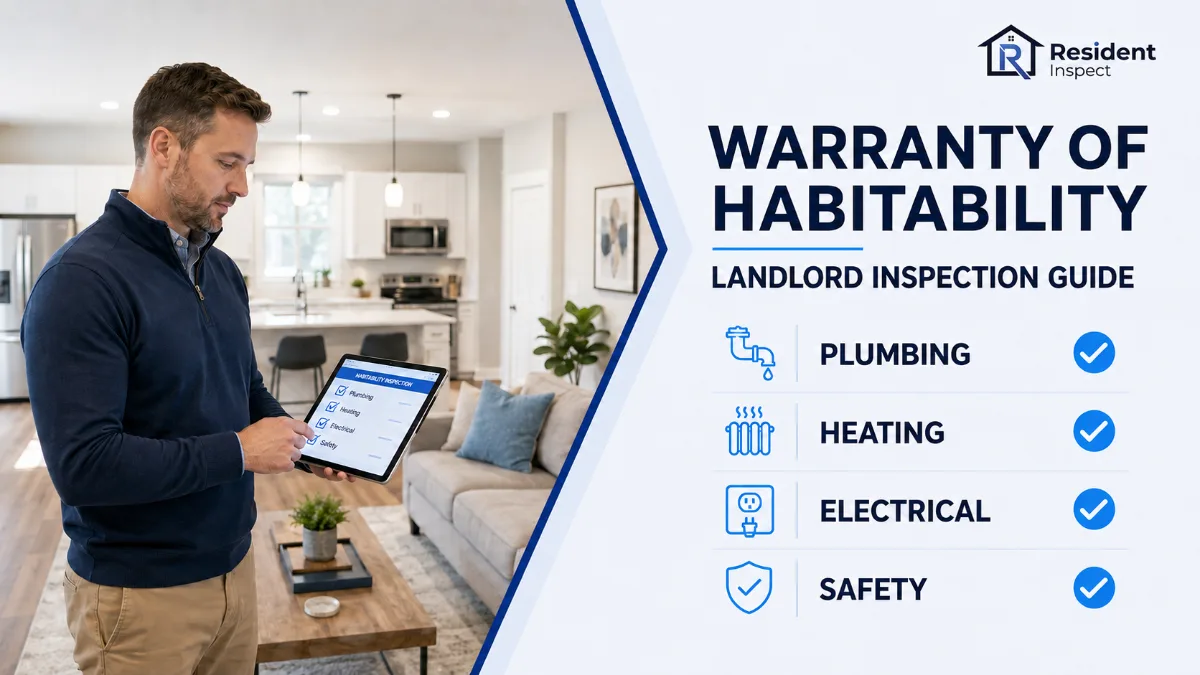 ## In this article
1. [What the warranty of habitability actually means](#what-the-warranty-of-habitability-actually-means)
2. [What counts as “habitable”](#what-counts-as-habitable)
3. [What happens when a unit becomes uninhabitable](#what-happens-when-a-unit-becomes-uninhabitable)
4. [How documented inspections prove you stayed compliant](#how-documented-inspections-prove-you-stayed-compliant)
5. [The compliant landlord’s habit](#the-compliant-landlords-habit)
Every residential landlord in the United States operates under a promise they may never have signed: the **warranty of habitability**. It is one of the most important legal duties in property management, and one of the easiest to satisfy with good documentation – yet many owners only learn about it when a tenant withholds rent or files a complaint.
> This article is general information, not legal advice. Landlord-tenant law varies significantly by state and locality – consult an attorney for guidance on your specific situation.
## What the warranty of habitability actually means
The warranty of habitability is a legal doctrine requiring landlords to keep residential rentals fit and safe to live in throughout the tenancy. According to the [Cornell Legal Information Institute: implied warranty of habitability](https://www.law.cornell.edu/wex/implied_warranty_of_habitability), it is recognized in nearly every state and generally cannot be waived by the tenant.
Crucially, it is usually *implied*. It attaches to the lease automatically, whether or not the written agreement mentions it. A clause telling a tenant they accept the unit “as is” will not erase your obligation to provide working heat or safe water. The duty also continues for the whole lease term – not just at move-in. Many owners also ask, [are landlords required to do inspections](https://residentinspect.com/blog/rental-property-inspection-laws-by-state/)? Our state-by-state guide covers what the law says.
## What counts as “habitable”
Exact standards are set by state statutes and local housing or building codes, but the core essentials are consistent. Federal HUD housing quality standards offer a widely used reference point for what a safe, decent unit looks like. In practice, a habitable rental generally provides:
- Working heat and safe, functioning electrical and plumbing systems
- Hot and cold running water and a working sewage or septic connection
- A sound roof, walls, floors, windows, and doors that keep out weather and intruders
- Freedom from serious pest infestations, mold, and toxic hazards such as lead or exposed asbestos
- Working smoke and carbon monoxide detectors and safe means of exit
- Compliance with applicable building, housing, and health codes
⚠ Habitable is not the same as flawless
The warranty covers health and safety essentials, not cosmetic perfection. A scuffed wall or dated cabinets are not habitability failures. No heat in January, a sewage backup, or an unsafe electrical panel are – and they are the conditions that trigger tenant remedies. A routine [annual apartment inspection](https://residentinspect.com/blog/what-do-apartment-inspections-look-for/) is a good time to confirm each of these essentials.
## What happens when a unit becomes uninhabitable
When a serious defect arises, the typical sequence is: the tenant notifies the landlord, and the landlord gets a reasonable time to fix it. If the landlord fails to act, state law may give the tenant remedies that can include:
- **Repair and deduct** – paying for the fix and subtracting the cost from rent
- **Rent withholding** – holding rent, sometimes in escrow, until repairs are made
- **Rent reduction** for the period the unit was impaired
- **Terminating the lease** and moving out without penalty
- In some cases, **damages** or reporting to a housing authority
These remedies vary dramatically from state to state, which is why local counsel matters. But the common thread is notice and opportunity to cure – and your ability to prove what you knew and when you responded.
## How documented inspections prove you stayed compliant
Here is where habitability shifts from legal theory to daily practice. The landlord who runs routine, documented inspections is far better protected than one who relies on memory and scattered text messages.
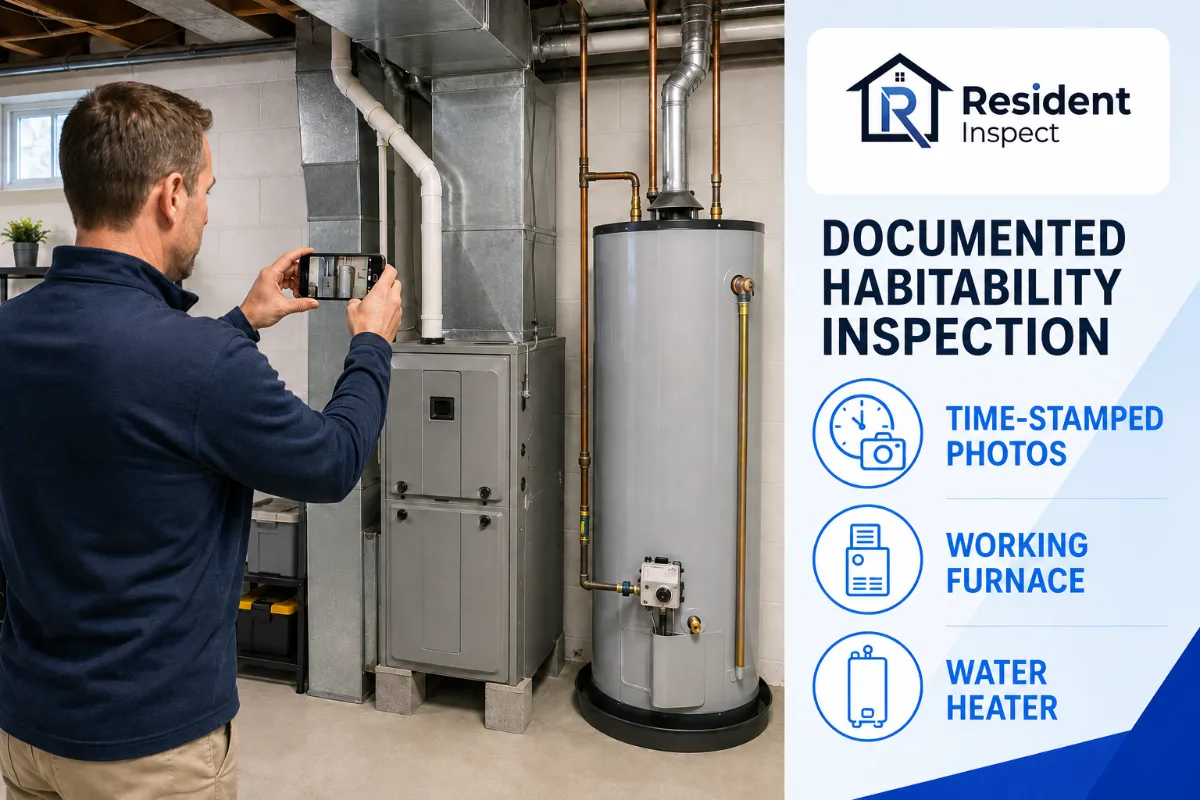Regular inspections help in three ways:
1. **They catch problems early.** A periodic walkthrough surfaces the failing water heater or the roof leak before it becomes an uninhabitability claim – so you repair on your schedule, not in a crisis.
2. **They create a dated record.** Time-stamped photos and video at move-in, periodically, and at move-out show the unit’s true condition on specific dates. If a tenant later claims a defect existed for months, your record either confirms or refutes it.
3. **They document your response.** A follow-up inspection after a repair proves the issue was fixed and when – exactly the evidence that defeats a withholding or repair-and-deduct dispute.
💡 Document the fix, not just the problem
When a tenant reports an issue, inspect and photograph it, log the repair, then re-inspect to confirm resolution. That three-step record – reported, repaired, verified – is the cleanest possible proof you met your obligations.
Scattered photos rarely hold up. A structured [virtual inspection software](/our-virtual-inspection-software/) walkthrough ties every photo and note to a date, a unit, and a checklist item, then generates a shareable report you can retain for years. Build habitability essentials directly into your standard [rental property inspection checklist](/blog/rental-property-inspection-checklist/) so heat, water, safety, and structure are verified on every pass. If you also rent to voucher holders, the same discipline aligns with the [Section 8 / HUD NSPIRE inspection checklist](/blog/section-8-hud-nspire-inspection-checklist/) most housing authorities require.
## The compliant landlord’s habit
The warranty of habitability is not a hurdle – it is a baseline that responsible landlords already meet. The gap is usually not maintenance; it is proof. Inspect on a schedule, document conditions and repairs, and you turn an implied legal duty into a body of evidence that keeps units safe, tenants housed, and disputes short. When a claim does surface, the record does the arguing for you.
## Frequently Asked Questions
What is the warranty of habitability?
The warranty of habitability is a legal doctrine, recognized in nearly every state, that requires residential landlords to keep a rental unit fit to live in for the entire lease term. It covers essentials like working heat, safe electrical and plumbing, hot and cold water, structural soundness, and freedom from serious health and safety hazards.
Is the warranty of habitability implied or written?
It is usually **implied** – it applies automatically to residential leases whether or not the lease mentions it, and in most states a landlord cannot make a tenant waive it. Some states also codify specific standards in statute or local housing codes.
What makes a rental unit uninhabitable?
Conditions that threaten health or safety: no heat or hot water, unsafe wiring, gas leaks, sewage backups, serious pest infestations, a leaking roof, mold, or a broken lock on an exterior door. Minor cosmetic issues generally do not rise to the level of uninhabitability.
How do inspections help prove habitability?
Routine, documented inspections create a dated photo-and-video record showing each unit was in habitable condition and that you responded to problems. That record is your strongest evidence if a tenant later claims the unit was unfit or withholds rent.
Can a tenant withhold rent for habitability problems?
In many states, yes – after giving the landlord notice and a reasonable chance to repair. Remedies vary widely by state and can include repair-and-deduct, rent withholding, or ending the lease. Always check your specific state and local rules.

Aaron Cooper Founder & CEO
After more than 20 years as a landlord and property management company owner-operator, Aaron Cooper built Resident Inspect to solve a problem he experienced firsthand: the inspection process was broken, expensive, and impossible to scale. Resident Inspect is the result — a live virtual inspection service that replaces in-person inspections with a faster, more consistent, and more defensible process. [See Full Bio](https://residentinspect.com/about-us/aaron-cooper/)
[Facebook](https://www.facebook.com/residentinspect/) [Instagram](https://www.instagram.com/residentinspect/) [TikTok](https://www.tiktok.com/@residentinspectofficial) [Pinterest](https://www.pinterest.com/aaron2762/) [YouTube](https://www.youtube.com/@ResidentInspect) [LinkedIn](https://www.linkedin.com/in/resident-inspect-a00b7a376/)
**Categories:** Blog
---
### [How to Train Your Team to Do Virtual Property Inspections Efficiently in 2026](https://residentinspect.com/blog/training-your-team-for-virtual-inspections/)
**Published:** October 29, 2025
**Author:** Aaron Cooper
**Content:**
 Aaron Cooper
Founder & Chief Executive Officer, Resident Inspect
📍 Jacksonville, FL
Aaron Cooper is a seasoned property technology entrepreneur and inspection industry expert. As the **Founder and CEO of Resident Inspect**, he leads the development of intelligent inspection platforms that empower landlords, property managers, and investors to streamline digital inspections and ensure compliance.
🌐 [residentinspect.com](https://residentinspect.com)
✉️ <aaron@residentinspect.com>
Virtual inspections are now a core capability for modern property management teams. The right training turns smartphones and video chat into defensible documentation, faster turnarounds, and a better resident experience. This guide shows you how to build (or upgrade) a training program that keeps quality high and costs low. If you are new to the topic, start with our complete guide to [virtual property inspections](https://residentinspect.com/blog/virtual-property-inspections-guide/).
## **Table of Contents**
1. [**Why Virtual Inspections Matter**](#why-virtual)
2. [**Core Skills Your Team Needs**](#core-skills)
3. [**Build a Step-by-Step Training Program**](#training-program)
4. [**Tools & Technology to Standardize Quality**](#tools-tech)
5. [**Metrics: Measure, Coach, Improve**](#metrics)
6. [**Common Challenges & How to Solve Them**](#challenges)
7. [**Field-Tested Best Practices**](#best-practices)
8. [**FAQs**](#faqs)
9. [**Next Steps**](#cta)
## [**Why Virtual Inspections Matter**](https://matterport.com/blog/virtual-inspections)
- **Speed & scale:** Cover more doors in less time with fewer site visits.
- **Owner transparency:** Live guidance plus rich media builds trust and reduces disputes.
- **Cost control:** Lower travel and labor without sacrificing documentation quality.
- **Consistency:** Checklists and scripts create uniform results across teams and regions.

## **Core Skills Your Team Needs**
### **1) Technical Proficiency**
- Confident use of smartphones/tablets, video meeting apps, and cloud storage.
- Basic troubleshooting: bandwidth checks, lighting, audio, screen capture.
- Device hygiene: lens cleaning, battery planning, backups.
### **2) Inspection & Reporting Discipline**
- Follow a room-by-room checklist end-to-end (no skipped spaces).
- Capture *wide* establishing shots and *close-up* evidence.
- Use consistent naming conventions and time-stamped media.
### **3) Resident Guidance & Communication**
- Explain the process, timing, and expectations in plain language.
- Direct the resident to angles/areas; verify understanding before moving on.
- De-escalation skills for sensitive findings and privacy concerns.
### **4) Compliance & Documentation**
- Create a defensible record (photos/video + notes) stored in a controlled system.
- Follow data retention, access controls, and audit requirements.
- Use standardized summaries and defect codes to reduce subjectivity.
## **Build a Step-by-Step Training Program**
1. **Define Your Protocols**
Document when to use virtual vs. on-site, inspection types (move-in/out, periodic, renewal), SLAs for scheduling and report turnaround.
2. **Select Your Toolkit**
Standardize on devices, video platform, and a branded reporting system. Provide accessories (clip-on lights, small tripod/grip) to improve capture quality.
3. **Create Modular Training**
- **Orientation:** Why virtual, benefits, expectations.
- **Tech Lab:** Join/link flows, bandwidth checks, recording/screenshots.
- **Workflow:** [Checklists, room order, defect coding, evidence standards](https://www.tdhca.texas.gov/sites/default/files/pmcdocs/inspections/docs/REAC-UPCS-Inspection-Checklist.pdf?utm_source=chatgpt.com).
- **Role-Play:** Simulated sessions with scripted scenarios and curveballs.
- **Assessment:** Rubric-based scoring of sample inspections and reports.
4. **Shadow → Practice → Certify**
New inspectors shadow two sessions, run two supervised sessions, then complete a practical exam to earn internal certification.
5. **Refreshers & QA**
Quarterly refreshers, peer reviews, and random quality audits to keep standards high.
## **Tools & Technology to Standardize Quality**
- **Devices:** Company-issued smartphones with minimum camera spec; backup battery.
- **Connectivity:** Wi-Fi first; mobile hotspot backup; pre-call signal check.
- **Lighting & Audio:** Clip-on light and simple mic improve clarity.
- **Reporting:** Branded templates, automated time stamps, immutable media logs.
- **Storage & Access:** Centralized repository with role-based permissions and retention policy.
## **Metrics: Measure, Coach, Improve**
| **Metric** | **Target** | **How to Use It** |
|---|---|---|
| Avg. time per inspection | 15–25 minutes (by type) | Flag outliers for coaching or process fixes. |
| Report turnaround | < 24 hours | Monitors capacity; triggers workload balancing. |
| Defect capture rate | Benchmark vs. on-site history | Ensures virtual quality matches (or beats) in-person. |
| Resident satisfaction | 4.6/5+ post-inspection | Correlate friction points to training modules. |
| Re-inspection rate | < 5% | Detects checklist misses and tech issues. |
## **[Common Challenges](https://www.hudexchange.info/sites/onecpd/assets/File/HTF-FAQ-Appendices-UPCS-for-Multifamily-and-Single-Family-Housing-Rehabilitation.pdf) & [How to Solve Them](https://en.wikipedia.org/wiki/Uniform_Physical_Condition_Standards)**
### **Low Bandwidth or Poor Lighting**
Schedule during strongest signal hours, switch to audio-only while capturing stills, use clip-on lighting, and reschedule if evidence is unclear.
### **Skipped Areas or Incomplete Evidence**
Use a mandatory checklist with “cannot advance” gates; require establishing shots and close-ups before moving rooms.
### **Inconsistent Resident Guidance**
Provide a script and on-screen prompts; confirm understanding before each step.
### **Documentation Gaps**
Automate time stamps, file naming, and storage. Lock reports after QA to preserve integrity.
## **Field-Tested [Best Practices](https://hudpass.com/upcs-v_training.html#:~:text=At%20this%20time%2C%20HUD%20is,%2Dby%2Dstep%20inspection%20process.)**
- **Pilot first:** Start with one property type and iterate.
- **Build a clip library:** Save great examples of angles, lighting, and narration.
- **Create a virtual kit:** Device checklist, quick lighting guide, lens wipes, power bank.
- **Monthly peer review:** Team watches a sample session and scores against the rubric.
- **Clear SOPs:** One page: pre-call, during call, post-call, escalation paths.
## **Frequently Asked Questions (FAQs)**
### **How long does training take?**
Most teams complete core training in 1–2 weeks: two shadows, two supervised sessions, and a practical exam. Refreshers run quarterly.
### **What equipment do we need?**
Standardized smartphones, a simple clip-on light, optional mic, and a hotspot backup. Use a branded reporting system with time-stamped media.
### **Are virtual inspections defensible?**
Yes, when you follow a checklist, capture clear establishing shots and close-ups, and store time-stamped media in a controlled repository.
### **How do we handle weak internet?**
Run a pre-call network check, switch to audio while capturing stills, ask for a Wi-Fi move near the router, or reschedule if evidence quality is compromised.
### **When should we still go on-site?**
For safety hazards, structural concerns, or when connectivity prevents adequate evidence. Escalate per your SOP.
## **Next Steps**
Ready to upskill your team and standardize virtual inspections? [**Schedule a free training walkthrough**](https://residentinspect.com/rental-property-inspections/) and get a customizable checklist, scripts, and QA rubric tailored to your portfolio.
## Want to learn more about Resident Inspect?
Complete the form below and one of our team members will contact you.

Aaron Cooper Founder & CEO
After more than 20 years as a landlord and property management company owner-operator, Aaron Cooper built Resident Inspect to solve a problem he experienced firsthand: the inspection process was broken, expensive, and impossible to scale. Resident Inspect is the result — a live virtual inspection service that replaces in-person inspections with a faster, more consistent, and more defensible process. [See Full Bio](https://residentinspect.com/about-us/aaron-cooper/)
[Facebook](https://www.facebook.com/residentinspect/) [Instagram](https://www.instagram.com/residentinspect/) [TikTok](https://www.tiktok.com/@residentinspectofficial) [Pinterest](https://www.pinterest.com/aaron2762/) [YouTube](https://www.youtube.com/@ResidentInspect) [LinkedIn](https://www.linkedin.com/in/resident-inspect-a00b7a376/)
**Categories:** Blog
---
### [Guide to Landlord Inspection Laws in Florida in 2026](https://residentinspect.com/blog/guide-to-landlord-inspection-laws-in-florida-in-2026/)
**Published:** February 17, 2026
**Author:** Aaron Cooper
**Content:**

Aaron Cooper
Founder & Chief Executive Officer, Resident Inspect
📍 Jacksonville, FL
Aaron Cooper is a seasoned property technology entrepreneur and inspection industry expert. As the **Founder and CEO of Resident Inspect**, he leads the development of intelligent inspection platforms that empower landlords, property managers, and investors to streamline digital inspections and ensure compliance.
🌐 [residentinspect.com](https://residentinspect.com)
✉️ <aaron@residentinspect.com>
## Florida Landlord Inspection Laws Explained
**Table Of Contents**
1. [Florida Landlord Inspection Laws Explained](#florida-landlord-inspection-laws-explained)
- [Overview of Florida Laws](#overview-of-florida-laws)
2. [Why Inspection Rights Matter](#why-inspection-rights-matter)
3. [Resident Rights in Florida](#resident-rights-in-florida)
- [Right to Privacy](#right-to-privacy)
-
- [Notice Requirements for Inspections](#notice-requirements-for-inspections)
-
- [When a Resident Can Refuse Entry](#when-a-resident-can-refuse-entry)
4. [Landlord Obligations in Florida](#landlord-obligations-in-florida)
- [Duty to Maintain the Property](#duty-to-maintain-the-property)
-
- [Inspection Notification Process](#inspection-notification-process)
-
- [Respecting Resident Privacy](#respecting-resident-privacy)
5. [Landlord Access to Property](#landlord-access-to-property)
- [Emergency Entry Situations](#emergency-entry-situations)
6. [Types of Property Inspections](#types-of-property-inspections)
- [1. Routine Inspections](#1-routine-inspections)
-
- [2. Emergency Inspections](#2-emergency-inspections)
-
- [3. Move-In and Move-Out Inspections](#3-move-in-and-move-out-inspections)
7. [Property Condition Reports](#property-condition-reports)
- [Why Documentation Matters](#why-documentation-matters)
-
- [Tips for Creating Strong Reports](#tips-for-creating-strong-reports)
8. [Balancing Rights Between Landlords and Tenants](#balancing-rights-between-landlords-and-tenants)
9. [Common Questions About Inspections](#common-questions-about-inspections)
- [How much notice is required?](#how-much-notice-is-required)
-
- [Can a landlord enter without notice?](#can-a-landlord-enter-without-notice)
-
- [What if a resident refuses entry?](#what-if-a-resident-refuses-entry)
10. [Final Thoughts](#final-thoughts)
### Overview of [Florida Laws](https://www.fdacs.gov/Consumer-Resources/Landlord-Tenant-Law-in-Florida)
Under Florida laws, landlords have to give tenants (residents) proper notice before entering a rental property. In most cases, the notice period is at least 24 hours. The only time they can enter without notice is during an emergency or if the resident gives permission.
**Florida laws outline a few key rules:**
- A minimum 24-hour notice period
- Valid legal reasons for entry
- Emergency access rules
These laws are part of Florida’s broader rules covering residential leases and rental agreements. They focus on privacy protection while still allowing landlords to manage their property and conduct reasonable property inspections. Following these rules helps with compliance and lowers the risk of disputes by balancing rights. Other states have different rules. See our guide to [rental property inspection laws by state](https://residentinspect.com/blog/rental-property-inspection-laws-by-state/ "Rental Property Inspection Laws by State").

## [Why Inspection Rights Matter](https://dsdt.edu/what-is-the-importance-of-property-inspection/)
It’s important for both landlords and residents (tenants) to understand their legal rights. When everyone knows the rules, it helps avoid confusion and conflict. Clear expectations can prevent arguments later.
Inspection laws also support tenant privacy rights and overall privacy protection. Renters can feel secure knowing someone will not show up without warning. Property owners benefit too because staying in compliance builds trust and reduces legal trouble.
When rights are clearly understood, communication improves. A landlord who explains the reason for an inspection ahead of time is less likely to face resistance. A resident who understands the landlord’s rights is less likely to feel uneasy about scheduled visits. This kind of clarity makes rental agreements easier to manage for both landlords and tenants.
## Resident Rights in Florida
People who rent in Florida have legal rights that protect their privacy and make sure they’re treated fairly. State law limits when and why a landlord can enter a rental home.
**Some key tenant rights include:**
- The right to privacy in the home
- Proper notice before inspections
- The ability to refuse entry in certain situations
These protections allow residents to enjoy their living space without unnecessary interruptions. They also create a clear process for raising concerns about improper entry.
When both sides understand their rights and responsibilities, it helps keep rental agreements running smoothly.
### Right to Privacy

Privacy is a basic right for anyone renting a home in Florida. Residents have the right to live in their space without surprise visits.
[Landlords can only enter for specific legal reasons](https://nestfinders.com/blog/when-can-a-landlord-enter-your-apartment-tenant-rights-and-legal-limits-explained). They must respect the required notice period unless there is an emergency. This supports privacy protection and helps prevent harassment.
Privacy also includes freedom from repeated or excessive inspections. While landlords have legal rights to inspect the property, those visits must be reasonable. Too many visits could feel intrusive and may violate tenant privacy rights.
### Notice Requirements for Inspections
In Florida, landlords usually must give at least [24 hours’ notice](https://www.leg.state.fl.us/statutes/index.cfm?App_mode=Display_Statute&URL=0000-0099/0083/Sections/0083.53.html) before doing an inspection. This notice period gives the resident time to prepare.
**The notice should include:**
- The date and time of entry
- The reason for the visit
- Enough advance warning to adjust schedules
Written notice is strongly recommended. Email, text, or printed notice can help create a record. Keeping communication clear helps show compliance if questions come up later.
### When a Resident Can Refuse Entry
A resident can refuse entry if the landlord fails to give proper notice or does not have a valid reason to enter.
If this happens, the refusal should be clearly communicated. Putting it in writing is a smart move. Keeping records and documentation can help protect your legal rights if there is a dispute later.
That said, refusal should not be used unfairly. If the landlord gives proper notice for a valid reason, denying access could create legal problems.
## [Landlord Obligations in Florida](https://www.fdacs.gov/Consumer-Resources/Landlord-Tenant-Law-in-Florida)

Florida landlords also have responsibilities under state law. These obligations are meant to keep residents safe and comfortable. If ignored, they can lead to legal problems.
**These landlord obligations mean landlords must:**
- Keep the property in livable condition
- Provide proper notice before inspections
- Respect tenant privacy rights
Meeting these duties shows compliance with residential leases and rental agreements. It also helps build a more positive rental experience.
### Duty to Maintain the Property
Landlords must keep rental homes in good condition. This includes making repairs and addressing safety issues.
**Common maintenance responsibilities include:**
- Fixing plumbing or electrical problems
- Repairing structural damage
- Addressing safety hazards
Staying on top of maintenance protects both the property and the resident. It also prevents small issues from turning into bigger problems.
### Inspection Notification Process
Before an inspection, landlords should provide written notice. The notice should clearly state:
- The date and time
- The purpose of the visit
- How long it may take
Clear communication supports privacy protection and reduces confusion. It also shows good faith and professionalism.
### Respecting Resident Privacy
Respecting privacy is one of the most important parts of managing a rental property. Landlords cannot enter without permission or proper notice, unless there is an emergency.
Honoring personal space strengthens trust and shows respect for balancing rights between both sides. A respectful approach often leads to better long term rental relationships.
## [Landlord Access to Property](https://www.nrla.org.uk/resources/managing-your-tenancy/accessing-the-property-during-a-tenancy)
Landlords [do have the right to enter](https://www.floridabar.org/public/consumer/tip014/) a rental property, but only under specific conditions. Florida law focuses on balancing rights so that property owners can manage their rentals while residents keep their privacy.
**Common reasons for entry include:**
- Making repairs
- Performing inspections
- Showing the property to buyers or future renters
- Handling emergency situations
In most cases, a proper notice period is required.
### Emergency Entry Situations
Emergency entry is different from routine access. If there is a fire, flooding, gas leak, or serious safety threat, the landlord can enter without notice.
These situations are limited to real emergencies. They are not meant for convenience or routine checks. This rule protects both safety and legal rights, and clarifies how emergency access should work.
## [Types of Property Inspections](https://dsdt.edu/guide-to-different-types-of-home-inspections-a-complete-resource-for-aspiring-inspectors/)
Property inspections serve different purposes and may have different rules under residential leases.
### 1. Routine Inspections
These are scheduled to check the overall condition of the property. They help spot maintenance needs early and protect the property’s value.
### 2. Emergency Inspections
If there is a serious issue like a water leak, immediate entry may be allowed without notice as part of emergency access.
### 3. Move-In and Move-Out Inspections
These inspections document the property’s condition at the beginning and end of a lease. They help settle deposit questions fairly and reduce disputes.
## Property Condition Reports
Condition reports create a written and photo record of the property’s condition. They protect both landlords and residents.
**A strong report should include:**
- Clear descriptions of each area
- Photos of rooms and existing damage
- Notes about wear and tear
This record helps compare changes during the lease and supports fair outcomes.
[](https://residentinspect.com/pricing/)
### Why Documentation Matters
Good documentation can make a big difference if there is a dispute about damage or repairs. Clear records help protect legal rights and make deposit decisions easier to resolve. Strong property condition reports and organized documentation also help both sides.
Keeping organized records also shows compliance with the terms in rental agreements.
### [Tips for Creating Strong Reports](https://www.linkedin.com/advice/0/how-do-you-create-real-estate-reports-impress-skills-real-estate)
**To create reliable condition reports:**
- Walk through the property with the resident
- Use a checklist for consistency
- Add timestamps to photos
Staying organized reduces confusion and supports balancing rights on both sides.
## [Balancing Rights Between Landlords and Tenants](https://cms.law/content/download/434337/file/2010-0135374%20FLYR%20-%20v4%20Rebound%20%20Remodel%20-%20Balancing-Risk-Landlords-tenants.pdf)
Florida law aims at balancing rights. Property owners have the right to manage their rentals. Residents have the right to privacy and peaceful living.
**To keep things fair:**
- Provide the required notice period
- Respect privacy at all times
- Address maintenance issues promptly
When both sides understand their legal rights and follow the rules, rental agreements tend to work better.
## Common Questions About Inspections
### How much notice is required?
In most cases, at least 24 hours.
### Can a landlord enter without notice?
Only during true emergencies.
### What if a resident refuses entry?
If entry is refused without a valid reason, it could lead to legal action. Both sides should understand their rights before taking that step.
## Final Thoughts
Understanding Florida inspection laws helps landlords and residents avoid conflict. When everyone knows their legal rights and responsibilities, rental agreements run more smoothly.
Privacy protection, proper notice periods, compliance with residential leases, and clear communication all play a role. Knowing what the law requires helps protect your interests and gives you peace of mind for both landlords and tenants.
**Compliance to these Florida State inspection laws can be scary.**
**Are you ready to take that off your list of liabilities? Connect with us today!**

Aaron Cooper Founder & CEO
After more than 20 years as a landlord and property management company owner-operator, Aaron Cooper built Resident Inspect to solve a problem he experienced firsthand: the inspection process was broken, expensive, and impossible to scale. Resident Inspect is the result — a live virtual inspection service that replaces in-person inspections with a faster, more consistent, and more defensible process. [See Full Bio](https://residentinspect.com/about-us/aaron-cooper/)
[Facebook](https://www.facebook.com/residentinspect/) [Instagram](https://www.instagram.com/residentinspect/) [TikTok](https://www.tiktok.com/@residentinspectofficial) [Pinterest](https://www.pinterest.com/aaron2762/) [YouTube](https://www.youtube.com/@ResidentInspect) [LinkedIn](https://www.linkedin.com/in/resident-inspect-a00b7a376/)
**Categories:** Blog
---
### [Lease Violation Notices: How to Document and Enforce a Violation That Actually Holds Up](https://residentinspect.com/blog/lease-violation-notice/)
**Published:** October 3, 2026
**Author:** Aaron Cooper
**Content:**
In this article
- [The three notice types, and what each is for](#the-three-notice-types-and-what-each-is-for)
- [How long does a tenant get to cure?](#how-long-does-a-tenant-get-to-cure)
- [Anatomy of a notice that survives a hearing](#anatomy-of-a-notice-that-survives-a-hearing)
- [Service, and why proof of service is the whole game](#service-and-why-proof-of-service-is-the-whole-game)
- [The documentation standard: what actually holds up](#the-documentation-standard-what-actually-holds-up)
- [Consistency, selective enforcement, and fair housing](#consistency-selective-enforcement-and-fair-housing)
- [Retaliation: the other timing risk](#retaliation-the-other-timing-risk)
- [Common mistakes that void a notice](#common-mistakes-that-void-a-notice)
- [The record decides it](#the-record-decides-it)
A **lease violation notice** tells a tenant three things: what they did, which lease term it broke, and what they must do about it by a deadline. In most states it is not optional paperwork – it is the legal predicate for everything that follows, and the first document a judge reads.
It is also the document that most often fails, usually for one reason: it describes the breach too vaguely to prove. As [Illinois Legal Aid Online’s guidance on addressing lease violations](https://www.illinoislegalaid.org/legal-information/addressing-lease-violations) puts it, a notice that says only “noise” is insufficient – describing loud music from the unit at 3:30 a.m. on a named date is what a notice should look like. When it is not specific, the tenant can ask the judge to dismiss the case.
> General information, not legal advice – notice requirements are state-specific. Current as of September 2026. Confirm your state statute and local ordinance, and consult a landlord-tenant attorney before serving.
## The three notice types, and what each is for
Landlords routinely reach for the wrong instrument. These three carry different deadlines and consequences.
| Notice type | Also called | What it is for | Tenant’s option |
|---|---|---|---|
| **Cure or quit** | Notice to comply, notice to perform covenants | A fixable non-monetary breach: unauthorized pets or occupants, unapproved vehicles, subletting, unsanitary conditions | Fix it within the cure period; tenancy continues |
| **Pay or quit** | Notice to pay rent or quit | Unpaid rent only | Pay the stated amount within the notice period |
| **Unconditional quit** | Notice to quit, notice to vacate | Conduct that gets no second chance: serious damage, illegal activity, nuisance, or a repeat of a noticed violation | None – vacate by the deadline |
The distinction matters. A pay or quit notice cannot carry a conduct claim, and in many states cannot include late fees or utilities. An unconditional quit notice used where the statute required a chance to cure is void.
Several states build a ladder between the conduct notices. In California, tenancies under the Tenant Protection Act require a notice to perform covenants first; only if the tenant fails to cure can the landlord move to a 3-day notice to quit. Under [Florida Statutes section 83.56](https://www.flsenate.gov/laws/statutes/2025/83.56), repeats cut the other way: if the same or similar noncompliance recurs within 12 months of a written notice, eviction can proceed without another cure notice.
⚠ Notice periods and cure rights vary enormously by state
There is no national lease violation notice. The number of days, whether weekends count, and whether the tenant gets a chance to cure at all are set by state law. A downloaded template is a starting point, not a compliant notice. Verify the statute where the property sits – and check the city, because places like Chicago and New York City add requirements.
## How long does a tenant get to cure?
Cure periods for non-rent violations most commonly fall between 3 and 10 days:
- **California** – 3 days to perform covenants or quit, excluding Saturdays, Sundays and court holidays, counting from the day after receipt.
- **Florida** – 7 days from delivery to correct the noncompliance.
- **Arizona** – 10 days for material noncompliance, but 5 where the breach materially affects health and safety.
- **Washington** – 10 days after service to perform the covenant or surrender the property.
- **Colorado** – 10 days for a standard residential agreement, 5 for certain exempt agreements, 3 for employer-provided housing, 30 for a CARES Act property.
The [California Courts self-help guide to eviction notice types](https://selfhelp.courts.ca.gov/eviction-tenant/notice-types) explains how that 3-day clock is counted. [Arizona Revised Statutes section 33-1368](https://azleg.gov/ars/33/01368.htm) draws the 10-day and 5-day line, and [Washington’s RCW 59.12.030](https://app.leg.wa.gov/rcw/default.aspx?cite=59.12.030) preserves the tenant’s right to cure within the 10 days and save the lease from forfeiture. [Colorado’s JDF 99A Demand for Compliance form](https://www.coloradojudicial.gov/sites/default/files/2026-02/JDF99A.pdf) shows what a court expects a compliant notice to contain.
## Anatomy of a notice that survives a hearing
A valid notice does five jobs: identifies the right people and property, names the lease clause, describes the conduct with dates, states a deadline meeting the statutory minimum, and is provably served.
```
NOTICE TO COMPLY WITH LEASE OR VACATE (Cure or Quit)
[ALL TENANTS OF RECORD] To: Dana Ruiz and Marcus Ruiz, and all occupants
[PROPERTY IDENTIFIED] Premises: 118 Wren Street, Unit 4B, Springfield
[DATE OF NOTICE] October 6, 2026
[LEASE CLAUSE BREACHED] You are in violation of Section 12(b) of your lease
dated March 1, 2026: no animal may be kept on the
premises without prior written consent.
[SPECIFIC FACTS + DATES] During the periodic inspection on October 2, 2026 at
10:15 a.m., a dog was observed in Unit 4B, with a crate
in the living room and food bowls in the kitchen. No pet
application is on file. Inspection photographs attached
as Exhibit A; neighbor complaints dated September 18 and
27, 2026 as Exhibit B.
[WHAT CURES IT] Permanently remove the animal, or submit a pet
application and receive written approval.
[DEADLINE, COUNTED] 5:00 p.m., October 16, 2026 (10 days after service,
per [statute cite]).
[CONSEQUENCE STATED] If you do not comply, your lease will terminate and
possession proceedings may be commenced.
[SIGNATURE + CONTACT] ____________________ Alina Cortez, Property Manager
[PROOF OF SERVICE] Served October 6, 2026 by: [personal / substituted
service plus mailing / posting after failed attempts
Oct 4 and Oct 5]
Server: ____________ Signature: ____________
```
Note what the sample does not do. It does not editorialize, and it does not bundle unrelated grievances into one notice – separate notices are safer, because a defect in one will not poison the other.
💡 Attach the evidence, do not just reference it
A notice saying “photographs available on request” is weaker than one with them attached and labelled. Exhibits make the violation undeniable – which often produces a cure with no filing at all – and lock in what you observed and when.
## Service, and why proof of service is the whole game
Courts treat service as a strict-compliance matter. The three methods you will meet in most states are personal service on the tenant; substituted service on a person of suitable age and discretion at the residence, plus a mailing; and posting on the property plus a mailing, typically only after documented failed attempts at personal service. Colorado’s form requires each failed attempt date to be recorded before posting.
Proof of service is what makes it real: a signed affidavit naming who served, when, by what method, and where. This is the same discipline that governs a [tenant inspection notice](/blog/tenant-inspection-notice/) – different document, same rule underneath. The notice is only as good as your ability to prove delivery.
## The documentation standard: what actually holds up
The notice is an assertion; evidence makes it enforceable. Four categories do most of the work.
**Dated photographs with intact metadata.** Photographs persuade because they carry an embedded timestamp – an advantage that disappears the moment images are screenshotted, re-exported, cropped so EXIF data is stripped, or pulled from a group text weeks later. Capture in a system that preserves the original file and its date, and never alter an image you will rely on.
**Inspection reports tied to a unit and a date.** A photo shows a dog. An inspection report shows a dog, in Unit 4B, on October 2, observed by a named inspector, against a checklist item inspected in every other unit that quarter. That context defeats the argument that you went looking for a reason. Building pet, occupancy and cleanliness items into a standard [rental property inspection checklist](/blog/rental-property-inspection-checklist/) makes the evidence a byproduct of routine work, not something assembled mid-conflict.
**Third-party written complaints.** Dated, signed neighbor complaints carry weight a manager’s recollection does not – especially for noise claims.
**A communication log.** Every warning, email, text and tenant response, in order, with dates. Many jurisdictions expect an informal warning first; the log proves it.
💡 Photograph the condition, not the household
Inside a unit, capture only what relates to the violation or the condition of the property. Avoid personal documents, medications, mail, and people – especially children. Enter only under a lawful, properly noticed entry: evidence gathered during an improper entry can be challenged, and the entry itself becomes a claim against you.
For owners running more units than their calendar allows, [property management outsourcing](/property-management-outsourcing/) earns its keep here – not by changing the legal standard, but by producing the same evidence in every unit.
## Consistency, selective enforcement, and fair housing
Here is the exposure landlords underestimate: a perfectly valid notice, served perfectly, can still draw a discrimination complaint if the enforcement pattern is uneven. Those decisions sit under [the Fair Housing Act](https://www.justice.gov/crt/fair-housing-act-1), which prohibits discrimination on the basis of race, color, religion, sex, national origin, familial status and disability – and that protection reaches the terms and conditions of a tenancy, not just the decision to rent. The Department of Justice notes that providers may not impose special requirements on tenants with custody of children. A guest policy enforced against a family with kids but not other households is exactly that.
Selective enforcement claims rarely turn on a single notice. They turn on the comparison: three households had unregistered vehicles, one got a notice. Once that pattern exists, the tenant need not prove intent – the record does the work.
⚠ Enforce the rule, or change the rule
If you are not prepared to enforce a lease term against every tenant who breaches it, do not enforce it against one. The defensible posture is a written standard applied uniformly, with the same documentation trail for every unit regardless of who lives there. Consistent inspection records are the best evidence that a notice was triggered by conduct, not by who the tenant is.
## Retaliation: the other timing risk
Most states also restrict adverse action taken in response to a tenant exercising a legal right. As the [Cornell Legal Information Institute: retaliatory eviction](https://www.law.cornell.edu/wex/retaliatory_eviction) overview explains, rules vary widely – some states provide no statutory defense, others presume retaliation when a landlord acts within a set window after protected activity. California presumes it within 180 days of a tenant complaining to a government authority or requesting an inspection.
The result is a sequencing problem: if a tenant reports a habitability issue on Monday and gets a violation notice on Wednesday, the timing alone can shift the burden onto you. The defense is documentation predating the complaint.
## Common mistakes that void a notice
- **A conclusion instead of facts.** “Nuisance behavior” is a conclusion. “Amplified music audible in Unit 3B at 2:40 a.m. on August 14” is a fact.
- **No lease clause cited.** If you cannot name the provision breached, you may not have a violation – just a preference.
- **Wrong or missing parties.** All tenants of record must be named; a notice to one of three leaseholders is challengeable.
- **Shorting the cure period.** Counting calendar days where the statute excludes weekends, or starting the clock at mailing rather than completed service.
- **The wrong instrument.** An unconditional quit notice where cure was required, or rent folded into a conduct notice.
- **An unauthorized service method.** A text message is not service in most jurisdictions, however timestamped.
- **No proof of service.** No affidavit, no witness, no photo of the posting, no mail receipt.
- **Accepting rent after the violation.** In some states, accepting rent with actual knowledge of a noncompliance waives the right to terminate for it.
- **Evidence from an improper entry**, or **inconsistent enforcement**.
## The record decides it
Enforcement is not a question of who is right. It is a question of who can prove what, on what date, in a form a court accepts. A landlord with a routine inspection cadence, date-stamped photos and uniformly applied rules rarely has to litigate – the notice alone usually produces the cure, because the tenant can see there is nothing to argue with. Write the notice like a judge will read it, and serve it like you will have to prove it.
🚀 Turn every inspection into enforceable evidence
Resident Inspect runs live, guided virtual inspections that produce date-stamped photo documentation and a structured report for every unit, on schedule – the record that makes a lease violation notice stick and defends against selective enforcement and retaliation claims. See how it works at residentinspect.com.
## Frequently Asked Questions
What is a lease violation notice?
A lease violation notice is a written document telling a tenant that specific conduct has breached a specific term of the lease, what they must do to fix it, and by when. In most states it is the required first step before a landlord can file an eviction case for anything other than unpaid rent.
What is the difference between a cure or quit notice and a pay or quit notice?
A pay or quit notice deals with money – it demands overdue rent. A cure or quit notice deals with conduct – it demands the tenant fix a non-monetary breach such as an unauthorized pet, an extra occupant, or unapproved parking. The two carry different statutory notice periods in most states and are not interchangeable.
How many days does a tenant have to cure a lease violation?
It depends entirely on the state and sometimes the property type. Cure periods commonly run from 3 to 10 days, with longer windows in defined situations. California allows 3 days excluding weekends and court holidays, Florida allows 7, and Arizona, Washington and Colorado generally allow 10. Always confirm the current period in your own state statute.
What makes a lease violation notice legally defective?
The most common defects are a vague description of the breach, no reference to the lease clause violated, wrong or missing tenant names, a cure period shorter than the statute requires, an unauthorized service method, or no proof that service happened. Any one of these can get an eviction case dismissed.
What evidence do I need to prove a lease violation?
Dated, unaltered photographs with intact file metadata, an inspection report tied to a specific unit and date, written complaints from neighbors, and a communication log showing what you told the tenant and when. Contemporaneous records made at the time of observation carry far more weight than a summary written after the dispute began.
Can I take photos inside a tenant's unit as evidence?
Generally yes during a lawful, properly noticed inspection, but photograph only what relates to the condition of the unit or the violation itself. Avoid personal documents, medications, and people, and never enter without meeting your state’s entry notice requirements – an unlawful entry can taint the evidence and create its own claim against you.
Is it illegal to enforce a lease rule against some tenants and not others?
Selective enforcement is one of the most common ways a routine lease violation turns into a fair housing complaint. If you enforce a guest, pet, or noise rule against tenants in a protected class while overlooking the same conduct by others, the pattern itself becomes the evidence. Consistent, documented enforcement across every unit is the defense.
Can a tenant claim retaliation after receiving a lease violation notice?
In many states, yes. Several states presume a landlord’s adverse action is retaliatory if it follows a tenant’s protected activity – such as a code complaint or repair request – within a set window. A dated record showing the violation was observed and documented before the tenant’s complaint is the cleanest rebuttal.

Aaron Cooper Founder & CEO
After more than 20 years as a landlord and property management company owner-operator, Aaron Cooper built Resident Inspect to solve a problem he experienced firsthand: the inspection process was broken, expensive, and impossible to scale. Resident Inspect is the result — a live virtual inspection service that replaces in-person inspections with a faster, more consistent, and more defensible process. [See Full Bio](https://residentinspect.com/about-us/aaron-cooper/)
[Facebook](https://www.facebook.com/residentinspect/) [Instagram](https://www.instagram.com/residentinspect/) [TikTok](https://www.tiktok.com/@residentinspectofficial) [Pinterest](https://www.pinterest.com/aaron2762/) [YouTube](https://www.youtube.com/@ResidentInspect) [LinkedIn](https://www.linkedin.com/in/resident-inspect-a00b7a376/)
**Categories:** Blog
---
### [Virtual Inspections vs Tenant Self-Inspections: What Property Managers Need to Know](https://residentinspect.com/blog/virtual-inspections-vs-tenant-self-inspections/)
**Published:** July 25, 2025
**Author:** Aaron Cooper
**Content:**
In today’s fast-paced property management world, efficiency and reliability go hand in hand. With more companies managing rentals remotely or across wider regions, the traditional in-person inspection isn’t always practical. That’s where technology has stepped in, offering modern alternatives like **virtual inspections** and **tenant self-inspections**.
At first glance, both options might seem like smart solutions for conducting **rental home inspections**. But dig a little deeper, and the differences in reliability, risk, and consistency are hard to ignore. If you’re looking to streamline **property inspections** without sacrificing quality, here’s what you need to know.
## Virtual Inspection vs. Tenant Self-Inspection at a Glance
| **Factor** | **Virtual Inspection** | **Tenant Self-Inspection** |
|---|---|---|
| Who documents the property | Trained inspector, live on video | Tenant, unsupervised |
| Consistency | Same checklist, every unit, every time | Varies by tenant |
| Risk of edited or missing photos | Low inspector controls capture | Higher, no oversight |
| Legal defensibility | Time-stamped, neutral third-party report | Harder to defend in disputes |
| Tenant effort | Smartphone + guided call, no app to learn | Tenant must self-direct, sometimes an app download |
| Typical cost per inspection | Lower than in-person, modest premium over self-inspection | Lowest sticker price, highest hidden cost if disputes arise |
## What Is a Tenant Self-Inspection?
A tenant self-inspection is exactly what it sounds like: the resident walks through the property, takes photos or videos often through a self-inspection app and submits their report. It’s often marketed as low-effort and cost-effective. But that convenience can come at a cost.
Without any oversight, tenants may unintentionally miss critical issues or in some cases, intentionally avoid showing them. And without a third party guiding the process, the quality of inspection reports is unpredictable at best.
## What Is a Virtual Inspection?
**Virtual rental home inspections** also called remote property inspections are conducted live over a video call, typically with a trained inspector guiding the resident through a video walkthrough. The inspector can direct the tenant to specific areas, capture detailed images, ask follow-up questions, and ensure the entire home is properly documented.
This method brings the professionalism of an in-person visit to the convenience of remote technology and the results speak for themselves. To learn how the process works from start to finish, read our complete guide to [virtual property inspections](https://residentinspect.com/blog/virtual-property-inspections-guide/).
## Why Oversight Matters
One of the biggest weaknesses of tenant self-inspections is the lack of accountability. Tenants might skip areas they don’t think are important, or use editing tools to hide damage. We’ve even seen cases where residents removed trampolines, pets, or stains from photos before submitting them.
Virtual inspections prevent these issues by ensuring a trained professional is in control. They guide the resident through each area of the home, ask clarifying questions, and capture real-time photos. That oversight adds credibility, ensures no corners are cut, and can [cut labor hours with virtual inspections](https://residentinspect.com/blog/how-to-cut-labor-with-virtual-inspections/) compared to sending a team member out for every visit.
## The Legal and Financial Risks of Self-Inspections
When issues are missed—or hidden—during a self-inspection, it can create big problems later. Property managers may face disputes over deposits, insurance claims may be denied, and maintenance costs may skyrocket due to delayed detection of problems like mold or water damage. For a full breakdown of how these hidden risks add up in dollar terms, see our guide to [rental property inspection costs](https://residentinspect.com/blog/how-much-does-a-rental-property-inspection-cost/)
Virtual inspections help mitigate these risks by producing documented, time-stamped reports completed by a neutral third party. That documentation holds up better in court, during audits, and with owners or insurers who demand accountability.
## What Gets Missed in a Self-Inspection?
Most tenants aren’t trained to recognize early signs of property issues. During a self-inspection, they may overlook:
- Slow leaks under sinks or behind toilets
- Damaged window seals or door frames
- Failing appliances or unreported pest issues
- Fire safety concerns like expired smoke detectors
During a virtual inspection, the inspector ensures these areas are covered. They’ll follow a consistent checklist and know exactly what to flag for follow-up.
## Tenant Experience: Self-Inspection vs Virtual Inspection
Self-inspections can be confusing or frustrating for tenants, especially if they have to download an app or figure out what to photograph. That often results in missed steps or inconsistent submissions.
In contrast, virtual inspections require nothing more than a smartphone. The inspector walks the resident through the entire process in real time. It’s easier for the tenant, and it leads to higher-quality results for the property manager.
## Cost Comparison
Self-inspections might seem “free,” but they often come with hidden costs. When problems go undetected, repairs are delayed, or legal disputes arise, the long-term financial impact can far outweigh any short-term savings.
Virtual inspections offer a middle ground. They cost significantly less than in-person visits, while still providing the accuracy and defensibility that managers need. And when done at scale, they can save hours of team time each month.
## Real Risks We’ve Seen
Here are just a few examples of issues we’ve seen with tenant self-inspections:
- Photos edited to remove pet damage or unauthorized items
- Entire rooms (like attics or garages) skipped entirely
- Water damage or mold left unreported for months
Each of these led to thousands of dollars in unnecessary repairs, liability exposure, and difficult conversations with property owners.
## The Smarter Way Forward
Technology should make your job easier, not create new risks. **Virtual inspections** deliver the best of both worlds: flexibility for residents and accuracy for your team. With real-time guidance, consistent documentation, and less tenant confusion, they’re fast becoming the gold standard for **rental home inspections**. We discussed this topic in [The Future of Property Inspections](https://residentinspect.com/blog/the-future-of-property-inspections/) back in March.
If you’re still relying on tenant self-inspections or sending your team out for every visit, it’s time to explore a more efficient, more reliable approach.
## Take the Next Step
At [Resident Inspect](https://residentinspect.com/), we conduct live, guided[ **virtual rental home inspections**](https://residentinspect.com/our-virtual-inspection-software/) with trained professionals, never AI, and never left solely to the tenant. Our system saves time, cuts costs, and provides peace of mind that every home is being properly inspected.
**[Schedule a free trial inspection or contact us today to see how virtual inspections can work for you.](https://residentinspect.com/contact-us/)**
## **FAQs: Virtual Inspections vs Tenant Self-Inspections**
### **What is a tenant self-inspection?**
A tenant self-inspection is when the resident documents the property themselves with photos or video and submits a report. It’s convenient and low-effort, but without oversight the quality is inconsistent and important issues can be missed or edited out.
### **What is a virtual inspection?**
A virtual inspection is a live, guided video call with a trained inspector who directs the resident, verifies conditions in real time, and captures consistent, defensible documentation across the entire home.
### **Why does third-party oversight matter?**
Oversight ensures checklists are followed, prevents omissions or manipulated media, and produces time-stamped documentation from a neutral professional—improving accuracy and trust with owners, insurers, and auditors.
### **What legal or financial risks come with self-inspections?**
Missed or hidden issues can lead to deposit disputes, denied insurance claims, and higher maintenance costs from delayed detection of problems like leaks, mold, or safety hazards.
### **What problems are commonly missed by tenants?**
Early signs of leaks under sinks, damaged window or door seals, failing appliances, pest evidence, and fire-safety issues such as expired smoke detectors are frequently overlooked.
### **Are virtual inspections easier for residents?**
Yes. Residents only need a smartphone. An inspector guides them step-by-step, reducing confusion and ensuring full coverage—resulting in better reports for property managers.
### **How do costs compare?**
Self-inspections appear cheaper but can become costly when problems are missed. Virtual inspections cost far less than in-person visits while delivering accurate, defensible results at scale.
### **When should I choose a virtual inspection?**
Use virtual inspections for routine, move-in/move-out, renewal, or periodic checks where speed, documentation quality, and defensibility matter—especially across distributed portfolios.
### Is a self-inspection app the same as a virtual inspection?
No. A self-inspection app is a tool the tenant uses alone to submit photos or video with no one guiding the walkthrough. A virtual inspection is a live video call led by a trained inspector, so the documentation is created and verified by a neutral third party rather than self-reported by the tenant.
### Can virtual inspections replace self-inspections entirely?
For most portfolios, yes virtual inspections cost only modestly more than a self-inspection app while producing documentation that actually holds up in a deposit dispute. Some property managers keep a self-inspection option only for extremely low-stakes, low-value units where a dispute would cost more to fight than it’s worth.

Aaron Cooper Founder & CEO
After more than 20 years as a landlord and property management company owner-operator, Aaron Cooper built Resident Inspect to solve a problem he experienced firsthand: the inspection process was broken, expensive, and impossible to scale. Resident Inspect is the result — a live virtual inspection service that replaces in-person inspections with a faster, more consistent, and more defensible process. [See Full Bio](https://residentinspect.com/about-us/aaron-cooper/)
[Facebook](https://www.facebook.com/residentinspect/) [Instagram](https://www.instagram.com/residentinspect/) [TikTok](https://www.tiktok.com/@residentinspectofficial) [Pinterest](https://www.pinterest.com/aaron2762/) [YouTube](https://www.youtube.com/@ResidentInspect) [LinkedIn](https://www.linkedin.com/in/resident-inspect-a00b7a376/)
**Categories:** Blog
---
### [The Ultimate Guide to Best Property Management Softwares 2026](https://residentinspect.com/blog/guide-to-property-management-softwares/)
**Published:** November 6, 2025
**Author:** Aaron Cooper
**Excerpt:** Discover how the best property management software in 2025 is transforming real estate operations. This guide explores how automation, property inspection report software, and maintenance management tools streamline workflows, improve tenant satisfaction, and boost ROI. Learn what features to look for, how to choose the best software for property managers, and why digital transformation is the key to property success in 2025.
**Content:**
Aaron Cooper
Founder & Chief Executive Officer, Resident Inspect
📍 Jacksonville, FL
Aaron Cooper is a seasoned property technology entrepreneur and inspection industry expert. As the **Founder and CEO of Resident Inspect**, he leads the development of intelligent inspection platforms that empower landlords, property managers, and investors to streamline digital inspections and ensure compliance.
🌐 [residentinspect.com](https://residentinspect.com)
✉️ <aaron@residentinspect.com>
In 2026, the fastest-growing property operations are powered by modern property management software. These tools are a cloud-based platform. They automate rent collection, manage maintenance, and simplify inspections. They include built-in property inspection report software.
## **Table of Contents**
1. [Introduction: Why 2026 Is the Year for Smarter Property Management](#intro)
2. [What Is Property Management Software?](#what-is-pms)
3. [Key Features of the Best Property Management Software](#key-features)
1. [Lease & Contract Management](#lease)
2. [Tenant Communication Portals](#portals)
3. [Maintenance Scheduling & Tracking](#maintenance)
4. [Online Rent Collection](#rent)
5. [Financial Management & Analytics](#finance)
6. [Security & Data Protection](#security)
4. [How Property Management Software Streamlines Daily Operations](#ops)
5. [The Role of Property Inspection Software & Reporting Tools](#inspection)
6. [Maintenance Management & Automation](#maint-automation)
7. [Enhancing Communication & Tenant Satisfaction](#communication)
8. [Choosing the Best Software for Property Managers](#choosing)
9. [Future Trends in Property Management Software (2026 and Beyond)](#trends)
10. [Conclusion: The Digital Future of Property Management](#conclusion)
11. [FAQs](#faqs)
## **Introduction: Why 2026 Is the Year for Smarter Property Management**
Manual spreadsheets and email chains can’t keep pace with today’s portfolios. Modern property management software centralizes data, automates repetitive work, and elevates tenant experiences. Whether you manage a small apartment building or a larger portfolio, a cloud-based platform can lower costs. It helps prevent mistakes and provides real-time insights.
Throughout this guide, you will learn how the [**best property management software**](https://www.gartner.com/reviews/market/property-management-software) makes operations easier. You will see where property inspection report software fits in. You will learn how the best property maintenance software can help. It makes repairs faster and more reliable. This also keeps tenants happy.
## **What Is Property Management Software?**
Property management software is a centralized platform for leases, tenants, maintenance, and accounting. It replaces fragmented tools with one source of truth and offers automation that scales with your business.
- Centralized tenant, property, and lease data
- Automated workflows for rent, renewals, and reminders
- Built-in maintenance management and vendor coordination
- Accounting, reporting, and [**owner-ready statements**](https://www.nestfinders.com/blog/efficient-owner-statements-and-reporting-to-boost-your-rental-business)
- Integrated [**property inspection report software** ](https://residentinspect.com/rental-property-inspections/)for documentation and compliance
## **Key Features of the Best Property Management Software**
### **Lease & Contract Management**
Create, eSign, store, and renew leases from a single system. Automated alerts help prevent missed deadlines and compliance gaps.
### **Tenant Communication Portals**
Centralize communication with secure portals. Tenants can submit requests, access documents, and receive updates. This is key to a great apartment management software experience.
### **Maintenance Scheduling & Tracking**
The best property maintenance software turns requests into work orders. It assigns the right vendor and shows status updates until the job is done.
### **Online Rent Collection**
Offer ACH and card payments with automated reminders and smart late-fee rules to improve on-time collections.
### **Financial Management & Analytics**
Generate P&L, cash flow, and owner statements. Use dashboards to monitor vacancy, delinquency, and maintenance KPIs in real time.
### **Security & Data Protection**
The best [**property management softwares**](https://www.amgrents.com/kissimmee-property-management-blog/best-property-management-software) provide encryption, role-based access, and audit trails to safeguard sensitive information.
## **How Property Management Software Streamlines Daily Operations**
- **Automation:** Rent reminders, lease renewals, and inspection alerts run on autopilot.
- **Centralization:** One login for leases, tickets, and finances reduces errors and context-switching.
- **Collaboration:** Leasing, accounting, and maintenance work from the same data set.
- **Insights:** Dashboards surface trends for faster, better decisions.
- **Tenant Experience:** Clear updates and quick resolutions boost satisfaction and renewals.
## **The Role of Property Inspection Software & Reporting Tools**
**[Property inspection report](https://residentinspect.com/wp-content/uploads/2025/06/Sample-Condition-Report-Large-Home.pdf)** software standardizes scheduling, checklists, photos, and signatures—instantly generating shareable reports and triggering corrective work orders. Resident Inspect offers [rental property inspection software](https://residentinspect.com/) built around live, guided video inspections.
- Automated inspection scheduling and reminders
- Photo and note capture with condition ratings
- One-click report generation for compliance
- Maintenance integration to resolve issues faster
## **Maintenance Management & Automation**
Maintenance drives a large share of operating costs. The best property maintenance software automates triage, dispatch, and follow-up to minimize downtime. If your team uses Property Meld, see how our [Property Meld integration](https://residentinspect.com/property-meld-integration/) connects inspections to your maintenance workflow.
- Automatic ticket creation from tenant portals
- Smart vendor routing and SLA tracking
- Preventive schedules to reduce reactive work
- Real-time alerts for urgent issues
## **Enhancing Communication & Tenant Satisfaction**
Transparent, timely communication is the backbone of renewals. The best apartment management software provides portals, notifications, and feedback loops that keep everyone aligned.
- Online requests and status updates
- Automated notifications for rent and inspections
- Feedback tools to capture tenant sentiment
## **Choosing the Best Software for Property Managers**
Use this quick checklist to evaluate candidates and find the best software for property managers in your niche.
- **Portfolio fit:** Residential, commercial, mixed, or short-term rentals
- **Scalability:** Supports growth in units, users, and integrations
- **Ease of use:** Intuitive UI, robust mobile apps, onboarding resources
- **Integrations:** Accounting, CRM, payments, and IoT devices
- **Security & compliance:** Encryption, access controls, audit logs
- **Pricing model:** Per-unit vs. flat fee; transparent terms and support
- **Pilot & ROI:** Trial the platform and benchmark time/cost savings
**Pro tip:** List your must-haves. Choose 2–3 platforms. Run a live pilot. Measure results like time saved per task, maintenance resolution time, and on-time rent rate.
## **Future Trends in Property Management Software (2026 and Beyond)**
- **AI & analytics: [Predictive maintenance](https://www.appfolio.com/property-management-ai)**, pricing, and churn risk scoring
- **IoT & sensors:** Proactive alerts for leaks, HVAC, and access control
- **Mobile-first:** Field operations and approvals from any device
- **Self-service:** Tenants resolve routine needs via smart portals and chat
- **Privacy by design:** Stronger data governance and audit readiness
## **Conclusion: The Digital Future of Property Management**
In 2026, operational excellence hinges on automation, visibility, and tenant experience. Deploying modern property management software—with embedded property inspection report software and maintenance automation—reduces costs, accelerates work, and keeps residents satisfied. The sooner you consolidate tools and processes, the faster you’ll see measurable ROI. Some teams also use [back office outsourcing for property managers](https://residentinspect.com/property-management-outsourcing/) to free up staff for higher-value work.
## **Frequently Asked Questions (FAQs)**
### **What is the best software for property managers in 2026?**
The top options deliver end-to-end capabilities: leasing, portals, online payments, accounting, maintenance automation, and inspection reporting. Select a cloud-based, scalable platform tailored to your property type.
### **Can small landlords benefit from property management software?**
Yes. Even small portfolios save time and reduce errors with online rent collection, automated reminders, and easier maintenance workflows.
### **How does property inspection report software improve compliance?**
It standardizes inspections, captures photo evidence, and generates audit-ready reports, reducing disputes and ensuring timely maintenance.
### **Is the best apartment management software cloud-based?**
Most leading solutions are cloud-first for real-time access, automatic updates, and mobile-friendly operations.
### **How do I measure ROI after implementation?**
Benchmark the metrics before and after the launch. These include time saved for each task, on-time rent rate, maintenance resolution time, tenant satisfaction, and cost per unit.

Resident Inspect offers quick, live video property inspections. These inspections save property managers time and reduce disputes. They also provide clear condition reports without needing in-person visits. It’s a smarter, more efficient way to protect assets, improve resident experience, and streamline inspection workflows. Their property management inspection software can help you scale your business.
## Want to learn more about Resident Inspect?
Complete the form below and one of our team members will contact you.

Aaron Cooper Founder & CEO
After more than 20 years as a landlord and property management company owner-operator, Aaron Cooper built Resident Inspect to solve a problem he experienced firsthand: the inspection process was broken, expensive, and impossible to scale. Resident Inspect is the result — a live virtual inspection service that replaces in-person inspections with a faster, more consistent, and more defensible process. [See Full Bio](https://residentinspect.com/about-us/aaron-cooper/)
[Facebook](https://www.facebook.com/residentinspect/) [Instagram](https://www.instagram.com/residentinspect/) [TikTok](https://www.tiktok.com/@residentinspectofficial) [Pinterest](https://www.pinterest.com/aaron2762/) [YouTube](https://www.youtube.com/@ResidentInspect) [LinkedIn](https://www.linkedin.com/in/resident-inspect-a00b7a376/)
**Categories:** Blog
---
### [How Much Do Virtual Property Inspections Cost?](https://residentinspect.com/blog/inspections-costs-how-much/)
**Published:** November 12, 2025
**Author:** Aaron Cooper
**Excerpt:** Save money on your next virtual property inspection with smart strategies like bundling multiple properties, comparing quotes, choosing per-report pricing, and using built-in inspection tools. Resident Inspect makes it easy to streamline inspections while keeping costs low.
**Content:**
 Aaron Cooper
Founder & Chief Executive Officer, Resident Inspect
📍 Jacksonville, FL
Aaron Cooper is a seasoned property technology entrepreneur and inspection industry expert. As the **Founder and CEO of Resident Inspect**, he leads the development of intelligent inspection platforms that empower landlords, property managers, and investors to streamline digital inspections and ensure compliance.
🌐 [residentinspect.com](https://residentinspect.com)
✉️ <aaron@residentinspect.com>
**Table of Contents**
1. [Introduction](#introduction)
2. [What Is a Virtual Property Inspection?](#what-is-a-virtual-property-inspection)
3. [Average Cost of Virtual Property Inspections](#average-cost-of-virtual-property-inspections)
4. [Main Factors That Affect Virtual Inspection Costs](#main-factors-that-affect-virtual-inspection-costs)
5. [Virtual vs. In-Person Inspection: Cost Comparison](#virtual-vs-in-person-inspection-cost-comparison)
6. [How to Get Accurate Quotes](#how-to-get-accurate-quotes)
7. [Tips to Save on Virtual Property Inspections](#tips-to-save-on-virtual-property-inspections)
8. [The Value and ROI of Virtual Inspections](#the-value-and-roi-of-virtual-inspections)
9. [Conclusion](#conclusion)
10. [FAQs](#frequently-asked-questions-faqs)
## **Introduction**
In today’s fast-paced real estate market, [**virtual property inspections**](https://residentinspect.com/faq/) have become a cost-effective alternative to traditional in-person evaluations. With the help of video streaming and**[ 360° cameras](https://www.insta360.com)**, inspectors can remotely assess a property without ever stepping inside.
This guide explains **[how much virtual property inspections cost](https://residentinspect.com/pricing/)** in 2025, what affects those costs, and how you can save money while ensuring accuracy and compliance.
## **What Is a Virtual Property Inspection?**
A[ **virtual property inspection** ](https://residentinspect.com/blog/virtual-property-inspections-guide/)allows a inspector to evaluate a home or building remotely using live video, photos, or specialized software.
- The property owner or tenant streams a live walk-through.
- The inspector directs what to show and records key areas.
- Reports are generated from video or AI analysis tools.
**Use Cases:** Home sales, **[rental management](https://ostopm.com)**, insurance claims, and municipal compliance.
**Benefits:** Faster, cheaper, flexible scheduling, and ideal for multi-location or remote properties.
## **Average Cost of Virtual Property Inspections**
Virtual inspection pricing depends on property type, square footage, and scope. For a side-by-side look at in-house, third-party, and virtual options, see our full guide to [rental property inspection cost](https://residentinspect.com/blog/how-much-does-a-rental-property-inspection-cost/). Here’s the 2025 pricing overview:
| Property Type | Average Virtual Cost | In-Person Cost |
|---|---|---|
| Small Condo / Apartment | **$75 – $150** | $250 – $400 |
| Single-Family Home (1,500–2,500 sq ft) | **$150 – $300** | $350 – $550 |
| Large Home / Multi-Unit | **$300 – $500+** | $500 – $800+ |
**[See Resident Inspect Pricing](https://residentinspect.com/pricing/)**
## **Main Factors That Affect Virtual Inspection Costs**
- **Property Size & Complexity:** Larger areas require longer sessions and more data.
- **Scope:** Visual only vs. in-depth HVAC, plumbing, or electrical checks.
- **Technology Used:** Drones, 360° cameras, or thermal imaging tools.
- **Platform Fees:** Some companies charge per report or via **[monthly software access](https://appfolio.com)**.
- **Location & Market Rates:** Regional pricing variations apply.
- **Extras:** 3D tours, aerial footage, or custom documentation.
## **Virtual vs. In-Person Inspection: Cost Comparison**
| Factor | Virtual | In-Person |
|---|---|---|
| Travel Time | None | Charged hourly |
| Scheduling | Flexible | Limited by location |
| Average Turnaround | 24–48 hours | 3–5 business days |
| Average Cost | **$100–$300** | **$300–$600** |
**Conclusion:** Virtual inspections can save between **30%–60%** compared to traditional methods.
## **How to Get Accurate Quotes**
When requesting quotes, ask the following questions:
- What’s included in the price (report, images, video)?
- What’s the inspection duration?
- Are retakes or re-inspections extra?
- What tools or software are used?
- How is data secured?
**Pro Tip:** Request a [***sample inspection report***](https://residentinspect.com/wp-content/uploads/2025/06/Sample-Condition-Report-Large-Home.pdf) before hiring a provider.
## **Tips to Save on Virtual Property Inspections**
- Bundle multiple properties for discounted pricing.
- Try a hybrid model — owner walkthrough plus remote review.
- Compare quotes from three providers.
- Choose per-report pricing instead of monthly subscriptions.
- Use property management tools with built-in inspection features.
- Make sure [**teams are trained to efficently complete virtual inspections**](https://residentinspect.com/blog/training-your-team-for-virtual-inspections/).

## **The Value and ROI of Virtual Inspections**
Beyond cost savings, virtual inspections deliver faster turnaround, early issue detection, and valuable digital records for compliance or insurance claims. For landlords, **[property managers](https://narpm.org)**, and investors, the [**ROI is substantial** ](https://residentinspect.com/blog/how-to-make-more-money-in-your-property-management-business/)due to reduced travel, labor, and downtime.
## **Conclusion**
On average, virtual property inspections cost between $100 and $300 — a fraction of the traditional cost. They’re efficient, flexible, and ideal for most residential and commercial needs. Choose a reputable provider, confirm inclusions, and enjoy faster, more affordable property assessments.
## Save Time. Save Money. Inspect Smarter.
Discover transparent pricing for the most affordable virtual rental inspections.
[ Check Out Pricing ](https://residentinspect.com/pricing/)
## **Frequently Asked Questions (FAQs)**
### **Are virtual property inspections as accurate as in-person ones?**
Yes, for visual assessments. However, structural or hidden issues might require an in-person inspection for full accuracy.
### **How long does a virtual inspection take?**
Most inspections take between 30 and 60 minutes depending on property size and technology used.
### **Can virtual inspections be used for insurance or mortgage purposes?**
Yes. Many insurers and lenders accept virtual inspections if they meet documentation and photo quality standards.
### **What equipment do I need for a virtual inspection?**
You’ll need a smartphone, tablet, or 360° camera with a stable internet connection and good lighting.
### **When will I receive my virtual inspection report?**
Most providers deliver reports within 24–48 hours after the inspection.
## Want to learn more about Resident Inspect?
Complete the form below and one of our team members will contact you.

Aaron Cooper Founder & CEO
After more than 20 years as a landlord and property management company owner-operator, Aaron Cooper built Resident Inspect to solve a problem he experienced firsthand: the inspection process was broken, expensive, and impossible to scale. Resident Inspect is the result — a live virtual inspection service that replaces in-person inspections with a faster, more consistent, and more defensible process. [See Full Bio](https://residentinspect.com/about-us/aaron-cooper/)
[Facebook](https://www.facebook.com/residentinspect/) [Instagram](https://www.instagram.com/residentinspect/) [TikTok](https://www.tiktok.com/@residentinspectofficial) [Pinterest](https://www.pinterest.com/aaron2762/) [YouTube](https://www.youtube.com/@ResidentInspect) [LinkedIn](https://www.linkedin.com/in/resident-inspect-a00b7a376/)
**Categories:** Blog
---
### [What Do Apartment Inspections Look For? Essential Renter's Checklist](https://residentinspect.com/blog/what-do-apartment-inspections-look-for/)
**Published:** November 24, 2025
**Author:** Aaron Cooper
**Excerpt:** What Do Apartment Inspections Check? These inspections are a regular and important part of renting in the U.S. They help landlords make sure the place is safe and livable.
**Content:**
Resident Inspect – Blog Header Image for “What Do Apartment Inspections Look For?”
Aaron Cooper
Founder & Chief Executive Officer, Resident Inspect
📍 Jacksonville, FL
Aaron Cooper is a seasoned property technology entrepreneur and inspection industry expert. As the **Founder and CEO of Resident Inspect**, he leads the development of intelligent inspection platforms that empower landlords, property managers, and investors to streamline digital inspections and ensure compliance.
🌐 [residentinspect.com](https://residentinspect.com)
✉️ <aaron@residentinspect.com>
*Last Updated: July 13, 2026*
Apartment inspections check that your unit is safe, clean, and up to code. Inspectors look at smoke and carbonmonoxide detectors, plumbing and electrical systems, heating and cooling, structural condition, signs of leaks or
mold, and general cleanliness — comparing everything against your lease and local housing codes.
Whether it’s a routine annual check, a move-in or move-out walkthrough, or a periodic inspection, knowing what
inspectors look for helps you prepare, pass with confidence, and protect your security deposit. This guide breaks
down every area inspectors check, why these visits happen, your rights as a tenant, and a free checklist you can
use before your next inspection.
## **Table of Contents**
- [Introduction to Apartment Inspections](#introduction)
- [Purpose of Apartment Inspections](#purpose)
- [Why Do Apartments Do Inspections?](#why-do-apartments-do-inspections)
- [Why Do Apartments Do Random Inspections?](#apartments)
- [Key Areas of Focus During Inspections](#key-areas)
- [Safety and Habitability](#safety)
- [Fire Safety Measures](#fire)
- [Structural Integrity](#structural)
- [Ut](#utilities-and-appliances)[ilitie](#utilities)[s and Appliances](#utilities-and-appliances)
- [P](#plumbing-systems)[lumbing Systems](#plumbing)
- [Electrical Systems](#electrical)
- [Cleanliness and Maintenance](#cleanliness)
- [City Regulations and Legal Aspects](#city)
- [What Do City Inspectors Look For in Apartments?](#what)
- [Apartment Inspections Legal Requirements](#apartment-inspections-legal-requirements)
- [Preparing for Your Apartment Inspection](#preparing-for-your-apartment-inspection)
- [What to Expect During an Apartment Inspection](#what-to-expect-during-an-apartment-inspection)
- [Tips for a Successful Inspection](#tips)
- [Conclusion](#conclusion)
- [The Importance of Regular Inspections](#importance)
- [Final Checklist for Apartment Inspections](#final)
- [FAQs](#faqs)
## **What are Apartment Inspections?**
When you rent a unit in the United States, it’s helpful to know what to expect during an apartment maintenance inspection or any other type of apartment inspection. These inspections may be conducted by your landlord, property manager, or a city inspector to ensure the property remains safe, livable, and compliant with lease terms and local regulations.
Whether it’s a yearly check, a move-in or move-out walkthrough, or a random inspection, these visits help ensure the apartment is safe, livable, and meets lease and legal standards.
This article explains what inspections check for, why they happen, and how to prepare so you won’t be caught off guard.
## **Purpose of Apartment Inspections**
### **Why Do Apartments Do Inspections?**
Inspections serve multiple purposes. Some are scheduled annually, while others are [periodic](https://residentinspect.com/periodic-rental-inspection-service/) or random to address ongoing maintenance needs, verify lease compliance, or respond to specific concerns.
- **Maintenance & habitability**: They help identify issues early leaks, mold, broken appliances before they turn into major problems.
- **Lease‑compliance**: Your lease agreement likely contains provisions about how you maintain your unit (cleanliness, damage, appliances). Inspections verify compliance.
- **Safety & Risk Reduction**: Landlords and property managers want to lower their risks. Faulty wiring, fire hazards, and unsafe structures can harm both tenants and the building.
### **Why Do Apartments Do Random Inspections?**
Yes, many complexes carry out “random” inspections (though in practice they’re often periodic) for reasons like:
- Building‑wide maintenance scheduling (e.g., HVAC filters, pest control).
- Turnover units being prepared for next tenant.
- Regulatory compliance includes local housing code inspections. If you get a notice for a unit inspection, it’s usually not because of a mistake. It is just part of normal property management.
## **Key Areas of Focus During Inspections**
Here’s what an apartment inspection includes, area by area:
### **Safety and Habitability**
[Inspectors look at general unit condition](https://residentinspect.com/rental-property-inspections/ "Rental Property Inspections Done For You"): cleanliness, signs of water damage or mold, pest presence, and overall maintenance. A sturdy, safe‑feeling unit helps retain value and reduce emergency repairs.
### **Fire Safety Measures**
- Smoke detectors and carbon monoxide alarms must be present and functioning.
- Proper egress: windows that open, fire escapes (if required), emergency exit access.
- Fire extinguishers and sprinkler systems (where applicable) in common areas.
### **Structural Integrity**
- Walls, ceilings, and floors: look out for cracks, sagging, stains (may indicate leaks).
- Doors & windows: ensure they open/close properly, locks work, no broken panes or deteriorated frames.
### **Utilities and Appliances**
- HVAC/heating/cooling: system turns on/off, thermostat functions.
- Appliances: stove, refrigerator, dishwasher, washer/dryer (if included) should work as intended.
### **Plumbing Systems**
- Faucets, showers, toilets: check for leaks, drain flow, hot/cold water.
- Inspect sink drains, tub/shower drain speed, toilet flushes correctly.
### **Electrical Systems**
- All outlets should function, light fixtures switch on/off, GFCI outlets in wet areas.
- Inspect panel access, any signs of wiring trouble (e.g., flickering, burn marks).
### **Cleanliness and Maintenance**
Routine cleanliness checks are often part of a broader apartment maintenance inspection, distinct from move-in/move-out walkthroughs.
- Floor surfaces (carpet, tile, hardwood) should be intact, not damaged or excessively worn.
- Interior upkeep: tenant is typically responsible for general cleaning and avoiding damage beyond “[normal wear & tear.](https://www.rentspree.com/blog/normal-wear-and-tear)”
- Catching small issues early (scuffed walls, missing screens, small holes) prevents big deductions later.
## **City Regulations and Legal Aspects**
### **What Do City Inspectors Look For in Apartments?**
City or code inspectors will check if the building follows all rules. They will look at fire codes, health codes (like mold, pests, and air quality), structural codes, and safe exits for all units.
Some properties must undergo local mandated inspections or licensing checks. Units in the Housing Choice Voucher program also get HUD inspections, and property managers can prepare with our [Section 8 NSPIRE inspection checklist](https://residentinspect.com/blog/section-8-hud-nspire-inspection-checklist/).
### **Apartment Inspections Legal Requirements**
- **Notice**: Many states require landlords to give notice before entering. This is usually 24 to 48 hours for routine inspections or maintenance.
- **Tenant rights**: Tenants have the right to “[quiet enjoyment.](https://www.thelopezlawgroup.com/breach-of-quiet-enjoyment/)” Inspections should not be used to harass tenants or enter without a good reason.
- **Lease clauses**: Your lease may specify the landlord’s “right of entry” and frequency of inspections; reading this helps you know what to expect.
- **Random inspections**: Whether they are legal depends on state or local law. Yes, they can conduct them, but they usually must follow notice and reasonableness standards. Conducting an inspection without proper notice is illegal.
## **Preparing for Your Apartment Inspection**
### **What to Expect During an Apartment Inspection**
- You’ll likely receive [written notice](https://www.nestfinders.com/blog/rental-inspections-in-jacksonville-fl-when-and-how-landlords-can-enter-a-property) (via door, email, or posted notice) of the inspection date/time.
- The inspector or property manager [walks through the unit](https://residentinspect.com/our-virtual-inspection-software/), checks key areas (many from the above checklist).
- They may fill out a report noting items needing repair or tenant‑action items.
- If you’re present, you can ask questions and point out items you’ve already noted.
- After inspection: The landlord may schedule repairs, or ask the tenant to remedy certain items (per lease).
### **Tips for a Successful Inspection**
- **Declutter & clean**: A tidy unit makes inspection smoother and shows you’re a responsible tenant.
- **Fix or flag obvious issues**: Replace burnt‑out bulbs, change smoke alarm batteries, make note of leaks or broken light switches.
- **Document condition**: Take dated photos or videos of your unit before the inspection. This is important if you plan to [move out soon](https://residentinspect.com/move-in-move-out-inspection-checklist/).
- **Know your lease**: Clarify what you are responsible for (tenant) vs landlord.
- Be cooperative: If the inspection finds problems, respond quickly. This helps your rental record and may protect your security deposit.
## **Conclusion**
### **The Importance of Regular Inspections**
Regular apartment inspections benefit both tenants and landlords. They help maintain a safe, functioning living environment, preserve property value, and prevent expensive emergency repairs. For tenants, staying informed and prepared fosters good relationships, protects [deposits](https://www.amgrents.com/kissimmee-property-management-blog/when-must-a-landlord-return-a-security-deposit-in-florida), and ensures your home remains comfortable and compliant. For landlords, Resident Inspect offers [rental inspection software for property managers](https://residentinspect.com/) that keeps every report, photo, and repair note in one place.
### **Final Inspection Checklist**
Clean unit, no major clutter or maintenance neglect
Proper notice received for inspection
Documentation (photos/videos) of unit condition
Smoke & CO detectors working
All doors/windows lock and open properly
No visible leaks, water stains, or mold
Outlets, lights, appliances functioning
HVAC/Heating/Cooling working
Floors, walls, ceilings free from major damage
This list covers what a tenant should have ready. If you’re on the management side and need the room-by-room version used for move-in, periodic, and move-out documentation, see our [full rental inspection checklist](https://residentinspect.com/blog/rental-property-inspection-checklist/).
## **Frequently Asked Questions (FAQs)**
### What do apartment inspections look for?
Apartment inspections check that the unit is safe, clean, and code-compliant. Inspectors review smoke and carbonmonoxide detectors, plumbing, electrical outlets and fixtures, heating and cooling, structural condition, signs of leaks or mold, and overall cleanliness — comparing everything against your lease and local housing codes.
### Why do apartments do inspections?
Landlords and property managers inspect units to catch maintenance issues early, confirm the tenant is following the
lease, and reduce safety risks such as faulty wiring or fire hazards. Regular inspections protect both the resident’s living
conditions and the property’s value.
### What do city inspectors look for in apartments?
City or code inspectors verify the building meets fire codes, health codes (mold, pests, air quality), structural codes, and
safe-exit requirements. Some properties are also subject to local licensing or mandated periodic inspections.
### How much notice does a landlord have to give before an inspection?
Most states require 24 to 48 hours’ written notice for routine inspections or maintenance. Your lease may specify the
exact notice period and the landlord’s right of entry, so it’s worth checking your agreement.
### **Can apartments do random inspections?**
A. Yes, many units do periodic inspections. Landlords must generally follow notice and reasonableness rules under state/local law.
### **What happens if I fail an inspection?**
A. “Failing” isn’t always the term it means some items may require repair or tenant action. If ignored, it could affect safety, lease compliance or deposit.
### **How often can a landlord inspect?**
A. Frequency varies. Some leases say once per year, others every six months. A routine check is common with proper notice. State/local law often limits overly frequent entries without cause.
### **What counts as damage vs normal wear & tear?**
A. Normal wear & tear might include minor paint scuffs, faded carpet, or small nail holes. Damage might include large holes, broken fixtures, or misuse of property.
### **What does an apartment inspection include?**
An apartment inspection typically covers the unit’s safety, cleanliness, structural condition, plumbing, electrical systems, appliances, and overall maintenance. Inspectors also check for lease compliance, potential hazards, and any repairs that may be needed to keep the property safe and habitable.
### **What is an apartment maintenance inspection?**
An apartment maintenance inspection is a routine inspection conducted to identify maintenance issues before they become costly repairs. Unlike move-in or move-out inspections, it focuses on the ongoing condition of the property, including plumbing, HVAC systems, electrical components, appliances, and general wear and tear, helping property managers maintain a safe and well-functioning rental unit.

Aaron Cooper Founder & CEO
After more than 20 years as a landlord and property management company owner-operator, Aaron Cooper built Resident Inspect to solve a problem he experienced firsthand: the inspection process was broken, expensive, and impossible to scale. Resident Inspect is the result — a live virtual inspection service that replaces in-person inspections with a faster, more consistent, and more defensible process. [See Full Bio](https://residentinspect.com/about-us/aaron-cooper/)
[Facebook](https://www.facebook.com/residentinspect/) [Instagram](https://www.instagram.com/residentinspect/) [TikTok](https://www.tiktok.com/@residentinspectofficial) [Pinterest](https://www.pinterest.com/aaron2762/) [YouTube](https://www.youtube.com/@ResidentInspect) [LinkedIn](https://www.linkedin.com/in/resident-inspect-a00b7a376/)
**Categories:** Blog
---
### [How Better Inspection Documentation Can Significantly Reduce Disputes for Property Managers](https://residentinspect.com/blog/better-inspection-documentation-can-reduce-disputes/)
**Published:** January 1, 2026
**Author:** Aaron Cooper
**Content:**
*Last Updated: January 4, 2026*
Aaron Cooper
Founder & Chief Executive Officer, Resident Inspect
📍 Jacksonville, FL
Aaron Cooper is a seasoned property technology entrepreneur and inspection industry expert. As the **Founder and CEO of Resident Inspect**, he leads the development of intelligent inspection platforms that empower landlords, property managers, and investors to streamline digital inspections and ensure compliance.
🌐 [residentinspect.com](https://residentinspect.com)
✉️ <aaron@residentinspect.com>
### **Table of Contents**
1. **[Introduction](#introduction)**
2. **[Why Disputes Happen in Property Management](#why-disputes)**
3. **[The Business Case for Better Inspection Documentation](#business-case)**
4. **[What Effective Property Inspection Documentation Should Include](#effective "What Effective Property Inspection Documentation Should Include")**
5. **[Inspection Documentation at Key Property Management Touchpoints](#touchpoints)**
6. **[Digital Tools That Make Better Documentation Easier](#digital-tools)**
7. **[Training Your Team for Documentation Success](#training "Training Your Team for Documentation Success")**
8. **[Creating a Dispute‑Resistant Workflow](#workflow)**
9. **[Conclusion](#conclusion)**
10. **[FAQs ](#faqs)**
## Introduction
In property management, disputes are common. They often happen over move-in and move-out conditions, lease rules, maintenance issues, and security deposits. Many of these disputes can be prevented. The root cause of many disagreements is not the issue itself, but *how it was documented* (or not documented). Clear, [organized inspection documentation](https://residentinspect.com/our-virtual-inspection-software/) protects landlords, property managers, tenants, and vendors by establishing an objective account of property condition and expectations. A strong documentation process not only prevents conflicts — it also streamlines resolutions when disagreements do occur.
## **Why Disputes Happen in Property Management**
In the absence of accurate records, disputes often come down to “he said / she said.” For example:
- A tenant claims damage wasn’t present at move‑in.
- A landlord asserts a tenant caused damage but lacks evidence.
- Vendors claim they performed work that wasn’t properly logged.
Without [reliable inspection documentation](https://residentinspect.com/rental-property-inspections/), resolving these encounters becomes subjective — increasing stress, expense, and time for everyone involved.
## **The Business Case for Better Inspection Documentation**
[Security deposit disputes](https://evict.com/the-security-deposit-dispute "Security deposit disputes") are among the most frequent complaints in property management. Detailed inspection reports include photos and timestamps. They help set a fair standard for what is considered normal wear and tear compared to damage caused by tenants. This makes decisions around deposits easier, fairer, and legally defensible.
### **Protecting Security Deposits**
When inspection findings are clear and well-documented, they provide objective proof in disputes. This can help avoid mediation, small claims court, or arbitration. Proper documentation saves money by shortening dispute resolution timelines and discouraging frivolous claims.
### **Improving Accountability and Transparency**
Consistent inspections with detailed records show tenants and vendors that conditions are being monitored fairly. This transparency builds trust and reduces the likelihood of conflict.
## **What Effective Property Inspection Documentation Should Include**
A strong inspection document for property management should be:
### **Consistent and Standardized**
Using the same format each time is important. A [checklist](https://residentinspect.com/blog/what-do-apartment-inspections-look-for/) made for the property type helps cover all key areas. Standardization helps teams and third parties understand and compare reports easily.
### **Clear and Objective**
Avoid vague language like “looks worn” or “seems bad.” Instead, describe specifics: “Crack in drywall near north corner, approximately 3 inches, no prior marking noted on previous inspection.”
### **Date/Time and Location Stamped**
Every report should clearly show when the inspection occurred and which part of the property was examined.
### **Photo and Video Verified**
Visual evidence captures the condition far more effectively than text alone. Include close‑ups and wide‑angle shots — all with visible timestamps — to support written findings.
### **Signed and Filed Promptly**
Inspection reports should be signed, either digitally or physically. They should be stored in a secure and accessible system right away. This helps prevent loss or changes made later.
## **Inspection Documentation at Key Property Management Touchpoints**
### **Move‑In/Move‑Out Inspections**
Perhaps the most dispute‑prone stage of [the tenant lifecycle](https://www.biggerpockets.com/blog/tenant-lifecycle). A comprehensive move‑in report sets expectations; a matching [move‑out report](https://residentinspect.com/blog/top-landlord-move-out-inspections-mistakes/) confirms condition changes — or lack thereof.
### **Routine/Periodic Inspections**
Quarterly or semi‑annual inspections flag maintenance needs and compliance issues early, reducing larger disputes later.
### **Maintenance and Repair Documentation**
Every work order should include before and after photos, dates, vendor names, and notes on what was fixed (or not fixed). This prevents confusion over recurring issues.
### **Lease Compliance Checks**
Documentation shows where tenants may be violating lease terms. This includes things like unauthorized pets or unapproved changes. It gives managers the facts they need to enforce the rules.
## **Digital Tools That Make Better Inspection Documentation Easier**
Modern property management inspection tools allow managers to:
- Use customizable mobile checklists
- Take timestamped photos and videos
- Sync reports to a secure cloud
- Share inspection results instantly with tenants or owners
- [Reduce labor costs](https://residentinspect.com/blog/how-to-cut-labor-with-virtual-inspections/ "Reduce labor costs").
These systems eliminate messy paperwork, reduce errors, and ensure records are always available when needed.
## **Training Your Team for Inspection Documentation Success**
Even the best system fails without proper use, that is why [training your team](https://residentinspect.com/blog/training-your-team-for-virtual-inspections/) is so important. Property management teams should receive training on:
- Using templates consistently
- Taking clear, relevant photos
- Recording objective, non‑biased notes
- Uploading and organizing reports properly
Regular coaching and check-ins help everyone document in the same way. This reduces differences and lowers the chance of disputes.
## **Creating a Dispute‑Resistant Workflow**
To systematically minimize conflicts:
- **Integrate documentation into daily routines** — inspections shouldn’t be optional.
- **Use centralized storage** — avoid siloed or local files that can’t be accessed later.
- **Review reports within 24 hours** — quick follow‑through catches errors early.
- **Communicate results promptly** — share findings with tenants to avoid surprises.
This approach enhances accountability and gives all parties confidence that conditions are being tracked fairly.
## **Conclusion**
Better inspection documentation in property management is more than just paperwork. It is a smart tool that helps protect property owners, managers, tenants, and vendors. Clear and consistent reports based on evidence lower the number and seriousness of disputes. They also improve professionalism and offer peace of mind during the rental process.
By standardizing procedures, using modern tools, and training your team, you can reduce conflict. This lets you spend more time growing your portfolio and serving tenants.
## **FAQs Inspection Documentation**
### **What should a property inspection report include?**
Clear descriptions, date/time, photos/videos, location details, and objective findings.
### **How do inspection reports help with security deposit disputes?**
They provide proof of the property’s condition when you move in and out. This helps decide what is normal wear and tear.
### **Should property managers use digital tools for inspections?**
Yes, digital tools improve accuracy, organization, and accessibility of inspection records.
### **How often should routine property inspections be done?**
Many managers conduct quarterly or semi‑annual inspections, but frequency may vary by property type or lease requirements.
### **Can photos alone prevent disputes?**
Photos paired with clear written notes and timestamps are highly effective at supporting inspection findings and resolving disputes efficiently.
## Connect with Resident Inspect
Resident Inspect offers quick, live video property inspections. These inspections save property managers time and reduce disputes. They also provide clear condition reports without needing in-person visits. It’s a smarter, more efficient way to protect assets, improve resident experience, and streamline inspection workflows.

Aaron Cooper Founder & CEO
After more than 20 years as a landlord and property management company owner-operator, Aaron Cooper built Resident Inspect to solve a problem he experienced firsthand: the inspection process was broken, expensive, and impossible to scale. Resident Inspect is the result — a live virtual inspection service that replaces in-person inspections with a faster, more consistent, and more defensible process. [See Full Bio](https://residentinspect.com/about-us/aaron-cooper/)
[Facebook](https://www.facebook.com/residentinspect/) [Instagram](https://www.instagram.com/residentinspect/) [TikTok](https://www.tiktok.com/@residentinspectofficial) [Pinterest](https://www.pinterest.com/aaron2762/) [YouTube](https://www.youtube.com/@ResidentInspect) [LinkedIn](https://www.linkedin.com/in/resident-inspect-a00b7a376/)
**Categories:** Blog
---
### [The Ultimate Rental Inspection Toolkit](https://residentinspect.com/blog/ultimate-rental-inspection-toolkit/)
**Published:** January 19, 2026
**Author:** Aaron Cooper
**Content:**

Aaron Cooper
Founder & Chief Executive Officer, Resident Inspect
📍 Jacksonville, FL
Aaron Cooper is a seasoned property technology entrepreneur and inspection industry expert. As the **Founder and CEO of Resident Inspect**, he leads the development of intelligent inspection platforms that empower landlords, property managers, and investors to streamline digital inspections and ensure compliance.
🌐 [residentinspect.com](https://residentinspect.com)
✉️ <aaron@residentinspect.com>
## **Table of Contents**
1. [Introduction](#introduction)
2. [Why Rental Inspections Matter at Every Stage](#why)
3. [Essential Rental Inspection Checklists](#essential)
- [What Should Be on a Move-In/Move-Out Checklist](#what)
- [Downloadable and Printable Templates](#download)
4. [Best Rental Inspection Apps for 2026](#best)
- [Top Tools for Landlords & Property Managers](#top)
- [Resident-Led & DIY Tools](#resident)
5. [Physical Tools You’ll Need During Inspections](#physical)
6. [Legal and Documentation Best Practices](#legal)
7. [Creating a Repeatable Rental Inspection Workflow](#creating)
8. [Tips for First-Time Landlords](#tips)
9. [Conclusion](#conclusion)
10. [FAQs](#faqs)
## **Introduction**
This guide breaks down everything you need to have a rental inspection toolkit. It covers why inspections matter, what to include on move-in and move-out checklists, and how to choose between printable forms, inspection apps, and basic physical tools. You’ll also find tips on legal documentation, repeatable workflows, and options for tenant-led inspections, making it easier to protect your property, avoid disputes, and stay organized at every stage of the rental process.
## **Why Rental Inspections Matter at Every Stage**
Rental inspections are your first line of defense in protecting your property and rights.
- **Move-In Inspections:** Document the condition before the tenant arrives. This helps avoid disputes over pre-existing damage.
- **Move-Out Inspections:** Compare the final condition with move-in documentation to determine fair deposit returns.
- **[Routine Inspections:](https://residentinspect.com/blog/documenting-rental-property-condition/)** Identify maintenance issues early and keep tenants accountable.
Inspections also serve as proof of property condition that is critical for handling insurance claims or legal challenges.
## **Essential Rental Inspection Checklists**
### **What Should Be on a Move-In/Move-Out Checklist**
A comprehensive [rental inspection checklist](https://residentinspect.com/blog/rental-property-inspection-checklist/) should cover:
- **General areas:** Walls, ceilings, floors, windows, doors
- **Kitchen:** Appliances, countertops, cabinets, sink
- **Bathrooms:** Toilets, showers/tubs, faucets, ventilation
- **Bedrooms/Living Areas:** Lighting, outlets, fans, flooring
- **Safety Checks:** Smoke detectors, CO2 alarms, locks
- **Utilities:** HVAC, plumbing, electrical
Include notes for damages, spaces for tenant and landlord signatures, and photo references.
### **Downloadable and Printable Templates**
For those who prefer pen and paper, many reliable platforms offer free printable checklists, including:
- Standard government condition forms
- Landlord checklists from platforms like RentRedi, TurboTenant, and Zillow
- Customizable templates you can edit and reuse
Tip: Always keep a scanned or photo version of signed paper checklists.
## **Best Rental Inspection Apps for 2026**
### What Are the **Top Tools for Landlords & Property Managers**?
Resident Inspect, SnapInspect, HappyCo, and Property Inspect. These apps transform your inspection workflow with digital convenience:
- [**Resident Inspect**](https://residentinspect.com/our-virtual-inspection-software/): Customizable reports, virtual inspections with a real inspector to guide the tenant, and is easy and affordable to use at any portfolio size.
- **[SnapInspect](https://www.snapinspect.com/howitworks):** Offers significant time savings (up to 75%) on inspections and reports, enhancing detail capture and consistency with features for various report types.
- **[HappyCo:](https://happy.co/explore/customer-stories)** Known for user-friendly templates and PDF/HTML report generation with media attachments, simplifying move-in/out inspections.
- **[Property Inspect](https://propertyinspect.com/case-studies/):** A customizable system for streamlining workflows, managing maintenance, and providing portfolio oversight with a shared dashboard and audit trails.
Key features to look for:
| Platform | Customizable Reports | Tenant Lead | Virtually Guided |
|---|---|---|---|
| Resident Inspect | Yes | Yes | Yes |
| SnapInspect | Yes | No | No |
| HappyCo | Yes | No | No |
| Property Inspect | Yes | No | No |
- Photo upload and annotation
- Digital signatures
- Cloud storage and backups
- Real-time reports
These tools are ideal for managing multiple units or properties remotely.
### **Resident-Led & DIY Tools**
Want tenants to handle inspections? Options like Resident Inspect guide renters through the process and submit reports to landlords.
Benefits include:
- Time savings
- Enhanced transparency
- Legally compliant documentation
## **Physical Tools You’ll Need During Inspections**

Even the best app can’t replace these hands-on tools:
- Flashlight – For inspecting under sinks, basements, or attics
- Tape measure – To verify furniture space or room specs
- Camera/Phone – For visual proof of property condition
- Outlet tester – Ensure electrical safety
- Gloves and ladder – For detailed inspections of hard-to-reach spots
Bonus Tip: Use a phone with a timestamp camera app to add automatic verification.
## **[Legal and Documentation Best Practices](https://www.linkedin.com/pulse/drafting-legal-documents-best-practices-accuracy-anshuman-mohapatra-nudkc)**
To avoid legal complications, always:
- Take before and after photos
- Timestamp all inspection reports
- Get signatures from both parties
- Keep copies of all checklists and digital reports
Apps with cloud storage can automatically back up data, ensuring it’s never lost.
## **[Creating a Repeatable Rental Inspection Workflow](https://www.appfolio.com/blog/inspections/)**
Consistency is key. Here’s a repeatable workflow:
1. Notify the tenant and schedule an appropriate time
2. Use a checklist and take timestamped photos during inspection
3. Share the report digitally, address any issues, and archive documentation
This ensures every inspection is thorough, documented, and professional.
## **[Tips for First-Time Landlords](https://www.legalzoom.com/articles/22-tips-for-first-time-landlords)**
- Start with printable templates if you’re new to digital tools.
- Use apps as you scale or manage multiple properties.
- [Never skip a move-out inspection.](https://residentinspect.com/blog/top-landlord-move-out-inspections-mistakes/) It could cost you your security deposit protection.
- Communicate clearly with tenants about what will be inspected.
## **Conclusion**
A successful rental inspection is all about preparation, documentation, and tools. By combining:
- Printable or digital checklists
- Reliable apps
- Essential physical tools
You can conduct thorough, stress-free inspections from move-in to move-out.
Streamline your workflow, protect your investment, and foster trust with your tenants using the ultimate rental inspection toolkit.
## **FAQs**
### **1. What is the best free rental inspection checklist?**
Many platforms offer free checklists—TurboTenant and RentRedi are among the most accessible.
### **2. Are digital rental inspections legally valid?**
Yes, as long as signatures and photos are properly recorded and dated.
### **3. How do I document damages during a rental inspection?**
Use photo evidence, write clear notes, and get signatures from both parties.
### **4. What’s the difference between move-in and move-out checklists?**
The checklist is similar, but move-out is compared against the move-in to assess changes.
### **5. Can tenants perform their own rental inspections?**
Yes, with apps like RentCheck, tenants can submit guided inspections.
Aaron Cooper
Founder & Chief Executive Officer, Resident Inspect
📍 Jacksonville, FL
Aaron Cooper is a seasoned property technology entrepreneur and inspection industry expert. As the **Founder and CEO of Resident Inspect**, he leads the development of intelligent inspection platforms that empower landlords, property managers, and investors to streamline digital inspections and ensure compliance.
🌐 [residentinspect.com](https://residentinspect.com)
✉️ <aaron@residentinspect.com>

Aaron Cooper Founder & CEO
After more than 20 years as a landlord and property management company owner-operator, Aaron Cooper built Resident Inspect to solve a problem he experienced firsthand: the inspection process was broken, expensive, and impossible to scale. Resident Inspect is the result — a live virtual inspection service that replaces in-person inspections with a faster, more consistent, and more defensible process. [See Full Bio](https://residentinspect.com/about-us/aaron-cooper/)
[Facebook](https://www.facebook.com/residentinspect/) [Instagram](https://www.instagram.com/residentinspect/) [TikTok](https://www.tiktok.com/@residentinspectofficial) [Pinterest](https://www.pinterest.com/aaron2762/) [YouTube](https://www.youtube.com/@ResidentInspect) [LinkedIn](https://www.linkedin.com/in/resident-inspect-a00b7a376/)
**Categories:** Blog
---
### [How to Save Money with Expert Inspection Reporting](https://residentinspect.com/blog/save-money-with-expert-inspection-reporting/)
**Published:** March 12, 2026
**Author:** Aaron Cooper
**Excerpt:** Learn how to save money with expert inspection reporting and the importance of proactive maintenance.
**Content:**
Aaron Cooper
Founder & Chief Executive Officer, Resident Inspect
📍 Jacksonville, FL
Aaron Cooper is a seasoned property technology entrepreneur and inspection industry expert. As the **Founder and CEO of Resident Inspect**, he leads the development of intelligent inspection platforms that empower landlords, property managers, and investors to streamline digital inspections and ensure compliance.
🌐 [residentinspect.com](https://residentinspect.com)
✉️ <aaron@residentinspect.com>
## **Table of Contents**
1. **[Introduction](#introduction "Introduction")**
2. **[The Cost of Reactive Maintenance](#cost "The Cost of Reactive Maintenance")**
3. **[Why Inspection Reporting Matters](#why "Why Inspection Reporting Matters")**
4. **[How Proactive Inspection Saves Money](#how "How Proactive Inspection Saves Money")**
5. **[Best Tools for Digital Reporting](#best-tools "Best Tools for Digital Reporting")**
6. **[Integrating Reports with Maintenance Systems](#integrating "Integrating Reports with Maintenance Systems")**
7. **[Training Staff for High-Quality Inspections](#training "Training Staff for High-Quality Inspections")**
8. **[Using Reports to Forecast Failures](#using-reports "Using Reports to Forecast Failures")**
9. **[Going Mobile: Speed and Accuracy](#mobile "Going Mobile: Speed and Accuracy")**
10. **[Track & Act on KPIs](#track "Track & Act on KPIs")**
11. **[Conclusion](#conclusion "Conclusion")**
12. **[FAQs](#faqs "FAQs")**
## **Introduction**
Maintenance doesn’t have to be a fire drill. Yet, too many businesses rely on fixing what’s broken, rather than preventing breakdowns. The difference between reactive and proactive maintenance? One burns cash. The other saves it.
The secret weapon to cost-effective maintenance?
**Expert Inspection reporting.**
## **The Cost of Reactive Maintenance**
Reactive maintenance leads to:
- Costly emergency service calls
- Equipment downtime and lost productivity
- [Increased labor ](https://residentinspect.com/blog/how-to-cut-labor-with-virtual-inspections/ "How to Cut Labor with Virtual Inspections For PMs")overtime
- Shortened asset lifespan
- Safety violations and penalties
This “fix it when it breaks” approach quickly balloons your operational budget — and it’s entirely preventable.
## **Why Expert Inspection Reporting Matters**
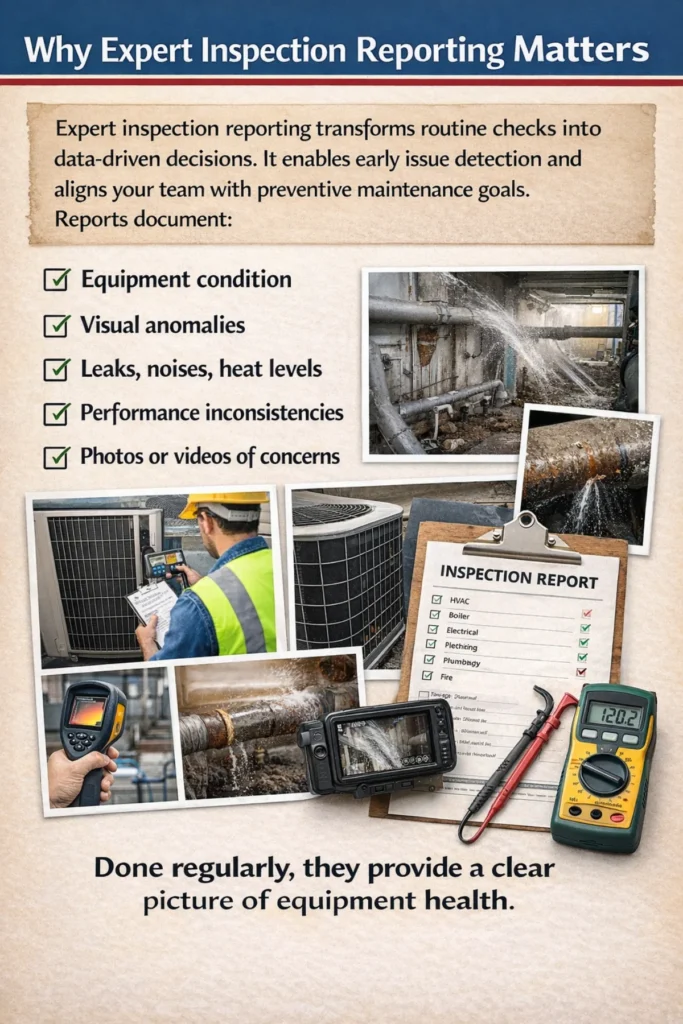
Expert Inspection reporting transforms routine checks into data-driven decisions. It enables early issue detection and aligns your team with preventive maintenance goals. Reports document:
- [Equipment condition](https://www.nationalequipmentappraisal.com/appraisal/definitions/machinery-and-equipment-condition.html)
- [Visual anomalies](https://www.argenie.ai/blogs/why-visual-inspection-is-important-seeing-beyond-the-surface)
- [Leaks, noises, heat levels](https://daikinquebec.net/en/heat-pump/noise-levels-whats-normal/)
- [Performance inconsistencies](https://www.collinsdictionary.com/dictionary/english/inconsistent-performance)
- Photos or videos of concerns
Done regularly, they provide a clear picture of equipment health.
## **How Proactive Inspection Saves Money**

Here’s how expert inspection reporting reduces costs:
- **Catches problems early**, before they escalate
- **Prevents unplanned downtime**
- **Extends asset lifespan** by addressing wear early
- **Reduces emergency repairs**
- **Improves resource scheduling** for parts and labor
- **Supports warranty claims** with proper documentation
In short: you fix small problems before they become big (and expensive) ones.
## **Best Tools for Digital Reporting** That Save Money
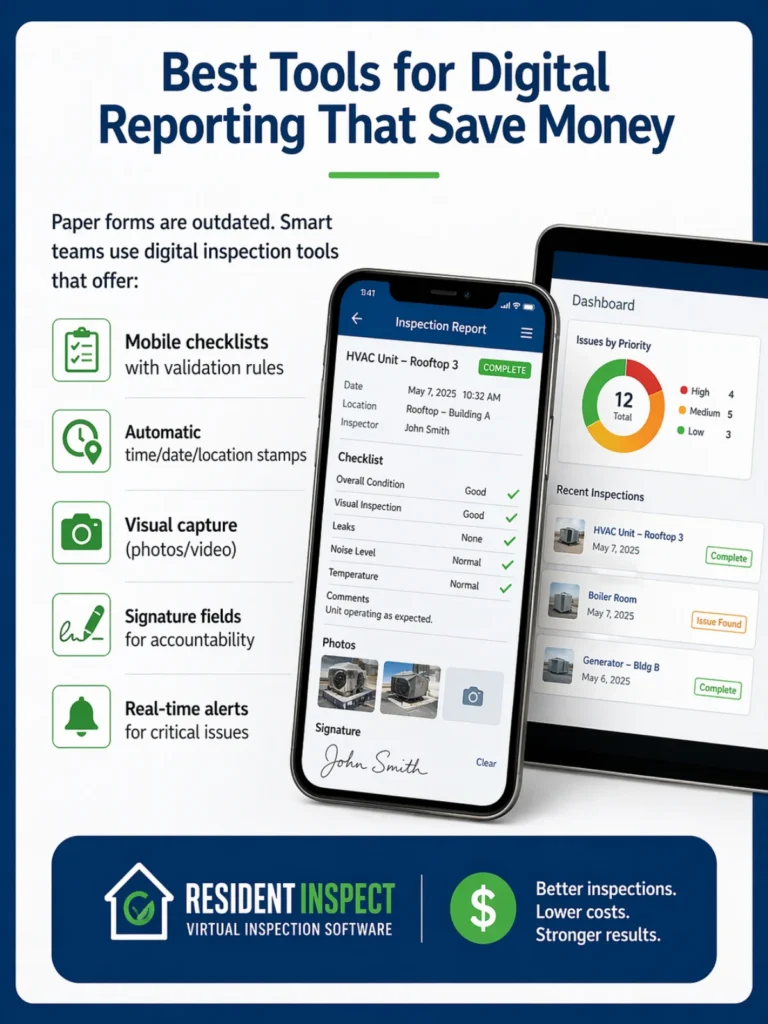
Paper forms are outdated. Smart teams use digital inspection tools that offer:
- Mobile checklists with validation rules
- Automatic time/date/location stamps
- Visual capture (photos/video)
- Signature fields for accountability
- Real-time alerts for critical issues
- Resident Inspect [Virtual Inspection Software](https://residentinspect.com/our-virtual-inspection-software/ "Virtual Inspection Software for Rentals")
Top-rated tools include: **[UpKeep](https://upkeep.com/), [MaintainX](https://www.getmaintainx.com/pricing "MaintainX"), [Fiix](https://fiixsoftware.com/), [Flowdit](https://flowdit.com/), and [Ezo](https://ezo.io/ezo-cmms/) CMMS**.
## **Integrating Reports with Maintenance Systems**
When inspection reports feed into your [**CMMS** (Computerized Maintenance Management System)](https://www.ibm.com/think/topics/what-is-a-cmms "CMMS (Computerized Maintenance Management System)"), it unlocks:
- **Auto-generated work orders**
- **Trend and failure pattern analysis**
- **Parts and labor forecasting**
- **Automated maintenance scheduling**
This connected ecosystem leads to leaner operations and lower costs.
## **Training Staff for High-Quality Inspections** Can Save Money
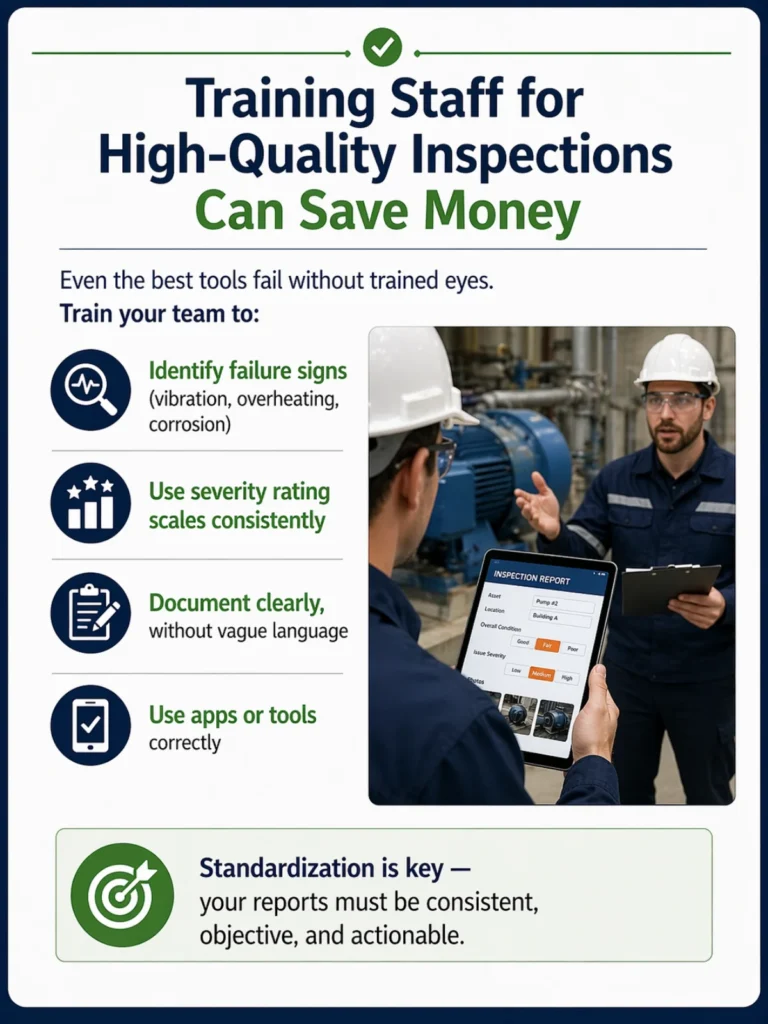
Even the best tools fail without trained eyes. [Train your team](https://residentinspect.com/blog/training-your-team-for-virtual-inspections/ "Training Your Team for Virtual Inspections") to:
- Identify failure signs (vibration, overheating, corrosion)
- Use severity rating scales consistently
- Document clearly, without vague language
- Use apps or tools correctly
Standardization is key — your reports must be consistent, objective, and actionable.
## **Using Reports to Forecast Failures**
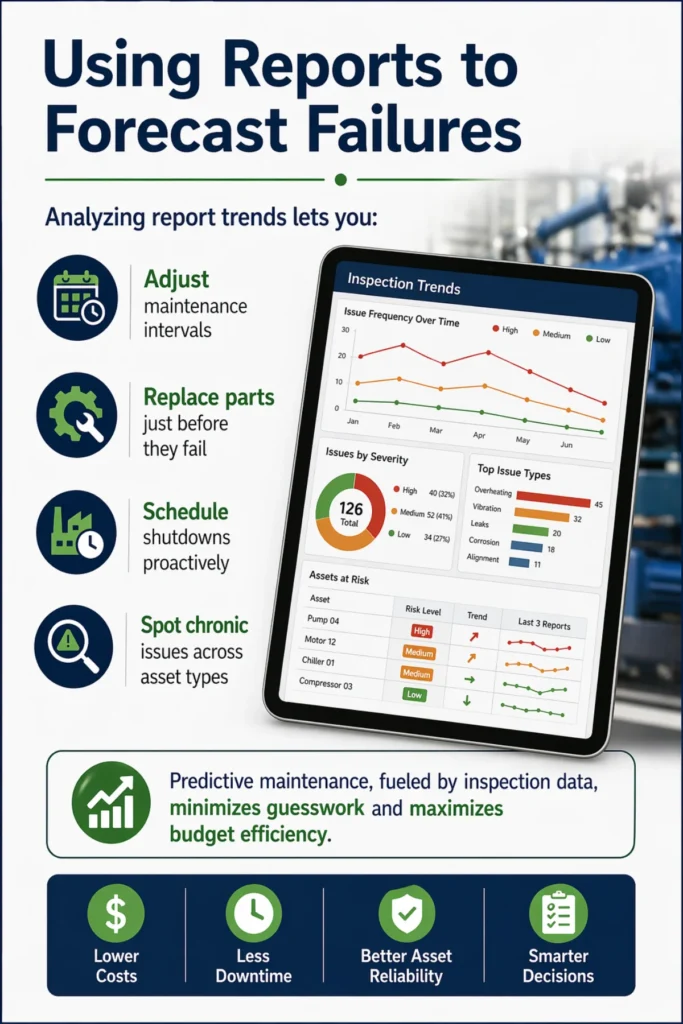
Analyzing report trends lets you:
- Adjust maintenance intervals
- Replace parts just before they fail
- Schedule shutdowns proactively
- Spot chronic issues across asset types
Predictive maintenance, fueled by [inspection data](https://residentinspect.com/blog/ultimate-rental-inspection-toolkit/ "The Ultimate Rental Inspection Toolkit for Property Managers"), minimizes guesswork and maximizes budget efficiency.
## **Going Mobile: Speed and Accuracy**
[Field technicians ](https://www.indeed.com/career-advice/finding-a-job/what-does-a-field-technician-do)using mobile reporting tools can:
- Instantly log findings
- Capture media for proof
- Submit reports in real time
- Eliminate transcription errors
Mobile-first expert inspection reporting ensures speed, accuracy, and traceability.
## **Track & Act on KPIs** to Save Money
Measure what matters. Track:
- [Mean Time Between Failures (MTBF)](https://en.wikipedia.org/wiki/Mean_time_between_failures "Mean Time Between Failures (MTBF)")
- Average Repair Time (ART)
- First-Time Fix Rate (FTFR)
- Planned vs. Unplanned Maintenance Ratio
- Inspection-to-Work-Order Conversion Rate
Use this data to continuously improve efficiency and cost-saving strategies.
## **Conclusion**
Expert Inspection reporting is the bridge between reactive maintenance chaos and proactive maintenance control.
It saves money by:
- Preventing downtime
- Reducing emergency fixes
- Extending equipment life
- Helping you plan smarter
From clipboard to cloud, from fire-fighting to foresight, the future of cost-effective maintenance starts with inspection reporting. If your team is stretched thin, [property management outsourcing](https://residentinspect.com/property-management-outsourcing/) can take routine reporting and admin tasks off your plate.
> ## **Frequently Asked Questions (FAQs)**
>
> ### **What is the difference between reactive and proactive maintenance?**
>
> Reactive fixes problems after they happen. Proactive prevents them through inspections, planning, and early interventions.
>
> ### **How can inspection reporting reduce repair costs?**
>
> By catching issues early, you avoid expensive breakdowns and emergency service fees.
>
> ### **Do small businesses benefit from digital inspection tools?**
>
> Yes. Even low-cost tools help small teams stay organized, prevent failures, and reduce waste.
>
> ### **How often should inspections be done?**
>
> It depends on equipment criticality, but monthly or weekly is a good start. Consistency is more important than frequency.
>
> ### **What’s the ROI on implementing digital inspection reporting?**
>
> Studies show 20–40% savings in maintenance-related costs within the first year of adoption.
> 
>
> Aaron Cooper Founder & CEO
>
> After more than 20 years as a landlord and property management company owner-operator, Aaron Cooper built Resident Inspect to solve a problem he experienced firsthand: the inspection process was broken, expensive, and impossible to scale. Resident Inspect is the result — a live virtual inspection service that replaces in-person inspections with a faster, more consistent, and more defensible process. [See Full Bio](https://residentinspect.com/about-us/aaron-cooper/)
>
>
>
> [Facebook](https://www.facebook.com/residentinspect/) [Instagram](https://www.instagram.com/residentinspect/) [TikTok](https://www.tiktok.com/@residentinspectofficial) [Pinterest](https://www.pinterest.com/aaron2762/) [YouTube](https://www.youtube.com/@ResidentInspect) [LinkedIn](https://www.linkedin.com/in/resident-inspect-a00b7a376/)
**Categories:** Blog
---
### [Rental Inspection Checklist: Move-In, Periodic & Move-Out](https://residentinspect.com/blog/rental-property-inspection-checklist/)
**Published:** March 17, 2026
**Author:** Aaron Cooper
**Content:**
💡 Quick Answer
A **rental inspection checklist** is a structured document landlords and property managers use to record the condition of a rental property during **move-in, periodic walkthroughs, and move-out**. A consistent checklist with **time-stamped photos** helps support security deposit decisions and catches maintenance issues before they become costly.
This guide gives you the complete **rental property inspection checklist**, organized by inspection type and broken down room by room. It covers what to document, what landlords most commonly miss, and how to build a documentation system that protects you, your owners, and your business.
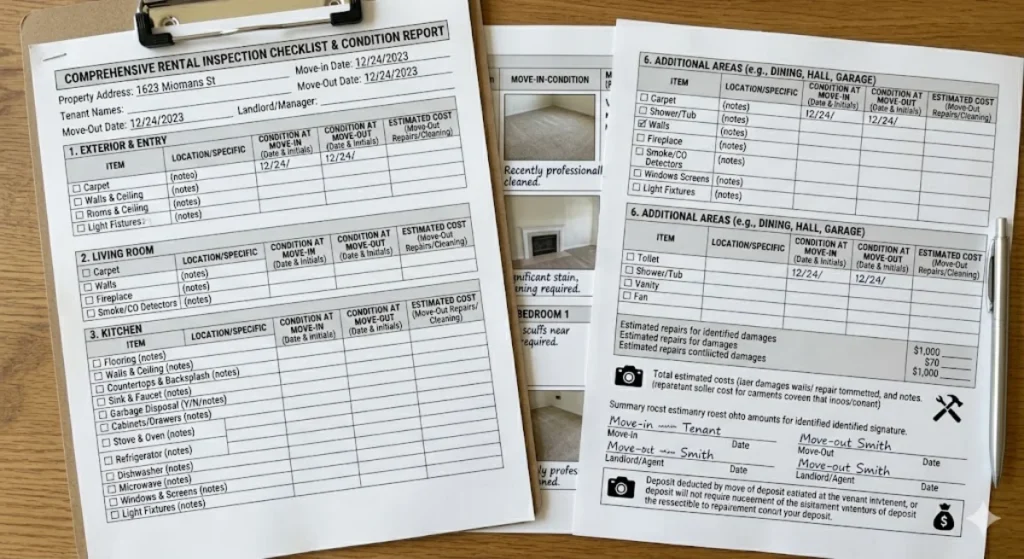
 Aaron Cooper
Founder & CEO, Resident Inspect
Jacksonville, FL • Property Technology
[Website](https://residentinspect.com/) [Email](mailto:aaron@residentinspect.com)
Aaron Cooper is the Founder and CEO of Resident Inspect, helping property managers streamline rental inspections, improve documentation, and create more consistent inspection workflows.
## In This Guide
1. [ Why rental inspection checklists matter ](#why-checklists-matter)
2. [ The three types of rental inspections ](#three-types)
3. [ Move-in inspection checklist ](#move-in-checklist)
4. [ Periodic inspection checklist ](#periodic-checklist)
5. [ Move-out inspection checklist ](#move-out-checklist)
6. [ What property managers commonly miss ](#commonly-missed)
7. [ Frequently asked questions ](#faq)
8. [ Free Rental Inspection Checklist PDF Download ](#move-in-inspection-form)
## Why Rental Inspection Checklists Matter
Most property managers know inspections are important. However, having a standardized rental inspection checklist that is consistently used for every inspection helps protect your business, your owners, and your residents.
Whether you’re completing a move-in, periodic, or move-out inspection, documenting the property’s condition with detailed notes, photos, and inspection reports creates a reliable record that supports maintenance planning, lease compliance, and dispute resolution.
- **Security deposit disputes:** Before-and-after documentation can help support damage claims and distinguish tenant-caused damage from ordinary wear.
- **Maintenance cost surprises:** Routine inspections can identify leaks, HVAC issues, roof damage, and electrical concerns before they become larger repairs.
- **Owner trust and liability:** A documented inspection process demonstrates that the property is being monitored consistently.
- **Documentation:** Detailed inspection reports, photos, and signed condition records create a clearer history of the property.
Download the Move-In Inspection Checklist
Get a ready-to-use move-in inspection checklist to help your team document property condition consistently, capture the right details, and create a stronger inspection record from day one.
[ Download the Free Checklist ](#move-in-inspection-form)
## Types of Rental Property Inspections
A complete rental inspection program typically includes move-in, periodic, and move-out inspections. Each serves a different purpose during the tenancy and creates documentation that can be compared throughout the life of the lease.
| Inspection Type | Timing | Purpose |
|---|---|---|
| **Move-In** | Before occupancy | Establishes the property’s baseline condition. |
| **Periodic** | During tenancy | Identifies maintenance and property-condition issues. |
| **Move-Out** | After vacancy | Compares the property against its move-in condition. |
💡 Property Manager Tip
Many property managers use **virtual property inspection services** to reduce drive time and scheduling friction while maintaining consistent documentation. Learn more about [virtual inspection software](https://residentinspect.com/our-virtual-inspection-software/) or [view pricing](https://residentinspect.com/pricing/).
## The Complete Move-In Rental Inspection Checklist
A move-in inspection establishes the property’s condition before a tenant takes possession. Document each area using clear photos and written condition notes so future inspections can be compared against a reliable baseline.
### Exterior
- **Roof condition:** Missing shingles, damaged flashing, or visible sagging.
- **Gutters and downspouts:** Properly attached and directing water away.
- **Foundation:** Cracks, settling, or moisture intrusion.
- **Siding and walls:** Damage, cracks, loose panels, or peeling paint.
- **Windows:** Glass, locks, screens, weather stripping, and frames.
- **Driveways and walkways:** Cracks, drainage issues, and trip hazards.
- **Exterior lighting:** Confirm fixtures are operational.
- **Landscaping and fencing:** Document overall condition.
- **Garage door:** Test operation and safety reverse function.
### Entry and Common Areas
- **Front door:** Locks, deadbolt, weather stripping, and condition.
- **Keys issued:** Document keys, remotes, and access cards.
- **Interior doors:** Check operation and damage.
- **Flooring:** Scratches, stains, chips, or loose materials.
- **Walls and ceilings:** Holes, stains, dents, or water damage.
- **Lighting:** Test fixtures and switches.
- **Safety detectors:** Test smoke and carbon monoxide detectors.
### Kitchen
- **Cabinets and drawers:** Doors, hinges, interiors, and cleanliness.
- **Countertops:** Burns, chips, cracks, or stains.
- **Sink and faucet:** Water flow, drainage, and leaks.
- **Garbage disposal:** Test operation if applicable.
- **Appliances:** Refrigerator, dishwasher, range, oven, and microwave.
- **Range hood:** Test ventilation.
- **Electrical outlets:** Test applicable GFCI outlets.
### Living Areas & Bathrooms
- **Living areas:** Walls, flooring, windows, blinds, outlets, and fans.
- **Water damage:** Look for staining, moisture, or visible mold.
- **Toilets:** Test flushing and inspect for leaks.
- **Showers and tubs:** Check caulking, drainage, and condition.
- **Bathroom exhaust:** Confirm the fan operates.
## Periodic Rental Inspection Checklist
Periodic rental inspections help property managers monitor property condition throughout the lease term and identify preventive maintenance or lease-compliance concerns. If your team is short on time, Resident Inspect offers [professional rental property inspections](https://residentinspect.com/rental-property-inspections/) that handle the walkthrough for you.
⚠️ Notice Requirements
Landlord-entry notice requirements vary by jurisdiction. Always verify applicable state and local law and your lease requirements before entering an occupied rental property.
### What to Check During a Periodic Inspection
- **Exterior:** Roof, gutters, siding, walkways, landscaping, and drainage.
- **Interior:** Walls, ceilings, flooring, windows, doors, moisture, and mold.
- **Kitchen and bathrooms:** Faucets, plumbing, appliances, GFCI outlets, and caulking.
- **HVAC and utilities:** Filters, thermostat, vents, water heater, and detectors.
- **Lease compliance:** Unauthorized occupants, pets, smoking, modifications, or safety hazards.
Don’t Miss a Detail at Move-In
Download the free Move-In Inspection Checklist and give your team a consistent framework for documenting each rental before a resident takes possession.
[ Get the Move-In Checklist ](#move-in-inspection-form)
## Move-Out Rental Inspection Checklist
Document the property’s condition after the tenant vacates and before turnover work alters its condition whenever appropriate under your process and applicable law. Resident Inspect can help your team run [move-in and move-out inspections](https://residentinspect.com/move-in-move-out-inspection-checklist/) so each report is easy to compare.
🚨 Documentation Tip
Capture the property’s as-vacated condition before cleaning or repairs whenever possible so the move-out report can be compared accurately with prior documentation.
### Examples of Potential Tenant-Caused Damage
**×** Large holes in walls or unauthorized paint changes
**×** Pet damage to flooring, screens, carpet, or fixtures
**×** Burns or permanent stains
**×** Broken windows, blinds, fixtures, or doors
**×** Missing keys, remotes, appliances, or fixtures
## What Property Managers Most Commonly Miss
**1. Under sinks:** Check for moisture, staining, loose plumbing connections, and signs of leaks.
**2. Dryer vents:** Check for lint buildup, damaged vent hoses, or restricted airflow.
**3. HVAC filters:** Document filter condition during periodic inspections.
## Frequently Asked Questions
### What should a rental inspection checklist include?
A rental inspection checklist should cover the exterior, living areas, kitchen, bathrooms, bedrooms, appliances, HVAC, plumbing, electrical components, safety devices, and property condition.
### How often should a landlord inspect a rental property?
Inspection frequency depends on applicable law, lease provisions, property requirements, and company policy. Many property managers conduct periodic inspections during the tenancy.
### What is the difference between move-in and move-out inspections?
The move-in inspection establishes the property’s baseline condition. The move-out inspection documents its condition after vacancy so changes can be compared against that baseline.
### Should rental inspections include photos?
Yes. Clear photographs make inspection documentation more useful by creating a visual record of property condition.
### Can rental inspections be performed virtually?
Yes. Virtual inspection workflows can help property managers document property condition remotely while reducing travel and scheduling requirements.
Free Download
## Get Your Free Move-In Inspection Checklist
Complete the form below to get the Move-In Inspection Checklist and start building a more consistent property inspection process.

Aaron Cooper Founder & CEO
After more than 20 years as a landlord and property management company owner-operator, Aaron Cooper built Resident Inspect to solve a problem he experienced firsthand: the inspection process was broken, expensive, and impossible to scale. Resident Inspect is the result — a live virtual inspection service that replaces in-person inspections with a faster, more consistent, and more defensible process. [See Full Bio](https://residentinspect.com/about-us/aaron-cooper/)
[Facebook](https://www.facebook.com/residentinspect/) [Instagram](https://www.instagram.com/residentinspect/) [TikTok](https://www.tiktok.com/@residentinspectofficial) [Pinterest](https://www.pinterest.com/aaron2762/) [YouTube](https://www.youtube.com/@ResidentInspect) [LinkedIn](https://www.linkedin.com/in/resident-inspect-a00b7a376/)
**Categories:** Blog
---
### [How To Write a Tenant Inspection Notice](https://residentinspect.com/blog/tenant-inspection-notice/)
**Published:** April 14, 2026
**Author:** Aaron Cooper
**Content:**
Aaron Cooper
Founder & Chief Executive Officer, Resident Inspect
📍 Jacksonville, FL
Aaron Cooper is a seasoned property technology entrepreneur and inspection industry expert. As the **Founder and CEO of Resident Inspect**, he leads the development of intelligent inspection platforms that empower landlords, property managers, and investors to streamline digital inspections and ensure compliance.
🌐 [residentinspect.com](https://residentinspect.com) ✉️ <aaron@residentinspect.com>
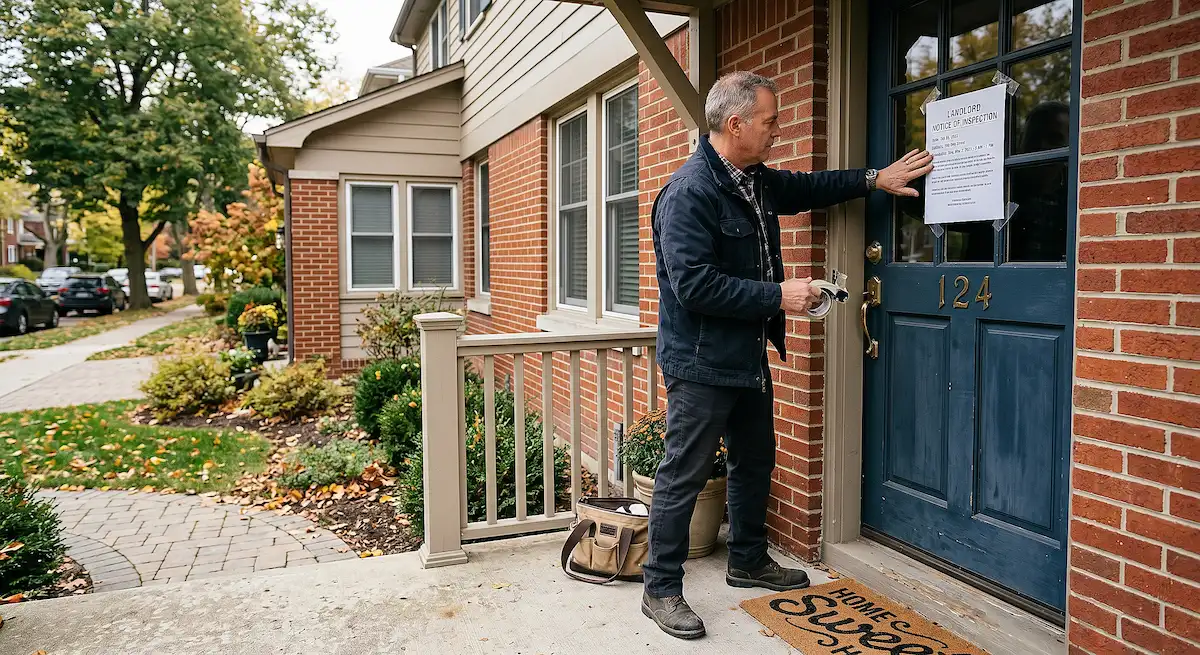 📌 SummaryThe tenant inspection notice is a small document with significant consequences when it goes wrong. A notice that meets the legal standard, explains the inspection clearly, and respects the tenant’s time is the foundation of a smooth inspection process. A notice that’s vague, improperly delivered, or legally deficient is a problem that starts before the inspector ever arrives.
The essentials: know your state’s minimum notice period, put it in writing, state the purpose and time window, deliver through a channel that creates a timestamp, and document the delivery. Use the templates in this post to standardize your notice process across your portfolio — then adapt them for virtual inspections as your program evolves.
[Resident Inspect](https://residentinspect.com) handles all tenant communication and scheduling for virtual periodic inspections — including inspection reminders that dramatically reduce no-shows. Your staff sends the formal notice; we handle everything else.
The inspection notice is the document most property managers think least about — and the one that causes the most problems when it goes wrong.
## **How to Write a Tenant Inspection Notice (Templates, Legal Requirements, and What Not to Do)**
A notice that doesn’t meet your state’s minimum requirements invalidates your right to enter. A notice that’s vague, threatening, or poorly written sets an adversarial tone before the inspection even happens. A notice sent through the wrong channel — a text when your lease requires written notice, or an email when your state requires posted notice — can expose you to claims of unlawful entry even if everything else about the inspection was handled correctly.
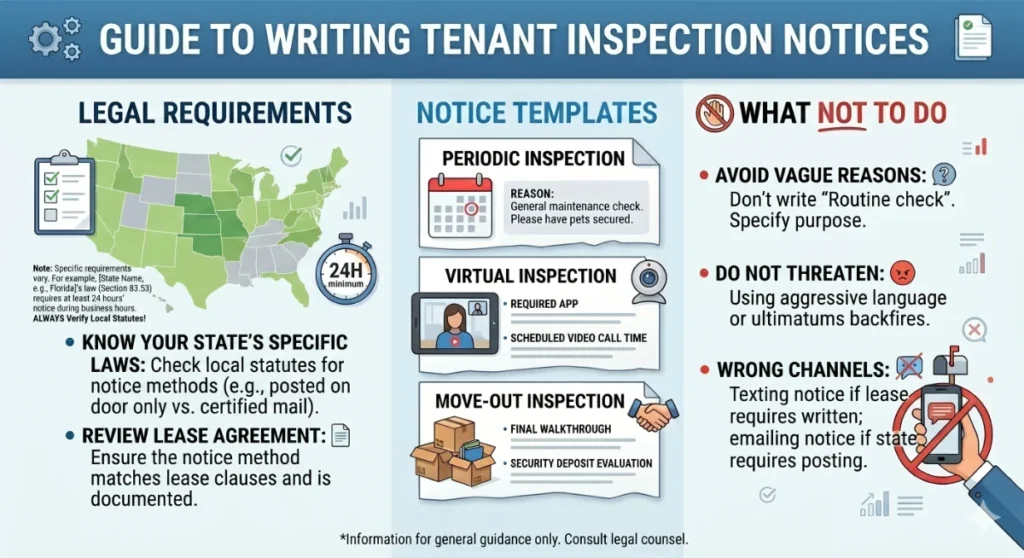Getting the notice right is not complicated. But it requires knowing what your state requires, what your lease requires, and how to communicate the inspection in a way that gets tenant cooperation rather than resistance.
This guide covers the legal requirements for tenant inspection notices across all 50 states, the elements every notice must include, the channels that work and the ones that don’t, and ready-to-use templates for periodic inspections, virtual inspections, and move-out inspections.
---
## Why the Inspection Notice Matters More Than You Think
The notice is not a formality. It is the legal foundation for your right to enter.
If a tenant later claims that you entered without proper notice — whether in a security deposit dispute, a habitability complaint, or a harassment allegation — the notice is your defense. A well-documented, properly delivered notice that meets your state’s requirements makes the tenant’s claim very difficult to sustain. An improper or missing notice hands them a significant legal advantage regardless of what you actually found during the inspection.
Beyond the legal dimension, the notice shapes the tenant’s experience of the inspection before it starts. A notice that reads like a threat or feels like surveillance produces a defensive, uncooperative tenant. A notice that’s professional, clear about what to expect, and respectful of the tenant’s time produces a cooperative one. The same information, delivered differently, generates different outcomes. This holds true for all [rental property inspections](https://residentinspect.com/rental-property-inspections/), whether they happen in person or by video.
💡
First Impression Sets the ToneThe inspection notice is your first communication about a specific inspection. It sets the tone for everything that follows.
---
## Legal Requirements: What Your Notice Must Cover
Every legally valid inspection notice must satisfy the requirements of both your state’s landlord-tenant statutes and your lease agreement. Where the two differ, the more protective standard applies — meaning if your state requires 24 hours but your lease says 48, give 48. For more detail, see our guide to [rental inspection laws by state](https://residentinspect.com/blog/rental-property-inspection-laws-by-state/).
The core legal elements every notice must address:
[**Timing of notice delivery.**](https://www.nolo.com/legal-encyclopedia/chart-notice-requirements-enter-rental-29033.html) The notice must be delivered far enough in advance to meet your state’s minimum notice period. This is typically 24 hours in most states, 48 hours in others (Arizona, Delaware, Hawaii, Kentucky, Rhode Island, Vermont, Washington), and 12 hours in a small number of states (Florida, Wisconsin). The clock starts when the tenant receives the notice, not when you send it — which matters if you’re delivering by mail.
**Method of delivery.** Some states specify that the inspection notice must be in writing. Others allow oral notice. Even in states where oral notice is technically permissible, written notice is always the better practice because it creates a record. The safest delivery methods are email (with a timestamp), text message (with a timestamp), notice posted to the door (document with a photo), or delivery through your property management software’s messaging system.
**Stated purpose of entry.** The notice must state why you are entering. “Periodic inspection” or “routine property inspection” is sufficient in most states. California is the most specific in this regard — notices must state the approximate time, date, and purpose of entry.
**Date and approximate time of entry.** Specify the date and a time window. Showing up three hours outside the window stated in the notice can be challenged in some states.
**Contact information.** Include a name and contact method so the tenant can respond to reschedule if needed. This is not required by most state statutes, but it is good practice and reduces resistance.
---
## Notice Requirements by State: A Quick Reference
[Most states fall into one of four categories](https://www.turbotenant.com/state):
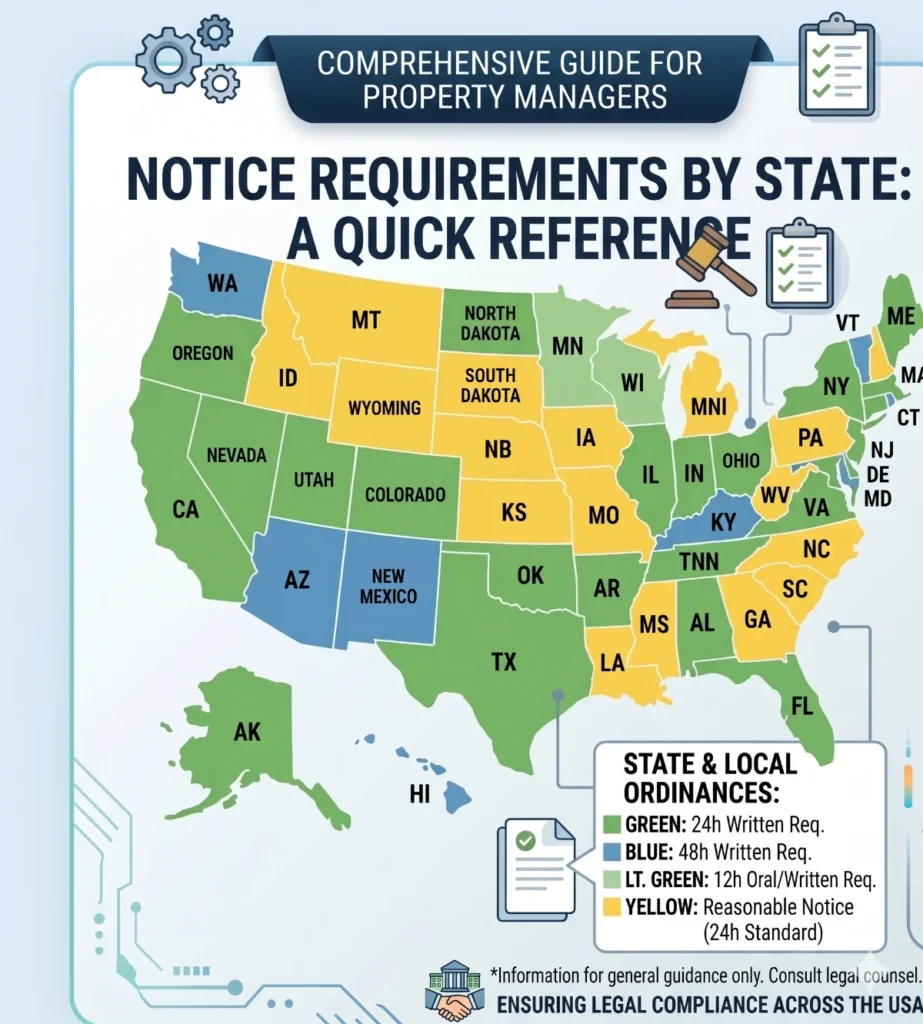🕐 24-Hour Written Notice Required
Alaska, California, Iowa, Maine, Montana, Nebraska, Nevada, New Hampshire, New Mexico, North Dakota, Ohio, Oklahoma, Oregon, South Carolina, South Dakota, Tennessee, Utah, Virginia
🕑 48-Hour Written Notice Required
Arizona, Delaware, Hawaii, Kentucky, Rhode Island, Vermont, Washington
⚡ 12-Hour Notice Required (Written or Oral)
Florida, Wisconsin
📋 “Reasonable Notice” (24-Hour Standard)
Arkansas, Colorado, Connecticut, Georgia, Idaho, Indiana, Kansas, Louisiana, Maryland, Massachusetts, Michigan, Minnesota, Mississippi, Missouri, New Jersey, New York, North Carolina, Pennsylvania, Texas, Wyoming
⚠️
Local Ordinances May ApplyFor Illinois, note that Chicago has specific local ordinances that may impose additional requirements beyond state law. New York City similarly layers local requirements on top of state law. Always verify the current statute in your state before relying on this summary.
---
## The Elements of an Effective Inspection Notice
A notice that is legally sufficient is not automatically an effective one. An effective notice accomplishes three things: it meets the legal standard, it gives the tenant enough context to cooperate, and it makes it easy for the tenant to respond if rescheduling is needed.
Every inspection notice should include:
- 1
**Date the notice is being sent.** This establishes the start of the notice period.
- 2
**The tenant’s name and property address.** Personalizing the notice to the specific tenant and property reduces the bureaucratic feel and confirms the notice is intended for them.
- 3
**The date of the inspection.** Clear and specific. Not “next week” or “sometime in the next few days.”
- 4
**The time window for the inspection.** A 1 to 2 hour window is professional and practical. A 4 to 6 hour window is inconvenient for the tenant and unnecessary for the property manager.
- 5
**The purpose of the inspection.** “Routine periodic inspection” or “semi-annual property inspection” is appropriate. You do not need to specify what you’re looking for.
- 6
**Who will be conducting the inspection.** For in-person inspections, this is the name of the property manager or inspector. For virtual inspections conducted by a service like Resident Inspect, note that the inspection will be conducted by a trained inspector via live video call.
- 7
**Approximately how long the inspection will take.** Setting this expectation reduces anxiety and shows respect for the tenant’s time. A periodic inspection takes 20 to 45 minutes. A move-in or move-out inspection may take longer.
- 8
**What the tenant needs to do.** For in-person inspections, this might be providing access or confirming they’ll be home. For virtual inspections, this includes instructions for the video call. For all inspections, include a contact method for rescheduling.
- 9
**Your contact information.** Name, phone, and email so the tenant can respond easily.
---
## Ready-to-Use Inspection Notice Templates
The following templates can be used as-is or modified to match your company’s tone and lease language. Replace bracketed fields with the appropriate information.
| Template | Primary Purpose | Est. Duration | Key Tenant Action |
|---|---|---|---|
| 1. Standard Periodic | Routine maintenance check and general property condition verification. | 20–45 mins | Optional presence; ensure access is available for the inspector. |
| 2. Virtual Inspection | Remote walkthrough via live video call to assess condition without entry. | 20–30 mins | **Mandatory** presence; must have smartphone and Wi-Fi/data. |
| 3. Move-Out | Final assessment to determine security deposit deductions vs. move-in state. | 30–60 mins | Remove all property, clean to lease standards, and return all keys/remotes. |
| 4. Rescheduled | Updating a previously set inspection time due to conflicts or changes. | 20–45 mins | Confirm receipt of the new date/time or request another alternative. |
| 5. Second Notice | Follow-up for a failed/missed inspection; emphasizes lease compliance. | Varies | Immediate confirmation required to avoid potential re-inspection fees. |
📋 Template 1 — Standard Periodic Inspection Notice (In-Person)
Notice Date \[Date notice is sent\]
**To:** \[Tenant name(s)\]
**Property address:** \[Full address\]
This notice is to inform you that a routine periodic inspection of your rental property is scheduled for:
**Date:** \[Inspection date\]
**Time:** \[Start time\] to \[End time\]
**Inspector:** \[Name of inspector or property manager\]
**Estimated duration:** 20–45 minutes
This is a standard inspection conducted as part of our regular property maintenance program. The purpose of the inspection is to verify the general condition of the property and identify any maintenance needs.
You are not required to be present during the inspection, provided access is available. If you would like to be present or need to reschedule, please contact us at least \[24/48\] hours before the scheduled time.
**Contact:** \[Name\] \| \[Phone\] \| \[Email\]
\[Company name\] \| \[Company address\]
📱 Template 2 — Virtual Inspection Notice
Notice Date \[Date notice is sent\]
**To:** \[Tenant name(s)\]
**Property address:** \[Full address\]
This notice is to inform you that your upcoming periodic inspection will be conducted as a virtual inspection via live video call.
**Scheduled date:** \[Inspection date\]
**Scheduled time:** \[Time window\]
**Estimated duration:** 20–30 minutes
**Inspector:** A trained Resident Inspect inspector will connect with you via video call
**How it works:** At the scheduled time, you will receive a video call from your inspector. The inspector will guide you through the property room by room via your smartphone camera. You do not need to download any special application — the call is initiated through a standard video link.
**What you will need:**
- A smartphone with a working camera
- Cellular service or Wi-Fi connection at the property
- Access to all areas of the property including any storage areas, garage, and utility spaces
If you need to reschedule or have questions about the virtual inspection process, please contact us at least \[24/48\] hours before the scheduled time.
**Contact:** \[Name\] \| \[Phone\] \| \[Email\]
\[Company name\] \| \[Company address\]
📦 Template 3 — Move-Out Inspection Notice
Notice Date \[Date notice is sent\]
**To:** \[Tenant name(s)\]
**Property address:** \[Full address\]
As your tenancy at the above address is ending on \[move-out date\], this notice is to inform you that a move-out inspection has been scheduled for:
**Date:** \[Inspection date\]
**Time:** \[Start time\] to \[End time\]
**Inspector:** \[Name\]
**Estimated duration:** 30–60 minutes
The move-out inspection will document the condition of the property at the end of your tenancy and will be compared against the move-in inspection report on file. The inspection report will be used to determine whether any deductions from your security deposit are applicable under the terms of your lease.
You are welcome to be present during the move-out inspection. If you would like to attend, please confirm your availability by \[date\].
**Please ensure that:**
- All personal property has been removed from the premises before the inspection
- All keys, garage door openers, remotes, and mailbox keys are available for return
- The property has been cleaned to the standard required by your lease
If you have questions or need to adjust the inspection time, please contact us by \[date\].
**Contact:** \[Name\] \| \[Phone\] \| \[Email\]
\[Company name\] \| \[Company address\]
🔄 Template 4 — Rescheduled Inspection Notice
Notice Date \[Date notice is sent\]
**To:** \[Tenant name(s)\]
**Property address:** \[Full address\]
Following our previous communication regarding the inspection originally scheduled for \[original date\], your periodic inspection has been rescheduled for:
**New date:** \[New inspection date\]
**Time:** \[Start time\] to \[End time\]
**Inspector:** \[Name\]
**Estimated duration:** 20–45 minutes
Please confirm receipt of this notice by replying to this message or contacting us at the information below. If this time does not work for your schedule, please contact us at least \[24/48\] hours in advance so we can find an alternative.
**Contact:** \[Name\] \| \[Phone\] \| \[Email\]
\[Company name\] \| \[Company address\]
⚠️ Template 5 — Second Notice After Missed Inspection
Notice Date \[Date notice is sent\]
**To:** \[Tenant name(s)\]
**Property address:** \[Full address\]
This notice follows our previous inspection notice dated \[original notice date\] for the inspection scheduled on \[original inspection date\], which was not completed.
As noted in your lease agreement and in accordance with \[state\] landlord-tenant law, periodic inspections are conducted every \[frequency\] as a standard part of your tenancy. Your cooperation in scheduling and completing these inspections is a condition of your lease.
A new inspection has been scheduled for:
**Date:** \[New date\]
**Time:** \[Time window\]
**Inspector:** \[Name\]
Please confirm by \[date\] that this time works for your schedule, or contact us to arrange an alternative. If we are unable to complete this inspection as scheduled, we may assess a re-inspection fee of $\[amount\] as provided in your lease agreement.
If you have any questions or concerns about the inspection process, we welcome the opportunity to address them.
**Contact:** \[Name\] \| \[Phone\] \| \[Email\]
\[Company name\] \| \[Company address\]
---
## Delivery Methods: What Works and What Creates Risk
How you deliver the notice matters as much as what it says. Different delivery methods create different evidentiary records — and some methods are legally required in certain states.
🖥️ Property Management Software Best
AppFolio, Propertyware, Buildium, etc. timestamps delivery, logs the message in the tenant’s file, and provides a documented communication trail that is hard to dispute.
📧 Email Good
Creates a timestamp and a searchable archive. To strengthen the record, request a read receipt or send a follow-up text to confirm the email was received.
💬 Text Message Good
Creates a timestamp and increasing common in property management communication. Screenshot and archive all text communications related to inspections.
📬 Posted Notice (Door) OK
Required by some states as an alternative method and visually confirmable. Document the posting with a timestamped photo on your phone.
📮 Certified Mail Formal Only
Creates the strongest proof of delivery but is overkill for routine inspection notices. Reserve certified mail for second notices after refusals or formal lease violation notices.
🗣️ Oral Notice Avoid
Technically permissible in some states but creates no documentation and is impossible to prove if the tenant later disputes it. Almost never the right choice.
**✅ Best Practice** Send via your property management software or email, and follow up with a text confirming the notice was sent. You now have two timestamped records and a confirmation of receipt.
---
## Common Mistakes That Invalidate Inspection Notices
These are the errors that most frequently turn a routine inspection into a legal problem:
- ✕
**Sending notice too late.** If your state requires 24 hours and you send the notice at 4:00 p.m. for an inspection at 9:00 a.m. the next morning, the notice period was not met. Build in buffer — send notices at least a day ahead of the minimum requirement.
- ✕
**Sending notice without stating the purpose.** Some states, [particularly California](https://www.findlaw.com/realestate/landlord-tenant-law/state-by-state-chart-of-landlord-and-tenant-laws.html), require the purpose to be stated. Even where not legally required, stating the purpose reduces tenant anxiety and resistance.
- ✕
**Scheduling outside reasonable hours.** Most states require inspections to occur at “reasonable” times — typically 8:00 a.m. to 6:00 p.m. on weekdays. Scheduling an inspection outside these hours without tenant consent creates legal exposure.
- ✕
**Using an informal channel that leaves no record.** A verbal notice to the tenant in passing, a message on a platform that doesn’t timestamp, or a note slipped under the door without documentation are all weak substitutes for a proper written notice.
- ✕
**Entering at a different time than stated in the notice.** If your notice says 10:00 a.m. to noon and you arrive at 2:00 p.m., the notice is arguably invalid for the actual entry. Match your arrival to the time window stated.
- ✕
**Sending notice to the wrong contact.** If the lease lists multiple tenants, the notice should go to all of them — or to the primary contact as defined in the lease. Sending notice only to one tenant when another had a concern about the inspection creates ambiguity.
- ✕
**Failing to document delivery.** The notice is only useful as evidence if you can prove it was sent. Document every notice delivery in your property management system.
---
## How Resident Inspect Handles Notice for You
One of the operational advantages of using a professional virtual inspection service is that the notice and communication process is handled by the service — not by your staff.
When a property is submitted for inspection through Resident Inspect, the service contacts the tenant directly to schedule the appointment. That contact — including the initial outreach, the scheduling confirmation, and the appointment reminders — constitutes notice of the upcoming inspection and creates a documented communication trail.
📋
Important: Your Formal Notice Is Still RequiredThe Resident Inspect scheduling process doesn’t replace your obligation to provide a formal inspection notice under your lease and state law. But the scheduling and reminder process that Resident Inspect manages eliminates the follow-up friction and reduces no-shows dramatically, because tenants receive multiple touchpoints before the inspection rather than a single notice and silence.
For property managers running inspections at scale, the combination of a formal company notice and the inspection service’s scheduling communications creates a robust documentation trail for every inspection event. When you are ready, you can [schedule an inspection](https://residentinspect.com/schedule/) online.
---
## Adapting Your Notice for Virtual Inspections
If you’re transitioning periodic inspections to a virtual format, the standard inspection notice needs adjustment in two specific areas.
First, the notice must explain what a virtual inspection is. Many tenants have never participated in one. A notice that simply says “your inspection will be conducted virtually” without explaining what that means will generate confusion and questions — which delays the process and creates friction.
Template 2 above addresses this by describing the video call format, what the tenant needs, and what to expect. Including this context upfront dramatically reduces the questions and concerns that come back to your office before the inspection day.
Second, if your lease does not already address virtual inspections, include a brief reference to your right to conduct inspections “via in-person or remote video technology” in the notice. This doesn’t replace the lease addendum — it’s not legally binding to say it in a notice — but it normalizes the format and reduces the likelihood of the tenant objecting on the day of the inspection.
---
## Frequently Asked Questions
Q
Can I send an inspection notice by text message? In most states, yes — a text message satisfies the “written notice” requirement. Some states specify the method more precisely, so verify your state’s requirements. Even where text is permissible, follow up with email or a notice through your property management software to create a stronger documentation trail.
Q
What if the tenant says they never received the notice? This is why delivery method and documentation matter. If you sent the notice via your property management software or email with a timestamp, you have evidence of delivery. If the tenant claims non-receipt, resend immediately via a different channel and document the resend. In a dispute, your documented delivery record is your defense — “I never got it” is very difficult to sustain when you have a read receipt, a timestamped email, and a follow-up text in the record.
Q
Does the notice period start when I send the notice or when the tenant receives it? The notice period starts when the tenant receives the notice — not when you send it. If you send an email at 11:00 p.m. and the tenant doesn’t read it until 8:00 a.m. the next day, the 24-hour clock arguably started at 8:00 a.m. To avoid any ambiguity, send notices during business hours and allow buffer beyond the minimum required period.
Q
Do I need to give separate notice for each inspection? Yes. A single notice at the beginning of the tenancy saying “we will inspect periodically” does not satisfy the notice requirement for individual inspections. Each inspection event requires its own notice meeting the timing and content requirements of your state’s law.
Q
Can I include the inspection notice in a broader move-in communication? You can send the move-in inspection notice as part of a move-in communication package, but it should be clearly identified as a separate notice. Include all the required elements — date, time, purpose — and make sure the timing meets your state’s minimum notice period from the scheduled inspection date.
Q
What notice is required if I need to enter for an emergency? Emergency entry does not require advance notice in any state. The standard is that a genuine emergency — fire, flooding, gas leak, structural danger — allows immediate entry. Document the emergency, what you found, and what actions you took. Notify the tenant as soon as reasonably possible after the emergency entry.

Aaron Cooper Founder & CEO
After more than 20 years as a landlord and property management company owner-operator, Aaron Cooper built Resident Inspect to solve a problem he experienced firsthand: the inspection process was broken, expensive, and impossible to scale. Resident Inspect is the result — a live virtual inspection service that replaces in-person inspections with a faster, more consistent, and more defensible process. [See Full Bio](https://residentinspect.com/about-us/aaron-cooper/)
[Facebook](https://www.facebook.com/residentinspect/) [Instagram](https://www.instagram.com/residentinspect/) [TikTok](https://www.tiktok.com/@residentinspectofficial) [Pinterest](https://www.pinterest.com/aaron2762/) [YouTube](https://www.youtube.com/@ResidentInspect) [LinkedIn](https://www.linkedin.com/in/resident-inspect-a00b7a376/)
**Categories:** Blog
---
### [How a Jacksonville Property Manager Cut Inspection Headaches at Scale](https://residentinspect.com/blog/jacksonville-property-manager-cut-inspection-headaches/)
**Published:** August 5, 2026
**Author:** Aaron Cooper
**Excerpt:** How Nest Finders, a Jacksonville property management company, scaled rental inspections without the travel, no-shows, and inconsistency that slow most teams down.
**Content:**
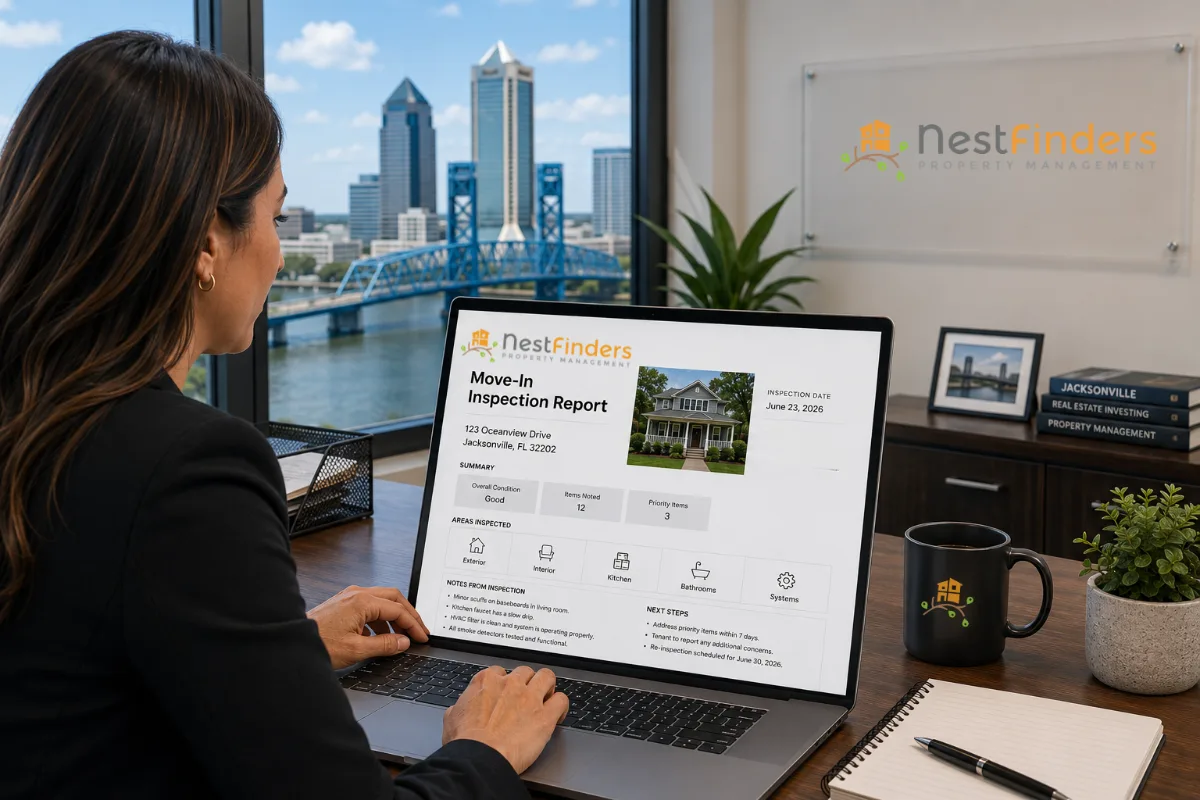In this article
- [The bottleneck: good inspections that didn't scale](#the-bottleneck-good-inspections-that-didnt-scale)
- [The shift: guided live virtual inspections](#the-shift-guided-live-virtual-inspections)
- [The payoff: capacity, consistency, and cleaner owner reporting](#the-payoff-capacity-consistency-and-cleaner-owner-reporting)
- [Why consistency is the real unlock](#why-consistency-is-the-real-unlock)
- [Why location stopped being a constraint](#why-location-stopped-being-a-constraint)
- [The takeaway for growing managers](#the-takeaway-for-growing-managers)
Most property management companies don’t have an inspection *problem* – they have an inspection *capacity* problem. Doing inspections well is straightforward when you have ten doors. At a few hundred, spread across a metro area, the same task quietly turns into one of the biggest time sinks on the team’s calendar.
I run [Nest Finders Property Management](https://www.nestfinders.com/) — a Jacksonville and St. Augustine company that has managed rentals across the Greater First Coast area since 2004. We hit exactly that wall. Here’s how we kept inspections thorough while growing, and what other managers can take from it.
## The bottleneck: good inspections that didn’t scale
We built Nest Finders on a hands-on, local approach — the kind of service that’s easy to deliver on a small portfolio and increasingly hard to protect as you grow. Inspections were a perfect example. Driving to each property, coordinating with residents, and documenting condition by hand worked, but it competed directly with leasing, rent collection, and maintenance for my team’s hours.
The math is unforgiving. A single inspection might only take 30 minutes inside the unit – but add drive time across a spread-out metro, the back-and-forth to schedule a time the resident will actually be home, the no-shows that send an inspector home empty-handed, and the write-up afterward, and one inspection can swallow half a day. Multiply that across a growing portfolio and inspections stop being a routine task and start being a staffing decision.
ℹ The three bad options
As portfolios grow, managers usually get stuck choosing between doing inspections themselves, paying a high-cost third-party inspector, or pushing residents to self-inspect. The first doesn’t scale, the second gets expensive, and the third trades reliability for convenience.
Each of those options carries a hidden cost. Doing it in-house caps how many doors the team can take on. Third-party inspectors can run $125 or more per visit and still deliver uneven results. And resident self-inspections – the tempting “free” option – routinely miss damage, produce unusable photos, and leave gaps that surface at exactly the wrong moment, like a security-deposit dispute.
## The shift: guided live virtual inspections
Instead of adding inspectors or accepting thinner documentation, we moved to [live virtual inspections](/our-virtual-inspection-software/) – walkthroughs run over a video call with the resident, led in real time by a trained specialist. The specialist guides the resident room by room, directs the camera to the spots that matter, and captures clear photos and notes as they go.
The change addressed the bottleneck directly:
- **No travel.** Inspectors aren’t burning hours driving between Mandarin, the beaches, and St. Augustine.
- **Resident scheduling handled for them.** Coordination, reminders, and evening or weekend slots come off the team’s plate.
- **A consistent process every time.** The same checklist and photo standards apply to every property, so quality doesn’t drift from one inspector or one week to the next.
- **Fewer no-shows.** Flexible scheduling plus reminders means more inspections actually happen on the first attempt, instead of being rebooked two or three times.
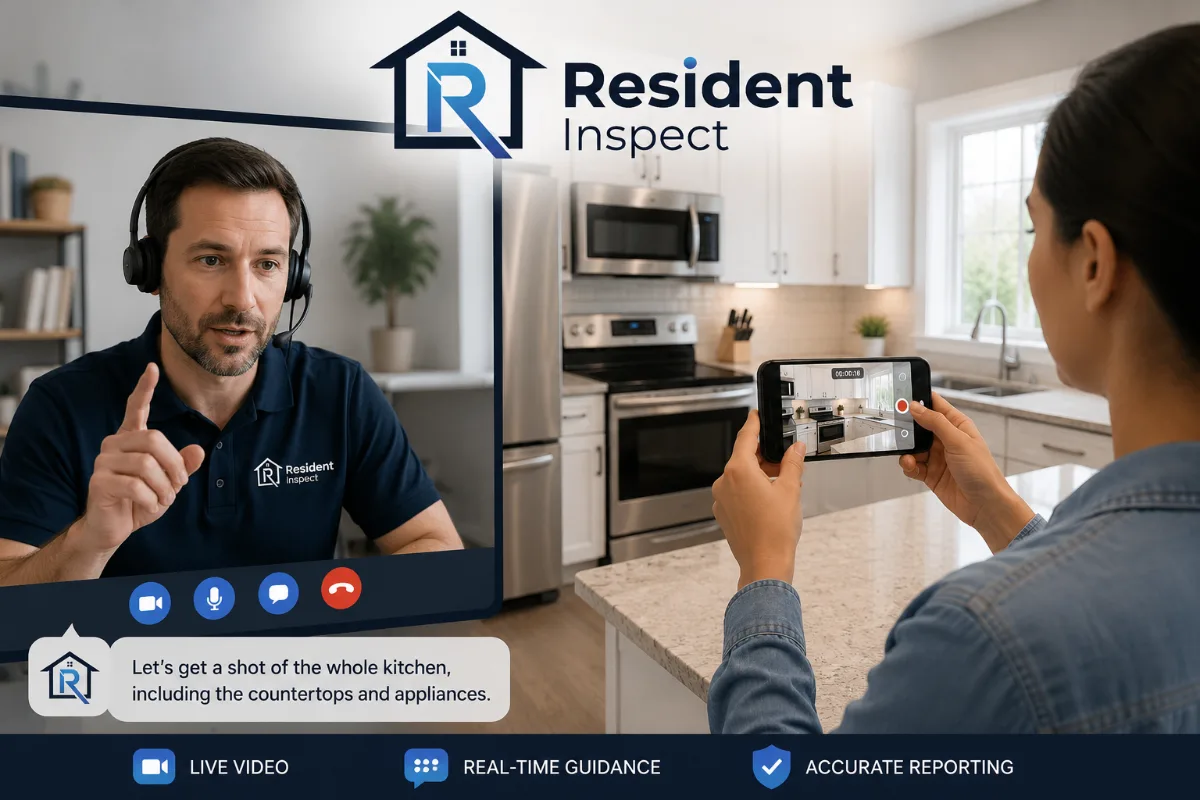Crucially, this isn’t a resident self-inspection with a nicer label. A trained person is on the call the entire time, controlling what gets documented and making sure the kitchen, the bathrooms, under the sinks, the smoke detectors, and any pet-related wear all get captured – the areas that matter most and the ones residents are most likely to skip on their own.
## The payoff: capacity, consistency, and cleaner owner reporting
The most obvious win is time back. Every hour a team isn’t spending in the car or chasing a resident to reschedule is an hour that goes toward leasing, maintenance coordination, and owner relationships – the work that actually grows the business. This kind of [property management outsourcing](https://residentinspect.com/property-management-outsourcing/) gave us more capacity without adding staff.
But the quieter win is consistency. Every property runs through the same [periodic rental inspection service](/periodic-rental-inspection-service/) and produces a clear, branded, photo-backed report – the kind of documentation that protects rental income, supports security-deposit decisions, and answers owner questions before they’re even asked.
❝ In their words
“Inspections used to be the thing that scaled the worst. Now every property gets the same thorough walkthrough and the same clean report, whether it’s one door or fifty – and my team gets their week back.” — Blakely Hughes, Founder & Broker, [Nest Finders Property Management](https://www.nestfinders.com)
For us, that consistency isn’t a nice-to-have. It’s the thing that lets us keep promising a hands-on experience while the door count climbs. Owners don’t see a team stretched thin; they see clean, predictable reporting on every property, every cycle.
## Why consistency is the real unlock
It’s tempting to frame this as a story about saving money on inspections, and the savings are real. But the deeper value is removing variance. When inspections depend on which staffer ran them, how rushed they were that day, and whether they remembered to photograph the water heater, your documentation is only as strong as your worst walkthrough.
A standardized process changes the floor, not just the average. Every report covers the same areas to the same standard. That predictability is what makes inspection data genuinely useful downstream – for lease enforcement, for deposit decisions, for owner updates, and for spotting a maintenance issue while it’s still cheap to fix.
## Why location stopped being a constraint
There’s a second, less obvious benefit that shows up as a portfolio grows: geography stops dictating what a team can take on. When inspections require a person to physically drive to a property, your service area is capped by how far an inspector can reasonably travel in a day. Every new neighborhood adds windshield time, and every property at the edge of the map is a little less profitable than the one next door to the office.
A guided virtual process removes that ceiling. An inspection in St. Augustine costs the team the same time as one in the heart of Jacksonville, because no one is driving to either. For a company eyeing steady, long-term growth, that changes the calculus: you can say yes to a well-located property without first asking whether it’s too far from your current cluster of units.
The same logic is why this model travels well beyond a single metro. A team managing across multiple markets – or planning to – isn’t limited by where its inspectors happen to live. The process is identical whether the property is five minutes away or five hundred miles, which makes inspection capacity a fixed, predictable cost instead of one that balloons every time the map gets bigger.
## The takeaway for growing managers
Our story at Nest Finders isn’t really about software — it’s about refusing to trade inspection quality for growth — a lesson that reaches well beyond the local [Jacksonville property management](https://www.nestfinders.com/jacksonville-property-management) market. If inspections have started competing with everything else on your team’s calendar, the fix usually isn’t more inspectors. It’s a repeatable, [done-for-you rental inspections](/rental-property-inspections/) process that holds the same standard at any scale.
The companies that scale well aren’t the ones that work inspections harder – they’re the ones that take the variability out of them. Whatever tool or partner you use, the principle is the same: make every inspection look the same, capture the things that actually drive disputes and repairs, and stop letting a routine task dictate how many doors you can take on.
🚀 Inspections slowing your growth?
See how Resident Inspect runs live, guided inspections for property managers like Nest Finders – consistent reports, no travel, no scheduling headaches. Book a free demo and inspect smarter.
## Frequently Asked Questions
How do virtual inspections help a property manager scale?
They remove the two things that cap an in-house team’s capacity: travel time and scheduling. A trained specialist runs the walkthrough on a live video call with the resident, so a manager can cover more doors without adding inspectors or windshield time.
Are virtual inspections as reliable as in-person visits?
When they’re guided by a trained inspector following a fixed checklist, yes – often more so. Every property gets the same angles, the same documentation standard, and a dated, photo-backed report, which is hard to guarantee when inspections are squeezed between other tasks.
What kind of property manager benefits most?
Growing single-family and small multi-family portfolios where inspections have started to compete with leasing, rent collection, and maintenance for the team’s time. That’s exactly the stage where consistency tends to slip.
Does switching to virtual inspections mean firing inspectors?
Not usually. Most teams redeploy that time into higher-value work – leasing, owner relationships, and maintenance coordination – rather than cutting staff. The win is capacity, not headcount reduction.
How does better inspection documentation help with owners?
Clear, branded, photo-backed reports answer owner questions before they’re asked, support repair decisions, and make condition easy to demonstrate. That builds trust and cuts down on the back-and-forth that eats a manager’s week.
Blakely Hughes
Founder & Broker, Nest Finders Property Management
📍 Jacksonville, FL
Blakely Hughes is the **Founder and Broker of Nest Finders Property Management**, a Jacksonville-based property management and real estate company serving owners, investors, and residents throughout the First Coast. With extensive residential real estate and property management experience, Blakely is known for his practical, proactive approach to rental property operations, owner communication, and long-term asset performance.
🌐 [nestfinders.com](https://www.nestfinders.com)
✉️ <admin@nestfinders.com>
---
## Need Help Managing Your Jacksonville Rental?
Connect with Nest Finders to learn how professional property management can help protect your investment, reduce stress, and improve your rental performance.
[Contact Nest Finders](https://www.nestfinders.com/contact)Prefer to learn more? [View property management services](https://www.nestfinders.com/jacksonville-property-management).

Aaron Cooper Founder & CEO
After more than 20 years as a landlord and property management company owner-operator, Aaron Cooper built Resident Inspect to solve a problem he experienced firsthand: the inspection process was broken, expensive, and impossible to scale. Resident Inspect is the result — a live virtual inspection service that replaces in-person inspections with a faster, more consistent, and more defensible process. [See Full Bio](https://residentinspect.com/about-us/aaron-cooper/)
[Facebook](https://www.facebook.com/residentinspect/) [Instagram](https://www.instagram.com/residentinspect/) [TikTok](https://www.tiktok.com/@residentinspectofficial) [Pinterest](https://www.pinterest.com/aaron2762/) [YouTube](https://www.youtube.com/@ResidentInspect) [LinkedIn](https://www.linkedin.com/in/resident-inspect-a00b7a376/)
**Categories:** Blog, Case Studies
---
### [Deferred Maintenance in Rental Portfolios: The Q4 Condition Review](https://residentinspect.com/blog/deferred-maintenance-rental-portfolios/)
**Published:** September 25, 2026
**Author:** Aaron Cooper
**Content:**
In this article
- [Deferred maintenance is a balance-sheet item, not a chore list](#deferred-maintenance-is-a-balance-sheet-item-not-a-chore-list)
- [The two metrics that make a portfolio comparable](#the-two-metrics-that-make-a-portfolio-comparable)
- [Component useful life: the spine of a capital plan](#component-useful-life-the-spine-of-a-capital-plan)
- [What deferring actually costs: a worked example](#what-deferring-actually-costs-a-worked-example)
- [Why the popular rules of thumb break at portfolio scale](#why-the-popular-rules-of-thumb-break-at-portfolio-scale)
- [The Q4 portfolio condition review, step by step](#the-q4-portfolio-condition-review-step-by-step)
- [The deferred maintenance register: what to track](#the-deferred-maintenance-register-what-to-track)
- [Turning the register into a 2027 CapEx budget](#turning-the-register-into-a-2027-capex-budget)
- [Repair or capital improvement: which line it lands on](#repair-or-capital-improvement-which-line-it-lands-on)
- [What to do in the next two weeks](#what-to-do-in-the-next-two-weeks)
Every portfolio carries a number nobody has written down: the sum of the repairs you know about, priced at today’s cost, that have not been done. That number is **deferred maintenance** – defined in the federal accounting standard as maintenance and repairs that were not performed when they should have been or were scheduled to be, and which are put off or delayed for a future period. It is not a forecast. It is a liability you already own.
September is when that number stops being abstract. What you commit to now decides what gets fixed in 2027 and what gets deferred again – and a deferred item does not stay the same size. This is portfolio capital planning, not a seasonal task list.
## Deferred maintenance is a balance-sheet item, not a chore list
Three things get muddled together. **Routine maintenance** keeps components working – filters, gutters, servicing the furnace. **Deferred maintenance** is work already overdue, with a date it should have happened and a cost to correct today that does not hold still. **Capital renewal** is scheduled replacement at the end of a component’s useful life.
[Statement of Federal Financial Accounting Standards 42](https://files.fasab.gov/pdffiles/handbook_sffas_42.pdf) requires agencies to report deferred maintenance and repairs as a distinct disclosure, not blended into operations. Private portfolios rarely do this, which is why owners get surprised by capital calls they could have seen four years out.
💡 Separate the two numbers before you budget
Report backlog (overdue work) and reserve requirement (scheduled replacement) as separate lines. A portfolio with a $180,000 backlog and a funded reserve has a very different problem from one with no backlog and an empty reserve.
## The two metrics that make a portfolio comparable
You cannot manage twelve properties by feel. You need one axis they all sit on.
**Facility Condition Index** divides the estimated cost of identified deficiencies by the building’s **current replacement value** – what it would cost to rebuild today, not appraised value and not depreciated book value.
> FCI = Cost of identified deficiencies ÷ Current replacement value
A duplex with $48,000 of deficiencies and a $780,000 replacement value has an FCI of 6.2%. Common bands treat below 5% as good, 5-10% as fair, above 10% as poor. The federal facilities community formalized FCI as a portfolio indicator in [Key Performance Indicators for Federal Facilities Portfolios](https://www.nationalacademies.org/read/11226/chapter/5); the percentage ranks dissimilar assets and defends the ranking to a lender.
**The 2-4% benchmark** comes from the National Research Council’s 1990 report [Committing to the Cost of Ownership](https://nap.nationalacademies.org/read/9807/chapter/4), which found that routine maintenance and repair across a substantial inventory of facilities typically warrants **2% to 4% of aggregate current replacement value** annually. It is a portfolio-scale guide, and it is not your capital reserve.
## Component useful life: the spine of a capital plan
A capital plan is a list of components, each with an install date, an expected life and a replacement cost. Everything else is arithmetic. The most citable public source for component lives is Fannie Mae’s [Estimated Useful Life tables](https://multifamily.fanniemae.com/media/document/pdf/appendix-f-estimated-useful-life-tables) (Form 4099.F, August 2019), used in multifamily property condition assessments. The NAHB Study of Life Expectancy of Home Components (February 2007) is the single-family equivalent.
| Component | Useful life (Fannie Mae, 2019) | Illustrative cost |
|---|---|---|
| Asphalt shingle roof (3-tab) | 20 years | $12,000 – $35,000 |
| Gutters and downspouts | 10 years | $1,200 – $3,500 |
| Furnace (gas heat with A/C) | 20 years | $6,000 – $13,000 |
| Packaged HVAC, dwelling unit | 15 years | $7,000 – $15,000 |
| Heat pump condensing component | 15 years | $5,500 – $11,000 |
| Water heater, tank, dedicated fuel | 10 years | $1,400 – $3,200 |
| Windows, vinyl or aluminum | 30 years | $650 – $1,400 each |
| Vinyl siding | 25 years | $14,000 – $30,000 |
| Exterior painting | 5-10 years | $4,000 – $11,000 |
| Carpet, dwelling unit | 7 years | $3.50 – $7.00 / sq ft |
| Resilient flooring, dwelling unit | 10 years | $4.00 – $9.00 / sq ft |
**Useful lives are sourced. The cost column is illustrative planning ranges, not research** – current as of September 2026, and to be replaced with local quotes. For scale, the 2025 [Cost vs. Value Report](https://zondahome.com/2025-cost-vs-value-report/) put the national average asphalt shingle roof replacement at $31,871.
💡 Install date beats condition guess
If you know when a component was installed, you know more than an inspector eyeballing it. Capture install dates at turnover, while the invoice is in front of you. Retrofitting them three years later is nearly impossible.
## What deferring actually costs: a worked example
The industry repeats a figure – every $1 of deferred maintenance becomes $4 later. It is quoted constantly and traced to no primary study. Treat it as folklore. The mechanism, though, is defensible, so here is a **clearly illustrative worked example** built from realistic trade pricing, not research: one 1,600 sq ft rental, one failing chimney flashing detail, first noted in a routine inspection.
| Year | Condition | Scope of work | Illustrative cost |
|---|---|---|---|
| 0 | Cracked sealant at flashing, no interior evidence | Service call, strip and reseal step flashing | **$450** |
| 2 | Water into sheathing, ceiling stain | Flashing rebuild, sheathing patch, drywall, paint | **$3,200** |
| 4 | Rot into two rafter tails, wet insulation, attic growth | Structural repair, remediation, interior restoration | **$11,000** |
| 6 | Habitability complaint, sagging deck at the slope | Slope tear-off, full roof deck replacement, three weeks lost rent | **$34,000** |
The escalation is not inflation, it is scope. Once water reaches the roof deck you are buying a carpenter, a remediation crew, a painter and a vacancy.
So every register item carries a **cost to correct today** and a separate **rate of scope growth**. Water, structural and life-safety items grow fast. Cosmetic items barely grow.
💡 Rank by consequence, not invoice size
The cheapest item on your register is often the most urgent. Score every entry for consequence of failure and multiply by cost. Fund the top of that list first, whatever the individual price tags look like.
## Why the popular rules of thumb break at portfolio scale
Three shortcuts circulate constantly, and all three are sanity checks rather than budgets. The **1% rule** sets aside 1% of property value annually – $3,000 on a $300,000 house – anchored to market value, which moves for reasons unrelated to the age of the furnace. The **50% rule** assumes operating costs consume half of gross rent, bundling taxes, insurance and maintenance so tightly it cannot say which is out of line. The **square-foot rule** budgets $1 per square foot per year and ignores building age.
Run all three on one property and you land anywhere from $3,000 to $12,000. None of them knows your roof is nineteen years into a twenty-year life – the most important fact about that property’s next budget cycle.
## The Q4 portfolio condition review, step by step
Eight weeks, once a year. This is the process that produces the register.
1. **Freeze the component list.** Typically 18 to 25 lines, identical across every property or nothing is comparable. Start from a standard [rental property inspection checklist](/blog/rental-property-inspection-checklist/) and strip it to capital components.
2. **Fix the condition scale.** Five points defined in words: 5 = near-new; 4 = serviceable, within life; 3 = serviceable, past two-thirds of life; 2 = deficient; 1 = failed or unsafe.
3. **Schedule the inspections.** Occupied units need lawful notice – generally 24 to 48 hours – and getting the [tenant inspection notice](/blog/tenant-inspection-notice/) right keeps the review from stalling on access disputes.
4. **Capture evidence, not opinions.** Every scored component gets dated photos. An entry without evidence is an argument waiting to happen when a partner questions a $40,000 line.
5. **Pull install dates** from invoices, prior reports, disclosures and permits; where unknown, estimate and flag it.
6. **Price the deficiencies** at today’s cost: two quotes above your capitalization threshold, unit-cost estimates below.
7. **Compute FCI** per property and portfolio-wide.
8. **Sequence by risk score** – cost times consequence of failure – then apply the funding constraint.
Portfolios above roughly twenty doors rarely run this manually alongside normal operations, which is one honest argument for [property management outsourcing](/property-management-outsourcing/) – or for software that collects component data automatically.
## The deferred maintenance register: what to track
One row per component per property. These columns earn their place.
| Column | Why it exists |
|---|---|
| Property / unit ID | Rolls up to region and portfolio |
| Component | Must match the frozen list exactly |
| Location | “Rear slope” – drives quoting |
| Condition rating (1-5) | Comparable year over year |
| Date observed | Ages the entry, proves the review |
| Inspection record ID | Links the row to its source report |
| Evidence reference | Dated photo or video file |
| Install date | Actual or estimated, flagged |
| Estimated useful life | From the component table |
| Remaining useful life | Useful life minus age |
| Cost to correct today | Quoted or unit-cost estimate |
| Consequence of failure (1-5) | Water, structural, safety, habitability |
| Risk score | Cost × consequence |
| Repair or capital | Which budget line it hits |
| Target fiscal year | The output of sequencing |
| Status | Open, quoted, scheduled, done, deferred-with-reason |
**Deferred-with-reason** is a legitimate status; deferred-because-nobody-looked is not. Keep one register, not twelve per-property spreadsheets: if you cannot filter to “every water heater over nine years old” in one query, it will not survive budget season.
## Turning the register into a 2027 CapEx budget
Reserve study methodology transfers cleanly, even though rental portfolios are not community associations. The [National Reserve Study Standards](https://www.caionline.org/getmedia/dcb2b9f8-4885-42d7-a2a4-33bf05bee6d9/CAI-Reserve-Study-Standards-July-2023-FINAL-1.pdf) published by the Community Associations Institute split a study into a physical analysis – component inventory, condition assessment, and life and valuation estimates – and a financial analysis covering fund status and a funding plan. That is the sequence you just ran, plus the money.
**The backlog number.** Sum cost-to-correct across all open entries, then divide by portfolio replacement value for portfolio FCI.
**The annual reserve requirement.** Divide each component’s replacement cost by its useful life. A $22,000 roof on a 20-year life accrues $1,100 a year. Sum across the portfolio: that is what you contribute annually to stand still.
**Fund status.** Compare what you hold against the accrued position – the sum of (replacement cost ÷ useful life) × current age. The ratio is your percent funded.
**Three tranches.** Must-fund first: life safety, habitability, active water intrusion, code. Then scheduled renewal – components with two years or less of remaining life, because planned replacement beats emergency pricing. Discretionary cosmetic work last.
**Catch-up contribution.** A backlog will not clear on the reserve requirement alone. Add a catch-up line that retires it over three to five years, then drops away.
## Repair or capital improvement: which line it lands on
Every register row needs a tax classification, because it decides whether the cost is deductible this year or depreciated. The [tangible property regulations](https://www.irs.gov/businesses/small-businesses-self-employed/tangible-property-final-regulations) require capitalizing amounts paid for a **betterment**, an **adaptation** or a **restoration** – the BAR test. Restoration covers replacing a major component or substantial structural part, and returning property to operating condition after it has deteriorated into disrepair. That last clause is where long-deferred items land: defer long enough and a deductible repair becomes a capitalized restoration.
Three elective provisions matter to landlords. The **de minimis safe harbor** allows deducting up to $2,500 per invoice or item without an applicable financial statement. The **routine maintenance safe harbor** covers building work you reasonably expect to repeat within ten years. The **safe harbor for small taxpayers** applies where a building’s unadjusted basis is $1 million or less and qualifying spend stays under the lesser of $10,000 or 2% of that basis. Confirm classifications with your CPA.
## What to do in the next two weeks
Current as of September 2026. Freeze a component list and condition scale, pull install dates for roofs, HVAC and water heaters, book the inspections, and compute one portfolio FCI.
A deferred maintenance register is not extra work. It is the by-product of inspections you already run, captured once with dates and photos attached – so next September the review takes two weeks, not eight.
🚀 Build the register out of inspections you already run
Resident Inspect turns routine and virtual rental inspections into structured, dated, photo-backed component data – the raw material of a deferred maintenance register and a defensible CapEx budget. Standard component lists, fixed condition scales, evidence on every line. [See how Resident Inspect works](https://residentinspect.com/).
## Frequently Asked Questions
What is deferred maintenance in a rental portfolio?
Deferred maintenance is work that should already have been done and was postponed. The federal accounting definition in SFFAS 42 is **maintenance and repairs that were not performed when they should have been or were scheduled to be, and which are put off or delayed for a future period**. In a rental portfolio it shows up as a known-but-unfunded list: the failing flashing, the 19-year-old furnace, the exterior paint two years past due. It is a liability you already own, not a future expense you might incur.
How do I measure deferred maintenance across a portfolio?
Use the Facility Condition Index. FCI is the total estimated cost to correct all identified deficiencies divided by the building’s current replacement value, expressed as a percentage. A building with $60,000 of deficiencies and a $900,000 replacement value has an FCI of 6.7%. Commonly used bands treat under 5% as good, 5-10% as fair, and above 10% as poor. FCI lets you rank twelve dissimilar properties on one axis and defend where the money goes.
How much should I budget annually for rental property maintenance?
The most durable benchmark comes from facilities research, not real estate blogs: routine maintenance and repair for a substantial building inventory typically runs **2% to 4% of aggregate current replacement value per year**. That is separate from capital replacement reserves, which you fund from a component schedule. The popular shortcuts – 1% of property value, 50% of gross rent, $1 per square foot – are sanity checks, not budgets.
What is the difference between deferred maintenance and a capital reserve?
Deferred maintenance is backlog: work already overdue. A capital reserve is forward funding: money set aside for components that will reach the end of their useful life on a predictable schedule. A healthy portfolio pays the backlog down to near zero and then funds the reserve so the backlog never rebuilds. Reporting them as one number hides which problem you actually have.
Does a repair or a capital improvement go in the CapEx budget?
Only capital improvements. Under the IRS tangible property regulations you must capitalize an amount paid for a **betterment, an adaptation, or a restoration** – the BAR test. Routine repairs that keep the property in ordinarily efficient operating condition are deductible in the year incurred. The classification is a tax question with a budgeting consequence, so make it a column in your register and confirm each item with your CPA.
How often should I inspect properties to keep the register current?
For most single-family and small multifamily portfolios, twice yearly plus move-in and move-out is enough to keep component data fresh, with an annual portfolio-wide condition pass in Q3 or Q4 feeding the budget. What matters more than frequency is consistency: the same component list, the same condition scale, and dated photo evidence every time, so year-over-year change is measurable rather than remembered.
What does a deferred maintenance register need to include?
At minimum: property and unit, component, condition rating on a fixed scale, date observed, the inspection record and photos it came from, estimated remaining useful life, estimated cost to correct today, a consequence-of-failure rating, repair-versus-capital classification, target fiscal year, and status. Cost and consequence together give you a risk score, and the risk score – not the invoice size – is what should drive sequencing.
Can I use component useful-life tables for single-family rentals?
Yes, with judgment. Fannie Mae’s tables are written for multifamily property condition assessments but the component lives transfer well to single-family and small multifamily. Treat the numbers as averages that assume normal use and maintenance, then adjust for climate, install quality and tenant intensity. A 20-year asphalt shingle roof in a hail belt is not a 20-year roof.

Aaron Cooper Founder & CEO
After more than 20 years as a landlord and property management company owner-operator, Aaron Cooper built Resident Inspect to solve a problem he experienced firsthand: the inspection process was broken, expensive, and impossible to scale. Resident Inspect is the result — a live virtual inspection service that replaces in-person inspections with a faster, more consistent, and more defensible process. [See Full Bio](https://residentinspect.com/about-us/aaron-cooper/)
[Facebook](https://www.facebook.com/residentinspect/) [Instagram](https://www.instagram.com/residentinspect/) [TikTok](https://www.tiktok.com/@residentinspectofficial) [Pinterest](https://www.pinterest.com/aaron2762/) [YouTube](https://www.youtube.com/@ResidentInspect) [LinkedIn](https://www.linkedin.com/in/resident-inspect-a00b7a376/)
**Categories:** Blog
---
### [Normal Wear and Tear vs. Tenant Damage: A Landlord's Guide (With Examples)](https://residentinspect.com/blog/normal-wear-and-tear-vs-tenant-damage/)
**Published:** June 29, 2026
**Author:** Aaron Cooper
**Content:**

In this article
- [The simple definition](#the-simple-definition)
- [Wear and tear vs. damage: side-by-side](#wear-and-tear-vs-damage-side-by-side)
- [Item-by-item: the four big arguments](#item-by-item-the-four-big-arguments)
- [Paint and walls](#paint-and-walls)
- [Carpet](#carpet)
- [Appliances and fixtures](#appliances-and-fixtures)
- [Bathrooms and kitchens](#bathrooms-and-kitchens)
- [How to actually prove it](#how-to-actually-prove-it)
- [How this connects to the deposit](#how-this-connects-to-the-deposit)
- [Bottom line](#bottom-line)
📝 General information, varies by state
This article is general information for landlords and tenants, not legal advice. Security deposit and wear-and-tear rules **vary significantly by state** (and sometimes by city). Check your state’s landlord-tenant statute or consult a local attorney before withholding or disputing a deposit.
“Normal wear and tear” is one of the most argued-about phrases in renting – and one of the least defined. When a tenant moves out, the line between wear and tear (which the landlord eats) and damage (which can come out of the deposit) decides who pays for what. Get it wrong and you either lose money or end up in a deposit dispute.
This guide gives you a working definition, a side-by-side comparison table, and item-by-item examples for the things that cause the most arguments: paint, carpet, walls, and appliances.
## The simple definition
**Normal wear and tear** is the gradual deterioration that happens when a unit is lived in responsibly. It is the result of time and ordinary use – not negligence, not accident, not abuse. Because it is expected, the landlord is responsible for it, and it generally cannot be deducted from a security deposit.
**Damage** is different in kind, not just degree. It is sudden, excessive, or caused by carelessness, misuse, or pets. Damage can usually be charged to the tenant.
A useful test: *Would this have happened to any reasonable tenant just by living here normally over this length of time?* If yes, it’s probably wear and tear. If it took a specific careless or destructive act, it’s probably damage.

## Wear and tear vs. damage: side-by-side
| Item | Normal wear and tear (landlord pays) | Damage (tenant may be charged) |
|---|---|---|
| **Paint / walls** | Faded paint, minor scuffs, a few small nail holes | Large or numerous holes, unapproved paint colors, crayon/marker, big gouges |
| **Carpet / flooring** | Worn paths in high-traffic areas, light matting, minor fading | Pet-urine stains, burns, paint spills, large tears, water damage from neglect |
| **Walls / doors** | Light dirt at switch plates, minor door dings | Holes from doorknobs, broken doors, missing fixtures |
| **Appliances** | Normal aging, minor wear on finishes | Cracked stovetop, broken racks, appliances damaged by misuse |
| **Bathroom / kitchen** | Worn grout, faded countertops, loose toilet handle | Cracked tile, chipped sinks/tubs, mold from unreported leaks left to spread |
| **Fixtures / blinds** | Lightly worn blinds, dimming light fixtures | Broken blinds, missing or smashed fixtures |
## Item-by-item: the four big arguments
### Paint and walls
Paint has a limited useful life – often cited around three years – and routine repainting between tenants is generally a cost of doing business, not a deductible expense. Faded color, a few thumbtack holes, and light scuffing are classic wear and tear. What flips it to damage: large or anchor-bolt holes, walls painted an unapproved color without permission, and excessive marks (think crayon murals or heavy grease).
### Carpet
This is the most disputed item of all. You generally cannot charge a tenant for carpet that is simply worn from normal foot traffic. Two principles protect tenants here. First, only damage beyond normal use – large stains, pet urine, burns – is chargeable. Second, even legitimate carpet charges are usually limited to the carpet’s **remaining useful life**: if a carpet was already seven years into a ten-year lifespan, you can’t bill the tenant for a brand-new one. Most states require prorating for age.
💡 The useful-life rule
For items like carpet and paint, many states only let you charge the depreciated value, not full replacement. A simple way to think about it: charge for the *life the tenant took*, not the full life of the item.
### Appliances and fixtures
Normal aging of finishes, slightly worn appliance surfaces, and dimming light fixtures are wear and tear. A cracked stovetop, broken oven racks, smashed blinds, or appliances killed by misuse are damage. Photographing appliance condition at move-in saves you here. Our [rental property inspection checklist](https://residentinspect.com/blog/rental-property-inspection-checklist/) shows what to capture in each room.
### Bathrooms and kitchens
Worn grout, faded laminate, and a wobbly toilet handle age in on their own. Chipped or cracked tile and tubs, and especially mold that spread because a tenant never reported a leak, lean toward damage.
## How to actually prove it
Here’s the uncomfortable truth: the wear-and-tear/damage line is only as strong as your documentation. In a dispute – and certainly in small claims court – the side with dated photos and a signed condition report almost always wins. Resident Inspect creates [time-stamped photo inspection reports](https://residentinspect.com/our-virtual-inspection-software/) so that proof is ready when you need it.
That’s why thorough, photo-backed [move-in and move-out inspections](https://residentinspect.com/move-in-move-out-inspection-checklist/) are the foundation of every clean deposit return. Compare the two inspections side by side and the “what changed” answer is obvious to everyone, including a judge.
If you want a deeper system for this, see our guide to [documenting rental property condition](https://residentinspect.com/blog/documenting-rental-property-condition/), and avoid the pitfalls in [top landlord move-out inspection mistakes](https://residentinspect.com/blog/top-landlord-move-out-inspections-mistakes/).
⚠ No documentation, no deduction
If you can’t show the unit’s condition at move-in, you usually can’t prove the tenant caused a given problem. Skipping the move-in inspection is the most expensive shortcut in renting.
## How this connects to the deposit
Everything above feeds directly into the security deposit. Wear and tear stays with the landlord; documented damage (and unpaid rent or agreed cleaning) can be itemized and deducted. For a state-by-state primer on what can come out of a deposit, see [Nolo’s guide to security deposit deductions](https://www.nolo.com/legal-encyclopedia/security-deposits). For the tenant’s side of that equation – deadlines, itemized statements, and disputes – see our companion guide on how renters get their full deposit back.
🚀 Settle disputes before they start
Resident Inspect gives landlords time-stamped, photo-backed inspection reports that make the wear-versus-damage call obvious. Explore our [rental property inspections](https://residentinspect.com/rental-property-inspections/) to protect every deposit decision with evidence.
## Bottom line
Wear and tear is gradual and expected; damage is sudden, excessive, or careless. Use the useful-life rule for big-ticket items like carpet and paint, check your state’s specific rules, and – above all – document condition at move-in and move-out. Good evidence turns a he-said-she-said argument into a quick, defensible decision.
## Frequently Asked Questions
What is normal wear and tear in a rental?
Normal wear and tear is the gradual, expected deterioration that happens when a unit is lived in responsibly – faded paint, lightly worn carpet in walkways, minor scuffs, and small nail holes. It results from ordinary use and time, not from negligence, abuse, or accident, and a landlord generally **cannot** deduct it from the security deposit.
What is the difference between wear and tear and damage?
Wear and tear is gradual and expected from normal living; damage is sudden, excessive, or the result of negligence, abuse, or accident. A faded carpet is wear; a large pet-urine stain or a cigarette burn is damage. Damage can typically be deducted from the deposit, wear and tear cannot.
Can a landlord charge a tenant for carpet replacement?
A landlord generally cannot charge for carpet that is simply worn from normal foot traffic, and most states only allow charging for the **remaining useful life** of the carpet, not a brand-new replacement. Charges are usually justified only for damage beyond normal use, such as large stains, burns, or pet damage, and even then the amount is often prorated for the carpet’s age.
Can a landlord charge for repainting?
Usually not for normal fading or minor scuffs, since paint has a limited useful life (often around three years) and routine repainting is considered a cost of doing business. Repainting charges are more defensible when walls are damaged – large holes, unapproved colors, or excessive marks beyond ordinary use.
How do I prove what was wear and tear versus damage?
Documentation. A dated, photo-backed move-in inspection compared against a move-out inspection is the single best proof of what the tenant actually changed. Without it, disputes usually come down to one person’s word against another’s.

Aaron Cooper Founder & CEO
After more than 20 years as a landlord and property management company owner-operator, Aaron Cooper built Resident Inspect to solve a problem he experienced firsthand: the inspection process was broken, expensive, and impossible to scale. Resident Inspect is the result — a live virtual inspection service that replaces in-person inspections with a faster, more consistent, and more defensible process. [See Full Bio](https://residentinspect.com/about-us/aaron-cooper/)
[Facebook](https://www.facebook.com/residentinspect/) [Instagram](https://www.instagram.com/residentinspect/) [TikTok](https://www.tiktok.com/@residentinspectofficial) [Pinterest](https://www.pinterest.com/aaron2762/) [YouTube](https://www.youtube.com/@ResidentInspect) [LinkedIn](https://www.linkedin.com/in/resident-inspect-a00b7a376/)
**Categories:** Blog
---
## Pages
### [Home](https://residentinspect.com/)
**Published:** February 12, 2026
**Author:** Scott Hunter
**Content:**

# Property Inspection Services for Property Managers Built to Scale
**Live Inspections.**
Expertly executed, seamlessly delivered
Resident Inspect Property Management service replaces in-person inspections with [live virtual walkthroughs](#live) conducted by our trained team.

```
```
```
```
```
```
[Book Your Free Demo](https://residentinspect.com/book-a-demo/)
[Ask A Question](https://residentinspect.com/contact-us/)
Trusted nationally by:


## Hello, Property Managers and Landlords!
### *Welcome to Resident Inspect!*
*…the only property inspection services solution* if you want **effortless, innovative, [done-for-you rental property inspections](https://residentinspect.com/rental-property-inspections/ "Rental Property Inspections Done For You").**
Resident Inspect uses state of the art [software for property management inspections](https://residentinspect.com/our-virtual-inspection-software/). The design targets property managers, management companies, and landlords. This service helps ensure that inspectors perform inspections correctly. It saves time and reduces stress.
Our tailored service and software combines live video inspections, a guided inspection process, and clear white labeled inspection reports. This helps property managers protect rental income, reduce disputes, and simplify day-to-day operations.
With Resident Inspect, [rental property inspections](https://residentinspect.com/our-virtual-inspection-software/) become consistent, predictable, and easy to manage.
## 100% Satisfaction Guarantee
At Resident Inspect, we understand the importance of clear pricing for our clients. Therefore, we always offer a [**value-based pricing** ](https://residentinspect.com/pricing/)structure that not only prioritizes transparency but can also save you up to 60% compared to standard in-person rental inspections.
We also know the importance of trust and accountability and that is why EVERY inspection we conduct comes with our **[Live Look Guarantee](https://residentinspect.com/pricing/#guarantees)** as well as our **[Happy Resident Promise](https://residentinspect.com/pricing/#guarantees)**. To learn more about the team behind these standards and [why we built Resident Inspect](https://residentinspect.com/about-us/) the way we did, visit our About Us page. Inspect Smarter with Resident Inspect.
[Upgrade My Property Inspections](https://residentinspect.com/book-a-demo/)
Not ready for a call? [Fill out our contact form instead](https://residentinspect.com/contact-us/)
[](https://www.bbb.org/us/fl/jacksonville-beach/profile/apartment-rental-service/resident-inspect-0403-236031209)
[](https://www.narpm.org/find/affiliate-members?submitted=true&a=affiliates&toresults=1&company=R&sort=Office_Name&type=)
```
Posted on Google
Butterfly
12 October 2026
Trustindex verifies that the original source of the review is Google.
I had the pleasure of working with Inspector Malaya. I didn’t know what to expect as I have never done my inspection like this. She was very kind and helpful, her instructions were clear and she was extremely professional. Based on my experience with Malaya, I would highly recommend this company, and definitely be happy to use them again.
Posted on Google
Jessica Black
11 October 2026
Trustindex verifies that the original source of the review is Google.
Malaya was vedy kind
Posted on Google
uincorn candy
3 October 2026
Trustindex verifies that the original source of the review is Google.
Thank you Christine for your kindness and support for walking my daughter through the inspection it was nice and smooth
Posted on Google
Gabe
1 October 2026
Trustindex verifies that the original source of the review is Google.
The entire process was quick, easy and professional. Malaya was wonderful to interact with and very polite! 5 stars for her especially!
Posted on Google
Shaknown Frazier
30 September 2026
Trustindex verifies that the original source of the review is Google.
Malaya was awesome this is my first time doing a virtual Inspection. She made it smooth and easy walk me through the process 10 out of 10
Posted on Google
Davis Family
26 September 2026
Trustindex verifies that the original source of the review is Google.
We worked with Christine, she did such an amazing job walking us through the inspection process. She was patient, kind, and professional! I highly recommend working with Christine for your Resident Inspect needs!
Posted on Google
Tiffiny LaCombe
25 September 2026
Trustindex verifies that the original source of the review is Google.
Very user friendly, Malaya was friendly and gave me very detailed instructions and walked me through entire process even when call dropped
Posted on Google
Shaibu Abdulai
21 September 2026
Trustindex verifies that the original source of the review is Google.
Malaya was meticulous, courteous and professional. She also respected her client privacy.
Posted on Google
Mary Pizarro
14 September 2026
Trustindex verifies that the original source of the review is Google.
Muy amable y Profesional
Posted on Google
Patrick McNerthney
9 September 2026
Trustindex verifies that the original source of the review is Google.
What a great process. Resident Inspect and the inspector, Malaya, were very thorough and easy to work with. Malaya went out of her way to guide me through the process and ensure I captured everything needed for the inspection while being friendly and informative the whole way through. The app worked great, and their scheduling process was easy.
Verified by Trustindex
Trustindex verified badge is the Universal Symbol of Trust. Only the greatest companies can get the verified badge who has a review score above 4.5, based on customer reviews over the past 12 months. Read more
```
```
```
## Our Property Management Inspection Software and Service is **Built for Property Managers and Landlords**

As portfolios grow, inspections often become harder to manage. Many property managers are forced to choose between:
- Doing inspections themselves
- Paying a [high-cost third-party inspection service](https://residentinspect.com/pricing/)
- Allowing risky tenant self-inspections
None of these options work well long term.
Resident Inspect is built for property management firms, residential and multi-family portfolios, single-family [rental property inspection](https://residentinspect.com/rental-property-inspections/) needs, and landlords and property managers with 100+ doors.
If inspections affect your property management experience, Resident Inspect is designed for you.
## Done-For-You Property Inspection Services with a Dedicated Inspection Team
*Resident Inspect is not a basic mobile app.
It is not a tenant self-inspection tool.
It is not an AI inspector*
Resident Inspect is a [virtual inspection software for rentals](https://residentinspect.com/our-virtual-inspection-software/) paired with a [fully trained inspection team](https://residentinspect.com/about-us/) at your service. We manage the entire inspection process. This allows your team to focus on important tasks. These tasks include leasing, collecting rent, handling maintenance requests, and communicating with tenants.

## **Live Video Rental Property Inspections**
Every inspection is completed through a live video call with the resident.
A trained inspection specialist leads the walkthrough in real time.
This approach allows us to:
**Provide true person to person customer service**
**Control what gets documented**
**Capture clear photos and video**
**Identify issues early**
**Ensure consistency across properties**
We inspect the entire property. We focus on the interior and exterior making sure to pay attention to where it matters most – kitchens, bathrooms, under sinks, smoke detectors, pets, and areas beyond normal wear and tear. Multi-family units add shared systems and common areas to that list; our [apartment inspection guide](/blog/what-do-apartment-inspections-look-for/) breaks down the full scope.
These [rental property inspections](https://residentinspect.com/rental-property-inspections/) are more reliable than tenant self-inspections and more efficient than in-person visits.
[What are Virtual Inspections?](https://residentinspect.com/blog/what-are-virtual-rental-property-inspections/)
## **Tenant Scheduling and Coordination Is Included**

Scheduling inspections takes time away from core responsibilities like collecting rent, screening tenants, and managing maintenance and repairs.
Resident Inspect handles scheduling for you , including for [periodic rental inspections](https://residentinspect.com/periodic-rental-inspection-service/) where consistent cadence matters most.
Our service includes:
- Direct tenant scheduling
- Evening and weekend options
- Email, text, and phone reminders
- Resident preparation before the inspection
We also provide recommended [lease addendums](https://residentinspect.com/free-periodic-inspection-lease-addendum/ "Free Periodic Inspection Lease Addendum form") to support participation and compliance.
## ****Clear, Branded Inspection Reports****
Every inspection produces a clear inspection report, generated through our [virtual inspection software for rentals](https://residentinspect.com/our-virtual-inspection-software/) and delivered under your brand.
Reports include:
- Your logo and company name
- High-quality photos
- Hyperlinked Images for immediate access
- Simple, organized notes
- Easy-to-share formats
These reports help with:
- Security deposit decisions
- Tenant move-out documentation
- Owner communication
- Long-term record keeping
Clear reports reduce disputes and protect rental income.

## ****Works With Your Property Management Software****
Resident Inspect fits into your existing systems.
Our internal property management inspection software and our white glove service integrates with tools used for:
**Rental property management**
**Maintenance requests**
**Tenant records**
**Day-to-day operations**
We support workflows with platforms like:


No extra steps. No duplicate work.
## **Nationwide Coverage for Long-Term Growth**
Resident Inspect works anywhere cellular service or Wifi is available
Whether you manager
- Local rentals
- [Multi-state portfolios](https://residentinspect.com/nationwide-rental-inspections/)
- Long-term real estate investments
Our service supports growth without travel costs or staffing limits.
This makes Resident Inspect a strong fit for real estate investment portfolios focused on long-term value.


## Consistency Across Teams and Markets
As teams grow, inspection quality often changes from one inspector to another. Resident Inspect removes that risk.
Every inspection follows the same inspection process, checklist, and documentation standards. This creates consistent results across properties, inspectors, and markets, and directly supports day-to-day operations too. When inspections are consistent and documented clearly, property managers can respond faster to maintenance requests, track repairs over time, reduce confusion during tenant move events, and protect rental income by addressing issues early.
Managers can use one inspection process instead of searching through emails or spreadsheets, which improves coordination across leasing, operations, and accounting teams.
## Built for Owners, Investors, and Compliance
Inspection data supports more than maintenance. Resident Inspect helps property managers show owners property conditions clearly, support repair decisions, reduce questions from property owners, and improve communication over time.
Clear inspections strengthen owner relationships and support better decisions, a track record you can read more about on our [about us](https://residentinspect.com/about-us/) page.
Strong inspection records also matter when dealing with lease enforcement, security deposit disputes, tenant move-outs, and habitability concerns. Resident Inspect creates time-stamped, photo-backed records that stand up to review, referencing the same standards outlined in our [move-in/move-out inspection checklist](https://residentinspect.com/move-in-move-out-inspection-checklist/) and explained further in [how better inspection documentation can reduce disputes](https://residentinspect.com/blog/better-inspection-documentation-can-reduce-disputes/). This reduces risk and improves accountability for landlord and property manager teams.

## ****How Inspections Support Day-to-Day Property Management Operations****
Rental property inspections affect far more than property conditions. They directly support day-to-day operations for property management companies.
When inspections are consistent and documented clearly, property managers can:
- Respond faster to maintenance requests
- Track maintenance and repairs over time
- Reduce confusion during tenant move events
- Protect rental income by addressing issues early
- Improve coordination across leasing, operations, and accounting teams
Resident Inspect helps property managers stay organized by keeping inspection data easy to access, review, and share. This improves communication between internal teams, vendors, and property owners.
Managers can use one inspection process instead of searching through emails or spreadsheets. This helps them make better decisions and have smoother workflows.

## ****Built for Long-Term Rental Property Management Success****

Resident Inspect is designed to support long-term rental property management, not one-off inspections.
As portfolios grow, property managers need systems that scale with them. Clear inspection records help support lease agreements, reduce security deposit disputes, improve tenant accountability, strengthen trust with property owners, and protect long-term real estate investment value.
By using property management inspection software built for professionals, landlords and property managers gain better visibility into property conditions over time. This leads to fewer surprises, lower costs, and a stronger overall property management experience.
## **Why Traditional Inspection Methods Fall Short**
### **In-House Inspections**
In-house inspections cost time and money. Travel, no-shows, and delays often push costs well above **$75-$100 per visit.**
### **Third-Party Inspection Services**
Many services charge **$125 or more** and still deliver inconsistent results.
### **Tenant Self-Inspections**
Self-inspections increase risk. Missed damage, poor photos, and hidden issues lead to higher repair costs, a gap covered in more detail in our [virtual inspections vs tenant self-inspections](https://residentinspect.com/blog/virtual-inspections-vs-tenant-self-inspections/) comparison.
## **Save Up to 60% With Property Management Inspection Software**
*Resident Inspect reduces inspection costs by **up to 60%** while improving quality.
You gain lower costs, less admin work, better documentation and fewer disputes.*
## How Resident Inspect Works
### Step 1
Create
Provide us with a list of the properties needing inspections or request an [on demand inspection](https://residentinspect.com/book-a-demo/).
### Step 2
Schedule
We coordinate directly with tenants. We have nights and weekends available to accommodate all schedules.
### Step 3
Inspect
Our team completes a live video inspection with the tenant.
### Step 4
Review & Report
You receive a branded inspection report ready for records and owners.
## ****Built by a Property Manager****
Resident Inspect was founded by Aaron Cooper, a landlord and property manager.
After losing over $100,000 per year to inefficient inspections, he built a better solution.
Our goal is simple:
Leverage our property management inspection software and provide a quality service that saves time, reduces risk, and supports growth.

## ****Built by a Property Manager****
Resident Inspect was founded by Aaron Cooper, a landlord and [property manager](https://rivercityrentals.com/about-us/ "property manager").
After losing over $100,000 per year to inefficient inspections, he built a better solution.
Our goal is simple:
Leverage our [property management inspection software](https://residentinspect.com/our-virtual-inspection-software/ "Virtual Inspection Software for Rentals") and provide a quality service that saves time, reduces risk, and supports growth.

## **Frequently Asked Questions About Our Property Inspection Services**
****What are property inspection services?****
Property inspection services are done-for-you solutions where a trained team, not the property manager or tenant, conducts and documents each rental inspection on the manager’s behalf.
****What is property management inspection software?****
Property management inspection software helps property managers complete, document, and track rental property inspections using digital tools instead of paper or manual processes.
****How does Resident Inspect handle inspections?****
Resident Inspect conducts live video inspections guided by trained professionals. Inspections are completed in real time on a live video and delivered as branded inspection reports.
**Is this software designed for property managers?**
Yes. Resident Inspect is built specifically for property management companies, landlords, and rental portfolios that need consistent inspections at scale.
**Does Resident Inspect replace in-house inspections?**
Yes, many property managers use Resident Inspect to replace in-house inspections and reduce travel, labor, and scheduling issues. Other companies use Resident Inspect to supplement their inspection needs.
**Can inspection reports be shared with owners?**
Yes. All inspection reports are professional, branded, and easy to share with property owners and investors.
**How much does a property inspection cost?**
Resident Inspect uses value-based pricing that can save up to 60% compared to standard in-person rental inspections, with no per-visit surprises.
**How often should rental properties be inspected?**
Most property managers schedule periodic inspections on a recurring cadence, such as quarterly or biannually, to catch issues early and support lease compliance.
**Does Resident Inspect work in multiple states?**
Yes. Resident Inspect works anywhere cellular service or WiFi is available, supporting local rentals, multi-state portfolios, and nationwide operations without added travel costs.
**What happens if a tenant misses a scheduled inspection?**
Resident Inspect handles direct tenant scheduling, including evening and weekend options, along with email, text, and phone reminders to reduce no-shows.
**Are inspection reports time-stamped for legal or dispute purposes?**
Yes. Reports include time-stamped, photo-backed documentation that supports lease enforcement, security deposit decisions, and habitability disputes.
**What areas of the property are inspected?**
Inspections cover the full interior and exterior, with attention to kitchens, bathrooms, under sinks, smoke detectors, pets, and any areas beyond normal wear and tear.
**How is this different from a tenant self-inspection?**
A trained inspection specialist leads every walkthrough live, controlling what gets documented and ensuring consistency, rather than relying on tenants to self-report conditions.
[Answers to More FAQs](https://residentinspect.com/faq/)
## ****Ready to Upgrade Your Property Management Inspection Software and Service?****
If inspections slow down your business, Resident Inspect can help.
[Request a Free Demo](https://residentinspect.com/book-a-demo/)
[Get Started Today](https://residentinspect.com/contact-us/)
---
### [Resident Inspection Scheduling](https://residentinspect.com/schedule/)
**Published:** October 20, 2024
**Author:** Aaron Cooper
**Content:**
# Resident Scheduling Page
Use the calendar below to book your inspection with our friendly team!
Quick & Easy Scheduling
## No App Required.*No Login* and *No Usernames!*
Nothing to download
Nothing to sign up for
One Click Join Call
1
### Choose Your Language
Select the language you would like your inspection conducted in.
2
### Pick Your Time
Select the day and time that works best for you.
3
### You’re All Set!
Our friendly team will meet you live at your scheduled time.
📅 Appointments available **7 days a week**until **9:30pm Eastern** (6:30pm Pacific)
Book your inspection below**↓**
[Resident FAQs](https://residentinspect.com/resident-information/)
---
### [Rental Property Inspections Done For You](https://residentinspect.com/rental-property-inspections/)
**Published:** October 20, 2024
**Author:** Aaron Cooper
**Content:**
# Rental Property Inspections
## For Property Managers & Landlords,
Totally Done For You
[Book Your Free Demo](https://residentinspect.com/book-a-demo/)

When it comes to keeping your rental properties in top shape, property inspections are a *vital* component.
Unfortunately, traditional property home inspections can feel like an *endless grind.* Driving from location to location, coordinating with residents, and dealing with the inevitable no-shows all add up to **wasted time** and **mounting costs.**
***Resident Inspect is here to change that.***
Our rental property inspection service is designed to be *hassle-free,* offering live video, virtual, inspections that **save time, cut costs,** and **provide the thoroughness you need**, of the interior and exterior delivered to your inbox.
Whether you’re a property manager overseeing hundreds of homes, or a landlord with a few key investments, we’ll ensure your inspections are **expertly handled** with the same *care and precision* as in-person visits.


Our live, guided video inspections are conducted by **experienced professionals,** ensuring nothing is missed, giving you the confidence that your properties are **exceptionally well-managed.**
It’s an innovative solution that fits seamlessly into your routine, providing everything you need to maintain the integrity of your rentals—quickly, efficiently, and from anywhere. Learn [how our virtual inspection software works](https://residentinspect.com/our-virtual-inspection-software/).
[I Want To Innovate](https://residentinspect.com/book-a-demo/)
Want more info? [Ask your questions on our contact form](https://residentinspect.com/contact-us/)
## Key Features & Benefits

### **Resident-led
Virtual Inspections**
We conduct thorough property inspections remotely, with residents guiding our inspectors through the property via live HD video.

### **Expert
Oversight**
Real-time inspections are led by trained professionals who ensure every critical detail is captured in accordance with your requirements.

### **Flexible
Scheduling**
Residents can schedule inspections at convenient times, including evenings and weekends, reducing no-shows.

### **Seamless
Resident Coordination**
Resident Inspect handles all resident communication and scheduling, removing the burden from property managers.

### **Customizable
Inspection Templates**
Tailor each inspection to focus on the areas that matter most to your property management needs.

### **Branded,
Professional Reports**
Receive high-quality, fully branded reports that you can confidently share with property owners.

### **Comprehensive
Photo Documentation**
High-resolution images are captured during the inspection, providing visual proof of the property’s condition to defend security deposit claims.

### **Nationwide
Coverage**
Available across all 50 states, allowing for inspections regardless of your property’s location.

### **Rapid
Post-Disaster Inspections**
Get immediate assessments of properties following natural disasters or emergency situations.
## Effortless Inspections, From Anywhere
At Resident Inspect, we’ve taken the headache out of property inspections.
Our service is designed to help property managers and landlords conduct rental inspections *without ever stepping foot on the property.*
With our virtual solution, we can complete your inspections anywhere in the US—whether you’re managing properties across town or across the country.
**No more rushing from one property to the next or getting stuck in traffic.**
Our live video inspections ensure that every detail is captured, giving you the full picture to protect your investment without the hassle.
[Click For Easy Rental Inspections](https://residentinspect.com/book-a-demo/)

Our approach saves you time by **eliminating travel** and cutting down on administrative back-and-forth. **We schedule and conduct the inspection for you,** providing a seamless, stress-free process that ensures you can focus on managing your portfolio rather than getting bogged down in the logistics. It is a simple form of [property management outsourcing](https://residentinspect.com/property-management-outsourcing/) that keeps your team focused.
And because our inspections are conducted via live video with real-time oversight from our experts, you can rest assured that the quality of the inspection is just as high—if not higher—than traditional, in-person methods.
**No more missed details, no more wasted hours.** Just effortless, thorough inspections that give you the peace of mind you need.

## Seamless Scheduling and Preparation
We know how challenging it can be to coordinate with residents for property inspections, especially when their schedules clash with yours.
**At Resident Inspect, we handle all of that for you.**
Once you’ve decided on an inspection date, we work directly with your resident to arrange a time that fits their availability. Our real-time calendar makes it easy for them to select a convenient time, and we send reminders via email, text, and phone to ensure everything runs smoothly.
Whether the resident needs an evening or weekend appointment, **we’ve got it covered**—taking the stress of scheduling completely off your plate.


But scheduling is just the beginning.
We also make sure the resident is fully prepared for the inspection. We provide them with **clear instructions** on what to expect, what areas of the property they’ll need to show, and what they need to have ready. This helps the inspection run smoothly and ensures that nothing important is overlooked.
From smoke detectors and HVAC filters, to examining any potential maintenance issues, the resident is guided through the process step by step. By the time the inspection begins, everyone knows exactly what’s expected—resulting in a more *efficient, comprehensive* inspection.

[Please Handle My Rental Property Inspections!](https://residentinspect.com/book-a-demo/)
Want to learn more? [Fill in our contact form](https://residentinspect.com/contact-us/) and we’ll get in touch
## Live Inspections with Real Experts
Unlike resident self-inspections, which often leave important details unnoticed (or worse, hidden), Resident Inspect’s virtual property inspections are **conducted by real experts.**
During the live video inspection, a trained property inspector connects with the resident and guides them through every part of the home. Our inspectors know exactly what to look for and ensure that **all critical areas of the property are examined in detail,** from checking for damage to inspecting key systems like plumbing and electrical.
### Inspect
As the resident moves through the property, our inspector directs them to focus on specific areas—whether it’s the condition of the flooring, the windows, or the exterior of the building. No stone is left unturned during the inspection, so you can be confident of the property’s condition.
### Document
High-resolution pictures are taken in real time, and the inspector notes any areas of concern. This hands-on, guided approach ensures that nothing slips through the cracks, and the property manager receives a comprehensive overview of the property’s current state.
### Scrutinize
The live nature of the inspection allows for real-time adjustments, meaning if something seems off, the inspector can immediately ask for a closer look. It’s a level of oversight that goes far beyond standard resident-led inspections, ensuring your properties are always in excellent condition.
[I’m In](https://residentinspect.com/book-a-demo/)
[I have questions for you](https://residentinspect.com/contact-us/)
## Comprehensive Reports for Property Managers
At the end of the inspection, Resident Inspect delivers a **professional, detailed report** that’s branded with your company’s logo and tailored to your specific needs.
Each report includes **high-resolution images** of every room, notes on any areas that require attention, and a clear summary of the property’s condition.
This means you can quickly and easily share the report with property owners, confident that it provides an accurate, thorough assessment.
[Download A Sample Report](https://residentinspect.com/wp-content/uploads/2025/06/Sample-Condition-Report-Large-Home.pdf)


Our reports are designed to give you **full visibility** into your properties, with **comprehensive and accurate documentation,** making it far easier to manage maintenance issues, address resident concerns, or ensure that everything is in order before lease renewals.
Every report is **customizable,** allowing you to prioritize the information that matters most to you. And because we provide them digitally, you’ll receive them quickly—either via email or through a shared drive—so you can act on any issues promptly. Whether it’s routine inspections or post-disaster assessments, our reports give you the information you need to make informed decisions and keep your properties running smoothly.
## Book Your Free Demo Today!
With Resident Inspect, you’re getting more than just a rental property inspection service—you’re investing in a smarter, more efficient way to manage your properties that is totally future-proofed.
We handle the scheduling, the inspection, and the reporting, so you don’t have to. Our virtual inspections save you time, reduce costs, and provide a level of detail and accuracy that rivals in-person inspection. You can [see pricing and plans](https://residentinspect.com/pricing/) before you book.
[Let’s Do This!](https://residentinspect.com/book-a-demo/)
### Ready to revolutionize your rental property inspections?
*Contact us today to book your free consultation and see for yourself how Resident Inspect can streamline your real estate inspection process.*
---
### [Rental Inspections 101: Types, Process & Frequency | Resident Inspect](https://residentinspect.com/rental-inspections-101/)
**Published:** August 27, 2026
**Author:** Alex Zweydoff
**Excerpt:** The complete guide to rental property inspections — what they are, every type (move-in, periodic, move-out, Section 8, virtual), what inspectors look for, how often, legal notice requirements, and done-for-you alternatives.
**Content:**

Complete Guide — Rental Inspections 101
# Rental Property Inspections:
*Types, Process & Frequency*
Everything property managers and landlords need to know about rental inspections — what they are, every type, what to document, how often, notice requirements, and how to do them without adding to your team’s workload.
In this guide
- [What is a rental inspection?](#what-is-a-rental-inspection)
- [Types of rental inspections](#types-of-rental-inspections)
- [What inspectors look for](#what-inspectors-look-for)
- [How often to inspect](#how-often)
- [Notice requirements](#notice-requirements)
- [Are rental inspections legal?](#are-rental-inspections-legal)
- [DIY vs. done-for-you inspections](#diy-vs-done-for-you)
- [FAQ](#faq)
Applies to all 50 states
Legal notice rules vary by state
Always document with dated photos
General information, not legal advice
The Basics
## What Is a Rental Inspection?
A rental inspection is a documented review of a rental property’s physical condition — walls, floors, appliances, systems, and fixtures — conducted at a specific point in the tenancy. The output is a dated record, typically with photos, that establishes the property’s state at that moment.
That record serves two purposes. For the landlord or property manager, it creates evidence of condition before and after a tenant occupies the unit — the foundation of any security deposit deduction. For the tenant, it documents pre-existing issues they can’t be held responsible for.
Done correctly, a rental inspection is one of the most valuable things a property manager does. Done poorly — or skipped entirely — it’s one of the most expensive mistakes.
### What makes an inspection legally useful
An inspection report gains its legal weight from three things: it must be **dated**, **documented with photos**, and — ideally — **signed or acknowledged by the tenant** at move-in. Without all three, a report that would otherwise support a deposit deduction can be challenged or dismissed.
Why inspections are the #1 landlord protection
Most security deposit disputes come down to one question: was this damage caused by the tenant, or did it exist before they moved in? Without a documented move-in inspection, it’s nearly impossible to prove. The report doesn’t have to be elaborate — it has to exist, be dated, and have photos.
Move-in report = move-out protection
The strength of your move-out inspection is only as good as the move-in documentation you have to compare it against. No baseline = no deductions that will hold up.
Inspection Types
## Types of Rental Property Inspections
Each inspection type serves a distinct purpose and happens at a different point in the tenancy. Here’s what each one is for and when to conduct it.
01
### Move-In Inspection
**When:** Before or on the day the tenant takes possession — before they move any belongings in.
The most important inspection you’ll conduct. Documents the unit’s condition at the start of the tenancy and becomes the baseline for every future comparison. Should be completed with the tenant present, signed by both parties, and retained with the lease.
[Move-in checklist guide →](https://residentinspect.com/move-in-move-out-inspection-checklist/)
02
### Periodic (Routine) Inspection
**When:** Once or twice a year during an active tenancy, with proper advance notice.
Catches maintenance issues before they become expensive, verifies the tenant is complying with lease terms, and builds a continuous condition record between move-in and move-out. Most landlords conduct periodic inspections every 6 to 12 months. State law may limit frequency.
[Periodic inspection service →](https://residentinspect.com/periodic-rental-inspection-service/)
03
### Move-Out Inspection
**When:** After the tenant vacates, ideally with the tenant present or within a few hours of turnover.
Documents the unit’s condition at the end of the tenancy and is compared directly against the move-in report. The comparison is what justifies any security deposit deductions. Without a strong move-in report to compare against, move-out findings are hard to enforce.
[Move-out checklist guide →](https://residentinspect.com/move-in-move-out-inspection-checklist/)
04
### Drive-By Inspection
**When:** As needed — often quarterly or after complaints from neighbors.
A visual exterior check of the property from the street — curb appeal, lawn condition, visible damage, unauthorized vehicles or structures. Drive-bys don’t require tenant notice in most states because they occur from public space. They’re not a substitute for a full interior inspection but serve as an early-warning system.
05
### Section 8 / HUD Inspection
**When:** Before HAP payments start (initial), and periodically (usually biennial) throughout the tenancy.
Conducted by the local Public Housing Authority (PHA) against HUD’s current NSPIRE standard. The unit must pass before Housing Assistance Payments begin. Life-threatening and severe deficiencies must be corrected within 24 hours of the inspection. A pre-inspection from Resident Inspect can catch fail items before the official PHA visit.
[Section 8 inspection prep →](https://residentinspect.com/blog/section-8-hud-nspire-inspection-checklist/)
06
### Virtual / Live Video Inspection
**When:** Any inspection type can be conducted virtually — move-in, periodic, move-out, or pre-Section 8.
A trained specialist joins a live video call with the resident, guides the walkthrough room by room, and documents condition in real time. No travel required, consistent documentation standard, and a finished report delivered within one business day. Used by property managers across all 50 states to scale inspections without field staff.
[Virtual inspection software →](https://residentinspect.com/our-virtual-inspection-software/)
Inspection Checklist Areas
## What Does a Rental Inspection Consist Of?
A thorough rental inspection covers the full interior of the unit, the building systems that serve it, and any exterior areas included in the lease. Here’s what to document in each area — and why it matters.
Life Safety — Check These First
- Smoke alarms — location, function, battery status
- Carbon monoxide alarms where required
- GFCI outlets near water sources (kitchen, bathrooms)
- Egress windows and doors — must open fully
- Fire extinguisher if required
Interior Condition
- Walls, ceilings, floors — damage, staining, holes
- Doors and windows — open, close, lock properly
- Outlet and switch cover plates — intact, present
- Paint condition — peeling, chipping (pre-1978: lead paint risk)
- No pest evidence
Kitchen & Bathrooms
- All appliances function (range, oven, refrigerator if provided)
- No leaks under sinks or at fixtures
- Hot and cold water at every faucet
- Toilets flush and don’t run
- Exhaust fans work; no mold or moisture
Mechanical & Systems
- HVAC — heat and cooling function; filter condition
- Water heater — vented properly; T&P valve present
- Electrical panel — no visible issues
- No exposed wiring or overloaded circuits
Exterior & Common Areas
- Roof visible condition (from ground)
- Walkways, steps, and handrails
- Exterior lighting
- Siding, windows, and doors (exterior view)
- Garage or storage if included in lease
Documentation Standard
- Dated photos of every room and area
- Written condition notes for each item
- Tenant signature at move-in (best practice)
- Stored with the lease — accessible for disputes
- Consistent format every inspection cycle
Normal wear and tear vs. damage
Inspections document damage — not normal wear and tear. Faded paint, lightly worn carpet, and small nail holes from picture hangings are expected after occupancy and are not deductible. Document any pre-existing wear at move-in so you can distinguish it from damage caused by the tenant at move-out.
Inspection Frequency
## How Often Should You Inspect a Rental Property?
Inspection frequency varies by inspection type. Here’s a practical framework:
Move-In
Before every tenancy, without exception. Do it before belongings arrive.
Periodic
**1–2 times per year** during active tenancy. Semi-annual (every 6 months) is the most common professional standard. Annual works for low-risk tenants in good-condition properties.
Drive-By
Quarterly or as-needed. Doesn’t require notice in most states — you’re viewing from public space.
Move-Out
After every vacancy, ideally within hours of the tenant returning keys.
Section 8
PHA-mandated — initial inspection before HAP begins, then periodic (typically biennial). Complaint-based inspections can occur at any time.
State law may limit frequency
Some states cap how often a landlord can enter for inspections — typically to a “reasonable” standard. Conducting inspections more frequently than what your state considers reasonable can be a violation of the tenant’s right to quiet enjoyment. Check your state’s landlord-tenant statutes or consult an attorney before establishing your inspection schedule.
How long does an inspection take?
A standard single-family rental inspection takes **30 to 60 minutes** for the walkthrough. Move-out inspections comparing against a detailed move-in report may take slightly longer. Multi-unit buildings add time proportionally. A live video inspection through Resident Inspect runs a similar length — with the report delivered within one business day.
Legal Notice Requirements
## Notice Requirements for Rental Inspections
Every state gives tenants the right to quiet enjoyment — which means landlords can’t walk into an occupied unit without advance notice, except in genuine emergencies. Here’s the framework:
#### Standard notice (most states)
**24–48 hours** written notice before a non-emergency entry for inspections. Most states fall here. Deliver notice in writing — text or email with a record is better than verbal.
#### Extended notice (some states)
A handful of states require longer advance notice — California, for example, generally requires 24 hours, but some circumstances require more. California also limits inspections to reasonable times (8am–8pm on weekdays and similar).
#### Emergency entry (no notice)
Genuine emergencies — active water leak, fire, gas smell — allow immediate entry without notice in virtually all states. “Emergency” is narrowly defined; it doesn’t apply to routine maintenance or inspections.
#### Drive-by inspections
Viewing the exterior from public space typically requires no notice — you’re not entering the property. Don’t photograph through windows or enter private areas (fenced yards, garages) without notice.
This is general information, not legal advice
Notice requirements vary by state and sometimes by city or county. Before establishing your inspection policy, verify the specific rules that apply to your properties with your state’s landlord-tenant statute or a licensed attorney. What’s standard in one state may be legally insufficient in another.
Legal Questions
## Are Rental Inspections Legal?
Yes — rental inspections are legal in all 50 states. A landlord’s right to inspect their property is a standard element of the landlord-tenant relationship. The conditions are straightforward: proper advance notice, entry at a reasonable time, and a legitimate purpose (inspection, maintenance, showing).
### Can a tenant refuse a rental inspection?
A tenant can attempt to refuse, but a landlord who has given proper notice and has a valid lease clause typically has the legal right to access the property. In practice, working with tenants to find a mutually convenient time — and offering flexible scheduling options — eliminates most refusals before they happen.
If a tenant repeatedly refuses access despite proper notice, that refusal may constitute a lease violation. Document every notice you send and every refusal you receive. If the situation continues, consult your state’s landlord-tenant law or an attorney before taking further action.
### Can you include inspection rights in the lease?
Yes — and you should. A well-drafted lease clause explicitly authorizes periodic inspections, specifies the notice period, and defines what constitutes a reasonable inspection schedule. Some property managers also use a [periodic inspection lease addendum](https://residentinspect.com/free-periodic-inspection-lease-addendum/) to make these rights explicit and separately signed.
The “right to quiet enjoyment”
Tenants have a legal right to quiet enjoyment of their rental — meaning freedom from unreasonable interference with their use of the property. Inspections don’t violate this right when they’re conducted with proper notice, at reasonable times, and at a reasonable frequency. Surprise visits, excessive frequency, or entries that feel harassing can cross the line.
Inspection best practices that prevent disputes
- Always give notice in writing with a date and time
- Offer flexible scheduling — evenings and weekends
- Invite the tenant to be present
- Stick to the scheduled time
- Document everything — don’t inspect without a record
- Include inspection rights explicitly in the lease
How to Conduct Inspections
## DIY Inspections vs. Done-for-You: Which Model Fits?
Once you understand what to inspect, when, and why — the question is how. Property managers typically choose between three approaches.
Option 1
### Staff-Led In-Person Inspection
Your team member travels to the property, walks through the unit with a checklist, takes photos, and writes up the report. The oldest and most common model.
Works well when…
- Portfolio is small and local
- Staff have time to inspect
- You want full in-house control
Breaks down when…
- Portfolio grows beyond local range
- Staff time is better spent elsewhere
- No-shows and rescheduling pile up
Option 2
### Tenant Self-Inspection App
A resident-led app (like RentCheck) guides the tenant through the inspection on their phone. Your team sends the request; the tenant completes it.
Works well when…
- Small portfolio, tight budget
- Tenant reliability is high
- You need a low-cost option
Breaks down when…
- Tenants skip areas or send blurry photos
- Documentation quality is inconsistent
- Deposit disputes require strong evidence
Option 3 — Resident Inspect
### Done-for-You Live Video Inspection
A trained Resident Inspect specialist joins a live video call with your resident, guides the walkthrough, controls the documentation, and delivers a white-labeled report within one business day. No travel. No staff coordination. No tenant self-inspection risk.
Best for…
- SFR and scattered-site portfolios
- Teams who want inspections off their plate
- Portfolios where consistency matters
- All 50 states, any market
What you get
- Same specialist-led standard every time
- Scheduling and coordination handled
- Report in 1 business day
- White-labeled, photo-backed
Frequently Asked Questions
## Rental Inspection FAQ
BasicsWhat is a rental inspection?
A rental inspection is a documented review of a rental property’s physical condition — walls, floors, systems, fixtures, and appliances — conducted at a specific point in the tenancy and recorded with dated photos. The resulting report creates a legal record of the property’s state that protects both landlords (deposit disputes, maintenance documentation) and tenants (pre-existing condition evidence).
Consists ofWhat does a rental inspection consist of?
A thorough rental inspection covers every room in the unit (walls, ceilings, floors, doors, windows), kitchen and bathrooms (appliances, plumbing, fixtures), life-safety items (smoke and CO alarms, GFCI outlets, egress), building systems (HVAC, water heater, electrical), and any exterior areas included in the lease. Each area is documented with written condition notes and dated photos.
FrequencyHow often can a landlord inspect a rental property?
Most states allow periodic inspections with proper notice — typically 24 to 48 hours — without limiting the number of inspections to a specific count, as long as frequency is “reasonable.” Industry standard is one to two interior inspections per year during active tenancy. Some states are more restrictive; check your state’s landlord-tenant law. Move-in and move-out inspections are standard for every tenancy change.
DurationHow long does a rental inspection take?
A standard single-family home inspection takes 30 to 60 minutes for the walkthrough itself. Move-out inspections — which require comparing condition against the move-in report — may run slightly longer. Multi-unit buildings or larger properties add proportional time. A live video inspection through Resident Inspect runs a similar length, with the finished report delivered within one business day.
LegalAre rental inspections legal?
Yes — rental inspections are legal in all 50 states when conducted with proper advance notice (typically 24 to 48 hours) at reasonable times. A landlord’s right to inspect their property is recognized in landlord-tenant law nationwide. Entering without notice or more frequently than what your state considers reasonable can violate the tenant’s right to quiet enjoyment and expose you to liability.
RefusalCan a tenant refuse a rental inspection?
A tenant can attempt to refuse, but landlords with a valid lease clause and proper notice generally have the legal right to enter for a legitimate inspection. Offering flexible scheduling — evenings, weekends — eliminates most refusals. Repeated refusals after proper notice may constitute a lease violation. Document every notice and refusal, and consult your state’s landlord-tenant law or an attorney before escalating.
## Want Inspections Handled for You?
Resident Inspect runs live, specialist-guided video walkthroughs for property managers across all 50 states — consistent documentation, no travel, finished reports in one business day.
[Book a Free Demo](https://residentinspect.com/book-a-demo/)
Explore Resident Inspect’s inspection services
[Rental Property Inspections](https://residentinspect.com/rental-property-inspections/) [Periodic Inspection Service](https://residentinspect.com/periodic-rental-inspection-service/) [Move-In / Move-Out Checklist](https://residentinspect.com/move-in-move-out-inspection-checklist/) [Section 8 Inspection Prep](https://residentinspect.com/blog/section-8-hud-nspire-inspection-checklist/) [Virtual Inspection Software](https://residentinspect.com/our-virtual-inspection-software/) [Free Lease Addendum](https://residentinspect.com/free-periodic-inspection-lease-addendum/) [Pricing & Plans](https://residentinspect.com/pricing/)
---
### [Property Meld Integration for Virtual Rental Property Inspections](https://residentinspect.com/property-meld-integration/)
**Published:** May 22, 2026
**Author:** Aaron Cooper
**Content:**
Property Meld Integration
# Request Professional Rental Property Inspections Directly Inside Property Meld
Resident Inspect is integrated with Property Meld, giving property managers a simple, connected way to request professional rental property inspections directly from the platform they already use.
[Book a Demo](https://residentinspect.com/book-a-demo/)
Resident Inspect
+Property Meld
▶
### Request Inspections in Real Time
With the Resident Inspect and Property Meld integration, property managers can request inspections in real time, see when tenants have scheduled their appointments, and receive completed inspection reports back inside Property Meld once the inspection is finished.
▶
### Tenant Contacted Within 5 Minutes
Once a Meld is assigned to Resident Inspect, our team contacts the tenant within 5 minutes to begin the scheduling process — giving property managers fast, reliable follow-through without manual coordination.
▶
### Flexible 7-Day Tenant Scheduling
Tenants can schedule their inspection 7 days a week, giving them the flexibility they need while helping property managers complete inspections on time with less back-and-forth.
Request inspections directly inside Property Meld
Tenant contacted within 5 minutes after assignment
Tenants can schedule inspections 7 days a week
Property managers can see when tenants have scheduled
Finished inspection reports delivered back into Property Meld
Built for periodic rental property inspections
Designed to reduce manual follow-up and coordination
Seamless Workflow
## A Seamless Inspection Workflow for Property Meld Users
Property Meld helps property management companies organize maintenance, vendor coordination, resident communication, and service activity in one connected platform. If you are still comparing platforms, see our guide to the [best property management software](https://residentinspect.com/blog/guide-to-property-management-softwares/).
Resident Inspect extends that connected workflow to rental property inspections.
Instead of managing periodic inspections through emails, spreadsheets, separate forms, or disconnected systems, Property Meld users can assign a Meld directly to Resident Inspect. From there, Resident Inspect handles the tenant outreach, scheduling coordination, guided virtual inspection, and final report delivery.
The result is a smoother process for property managers, a more convenient experience for tenants, and better organized inspection documentation inside Property Meld.
[Read our blog: How the Resident Inspect + Property Meld Integration Works →](https://residentinspect.com/blog/property-meld-integration/)
Step by Step
## How the Resident Inspect + Property Meld Integration Works
The Resident Inspect integration is designed to fit naturally into the Property Meld workflow your team already uses. When your team needs a periodic inspection, you can request Resident Inspect directly from inside Property Meld. Once assigned, our process begins immediately.
1
### Assign the Meld to Resident Inspect
Your team assigns the appropriate Meld to Resident Inspect from inside Property Meld. This allows your inspection request to begin without sending a separate email, filling out a separate request form, or manually entering the inspection into another system.
2
### Resident Inspect Contacts the Tenant Within 5 Minutes
Once the Meld is assigned to Resident Inspect, our team contacts the tenant within 5 minutes to begin scheduling. Fast tenant outreach helps reduce delays and keeps the inspection moving forward without requiring your team to manually follow up.
3
### Tenant Schedules at a Convenient Time
Tenants can schedule their inspection 7 days a week. This flexibility helps reduce inconvenience for the tenant and makes it easier to complete inspections without forcing residents into narrow appointment windows during normal business hours.
4
### Property Managers Can See When the Tenant Has Scheduled
Your team can see when the tenant has scheduled the inspection, giving you better visibility without having to chase status updates. This helps property managers stay informed while allowing Resident Inspect to handle the coordination.
5
### Resident Inspect Completes the Inspection
A trained Resident Inspect professional conducts the inspection through a live guided virtual process. The tenant participates from the property, while Resident Inspect guides the inspection, directs the process, and documents the property condition.
6
### Finished Report Is Delivered Back Into Property Meld
Once the inspection is complete, the finished inspection report is delivered back into Property Meld. Your team receives the documentation where the request started, keeping the inspection report connected to the Meld and easier to access later.
Summary
## From Request to Report — Inside Property Meld
The Resident Inspect integration keeps the inspection process simple and connected.
1
Assign the Meld to Resident Inspect.
2
Tenant contacted within 5 minutes.
3
Tenant schedules 7 days a week.
4
Resident Inspect completes the inspection.
5
Finished report is delivered back into Property Meld.
This creates one connected workflow from the inspection request to the completed report.
Getting Connected
## How to Find Resident Inspect in Property Meld
Property Meld users can connect with Resident Inspect directly through Vendor Nexus inside Property Meld.
#### Connect Through Vendor Nexus
Vendor Nexus is the marketplace inside Property Meld where property managers can discover and connect with vetted service providers — including Resident Inspect.
1
Log into Property Meld & click **Vendor Nexus**
→2
Search for **Resident Inspect**
→3
Select **Connect**
→4
Start assigning Melds
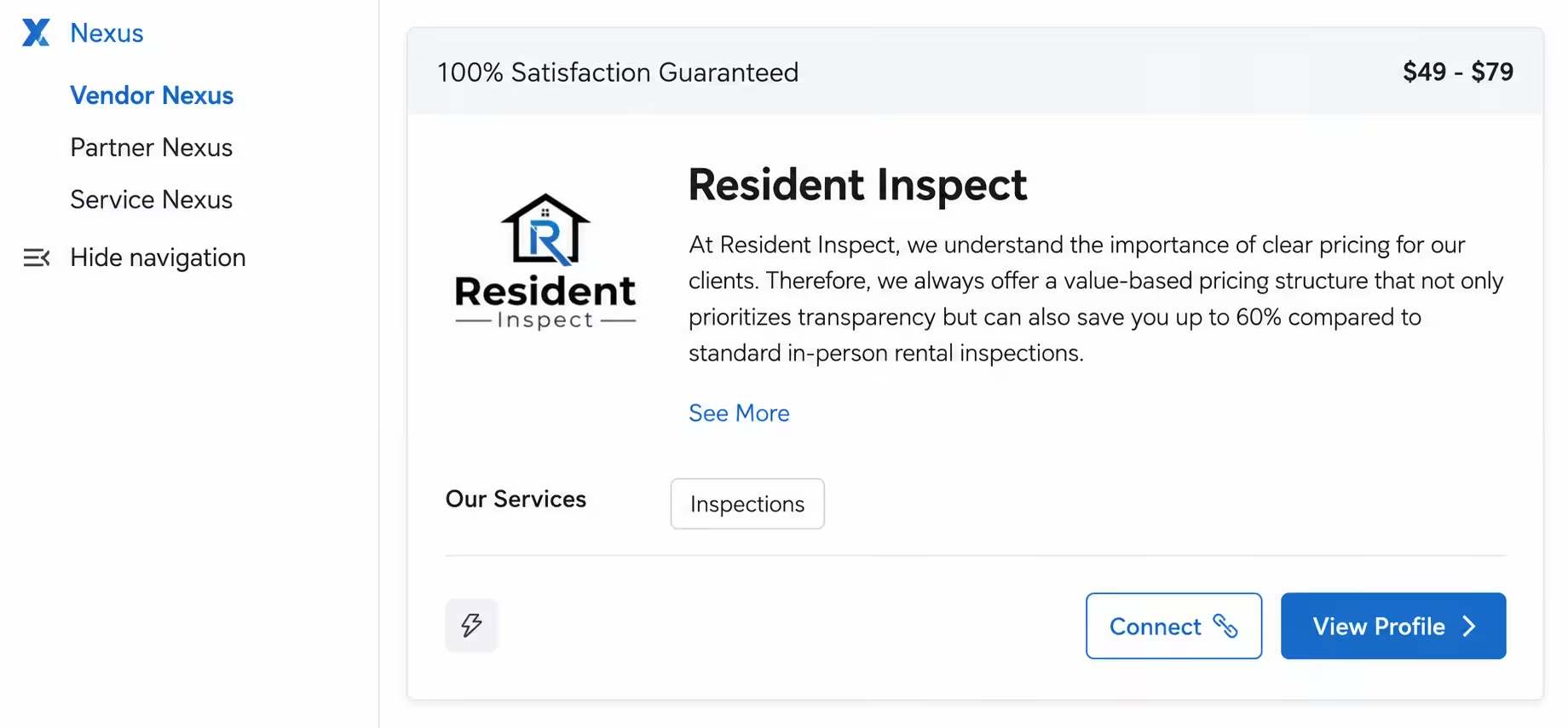 Resident Inspect listed in Property Meld’s Vendor Nexus — property managers can connect directly to request virtual rental property inspections. 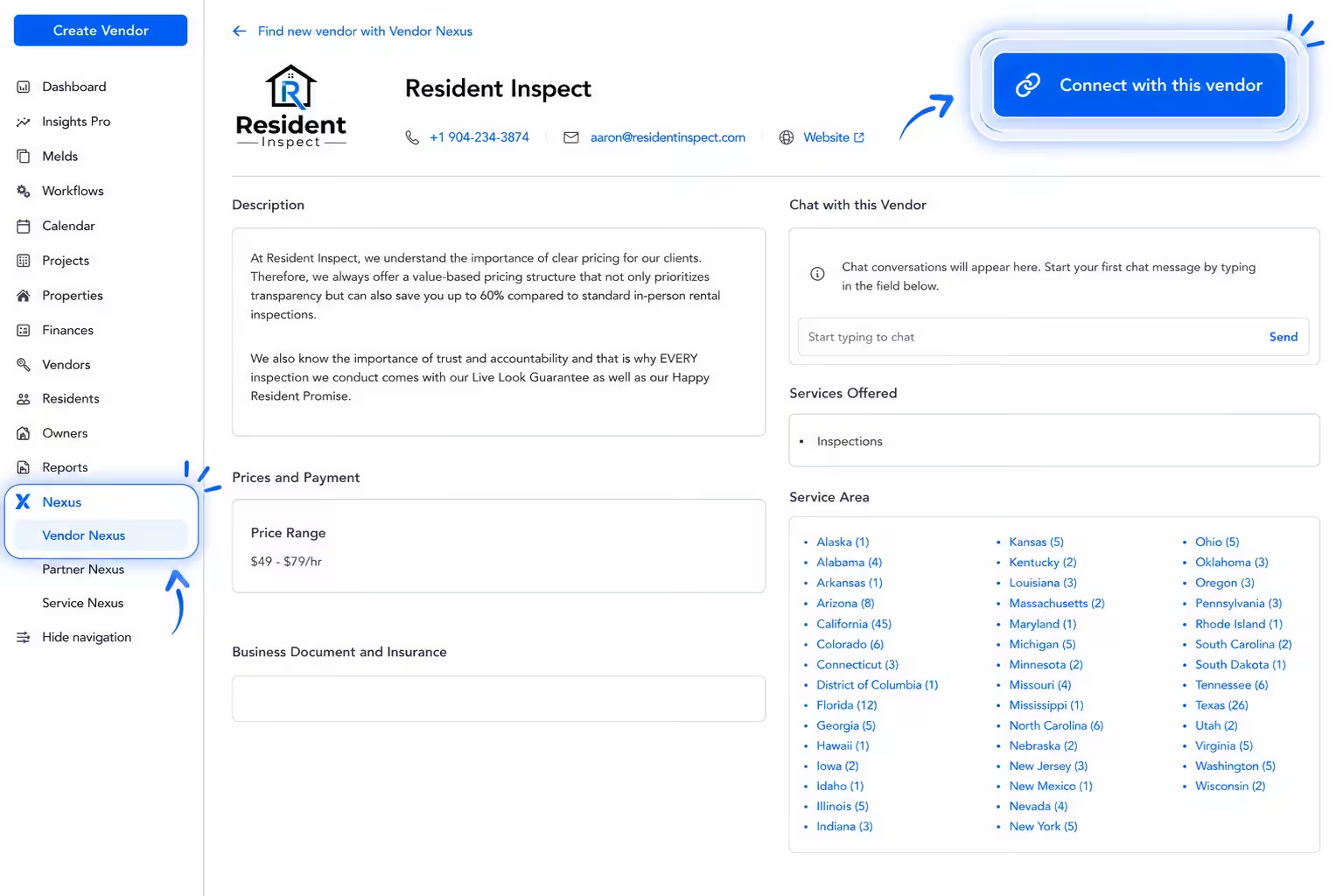 The complete Resident Inspect vendor profile inside Property Meld’s Vendor Nexus — including contact details, service description, pricing, 40+ state service area, and a direct Connect button.Once connected, Resident Inspect can receive inspection assignments directly through Property Meld, contact tenants quickly, coordinate scheduling, and deliver finished inspection reports back into your Property Meld workflow.
[Book a Demo](https://residentinspect.com/book-a-demo/)
Why It Matters
## Built to Remove Friction From Periodic Inspections
Periodic rental property inspections are important, but the process can create a lot of extra work for property management teams. Without an integrated workflow, your team may have to manually request inspections, contact tenants, coordinate appointment times, track scheduling progress, collect reports, upload files, and update internal records.
Resident Inspect’s Property Meld integration helps remove that friction. Your team can request the inspection directly from Property Meld, Resident Inspect handles the tenant scheduling process, and the completed report comes back into the same system.
Built for Property Managers
## Designed for Property Management Teams That Use Property Meld
Property managers need inspection processes that are easy to request, easy to track, and easy to document. Resident Inspect’s integration with Property Meld was built specifically for property management companies that want professional inspection support without creating another administrative process for their staff.
#### ✓Request Inspections Faster
Start the inspection process directly from Property Meld without creating a separate request outside your workflow.
#### ✓Reduce Tenant Coordination
Resident Inspect contacts the tenant within 5 minutes and manages the scheduling process.
#### ✓Improve Scheduling Flexibility
Tenants can schedule inspections 7 days a week, making the process easier and less disruptive.
#### ✓Increase Visibility
Your team can see when the tenant has scheduled the inspection — without chasing status updates.
#### ✓Keep Reports Organized
Finished reports are delivered back into Property Meld, keeping documentation tied to the original Meld.
#### ✓Support Scalable Inspection Programs
Whether one inspection or a recurring program across your portfolio, Resident Inspect makes the workflow easier to manage.
#### ✓Reduce Disconnected Processes
Fewer disconnected emails, forms, and follow-up tasks. One connected workflow from request to report.
#### ✓Improve Consistency Across Your Portfolio
A consistent, repeatable inspection process helps property managers maintain better documentation across all properties.
Tenant Contact
## Tenant Contact Within 5 Minutes
Tenant scheduling is one of the most important parts of the inspection process. When inspection requests sit too long before tenant outreach begins, appointments get delayed, residents become harder to reach, and your team may have to step in to keep the process moving.
Resident Inspect helps solve that problem with fast tenant outreach. Once a Meld is assigned to Resident Inspect, our team contacts the tenant within 5 minutes to begin scheduling their inspection. This quick response helps move the inspection forward while reducing the need for your team to manually coordinate with the resident.
Flexible Scheduling
## Inspections Scheduled Around the Tenant’s Availability
Periodic inspections are easier to complete when tenants have flexible scheduling options. Resident Inspect allows tenants to schedule inspections 7 days a week, helping reduce inconvenience and improve cooperation.
Instead of forcing tenants into limited appointment windows, Resident Inspect gives residents more flexibility to choose a time that works for them. That creates a better experience for the tenant while helping property managers complete inspections more efficiently.
Less inconvenience for tenants. Less follow-up for property managers. Better inspection completion.
Scheduling Visibility
## See When Tenants Have Scheduled
Property managers should not have to wonder whether an inspection is moving forward. With the Resident Inspect and Property Meld integration, your team can see when tenants have scheduled their inspection.
This gives your staff better visibility into the process without requiring unnecessary emails, phone calls, or manual status updates. Your team can stay informed while Resident Inspect handles the scheduling and coordination.
Report Delivery
## Completed Reports Delivered Back Into Property Meld
After Resident Inspect completes the inspection, the finished report is delivered back into Property Meld. This keeps the inspection documentation connected to the original Meld and helps your team avoid searching through email attachments, shared drives, or separate systems.
By returning the finished report into Property Meld, Resident Inspect helps property managers maintain cleaner records and a more organized inspection process.
- Finished reports delivered back into Property Meld
- Documentation connected to the original Meld
- Easier internal review
- Better organized property records
- Less manual uploading
- Fewer misplaced reports
- Cleaner inspection history
Professional Service
## Professional Guided Virtual Inspections
Resident Inspect performs professional guided virtual inspections for rental properties. The resident participates from the property, but the inspection is guided by a trained Resident Inspect professional.
During the inspection, our team directs the resident through the property, documents visible conditions, and completes the inspection report through a consistent process. This allows property managers to receive professional inspection documentation without sending internal staff to every property.
#### For Property Managers
Request inspections directly from Property Meld and receive finished reports back inside the same system.
#### For Tenants
Schedule inspections 7 days a week and complete the process with as little inconvenience as possible.
#### For Owners
Receive professional inspection documentation that supports better property oversight.
Use Cases
## Common Ways Property Managers Use Resident Inspect Through Property Meld
#### Periodic Rental Property Inspections
Request routine property inspections directly from Property Meld and receive completed reports back inside the same workflow.
#### Lease Renewal Condition Reviews
Before renewing a lease, request an inspection to better understand the current condition of the property.
#### Owner Property Updates
Provide owners with professional inspection documentation without requiring your internal team to visit the property.
#### Maintenance-Related Condition Checks
When a property condition concern is connected to maintenance activity, Resident Inspect can help document the current condition.
#### Post-Maintenance Verification
Use Resident Inspect to help document property condition after certain maintenance-related work has been completed.
#### Portfolio-Wide Inspection Programs
For property managers overseeing many doors, the integration helps make inspection requests easier to manage at scale.
Get Connected
## Connect With Resident Inspect Through Vendor Nexus
If your company uses Property Meld, connecting with Resident Inspect is simple. Inside Property Meld, click Vendor Nexus, search for Resident Inspect, and select Connect. Once connected, your team can begin assigning Melds to Resident Inspect for professional rental property inspections.
Vendor Nexus → Search Resident Inspect → Select Connect
[Book a Demo](https://residentinspect.com/book-a-demo/)
FAQ
## Property Meld Integration FAQs
#### How do I find Resident Inspect in Property Meld?
Inside Property Meld, click Vendor Nexus, search for Resident Inspect, and select Connect.
#### What happens after I connect with Resident Inspect?
Once connected, your team can assign eligible Melds to Resident Inspect. Resident Inspect will then begin the inspection coordination process.
#### How quickly does Resident Inspect contact the tenant?
Once a Meld is assigned to Resident Inspect, our team contacts the tenant within 5 minutes to begin scheduling.
#### Can tenants schedule inspections outside normal business hours?
Yes. Tenants can schedule their inspection 7 days a week, giving them more flexibility and reducing inconvenience.
#### Can property managers see when the tenant has scheduled?
Yes. Property managers can see when tenants have scheduled their inspection, giving your team better visibility into the process.
#### Where does the completed inspection report go?
Once the inspection is finished, the completed report is delivered back into Property Meld.
#### What kind of inspections can be requested?
Resident Inspect is commonly used for periodic rental property inspections, lease renewal condition reviews, owner updates, maintenance-related condition checks, post-maintenance verification, and portfolio-wide inspection programs.
#### Does Resident Inspect replace Property Meld?
No. Resident Inspect works inside the Property Meld ecosystem. The integration is designed to support your Property Meld workflow by allowing your team to request and receive professional inspection reports through the platform you already use.
#### Why should Property Meld users connect with Resident Inspect?
Resident Inspect helps Property Meld users request inspections in real time, reduce manual coordination, improve tenant scheduling visibility, and receive completed reports back inside Property Meld.
Ready to Get Started
## Make Periodic Inspections Easier Inside Property Meld
Resident Inspect helps Property Meld users create a simple, connected inspection process from request to report.
1
Assign the Meld.
2
We contact the tenant within 5 minutes.
3
The tenant schedules 7 days a week.
4
We complete the inspection.
5
The finished report is delivered back into Property Meld.
[Book a Demo](https://residentinspect.com/book-a-demo/)[Schedule a Demo](https://residentinspect.com/book-a-demo/)
**How to connect:** Click Vendor Nexus inside Property Meld, search Resident Inspect, and select Connect.
---
### [Property Management Outsourcing](https://residentinspect.com/property-management-outsourcing/)
**Published:** June 4, 2026
**Author:** Alex Zweydoff
**Excerpt:** Learn what property management outsourcing is, what to outsource, risks to avoid, and when system-based solutions make more sense.
**Content:**
Property Management Guide# Property Management Outsourcing:
*What It Is & When It Works*
As portfolios grow, many property owners start thinking about outsourcing. The goal is simple: reduce workload, control costs, and run operations more smoothly. But outsourcing is not the right answer for every situation — and the tasks you choose to outsource determine whether it works.
[Book a Free Demo](https://residentinspect.com/book-a-demo/) [Ask a Question](https://residentinspect.com/contact-us/)
Reduce workload without losing control
Know what to outsource vs. keep in-house
Avoid the most common outsourcing mistakes
Save up to 60% on property inspections
60%
Cost savings on inspections
50
States served
<24hr
Report delivery
100%
White-labeled reports
0
Travel required
Trusted By Property Managers Nationwide
     
The Basics
## What Is Property Management Outsourcing?
Property management outsourcing means hiring a third party to handle specific tasks instead of doing everything in-house. Rather than building large internal teams, property management companies assign work to vendors who specialize in those functions.
Some companies outsource only one task. Others rely on outsourced property management services for several parts of their business. The scope depends on portfolio size, growth stage, and internal staff capacity.
- Property inspections across single and multi-market portfolios
- Leasing support and showing coordination
- Accounting, bookkeeping, and owner reporting
- Maintenance coordination and vendor scheduling
- Call centers and after-hours tenant communication
- Administrative tasks and data entry
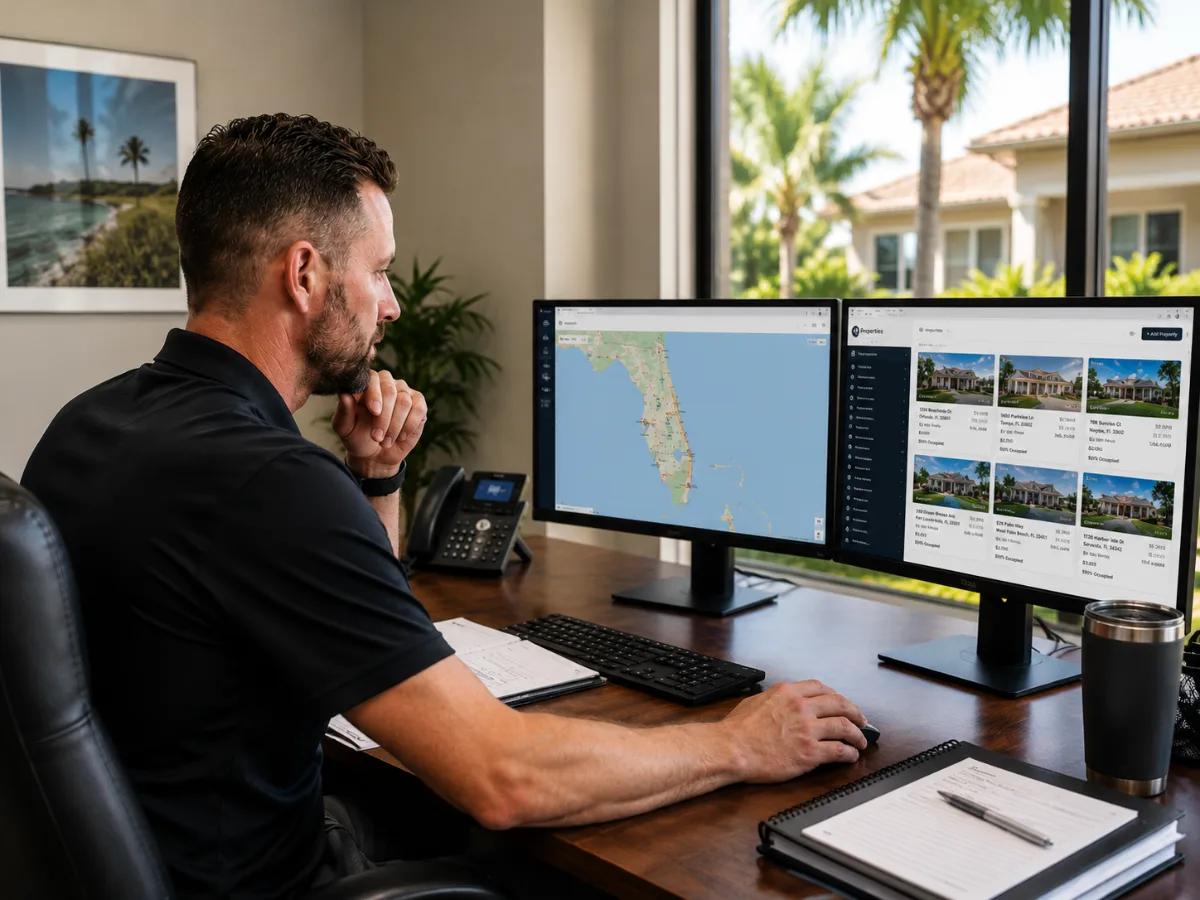
The Benefits
## Why Property Managers Consider Outsourcing
There are several common reasons property managers look at outsourcing. Here are the four primary drivers.
#### Reduced Workload
Outsourcing removes day-to-day tasks from internal teams. Staff can focus on growth, owner relationships, and long-term planning instead of repetitive processes.
#### Lower Staffing Costs
Hiring full-time employees takes time and money. Outsourcing turns fixed labor costs into flexible expenses — a real advantage for growing portfolios.
#### Easier Scaling
As portfolios grow, outsourcing makes it easier to handle more properties without immediately adding headcount. Vendors absorb volume faster than internal hiring allows.
#### Established Processes
Third-party providers often already have systems and workflows that would take years to build internally. You get that infrastructure from day one.
Common Tasks
## Commonly Outsourced Property Management Tasks
Not every task needs to stay in-house. Some functions are easier to outsource than others — especially those that are repeatable, process-driven, and do not require direct owner relationships.
1
### Property Inspections
Many companies outsource inspections to reduce travel time and staffing pressure across multiple markets. Virtual inspection platforms handle scheduling, walkthroughs, and white-labeled reports without your team leaving the office.
2
### Accounting & Reporting
Owner statements, bookkeeping, and reconciliations are often outsourced for accuracy and consistency — especially in single-family portfolios where volume outpaces in-house capacity.
3
### Maintenance Coordination
Some managers outsource maintenance calls, vendor scheduling, and follow-ups — particularly when paired with a work order tracking platform that keeps everything documented.
4
### Leasing Support
Administrative leasing tasks and showing coordination are commonly outsourced for firms managing high vacancy volume across multiple markets.
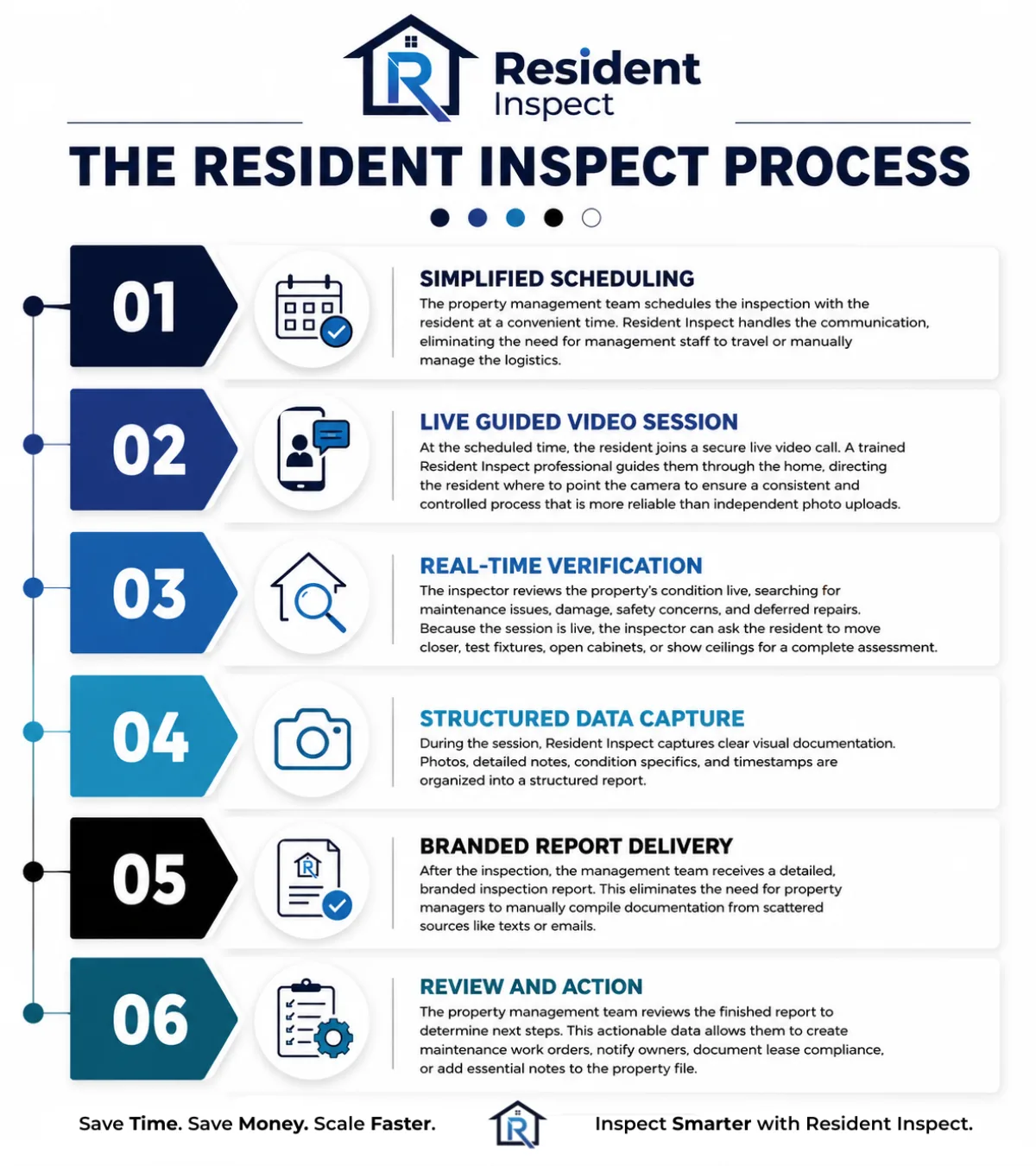
Know the Risks
## The Risks of Outsourced Property Management Services
Outsourcing can help — but it comes with real risks that can damage owner relationships and operational consistency if not managed carefully.
#### Common Risks
- Loss of quality control and oversight
- Inconsistent standards across vendors
- Limited documentation and reporting
- Vendor dependency and pricing risk
- Gaps in owner communication
#### How to Mitigate
- Set clear performance benchmarks upfront
- Use vendors with documented, repeatable processes
- Require detailed reports for every task completed
- Maintain multiple vendor relationships
- Keep owner communication in-house at all times
Decision Framework
## What to Outsource vs. What to Keep In-House
A common mistake is outsourcing too much, too fast. Some tasks work well outside your organization. Others should stay internal — especially anything tied to trust, judgment, or owner relationships.
The rule: **Outsource repetition. Keep strategy.** Successful companies keep control of key decisions and owner-facing communication regardless of how much they outsource.
#### Good to Outsource
- Routine property inspections
- Administrative leasing work
- Maintenance call handling
- After-hours tenant communication
- Data entry, reporting, and reconciliations
#### Keep In-House
- Owner communication and relationships
- Financial decisions and portfolio strategy
- Final vendor approvals and disputes
- Long-term lease decisions
- Owner reporting narrative and context

Modern Approach
## The Role of Technology in Modern Outsourcing
Today, outsourcing does not always mean hiring more people. Many property managers now outsource through systems instead of staffing.
#### Standardized Processes
Technology-driven outsourcing enforces consistent workflows every time — no variation based on which vendor or staff member handles the task.
#### Full Visibility
Every task is documented and trackable. You see exactly what was done, when, and by whom — without chasing vendors for status updates.
#### Scale Without Headcount
System-based outsourcing grows with your portfolio. Add 50 doors without adding staff — the platform handles the volume consistently.
#### Lower Long-Term Cost
Reduce per-unit cost over time as processes become more efficient. No staffing turnover, no retraining, no pricing surprises from vendor changes.
Side by Side
## Traditional Outsourcing vs. System-Based Outsourcing
Traditional outsourcing depends on people. System-based outsourcing depends on repeatable processes — producing more consistent, defensible results at lower long-term cost.
Traditional
Depends on vendor staff. Prone to turnover and inconsistency.
System-Based
Depends on repeatable processes. Scales without staffing risk.
Documentation
System-based keeps all data in one place with full audit trails.
Long-Term Cost
System-based lowers per-unit cost and long-term risk over time.
Scalability
Traditional hits a ceiling. Systems scale linearly with portfolio growth.
Control
System-based keeps visibility and accountability firmly in-house.
### Outsource Inspections the System-Based Way
Resident Inspect is the system-based alternative to in-house and third-party inspections. Live virtual walkthroughs by a trained team — white-labeled reports, tenant scheduling included, delivered within one business day. All 50 states.
[Book a Free Demo](https://residentinspect.com/book-a-demo/) [See How It Works](https://residentinspect.com/periodic-rental-inspection-service/)
Getting Started
## A Simple Way to Start With Property Management Outsourcing
If you are new to outsourcing, you do not need to outsource everything at once. Start small — choose one task that takes up significant time but does not require daily judgment or owner-facing decisions.
Good starting points for most property management firms:
- Property inspections — especially across multiple markets where travel is the bottleneck
- Administrative leasing tasks — showing coordination, application processing
- Maintenance call handling — after-hours and overflow volume
- Reporting and documentation — owner statements, reconciliations
- After-hours tenant communication — reducing on-call burden on your team
Starting small gives you proof of concept without operational risk. Most firms that successfully outsource started with one function, measured the result, then expanded.
[Start With Inspections](https://residentinspect.com/book-a-demo/)
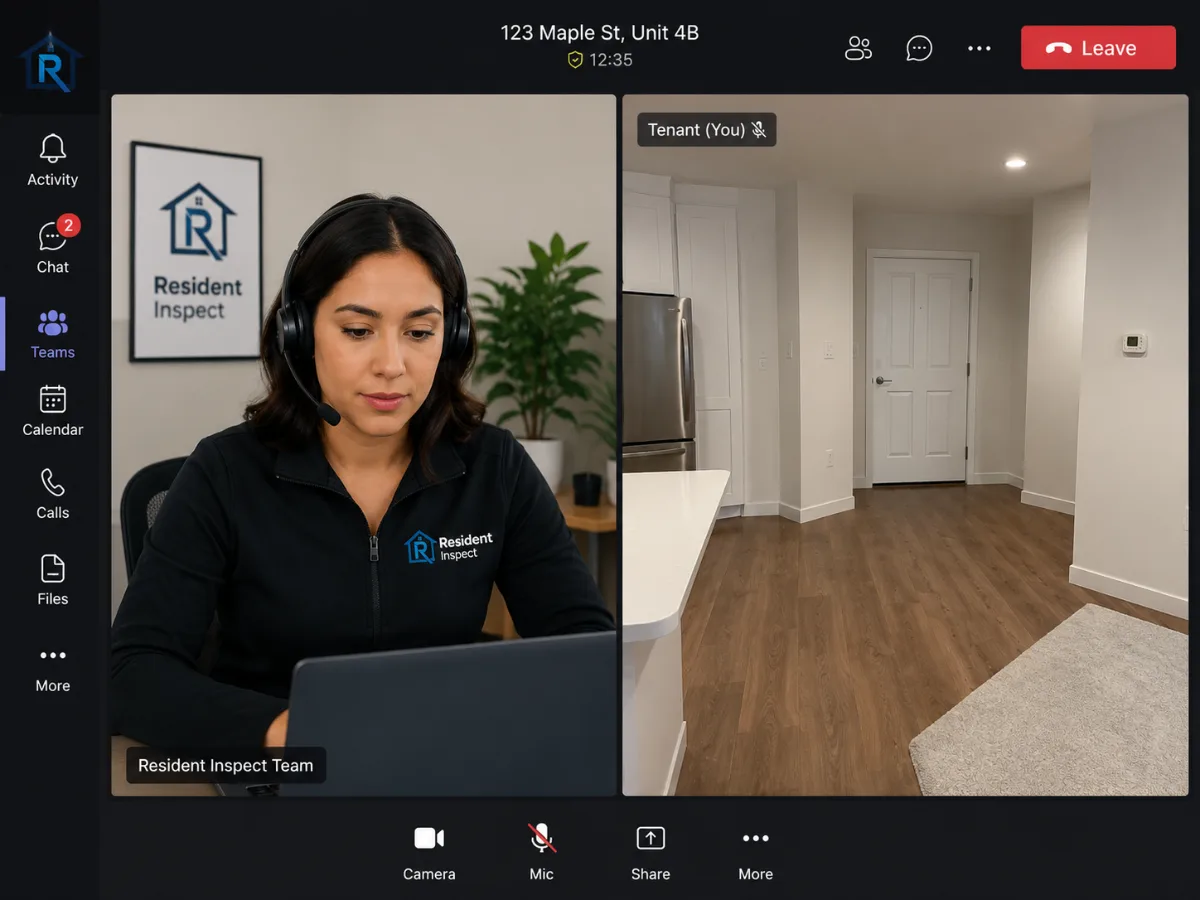
Further Reading
## Property Management Industry Resources
Authoritative sources for property management standards, labor data, and industry benchmarks referenced by professionals nationwide.
[Association
NARPM
Industry standards, member resources, and professional designations for residential property managers.
](https://www.narpm.org) [Resources
IREM Property Management Resources
Research, best practices, and educational content from the Institute of Real Estate Management.
](https://www.irem.org/resources/property-management) [Data
BLS — Property Manager Wages & Outlook
U.S. Bureau of Labor Statistics data on property manager employment, wages, and staffing costs.
](https://www.bls.gov/ooh/business-and-financial/property-real-estate-and-community-association-managers.htm) [Directory
Departments.com
Business services directory covering property management vendors and outsourcing providers.
](https://www.departments.com) [Industry
AllPropertyManagement Resources
Educational guides and resources for landlords and property owners managing rental portfolios.
](https://www.allpropertymanagement.com/resources) [Platform
Apartments.com Rental Manager Resources
Guides and tools covering leasing, tenant screening, and rental operations.
](https://www.apartments.com/rental-manager/resources)
Common Questions
## Property Management Outsourcing FAQs
Eight questions property managers ask most often before making outsourcing decisions.
#### What is property management outsourcing?
+
It means hiring third parties to handle specific property management tasks instead of managing everything in-house. Common examples include property inspections, maintenance coordination, administrative leasing work, and after-hours tenant communication.
#### What tasks are commonly outsourced in property management?
+
Inspections, maintenance coordination, administrative leasing work, and call handling are most common. Accounting and bookkeeping are also frequently handled by third-party providers or virtual assistants — particularly as portfolio volume outpaces in-house capacity.
#### What are the risks of outsourcing property management?
+
Loss of quality control, inconsistent standards across vendors, and limited visibility into vendor performance are the primary risks. Vendor dependency is also a concern if a provider changes pricing or service levels. The solution is to select vendors with documented processes and require detailed reporting for every completed task.
#### Is outsourcing always the best option for property managers?
+
No. Many companies get the best results by combining selective outsourcing with strong internal systems. Outsourcing works best for repeatable, process-driven tasks — not decisions that require judgment, owner context, or direct relationship management.
#### What is a better alternative to full outsourcing?
+
System-based outsourcing using standardized software and trained vendor teams instead of staffing-heavy generalist vendors. [Virtual inspection platforms](https://residentinspect.com/our-virtual-inspection-software/), maintenance tracking tools, and automated reporting software let you scale without giving up control or data ownership.
#### How much does outsourced property management typically cost?
+
Costs vary significantly by task and provider. In-person inspection services typically run $75–$125 or more per visit when you factor in travel, labor, and scheduling overhead. Virtual inspection services like [Resident Inspect](https://residentinspect.com/pricing/) can reduce that cost by up to 60% while improving documentation quality and consistency.
#### What should I look for in an outsourced inspection provider?
+
Look for documented inspection protocols, white-labeled reporting under your brand, consistent inspector training, direct tenant scheduling support, and photo documentation controlled by the inspector — not the tenant. See [how Resident Inspect approaches inspections](https://residentinspect.com/rental-property-inspections/) for a benchmark.
#### When does outsourcing property management make the most sense?
+
Outsourcing works best when managing properties across multiple markets, scaling faster than you can hire, handling high-volume repeatable tasks, or replacing in-house inspection workflows that consume staff time without producing defensible documentation.
[Periodic Inspection Service](https://residentinspect.com/periodic-rental-inspection-service/) [Virtual Inspection Software](https://residentinspect.com/our-virtual-inspection-software/) [Move-In / Move-Out Checklist](https://residentinspect.com) [Free Lease Addendum](https://residentinspect.com/free-periodic-inspection-lease-addendum/) [Pricing & Plans](https://residentinspect.com/pricing/)
What Clients Say
## Trusted by Property Managers Nationwide
Real reviews from property management companies, landlords, and rental operators who use Resident Inspect across their portfolios.
Built-In Automation
## Outsourcing That Runs Itself
The best outsourcing arrangements do not require your team to manage them. Resident Inspect is built with automation at every step — so inspections move from request to delivered report without manual follow-up.
01
#### Automated Tenant Outreach
Once you submit the inspection request, we contact your tenant automatically — no manual scheduling, no back-and-forth on your end.
02
#### Multi-Touch Reminder Sequences
Email, text, and phone reminders go out automatically in the days leading up to the inspection — reducing no-shows without any action from your team.
03
#### Compliance Addendum Enforcement
Tenants who signed the Periodic Inspection Lease Addendum receive automated notice of their legal obligation to participate — with financial consequences for refusal built in.
04
#### Automatic Report Delivery
Your branded inspection report is delivered to your inbox — or uploaded to your shared drive — automatically within one business day of the completed inspection.
05
#### PM Software Integration
Inspection requests come in from your property management software. Completed reports go back out — without any manual transfer, duplicate entry, or file management on your end.
06
#### Bulk Inspection Scheduling
Submit your entire monthly inspection list in one batch. We process and schedule every property automatically — scaling to any volume without adding complexity for your team.
[See the Full Automation Workflow](https://residentinspect.com/book-a-demo/)
Resources
## Guides for Property Managers Who Want to Outsource Smarter
The Resident Inspect blog covers the operational challenges property managers actually face — inspection workflows, tenant compliance, documentation standards, and outsourcing strategy.
[Inspection Operations
Rental Inspection Checklist: What Every PM Needs
](https://residentinspect.com/blog/) [Tenant Compliance
How to Reduce Inspection No-Shows in Your Portfolio
](https://residentinspect.com/blog/) [Security Deposits
Documentation That Actually Holds Up in Deposit Disputes
](https://residentinspect.com/blog/)
[Browse All Articles](https://residentinspect.com/blog/)
Free Periodic Inspection Lease Addendum
Used by property managers nationwide
NARPM Affiliate Member
National Association of Residential Property Managers
Google 5.0 · 201 Reviews
BBB Accredited Business
All 50 States Covered
Live virtual inspections nationwide
## Ready to Outsource Inspections the Smart Way?
Resident Inspect replaces in-person inspections with live virtual walkthroughs — white-labeled reports, trained team, guaranteed turnaround, up to 60% in savings. All 50 states.
[Book a Free Consultation](https://residentinspect.com/book-a-demo/) [Ask a Question Instead](https://residentinspect.com/contact-us/)
---
### [Periodic Rental Inspection Service — Done For You](https://residentinspect.com/periodic-rental-inspection-service/)
**Published:** June 5, 2026
**Author:** Alex Zweydoff
**Excerpt:** Resident Inspect conducts your periodic rental inspections via live video — tenant scheduling, guided walkthrough, branded reports delivered to your inbox. All 50 states.
**Content:**
All 50 States · Done For You
# Periodic Rental Inspections — *Done For You, In All 50 States*
Periodic inspections are the highest-risk, most time-consuming task in property management — and the one most firms handle wrong. Resident Inspect takes the entire process off your plate. We schedule with your tenant, conduct a live guided video walkthrough, and deliver a branded report to your inbox. No windshield time. No admin back-and-forth. No missed details.
[Book Your Free Consultation](https://residentinspect.com/book-a-demo/) [View Pricing](https://residentinspect.com/pricing/)
Live guided video walkthrough
Tenant scheduling included
White-labeled branded reports
Delivered within one business day
Trusted Nationally By
       
What’s Included
## What a Resident Inspect Periodic Inspection Includes
Every periodic inspection covers the full interior and exterior of the property — guided in real time by a trained Resident Inspect inspector over live HD video. Our inspector directs every room, every system, every area of concern. Nothing is left to the tenant to decide what to show.
- All interior rooms — walls, ceilings, floors, windows, doors
- Kitchen appliances, cabinets, plumbing under sink
- All bathrooms — fixtures, caulking, exhaust fans, signs of mold
- HVAC filter condition and visible mechanical systems
- Smoke and CO detector testing — confirmed and logged
- Lease compliance — unauthorized occupants, pets, modifications
- Visible maintenance issues with inspector notes
- Exterior — where accessible via tenant walkthrough or camera
Every item is photographed in real time at high resolution. The inspector controls what gets documented — not the tenant.

The Process
## How It Works — The Resident Inspect Process
Four steps — from inspection request to delivered report. We handle everything in between.
1
### You Send the Inspection Request
Send us your property address and tenant contact — one at a time or in bulk via your PM software. We work directly with Propertyware, AppFolio, Yardi, Buildium, Rent Manager, Rentvine, TenantCloud, and LeadSimple.
2
### We Handle All Tenant Communication and Scheduling
We contact your tenant directly, explain the process, and schedule at a time that works for them — including evenings and weekends. We send email, text, and phone reminders. No-shows are rare. When they happen, our lease addendum framework means the tenant has already agreed to cooperate and accepted the financial consequences of refusal.
3
### A Trained Inspector Conducts the Live Video Walkthrough
Your tenant joins a live video call using only their cell phone — no app download, no login, no password. They receive a unique 7-digit PIN to connect. Our inspector guides them through every area, directing the camera, asking follow-up questions, and capturing high-resolution photos in real time. Your tenant does not control what gets documented.
4
### You Receive a Branded, Professional Report
Your completed inspection report is delivered to your inbox — or uploaded to your shared drive — typically within one business day. White-labeled with your branding, photos organized by room, inspector notes on items of concern, and a clear condition summary. Ready to share with owner clients as-is.

The Problem
## The Three Ways Most Firms Handle Inspections — and Why None of Them Work
Most property management firms are using one of three approaches for periodic inspections. Every one of them creates liability, wastes staff time, or produces documentation that fails exactly when you need it most.
01
Approach #1
#### In-House Staff Inspections
Your property manager drives to the property, spends 45–90 minutes on site, and writes up notes back at the office. At scale, this consumes dozens of hours per month in windshield time alone — hours pulled directly from business development, owner communication, and work that actually moves the needle.
Hidden cost: 20–40 staff hours/month at scale
02
Approach #2
#### Tenant Self-Inspections
The tenant fills out a form and submits photos they chose to take. Critical issues get missed. Damage gets hidden. The documentation produced is rarely defensible in a deposit dispute — because you had zero control over what was shown, what was framed out, or what was recorded.
Hidden cost: Indefensible documentation when disputes arise
03
Approach #3
#### Deferred Inspections
Many firms simply fall behind. Inspections that should happen quarterly get pushed to annually or skipped entirely — resulting in deferred maintenance, compounding lease violations, and move-out damage surprises that cost far more than the inspections would have.
Hidden cost: $2,000–$8,000+ per deferred damage event
The Alternative
### Resident Inspect replaces all three — with a done-for-you system that produces defensible documentation every time.
Live inspector-led walkthroughs. Tenant scheduling handled. White-labeled reports in your inbox within one business day.
[Book a Free Consultation](https://residentinspect.com/book-a-demo/)
Built For
## Who This Is Built For
Resident Inspect is designed for property management firms and landlords managing 100 or more doors — where inspection volume is high enough that an unscalable process has real operational and financial consequences.
#### Property Management Companies
Running 100–2,000+ unit portfolios who need a reliable, repeatable inspection program that does not depend on staff bandwidth.
#### Single-Family Rental Operators
With properties spread across a region or multiple states where in-person inspections require significant travel time and cost.
#### Owners and Investors
Who want professional periodic inspections without hiring or managing an internal inspection team or scheduling process.
#### Firms Transitioning From Self-Reports
Who need documentation that will hold up for owner reporting and deposit disputes — not photos the tenant decided to take.
If your current inspection process relies on your staff having time, being in the right place, and tenants cooperating — it is not a system. It is a hope.
The Deliverable
## The Documentation That Protects You
A periodic inspection is only as valuable as the report it produces. Resident Inspect reports are built to be legally defensible, owner-ready, and operationally useful — not just a PDF of photos.
Sample reports are available on request.
[Request a Sample Report](https://residentinspect.com/book-a-demo/)
#### High-Resolution Photos
Organized by room and area — captured by our inspector, not selected by your tenant.
#### Inspector Notes
Condition, concerns, and recommended follow-up for each documented item — ranked by urgency.
#### Smoke & CO Confirmation
Tested and logged — not just noted as present. A critical liability item on every inspection.
#### Lease Compliance Flags
Unauthorized occupants, pets, and modifications documented with specificity — not general notes.
#### White-Label Branding
Your company name, logo, and contact information on every page. No Resident Inspect branding visible.
#### Digital Delivery
Email or shared drive — typically within one business day of inspection completion.
Integrations
## Works With Your Property Management Software
Resident Inspect fits into your existing systems. If your platform can produce a monthly report of properties due for inspection, we can work with it. Ask us about your specific setup during your free consultation.


Yardi
LeadSimple
FAQs
## Frequently Asked Questions
#### How much notice do tenants receive before a Resident Inspect inspection?
+
We handle all tenant communication. The notice process follows your state’s legal requirements — typically 24–48 hours written notice. We send the formal notice, manage responses, and handle rescheduling if needed.
#### What if a tenant refuses or is unresponsive?
+
This is rare in our experience. We recommend all clients use our free [Periodic Inspection Lease Addendum](https://residentinspect.com/free-periodic-inspection-lease-addendum/), which requires tenants to cooperate and accept a fee covering the cost of an in-person inspection if they refuse. When tenants know refusal has a financial consequence and the process has been normalized in the lease, participation rates are high.
#### Does the tenant need to download an app?
+
No. Tenants need only a cell phone with a camera and cell reception. There is no app download, no login, and no password. They receive a unique 7-digit PIN to join the live call.
#### How long does a typical periodic inspection take?
+
Most single-family home inspections run 25–40 minutes. Multi-family units typically run 15–25 minutes. Inspection duration depends on property size and any items requiring additional documentation.
#### What states do you cover?
+
All 50 states. Because inspections are conducted via live video, geography is not a constraint. We serve local rentals, multi-state portfolios, and long-term investment properties anywhere in the US.
#### How quickly do we receive the completed report?
+
Most reports are delivered within one business day of the completed inspection — via email or uploaded directly to your shared drive.
#### Is Resident Inspect a software tool or a service?
+
Both. Resident Inspect combines trained inspection professionals with proprietary inspection software. You are not buying a platform and doing the work yourself — you are getting a fully managed inspection service delivered via technology.
[Rental Inspection Checklist](https://residentinspect.com) [Free Lease Addendum](https://residentinspect.com/free-periodic-inspection-lease-addendum/) [Pricing & Plans](https://residentinspect.com/pricing/) [Property Meld Integration](https://residentinspect.com/property-meld-integration/)
What Clients Say
## Trusted by Property Managers Nationwide
Real reviews from property management companies using Resident Inspect across their portfolios.
## Stop Managing Your Inspection Process. Let Us Run It.
Book a free consultation and we will walk you through exactly how Resident Inspect integrates into your current workflow — including your PM software, lease agreements, and reporting cadence. Most clients are fully operational within a few days.
[Book Your Free Consultation](https://residentinspect.com/book-a-demo/) [View Pricing First](https://residentinspect.com/pricing/)
---
### [Virtual Inspection Software for Rentals](https://residentinspect.com/our-virtual-inspection-software/)
**Published:** October 20, 2024
**Author:** Aaron Cooper
**Content:**
# Our Virtual Inspection Software
**Revolutionize Your Inspections**
[Book Your Free Consultation](https://residentinspect.com/book-a-demo/)

At Resident Inspect, we offer more than just property inspections—we **leverage cutting-edge virtual inspection software** that *transforms* the way you manage your rental properties. Designed for *efficiency* and *precision*, our software allows us to **conduct real-time inspections without stepping foot on-site,** saving property managers and landlords time and money.
With features like *two-way communication, high-resolution photo capture,* and *customizable report templates,* Resident Inspect’s software ensures you **get accurate, professional results every time.**
Whether you manage a single property or a large portfolio, our software helps streamline your inspections, *saving you time, reducing costs,* and *maintaining your high standards.*
[What are Virtual Inspections?](https://residentinspect.com/blog/what-are-virtual-rental-property-inspections/)
## **Resident Inspect revolutionizes the inspection process.**
## Key Features & Benefits

### **Real-Time Two-Way Video**
**Live video call** between inspector and resident, allowing immediate feedback and control over the inspection process.

### **High-Resolution Image Capture**
Capture **high-quality photos** in real time, documenting the property’s condition in detail.

### **Customizable Branded Report Templates**
**Tailor inspection reports** to your specific needs, whether that’s periodic inspections or post-disaster inspections.

### **Real-Time Report Generation**
Reports are **completed during the inspection,** eliminating the need for follow-up visits or additional data entry.

### **Scalability**
The software **adapts to manage a single property or a large portfolio** with equal coherence, making Resident Inspect an ideal solution no matter the size of your company.

### **Increased Efficiency**
**Save time and reduce the complexity** of coordinating on-site inspections, while managing multiple inspections across various locations.

### **Flexibility for Residents**
Schedule inspections at **convenient times,** including evenings and weekends, improving compliance.

### **Professionalism**
Provide **polished, branded reports** that can be confidently shared with property owners and stakeholders.

### **Cost-Effective Solution**
**Eliminate the need for travel** and on-site labor, reducing operational costs and saving time.
## Real-Time Communication and Control
Our virtual inspection software allows for **seamless, two-way video communication** between the inspector and the resident in real time.
This live interaction ensures that the inspector can *guide the resident through every step* of the inspection process. By maintaining control over what the resident shows and focusing on key areas of the property, **the inspector guarantees that every detail is captured accurately and that nothing can remain hidden.**
[Click For Your Demo Call](https://residentinspect.com/book-a-demo/)

Through this real-time communication, inspectors can ask residents to zoom in on specific features, open cupboards, or test appliances, just as they would during an in-person inspection. If there’s a concern about potential damage or wear and tear, the inspector can immediately request a closer look, ensuring that nothing important is missed. This kind of **direct oversight ensures a more thorough and reliable inspection,** eliminating the gaps often left by resident self-inspections.
**Resident Inspect gives property managers peace of mind,** knowing that a professional is managing the process from start to finish.
Real-time communication also allows for a level of **control and responsiveness** that traditional inspections simply can’t match. Whether it’s a routine check or an emergency inspection, our software ensures that you’re always in charge, even from a distance. Learn more about our [rental property inspection services](https://residentinspect.com/rental-property-inspections/).

## High-Resolution Documentation
Resident Inspect’s software excels in providing high-resolution documentation during every inspection
Capturing the condition of a property in *vivid detail* is essential to **accurately assess its condition.** While the inspector guides the resident through the property, the software enables the **capture of crystal-clear images in real time.** These photos are taken instantly, allowing the inspector to document the condition of each room, every appliance, and any potential issues with *pinpoint accuracy.*


These *high-resolution photos* are crucial for assessing wear and tear, damages, or even hidden maintenance concerns that might otherwise go unnoticed. By embedding these images directly into the inspection report during the process, the software **creates a fully documented overview of the property** without any delays. From larger elements like structural features to smaller but significant details like window seals or appliance conditions, *every aspect of the property* is thoroughly covered.

The high-quality images **provide property managers with undeniable visual proof of the property’s condition,** making it easier to communicate with property owners, address resident disputes, or take action on needed repairs. This level of documentation not only *increases accountability* but also **protects property managers** **from potential issues** down the line.

[Show Me How!](https://residentinspect.com/book-a-demo/)
Questions? [Ask away on our contact form](https://residentinspect.com/contact-us/) and we’ll get back to you asap.
## Customizable Reports Tailored to Your Needs
One of the standout features of Resident Inspect’s software is its ability to **generate customizable reports** that can be tailored to the specific needs of each property manager. Our report templates are *fully flexible,* allowing you to **prioritize the details that matter most.** Whether you need to focus on routine maintenance or post-disaster inspections, our software lets us craft a report that fits your exact requirements.
[I’m In](https://residentinspect.com/book-a-demo/)
The final report is *fully branded* with your company’s logo and can be **customized to reflect your company’s standards and guidelines.** This means you’ll have a professional, polished report ready to share with property owners, stakeholders, or your internal team immediately after the inspection. The customization options provide both flexibility and professionalism, ensuring your reports are *both detailed and visually appealing.*
[Download A Sample Report](https://residentinspect.com/wp-content/uploads/2025/06/Sample-Condition-Report-Large-Home.pdf)


## Efficiency and Flexibility for Property Managers
Our virtual inspection software is designed to **make property management more efficient and flexible than ever.**
With Resident Inspect’s software, **our team schedules and conducts inspections** at times that suit both residents and their own busy schedules, including evenings and weekends. This flexibility ensures that inspections can be completed **quickly and efficiently,** without the usual delays associated with traditional inspections.
The software streamlines the entire process, from scheduling to reporting. Property managers no longer need to coordinate with multiple teams, travel between properties, or deal with the administrative burden of paperwork. Instead, **everything—from live communication to report generation—is handled** through the property inspection software in real time. This efficiency allows property managers to **conduct multiple inspections in a single day, across any location nationwide,** all while maintaining high standards of accuracy and professionalism. It is an easy way to [outsource your inspections](https://residentinspect.com/property-management-outsourcing/) without losing control.


The software’s **scalability** **gives property managers another key advantage** over their competition. Whether you manage a small number of properties or a large portfolio, *the system adapts to your needs.* You can **easily handle routine inspections, emergency assessments, and everything in between,** with *no added complexity.* And because the reports are delivered digitally via email or uploaded to a shared drive, they are immediately accessible, ensuring that property managers can act quickly when issues arise. You can also compare our [virtual inspection pricing](https://residentinspect.com/pricing/) for any portfolio size.

[Sounds Good, Tell Me More](https://residentinspect.com/book-a-demo/)
Not ready for a call? [You can fill out our contact form here](https://residentinspect.com/contact-us/)
## Book Your Consultation Today!
Resident Inspect’s virtual inspection software is a **game-changer for property managers and landlords** looking to streamline their operations without compromising on quality.
## Coming Soon…
***Want to leverage this software yourself in-house?*** Whether you’re managing one property or a hundred, purchasing Resident Inspect’s proprietary software for your own use gives YOU the tools you need to **quickly conduct thorough inspections—all from the convenience of your home or office.**
Soon you’ll be able to **transform your property inspections with your own in-house team** leveraging this software to start conducting your inspections *remotely and with greater accuracy.*
Contact us today to be added to our waiting list and get early access!
Upcoming features:
- Move-in inspections
- Move-out inspections
- Use Resident Inspect’s software yourself!
Join The List
### Ready to revolutionize your property inspections?
*Contact us today to book your free consultation and see for yourself how Resident Inspect can **streamline your inspection process.***
---
### [Nationwide Rental Inspections | Resident Inspect](https://residentinspect.com/nationwide-rental-inspections/)
**Published:** June 5, 2026
**Author:** Alex Zweydoff
**Excerpt:** Resident Inspect provides live virtual rental property inspections in all 50 states. No travel. Professional, white-labeled reports delivered within one business day.
**Content:**
Nationwide Coverage
# Virtual Rental Inspections in *All 50 States*
Resident Inspect conducts live virtual property inspections anywhere in the United States. No travel. No geographic limitations. One trained inspector, one live video call, one branded report — delivered within one business day regardless of where your portfolio is located.
[Book a Free Consultation](https://residentinspect.com/book-a-demo/) [View Pricing](https://residentinspect.com/pricing/)
50
States covered
26+
Active client cities
0
Travel required
<24hr
Report delivery
Coverage Map
## Where We Serve
Hover any pin to see which property management companies we work with in each market. The ⭐ gold pin is waiting for your market — click it to get started.
### Resident Inspect — Active Client Markets
Active client city
Your market
All 50 states covered
✕
West
Arlington, WA
PNW Property Management
WA
[Get Started](https://residentinspect.com/book-a-demo/)
Vancouver, WA
Invest West Management
WA
[Get Started](https://residentinspect.com/book-a-demo/)
Prosser, WA
Real Estate Gladiators
WA
[Get Started](https://residentinspect.com/book-a-demo/)
Nampa, ID
Sage Holden Property Management
ID
[Get Started](https://residentinspect.com/book-a-demo/)
Eureka, CA
Rentor
CA
[Get Started](https://residentinspect.com/book-a-demo/)
Santa Rosa, CA
Pro Rental Organization
CA
[Get Started](https://residentinspect.com/book-a-demo/)
Napa, CA
Pro Rental Organization
CA
[Get Started](https://residentinspect.com/book-a-demo/)
Lincoln, CA
Recovery Realty
CA
[Get Started](https://residentinspect.com/book-a-demo/)
Fremont, CA
Bay Area Residential Management
CA
[Get Started](https://residentinspect.com/book-a-demo/)
Pittsburg, CA
Croskey Real Estate
CA
[Get Started](https://residentinspect.com/book-a-demo/)
Manteca, CA
Aksland Real Estate
CA
[Get Started](https://residentinspect.com/book-a-demo/)
Tracy, CA
Crown Key Realty
CA
[Get Started](https://residentinspect.com/book-a-demo/)
Long Beach, CA
Coastal Cities Property Management
CA
[Get Started](https://residentinspect.com/book-a-demo/)
Reno, NV
Realty Boulevard
NV
[Get Started](https://residentinspect.com/book-a-demo/)
Chino Hills, CA
Clockwork Property Management
CA
[Get Started](https://residentinspect.com/book-a-demo/)
Long Beach, CA
Concept 360 Property Management
CA
[Get Started](https://residentinspect.com/book-a-demo/)
Los Angeles, CA
EGL Property Management
CA
[Get Started](https://residentinspect.com/book-a-demo/)
South
Edmond, OK
Integrity Oklahoma Real Estate
OK
[Get Started](https://residentinspect.com/book-a-demo/)
Austin, TX
Key Renter Property Management
TX
[Get Started](https://residentinspect.com/book-a-demo/)
El Paso, TX
El Paso Renters · Success Realty
TX
[Get Started](https://residentinspect.com/book-a-demo/)
Fredericksburg, TX
All In Property Management
TX
[Get Started](https://residentinspect.com/book-a-demo/)
San Antonio, TX
HomeLab Property Management
TX
[Get Started](https://residentinspect.com/book-a-demo/)
Jacksonville, FL
Nest Finders · River City Rentals · Resident Inspect PM
FL
[Get Started](https://residentinspect.com/book-a-demo/)
Fleming Island, FL
Green River Property Management
FL
[Get Started](https://residentinspect.com/book-a-demo/)
Orlando, FL
JAG Property Management · Allegiant Management Group
FL
[Get Started](https://residentinspect.com/book-a-demo/)
Tampa, FL
Rent Solutions
FL
[Get Started](https://residentinspect.com/book-a-demo/)
Sarasota, FL
Investus Realty
FL
[Get Started](https://residentinspect.com/book-a-demo/)
Atlanta / Decatur, GA
One Source Atlanta · Koja Property Solutions
GA
[Get Started](https://residentinspect.com/book-a-demo/)
Jacksonville, FL
River City Rentals and Realty
FL
[Get Started](https://residentinspect.com/book-a-demo/)
Marietta, GA
Atlanta Marietta Inc
GA
[Get Started](https://residentinspect.com/book-a-demo/)
Houston, TX
Key Renter Houston
TX
[Get Started](https://residentinspect.com/book-a-demo/)
Austin, TX
Key Renter Austin Property Management
TX
[Get Started](https://residentinspect.com/book-a-demo/)
San Antonio, TX
RE Solutions XV
TX
[Get Started](https://residentinspect.com/book-a-demo/)
Bridgeport, TX
Heritage Properties
TX
[Get Started](https://residentinspect.com/book-a-demo/)
Northeast
Murrysville, PA
Incline Real Estate
PA
[Get Started](https://residentinspect.com/book-a-demo/)
Indianapolis, IN
PMI Midwest
IN
[Get Started](https://residentinspect.com/book-a-demo/)
Silver Spring, MD
Ruddy Management Co.
MD
[Get Started](https://residentinspect.com/book-a-demo/)
Dayton, OH
Bridgestream Property Management
OH
[Get Started](https://residentinspect.com/book-a-demo/)
Virginia Beach, VA
Limehouse Property Management
VA
[Get Started](https://residentinspect.com/book-a-demo/)
Add Your Market
[Add Your Market
Be one of our next clients — we serve all 50 states
Get Started
](https://residentinspect.com/book-a-demo/)
No markets match. [Contact us — we serve all 50 states →](https://residentinspect.com/contact-us/)
Why It Works Everywhere
## No Geography. No Limits.
Because inspections are conducted via live video, the only requirement is a cell phone with a camera and cell reception. Resident Inspect serves every state with the same speed, quality, and consistency. Our [outsourced inspection services](https://residentinspect.com/property-management-outsourcing/) let you cover any market without adding staff.
#### No Travel Required
Add properties in any new state without adding travel cost, scheduling complexity, or staff bandwidth. Geography is never a bottleneck.
#### Same Process in Every State
Every inspection follows the same guided protocol, documentation standards, and report format — regardless of which state the property is in.
#### Delivered Within One Business Day
Branded, white-labeled inspection reports delivered to your inbox or shared drive — typically within one business day of the completed inspection.
What Clients Say
## Trusted by Property Managers Nationwide
Real reviews from property management companies, landlords, and rental operators across our active markets.
## Your Portfolio. Every State. One Inspection Partner.
Book a free consultation and we will walk you through exactly how Resident Inspect integrates with your current workflow — regardless of how many states your portfolio spans.
[Book a Free Consultation](https://residentinspect.com/book-a-demo/) [View Pricing First](https://residentinspect.com/pricing/)
[Book a consultation for this market →](https://residentinspect.com/book-a-demo/)
---
### [Move-In/Move-Out Inspection Checklist for Rentals](https://residentinspect.com/move-in-move-out-inspection-checklist/)
**Published:** June 7, 2026
**Author:** Alex Zweydoff
**Excerpt:** Use a clear move-in and move-out inspection checklist to document rental property condition, reduce disputes, and manage security deposits fairly.
**Content:**
Rental Property Guide
# Move-In & Move-Out Inspection Checklist for Rentals
A strong inspection process protects property managers, landlords, and tenants by setting clear expectations and documenting the condition of the home — before and after every tenancy.
[Book a Free Demo](https://residentinspect.com/book-a-demo/) [Ask a Question](https://residentinspect.com/contact-us/)
Document condition before & after every tenancy
Reduce security deposit disputes
Identify damage beyond normal wear and tear
Stay organized across your entire portfolio
The Foundation
## Why Move-In and Move-Out Inspections Matter
When a tenant moves in, the property should be in good condition. When a tenant moves out, someone should review the condition again. Together, these inspections create a clear record that everyone can trust.
- Track the property’s condition over time
- Identify damage beyond normal wear and tear
- Support fair security deposit decisions
- Reduce repair costs with early detection
- Protect both landlords and tenants
- Reduce the likelihood of disputes
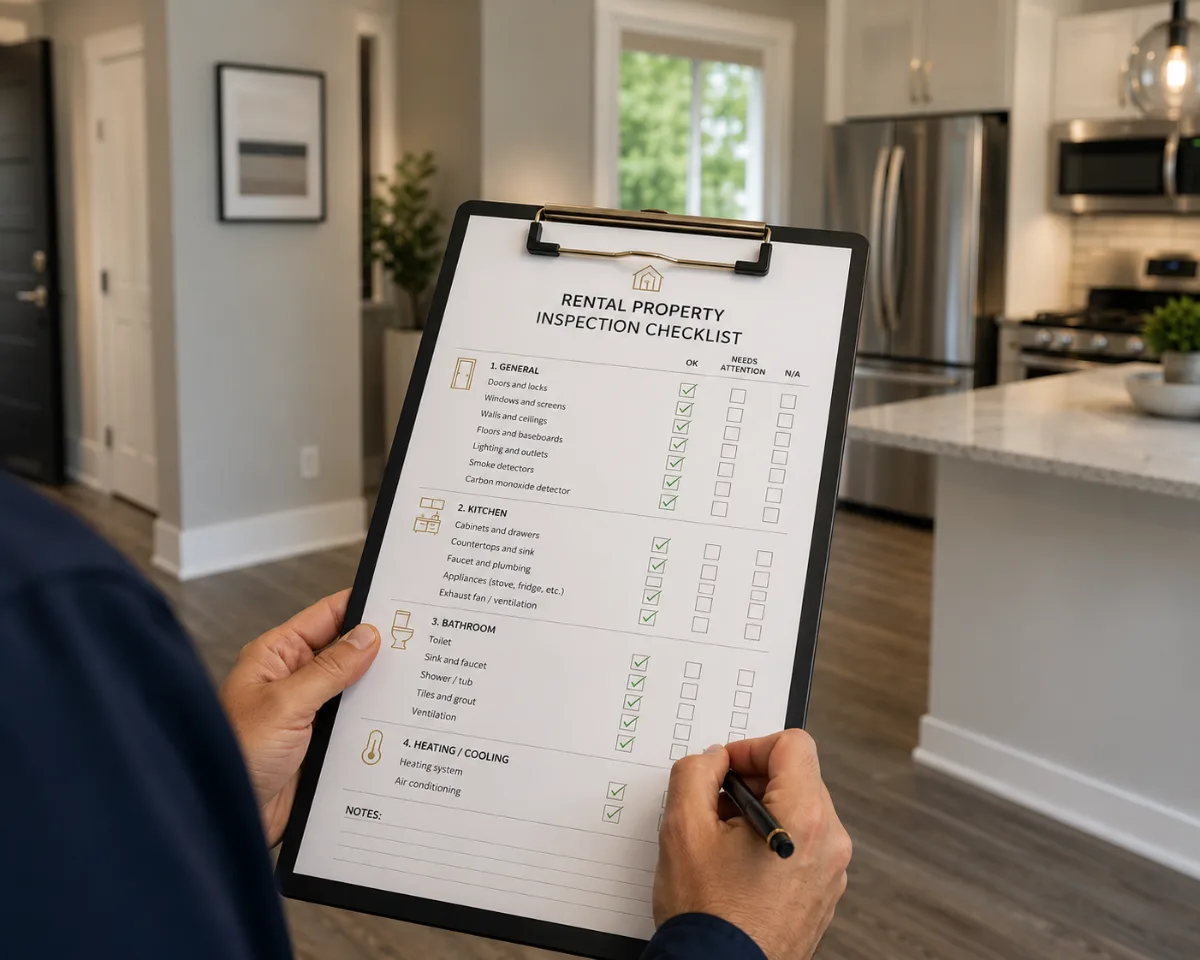
Before the Keys
## Move-In Inspection Checklist: What to Review Before a Tenant Moves In
A move-in inspection documents the condition of the rental before the tenant takes possession. Complete this before handing over the keys.
#### 🏠 Exterior Areas
- Front door condition and locks
- Windows and screens
- Exterior walls or siding
- Walkways, patios, or balconies
- Outdoor light fixtures
#### 🚪 Entry & Common Areas
- Flooring condition
- Walls and ceilings
- Doors and handles
- Light switches and outlets
- Smoke and carbon monoxide detectors
#### 🍳 Kitchen
- Cabinets and drawers
- Countertops and backsplash
- Sink and faucet operation
- Appliances in working order
- No leaks under the sink
#### 🚿 Bathrooms
- Toilet function
- Sink and faucet condition
- Tub or shower condition
- Tile and grout
- Exhaust fan
#### 🛏️ Bedrooms & Living Areas
- Doors and locks
- Windows and blinds
- Flooring or carpet
- Closets and shelving
#### ⚙️ Mechanical & Safety
- HVAC system operation
- Thermostat function
- Electrical panel access
- Fire extinguishers (if provided)
Take photos of all areas. Note any existing wear. This protects your team if questions come up later.
Why It Matters
## Why the Move-In Inspection Is Important
Without a clear starting point, disagreements are more likely. A thorough move-in inspection protects everyone involved from day one.
#### ✓ Sets Clear Expectations
Both parties agree on the condition of the property before any tenancy begins.
#### ✓ Documents Baseline
Shows the property started in good condition — critical for future comparisons.
#### ✓ Supports Future Claims
Detailed records make it easier to identify what changed during the tenancy.
#### ✓ Keeps Teams Organized
A consistent process reduces administrative burden across your portfolio.
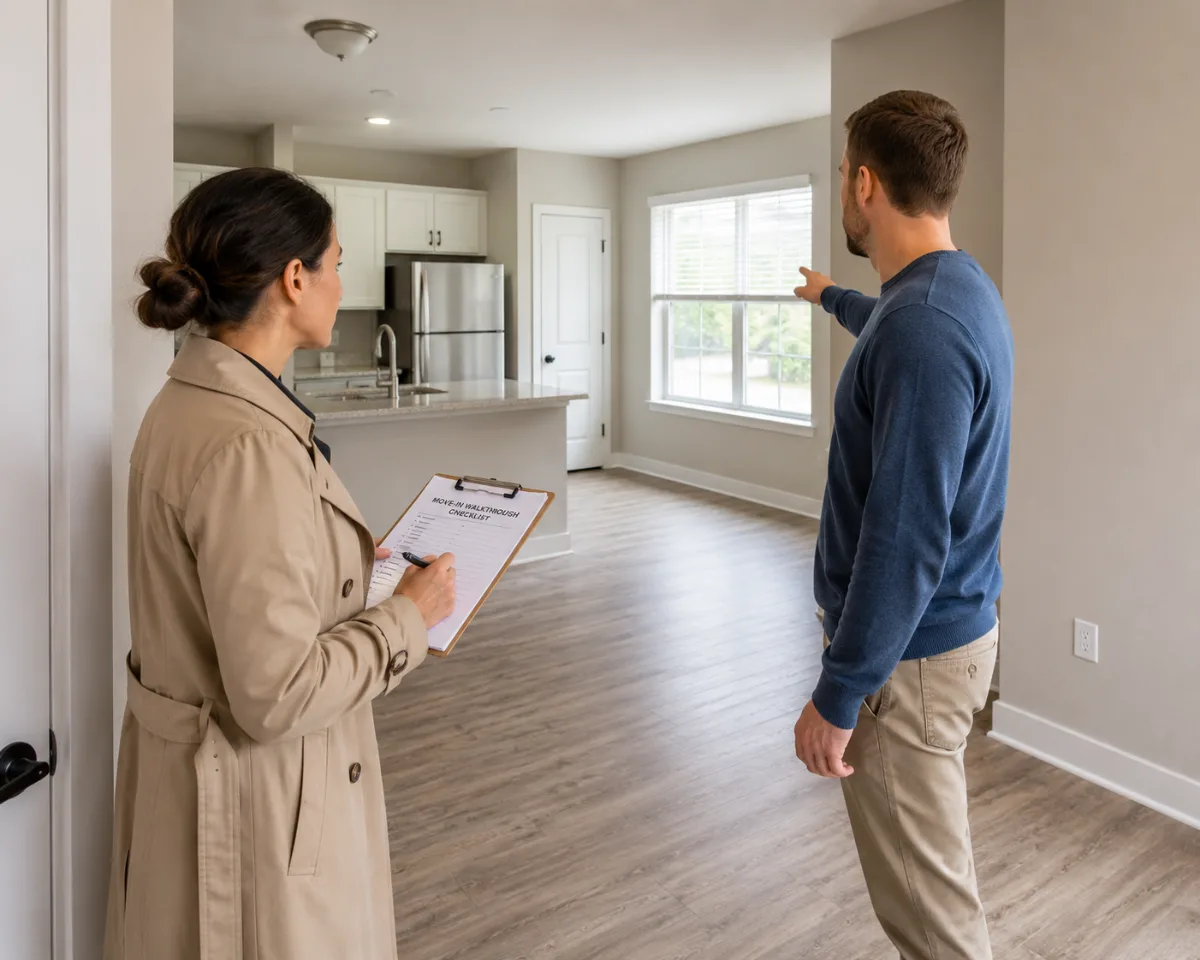
After the Tenant Leaves
## Move-Out Inspection Checklist: What to Review When a Tenant Leaves
A move-out inspection reviews the condition of the rental after the tenant moves out. Complete this once the unit is empty — and compare directly against the move-in report.
#### 🏠 Exterior Areas
- Door and lock condition
- Windows and screens
- Exterior damage
- Trash or debris left behind
#### 🧱 Interior Walls & Ceilings
- Holes or dents
- Stains or marks
- Paint condition
#### 🪵 Flooring
- Carpet stains or tears
- Scratches on hard flooring
- Missing tiles or planks
#### 🍳 Kitchen
- Appliance condition
- Cabinet damage
- Cleanliness
- Plumbing issues
#### 🚿 Bathrooms
- Cracks or chips
- Mold or mildew
- Plumbing leaks
- Fixture damage
#### 🔑 Final Checks
- Keys returned
- Garage remotes returned
- Utilities handled as required
- HVAC and thermostat condition
- Light fixtures and switches
Document everything with photos. Compare all findings directly to the move-in inspection checklist.
## Skip the In-Person Inspection. Get the Same Results.
Resident Inspect conducts live virtual move-in and move-out inspections for property managers nationwide — white-labeled reports, trained team, zero travel.
[Book a Free Demo →](https://residentinspect.com/book-a-demo/)
Know the Difference
## Normal Wear vs. Damage Beyond Normal Wear and Tear
Understanding this difference is critical to making fair security deposit decisions — and defending them if challenged.
#### Normal Wear
- Light carpet wear from foot traffic
- Small nail holes from pictures
- Minor scuffs on walls
- Faded paint over time
#### Beyond Normal Wear
- Large holes in walls
- Broken fixtures or hardware
- Missing or damaged items
- Heavy stains or burns
- Unauthorized alterations
Clear documentation at move-in and move-out makes this distinction easy to prove and defend.
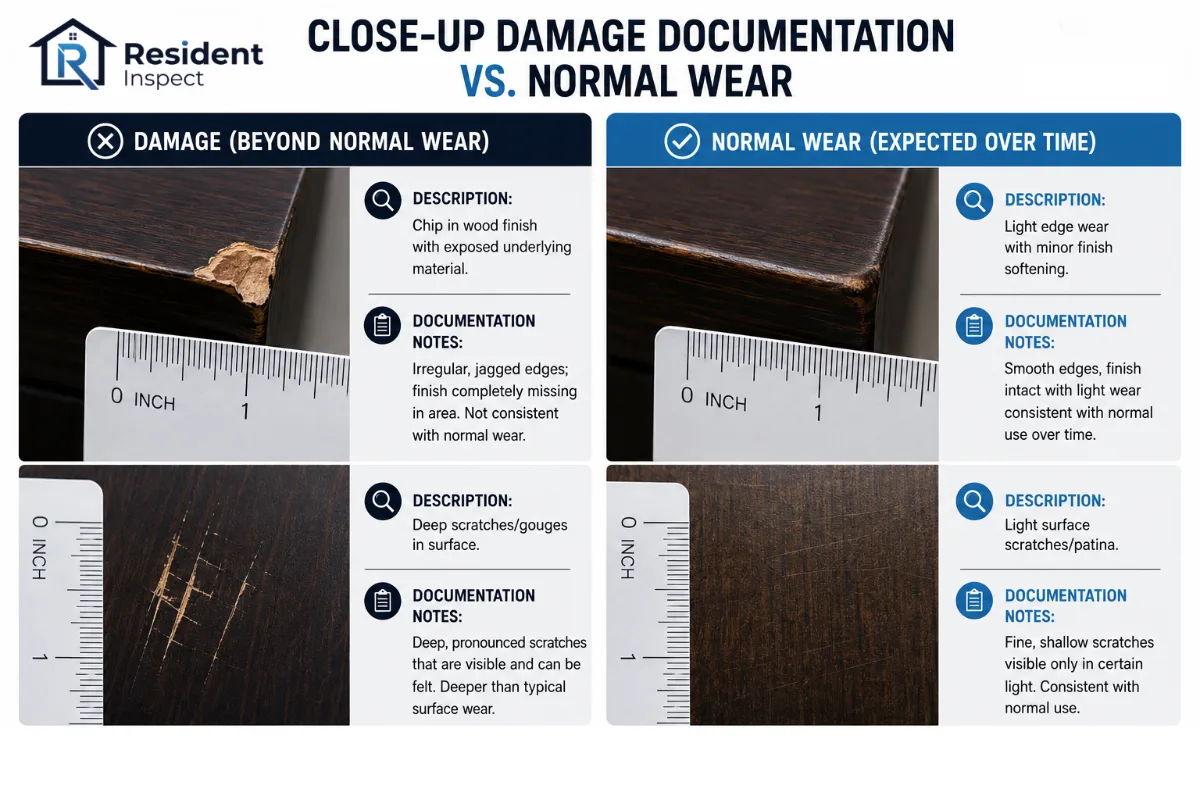
Avoid These
## Common Mistakes to Avoid During Rental Inspections
Even with a solid inspection checklist, mistakes can happen. Avoiding these issues protects property managers, landlords, and tenants.
1
#### Rushing the Inspection
When inspections move too fast, minor problems get missed. Small issues can turn into higher repair costs. Take time on every move-in and move-out inspection.
2
#### Poor Photo Documentation
Written notes matter, but photos provide proof. Always take clear photos of walls, floors, appliances, and fixtures. Visual records support decisions after a tenant moves.
3
#### Inconsistent Checklists
Using different forms makes it hard to compare results. A standard move-in and move-out checklist keeps inspections fair and consistent across every property.
4
#### Skipping Cleanliness Notes
Cleanliness is not normal wear and tear. If a tenant leaves a property dirty, note it clearly in the inspection report with supporting photos.
5
#### Failing to Set Expectations
When landlords and tenants understand the inspection process ahead of time, move-outs go more smoothly. Clear communication reduces the likelihood of disputes.
6
#### Not Comparing Reports
The move-out inspection only has value when compared directly to the move-in report. Always review both documents side by side before making deposit decisions.
Best Practices
## Best Practices for Staying Organized
A consistent inspection process saves time, improves accuracy, and protects property managers from disputes. Here is how to stay organized.
1
### Use the Same Checklist Every Time
Consistency across every unit and every tenancy makes comparisons reliable and defensible.
2
### Take Photos During Every Inspection
Photos are your strongest defense. Capture all rooms, fixtures, and areas of concern at both move-in and move-out.
3
### Store Reports in One System
Keep move-in and move-out reports together, labeled clearly, so they are easy to retrieve when needed.
4
### Use Digital Inspection Tools
Digital platforms capture photos in real time, generate reports quickly, and store records securely for side-by-side comparison.
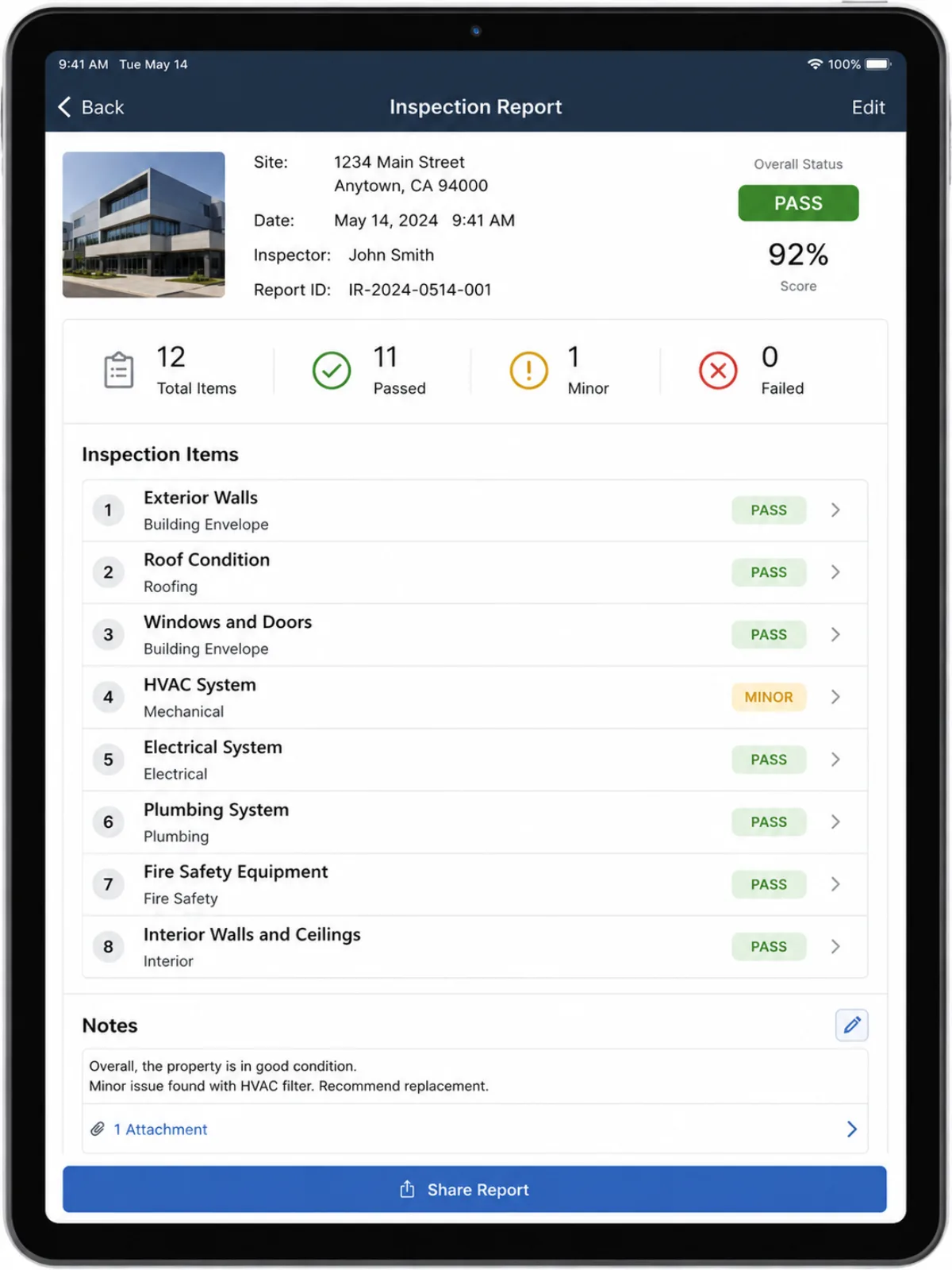
Who Benefits
## Who Uses Move-In and Move-Out Inspection Checklists?
Anyone responsible for a rental property benefits from a clear, consistent inspection process.
🏢
Property Management Companies
👤
Rental Managers
🏠
Property Owners
🔑
Landlords
📊
Asset Managers
🤝
Real Estate Investors
Modern Tools
## How Technology Improves the Inspection Process
Modern inspection tools streamline the entire process — from scheduling to report delivery — saving time and improving accuracy across every tenancy.
📸
#### Real-Time Photo Capture
Capture photos during the inspection and attach them instantly to the report — no manual uploads or filing needed.
📄
#### Instant Report Generation
Generate professional, white-labeled inspection reports immediately after each inspection is completed.
🔒
#### Secure Record Storage
Store all move-in and move-out reports securely in one place — accessible anytime, easy to retrieve when disputes arise.
🔄
#### Side-by-Side Comparison
Compare move-in and move-out reports side by side to identify exactly what changed during the tenancy.
Common Questions
## Move-In / Move-Out Inspection Checklist FAQs
#### What is a move-in inspection checklist?
+
A move-in checklist documents the condition of a rental property before a tenant moves in, creating a baseline record used for future comparisons at move-out.
#### What is a move-out inspection checklist?
+
A move-out checklist reviews the condition of the property after a tenant moves out to identify damage beyond normal wear and support fair, defensible security deposit decisions.
#### Why are both inspections important?
+
Comparing move-in and move-out inspections helps determine responsibility for damage and supports fair security deposit decisions. Without both, disputes are much harder to resolve.
#### What should always be documented during a rental inspection?
+
Walls, floors, appliances, light fixtures, cleanliness, and overall property condition should always be documented with photos and written notes at both move-in and move-out.
#### How do inspection checklists reduce disputes?
+
Clear documentation helps landlords and tenants agree on the condition of the rental property, reducing confusion and keeping security deposit decisions objective and professional.
Further Reading
## Authoritative Resources on Rental Inspections
Trusted sources used by landlords, property managers, and housing attorneys for inspection standards, tenant rights, and deposit law.
Federal
HUD — Responsibilities of a Landlord
U.S. Department of Housing and Urban Development guidelines on landlord obligations, habitability standards, and inspection requirements under federal housing law.
[Legal
Nolo — Move-In / Move-Out Checklist Guide
Attorney-written guidance on how to properly conduct move-in and move-out inspections, document property condition, and use checklists to protect security deposits in court.
](https://www.nolo.com/legal-encyclopedia/real-estate-rental-property) [Association
NARPM — Education & Resources
Professional standards and educational resources from the National Association of Residential Property Managers — covering inspection protocols, lease compliance, and documentation best practices.
](https://www.narpm.org/education/course-descriptions/) [State Law
iPropertyManagement — Security Deposit Laws by State
State-by-state breakdown of security deposit return laws, required inspection timelines, allowable deductions, and documentation requirements for landlords across all 50 states.
](https://ipropertymanagement.com/laws/security-deposit-return-laws)
## Let Resident Inspect Handle Your Move-In & Move-Out Inspections
Live virtual inspections conducted by our trained team — white-labeled reports, zero travel, and up to 60% savings vs. in-person inspections.
[Book a Free Consultation](https://residentinspect.com/book-a-demo/) [Ask a Question Instead](https://residentinspect.com/contact-us/)
---
### [zInspector Alternative: Resident Inspect vs. zInspector](https://residentinspect.com/compare/zinspector/)
**Published:** September 25, 2026
**Author:** Alex Zweydoff
**Excerpt:** zInspector is a feature-rich DIY inspection toolkit your staff operates. Resident Inspect is a done-for-you service with no software to run. See which model fits your team.
**Content:**
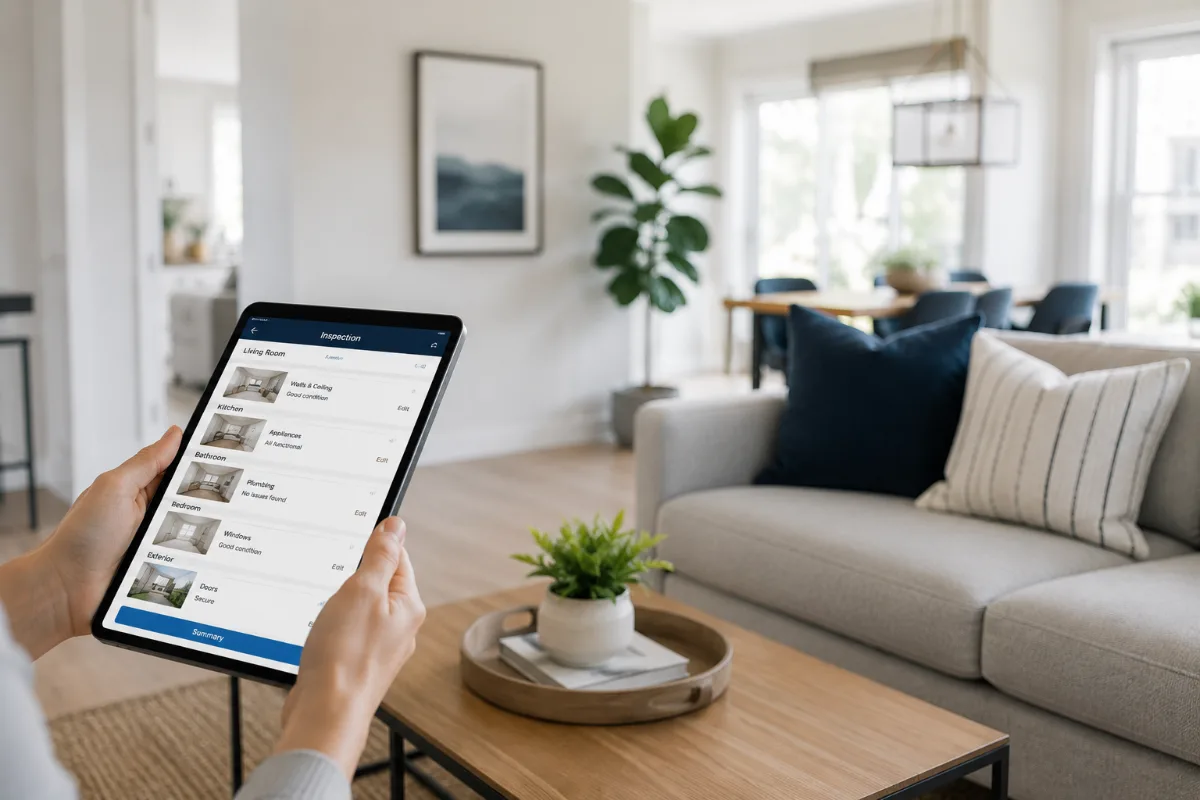
zInspector Alternative
# The zInspector Alternative:
*Resident Inspect vs. zInspector*
Looking for a zInspector alternative? zInspector is a feature-rich inspection app your staff or tenants use, with AI report writing, 360 tours, and deep PMS integrations. Resident Inspect, on the other hand, is a done-for-you service where a trained specialist handles every walkthrough.
[Book a Demo](https://residentinspect.com/book-a-demo/) [How It Works →](https://residentinspect.com/rental-property-inspections/)
Last reviewed: September 2026
Quick Verdict
## Who Each One Is For
zInspector
#### Best for teams that want a full-featured inspection app to run in-house
zInspector suits property management companies that want full control of the inspection process, features like AI report writing and 360 tours, and two-way PMS sync, and that are ready to train staff and manage the app.
Resident Inspect
#### Best for teams who want inspections fully handled, not managed
As a zInspector alternative, Resident Inspect is for property managers who don’t want another platform to run. Instead, trained specialists conduct live walkthroughs and deliver consistent reports, with no inspection software or field staff for your team to manage.
Side-by-Side
## zInspector vs. Resident Inspect: Full Comparison
| | zInspector |  |
|---|---|---|
| Who does the inspection | Your staff on-site, or your tenant through the zTenant self-inspection app | ✓ Trained Resident Inspect specialist, live on every call |
| Inspection method | Mobile app with custom checklists, photos, video clips, and optional 360 cameras | ✓ Live video walkthrough: specialist-led, resident guides the camera |
| Report writing | zAssistant AI turns spoken notes into a report; white-label PDF | ✓ White-labeled, photo-backed report delivered within 1 business day |
| Scheduling & coordination | Your team coordinates with tenants; the app sends tenant reminders | ✓ Fully handled: scheduling, reminders, evening & weekend slots |
| Consistency | Depends on which staff member or tenant does the inspection | ✓ Same standardized checklist every property, every cycle |
| Software for your team | Yes: mobile app, user seats, checklists, and integration setup | ✓ None. No app to learn, train on, or maintain |
| Integrations | Two-way sync with [AppFolio](https://www.appfolio.com/property-manager/maintenance), [Buildium](https://www.clearleaddigital.com/blog/buildium-review), Propertyware, Rent Manager, Rentvine, and Rentec Direct | Enterprise plan integrations including AppFolio, Yardi, Propertyware, Rent Manager, Buildium, and TenantCloud, plus [Property Meld](https://residentinspect.com/property-meld-integration/) |
| 360 tours | Yes, with 360 cameras purchased separately | No. Live video walkthrough format |
| Pricing model | Subscription billed per unit or per user | Pay-as-you-go Starter plan for smaller portfolios, volume plans for mid-size portfolios. [See pricing](https://residentinspect.com/pricing/) |
| Try before you buy | 15-day free trial; free tier for very small portfolios | ✓ [Free inspections](https://residentinspect.com/free-inspection/) to test the full service |
| Best fit | Teams wanting a feature-rich app and in-house control of inspections | SFR, scattered-site, and mid-size PM portfolios wanting inspections fully handled |
 A live remote walkthrough led by a specialist (left) vs. sending your own staff to the property (right). zInspector details are based on public information from [zinspector.com](https://zinspector.com/features/) as of September 2026 and may change. Please confirm current features and pricing directly with zInspector.
How zInspector Works
## How zInspector Works
zInspector gives your staff a mobile app to inspect properties. First, the inspector walks the unit, follows a custom checklist, and takes photos and short video clips. Then its AI assistant, zAssistant, turns spoken notes into a written report. In addition, the app works offline when there’s no signal.
If you don’t want to send staff, the zTenant app lets residents inspect their own unit, with reminders until they finish. After that, reports can be white-labeled, signed remotely, and synced back to your property management software.
Overall, zInspector is a capable platform. In fact, if your team wants full control of the inspection process and is comfortable running a feature-rich app, it’s one of the stronger do-it-yourself options on the market.
How Resident Inspect Works
## How Resident Inspect Works

Resident Inspect handles everything: scheduling, tenant coordination, the walkthrough, and report delivery. First, a trained specialist joins a [live video call](https://residentinspect.com/our-virtual-inspection-software/) with your resident and guides them room by room. As a result, your team doesn’t need to send anyone to the property.
Because the specialist follows a standardized checklist, the result doesn’t change based on who was available that day. Then a white-labeled, photo-backed report arrives within one business day.
In short, zInspector makes your staff more efficient. Resident Inspect, on the other hand, is a zInspector alternative that removes the need for your staff to be there at all.
Key Differences
## Why PMs Look for a zInspector Alternative
### 1. The labor still lives with your team
zInspector is a strong tool, but someone still has to use it. For example, your staff need training, and someone has to schedule inspections, follow up with tenants, do the walkthrough or review the tenant’s photos, and manage the workflow. In contrast, Resident Inspect, a done-for-you zInspector alternative, removes that whole layer with a [done-for-you inspection service](https://residentinspect.com/rental-property-inspections/). As a result, there’s no training, no field time, and no software to maintain.
### 2. Feature depth vs. zero overhead
To be fair, zInspector wins on features: 360 tours, AI report writing, offline mode, and two-way PMS sync. So if those tools matter to your workflow, zInspector is the more powerful app. However, if you won’t use 360 cameras and don’t want to invest in training and setup, those features add work instead of value.
### 3. Consistency at scale
When inspections depend on which staff member or tenant does them, quality drifts. After all, different people notice different things. Instead, Resident Inspect applies the same specialist-led checklist to every property, whether it’s a [move-in or move-out](https://residentinspect.com/move-in-move-out-inspection-checklist/) or a [periodic inspection](https://residentinspect.com/periodic-rental-inspection-service/).
 Organized, standardized digital reports (left) vs. scattered paperwork and inconsistent photos (right). ### 4. Scaling without adding headcount
To scale inspections with zInspector, you need more staff time or more tenants willing to self-inspect. By contrast, to scale with Resident Inspect, you just book more inspections. That’s because the specialist capacity is on our side, not yours, which also makes it a good fit for [scattered-site portfolios across the country](https://residentinspect.com/nationwide-rental-inspections/). New to the different inspection types? Start with [Rental Inspections 101](https://residentinspect.com/rental-inspections-101/).
## zInspector or a zInspector Alternative: When to Choose Each
#### zInspector is the better fit when…
- You want a feature-rich app with 360 tours and AI report writing
- Your team is ready to train on and run inspection software
- You use AppFolio, Buildium, Propertyware, Rent Manager, Rentvine, or Rentec Direct and want two-way sync
- You want full in-house control of the inspection workflow
- Staff-led or tenant self-inspections already fit your model and you want them faster
#### Resident Inspect is the better fit when…
- You don’t want another platform to train your team on or manage
- Inspections are a bottleneck and staff time is better spent on leasing, maintenance, and owner relations
- You want the same documentation quality no matter who is available
- You’re growing and want inspection capacity to grow without adding headcount
- White-labeled, photo-backed reports within one business day are the priority
Watch
## A Message from Resident Inspect
Hear from the team about how we take inspections off your plate.

Getting Started
## Switching to a zInspector Alternative: How to Get Started
Moving from zInspector to a done-for-you zInspector alternative takes about a week. Here’s how it works.
1
### Book a demo
[Schedule a short call](https://residentinspect.com/book-a-demo/) to walk through your portfolio, inspection types, and reporting needs.
2
### Try it free
[Claim your free inspections](https://residentinspect.com/free-inspection/) and see a real walkthrough and report before you commit.
3
### Send your properties
Share the units and inspection type. We contact residents and handle all scheduling and reminders.
4
### Get your reports
White-labeled, photo-backed reports arrive within one business day, backed by our Live Look Guarantee.
FAQ
## Frequently Asked Questions
Best### What is the best zInspector alternative for property managers?
If you want inspections done for you instead of by your staff or tenants, Resident Inspect is a zInspector alternative built for that. A trained specialist leads every live video walkthrough and delivers a white-labeled report within one business day. However, if you want a feature-rich app to run in-house, zInspector may still be the better fit.
What### What is zInspector?
zInspector is inspection software for property managers. Your staff use its mobile app to inspect units, or tenants self-inspect with the zTenant app. It includes an AI assistant that writes reports from spoken notes, white-label PDF reports, 360 tours, offline mode, and two-way sync with several property management systems. Verify current features and pricing at zinspector.com.
Free### Does zInspector have a free plan?
zInspector offers a 15-day free trial with no credit card and a free tier for very small portfolios. Paid plans are subscriptions billed per unit or per user. Resident Inspect lets you claim free inspections so you can see a real walkthrough and report before you commit.
Tenant### Can tenants do inspections themselves with zInspector?
Yes. zInspector’s zTenant app guides tenants through self-inspections and sends reminders until they finish. Your team still reviews what the tenant captured. With Resident Inspect, a trained specialist leads every live video walkthrough, so the documentation does not depend on what the tenant chooses to show.
PMS### Which property management software does each one integrate with?
zInspector lists two-way sync with AppFolio, Buildium, Propertyware, Rent Manager, Rentvine, and Rentec Direct. Resident Inspect offers integrations on its Enterprise plan, including AppFolio, Yardi, Propertyware, Rent Manager, Buildium, and TenantCloud, plus a Property Meld integration.
Diff### What’s the main difference between zInspector and Resident Inspect?
zInspector is a toolkit your team operates. Your staff or your tenants still do the inspection, and your team manages the app and the follow-up. Resident Inspect is a done-for-you service. A trained specialist runs a live video walkthrough with your resident, and your team receives a finished report. No tool to operate and no training required.
Scale### Is zInspector or Resident Inspect better for growing portfolios?
zInspector scales well for teams willing to invest in staff training and software management. Resident Inspect scales without adding staff. Each inspection is handled by a trained specialist, so your capacity grows without the matching labor cost.
## See Done-For-You Inspections in Action
Looking for a zInspector alternative? No software to learn and no staff to send. Book a free demo and see how Resident Inspect handles scheduling, the walkthrough, and the report without your team lifting a finger.
[Book a Free Demo](https://residentinspect.com/book-a-demo/)
Related resources
[Virtual Inspection Software](https://residentinspect.com/our-virtual-inspection-software/) [Rental Property Inspections](https://residentinspect.com/rental-property-inspections/) [Property Meld Integration](https://residentinspect.com/property-meld-integration/) [Pricing & Plans](https://residentinspect.com/pricing/) [Book a Consultation](https://residentinspect.com/book-a-demo/)
---
### [SnapInspect Alternative: Resident Inspect vs. SnapInspect](https://residentinspect.com/compare/snapinspect/)
**Published:** September 26, 2026
**Author:** Alex Zweydoff
**Excerpt:** Looking for a SnapInspect alternative? Compare features, pricing, integrations, and who does the inspection, then see if done-for-you Resident Inspect fits.
**Content:**

SnapInspect Alternative
# The SnapInspect Alternative:
*Resident Inspect vs. SnapInspect*
Looking for a SnapInspect alternative? SnapInspect is a full-featured inspection app with deep report customization that your staff or tenants use. Resident Inspect, on the other hand, is a done-for-you service where a trained specialist handles every walkthrough on a live video call.
[Book a Demo](https://residentinspect.com/book-a-demo/) [How It Works →](https://residentinspect.com/rental-property-inspections/)
Last reviewed: September 2026
Quick Verdict
## Who Each One Is For
SnapInspect
#### Best for teams wanting deep report customization and in-house control
SnapInspect suits residential and commercial property management companies that want to keep inspections in-house, need highly customized reports, and have staff to run inspections across the portfolio.
Resident Inspect
#### Best for teams that want inspections fully handled, without drive time
As a SnapInspect alternative, Resident Inspect is for property managers who want consistent inspections without sending staff. Instead, a trained specialist handles the live walkthrough remotely, and a finished report arrives within one business day.
Side-by-Side
## SnapInspect vs. Resident Inspect: Full Comparison
| | SnapInspect |  |
|---|---|---|
| Who does the inspection | Your staff on-site, or a tenant or third party through a Request Inspection link | ✓ Trained Resident Inspect specialist, live on every call |
| Inspection method | iOS, Android, and desktop app with custom checklists, photos, video, and eSignatures | ✓ Live video walkthrough: specialist-led, resident guides the camera |
| Report | Highly customizable report builder; AI report writing on Premium | ✓ White-labeled, photo-backed, delivered within 1 business day |
| Scheduling & coordination | Your team schedules, coordinates with tenants, and sends requests | ✓ Fully handled: scheduling, reminders, evening & weekend slots |
| Consistency | Depends on the inspector’s or tenant’s skill and care | ✓ Same standardized checklist every property, every cycle |
| Software for your team | Yes: field app, management portal, and report template setup | ✓ None. No app to learn, train on, or maintain |
| Travel required | Yes for staff-led inspections; no for tenant self-inspections | ✓ No. Live remote video walkthrough |
| Integrations | [AppFolio](https://support.snapinspect.com/en/articles/12092107-appfolio-integration-with-snapinspect), Yardi, Entrata, and Rentvine, among others, via API plans | Enterprise plan integrations including AppFolio, Yardi, Propertyware, Rent Manager, Buildium, and TenantCloud, plus [Property Meld](https://residentinspect.com/property-meld-integration/) |
| Property types | Residential, student housing, and commercial | Residential rentals (SFR, multifamily, scattered-site) |
| Pricing model | Custom quote, billed monthly per managed asset ([SnapInspect pricing](https://www.snapinspect.com/pricing)) | Pay-as-you-go Starter plan for smaller portfolios, volume plans for mid-size portfolios. [See pricing](https://residentinspect.com/pricing/) |
| Try before you buy | 14-day free trial | ✓ [Free inspections](https://residentinspect.com/free-inspection/) to test the full service |
| Best fit | PMs keeping inspections in-house who want deep report customization | SFR, scattered-site, and mid-size PM portfolios wanting inspections fully handled |
 A SnapInspect alternative in action: a specialist-led live video inspection (left) vs. sending an inspector to the property (right). SnapInspect details are based on public information from [snapinspect.com](https://www.snapinspect.com/) as of September 2026 and may change. Please confirm current features and pricing directly with SnapInspect.
How SnapInspect Works
## How SnapInspect Works
SnapInspect gives your team a mobile app for iOS and Android plus a desktop portal. First, an inspector walks the property, follows a custom checklist, and takes photos and video. Then the platform builds a formatted report. In addition, report templates are highly flexible, so you can shape the layout, fields, and branding to match your standards.
SnapInspect also has a Request Inspection feature. With it, a tenant or other third party can complete an inspection through an emailed link or QR code, with no account needed. On higher plans, AI helps write and route reports, and tasks can become work orders.
Overall, SnapInspect is a mature, flexible platform. However, as with any do-it-yourself tool, someone on your side still does the inspection: either your staff drives to the property, or your tenant decides what to capture. That’s why many teams start looking for a SnapInspect alternative.
How Resident Inspect Works
## How Resident Inspect Works

Resident Inspect handles everything remotely. First, a trained specialist joins a [live video call](https://residentinspect.com/our-virtual-inspection-software/) with your resident and guides them room by room. As a result, your staff doesn’t drive, coordinate, or run the walkthrough.
Because the specialist follows a standardized checklist, every property gets the same process. Then a finished, white-labeled report arrives within one business day, not after an inspector gets back to the office and writes it up.
In short, SnapInspect makes in-house inspections more efficient. Resident Inspect, on the other hand, is a SnapInspect alternative that takes inspections off your team’s plate entirely.
Key Differences
## Why PMs Look for a SnapInspect Alternative
### 1. Drive time and no-shows
Staff-led SnapInspect inspections require someone to drive to the property. As a result, drive time, no-shows when the tenant isn’t home, and rescheduling add up across a growing portfolio. In contrast, Resident Inspect’s live video model removes travel entirely, so an inspection across town takes the same time as one next door.
 No drive, no no-shows: the resident holds the phone while a specialist guides and documents the walkthrough remotely. ### 2. Report customization vs. report delivery
To be fair, SnapInspect wins on customization. If you need reports built a very specific way, its template builder gives you that control. Resident Inspect, however, delivers white-labeled reports in a standard format. So if your priority is getting the report done and delivered fast, Resident Inspect is quicker by design.
### 3. Staff overhead and training
Adopting SnapInspect means training your staff, managing the app, and maintaining templates. Instead, with Resident Inspect, a done-for-you SnapInspect alternative, your team doesn’t operate anything. Onboarding is a single demo call, not a software rollout, and it covers every [type of rental inspection](https://residentinspect.com/rental-inspections-101/), from [move-in and move-out](https://residentinspect.com/move-in-move-out-inspection-checklist/) to [periodic inspections](https://residentinspect.com/periodic-rental-inspection-service/).
### 4. Geography
Staff-led inspections are limited by where your team can reasonably drive. By contrast, Resident Inspect offers [nationwide rental inspections](https://residentinspect.com/nationwide-rental-inspections/), so the time and cost of an inspection don’t change based on how far the property is from your office.
## SnapInspect or a SnapInspect Alternative: When to Choose Each
#### SnapInspect is the better fit when…
- You want to keep inspections in-house with your own staff
- Highly customized report templates matter to your business or owners
- You manage commercial or student housing alongside residential
- You want work orders and maintenance tasks in the same app
- Your team is already comfortable with mobile inspection apps
#### Resident Inspect is the better fit when…
- Drive time and no-shows are eating into your team’s day
- You want inspections done without sending staff or relying on tenants
- Consistent documentation matters more than report customization
- You’re growing into new areas and don’t want inspections tied to where your staff lives
- You want a finished, white-labeled report within one business day
Watch
## A Message from Resident Inspect
Hear why property managers choose Resident Inspect as their SnapInspect alternative.

Getting Started
## Switching to a SnapInspect Alternative: How to Get Started
Moving from SnapInspect to a done-for-you SnapInspect alternative takes about a week. Here’s how it works.
1
### Book a demo
[Schedule a short call](https://residentinspect.com/book-a-demo/) to walk through your portfolio, inspection types, and reporting needs.
2
### Try it free
[Claim your free inspections](https://residentinspect.com/free-inspection/) and see a real walkthrough and report before you commit.
3
### Send your properties
Share the units and inspection type. We contact residents and handle all scheduling and reminders.
4
### Get your reports
White-labeled, photo-backed reports arrive within one business day, backed by our Live Look Guarantee.
FAQ
## Frequently Asked Questions
Best### What is the best SnapInspect alternative for property managers?
If you want inspections done for you instead of by your staff or tenants, Resident Inspect is a SnapInspect alternative built for that. A trained specialist leads every live video walkthrough and delivers a white-labeled report within one business day. However, if you want deep report customization or inspect commercial properties, SnapInspect may still be the better fit.
What### What is SnapInspect?
SnapInspect is inspection software for property managers, available on iOS, Android, and desktop. It includes a custom report builder, video inspections, eSignatures, and on higher plans, AI report writing, task and work order management, and API integrations. It covers residential, student housing, and commercial properties. Verify current features and pricing at snapinspect.com.
Travel### Does SnapInspect require staff to go to the property?
Not always. Most SnapInspect inspections are done by your staff on-site with the app. However, its Request Inspection feature lets a tenant or other third party complete an inspection through an emailed link or QR code. Either way, your team or the tenant does the inspection. With Resident Inspect, a trained specialist leads every walkthrough on a live video call.
Price### How much does SnapInspect cost?
SnapInspect does not publish prices. Its Essential, Premium, and Enterprise plans are billed monthly per managed asset, with a 14-day free trial and no long-term contract. Resident Inspect offers a pay-as-you-go Starter plan and free inspections to try the service.
PMS### Which property management software does each one integrate with?
SnapInspect lists integrations with AppFolio, Yardi, Entrata, and Rentvine, among others, on its API-enabled plans. Resident Inspect offers integrations on its Enterprise plan, including AppFolio, Yardi, Propertyware, Rent Manager, Buildium, and TenantCloud, plus a Property Meld integration.
Commercial### Which is better for commercial properties?
SnapInspect supports residential, student housing, and commercial inspections. Resident Inspect, by contrast, focuses on residential rentals: SFR, scattered-site, and mid-size PM portfolios. So for commercial inspection needs, SnapInspect is the more purpose-built option.
## Skip the Drive. Keep the Standards.
Looking for a SnapInspect alternative? See how Resident Inspect runs live, specialist-guided walkthroughs with no field visits and delivers a finished report within one business day.
[Book a Free Demo](https://residentinspect.com/book-a-demo/)
Related resources
[Rental Property Inspections](https://residentinspect.com/rental-property-inspections/) [Nationwide Inspections](https://residentinspect.com/nationwide-rental-inspections/) [Resident Inspect vs. HappyCo](https://residentinspect.com/compare/happyco/) [Resident Inspect vs. zInspector](https://residentinspect.com/compare/zinspector/) [Book a Consultation](https://residentinspect.com/book-a-demo/)
---
### [RentCheck Alternative: Resident Inspect vs. RentCheck](https://residentinspect.com/compare/rentcheck/)
**Published:** September 26, 2026
**Author:** Alex Zweydoff
**Excerpt:** Compare RentCheck vs. Resident Inspect: pricing, integrations, and who does the inspection. See if a specialist-led RentCheck alternative fits you.
**Content:**

RentCheck Alternative
# The RentCheck Alternative:
*Resident Inspect vs. RentCheck*
Looking for a **RentCheck alternative**? RentCheck is a resident-led inspection app where tenants complete inspections on their own phone. Resident Inspect, on the other hand, puts a trained specialist on a live video call for every walkthrough. Same goal, very different models.
[Book a Demo](https://residentinspect.com/book-a-demo/) [How It Works →](https://residentinspect.com/rental-property-inspections/)
Last reviewed: September 2026
Quick Verdict
## Who Each One Is For
RentCheck
#### Best for teams comfortable with tenant-led inspections
RentCheck is a low-cost, per-unit app for property managers who are happy to have tenants self-inspect, want PMS integration, and have staff to review what tenants submit.
Resident Inspect
#### Best for PMs who want consistent, documented walkthroughs
Resident Inspect is the RentCheck alternative for property managers who can’t afford missed damage or inconsistent photos. Instead of relying on the tenant, a trained specialist handles every inspection, so you get full coverage without adding staff.
Side-by-Side
## RentCheck vs. Resident Inspect: Full Comparison
| | RentCheck |  |
|---|---|---|
| Who does the inspection | Mostly the tenant. RentCheck says about 80% of inspections are completed by tenants | ✓ Trained Resident Inspect specialist, live on every call |
| Inspection method | Tenant takes photos and videos on their phone, guided by the app’s checklist | ✓ Live video walkthrough: specialist-led, resident guides the camera |
| Damage review | AI damage detection flags possible issues for your team to review | ✓ Specialist documents and flags issues in real time |
| Scheduling & coordination | You send the request; the app sends reminders; the tenant completes it on their own schedule | ✓ Fully handled: scheduling, reminders, evening & weekend slots |
| Consistency | Depends on the tenant: photo quality and checklist completion vary | ✓ Same standardized checklist every property, every cycle |
| Report | Built from tenant inputs, then reviewed by your team | ✓ White-labeled, photo-backed, delivered within 1 business day |
| Software for your team | Yes: app setup, templates, integration setup, and reviewing submissions | ✓ None. No app to learn, train on, or maintain |
| Integrations | AppFolio, Buildium, Rent Manager, Rentvine, and Property Meld, plus Zapier | Enterprise plan integrations including AppFolio, Yardi, Propertyware, Rent Manager, Buildium, and TenantCloud, plus [Property Meld](https://residentinspect.com/property-meld-integration/) |
| Pricing model | About $1 to $1.75 per unit per month, depending on plan | Pay-as-you-go Starter plan for smaller portfolios, volume plans for mid-size portfolios. [See pricing](https://residentinspect.com/pricing/) |
| Try before you buy | 14-day free trial, no credit card | ✓ [Free inspections](https://residentinspect.com/free-inspection/) to test the full service |
| Best fit | Teams comfortable with tenant-led inspections and staff time to review them | SFR, scattered-site, and mid-size PM portfolios wanting inspections fully handled |
 The resident holds the phone, but a Resident Inspect specialist guides the walkthrough and documents it in real time. RentCheck details are based on public information from getrentcheck.com as of September 2026 and may change. Please confirm current features and pricing directly with RentCheck.
How RentCheck Works
## How RentCheck Works
RentCheck sends an inspection request to the tenant by text or email. Then the tenant opens the app, follows a guided checklist, takes photos and videos on their phone, and submits the report. Meanwhile, the app sends countdown reminders until the inspection is done.
It’s a clever model, because it hands the inspection to the person already at the property. In fact, RentCheck says that on average 80% of inspections are completed by tenants. In addition, its AI damage detection flags possible issues so your team knows which reports to review first.
### The core trade-off
However, when a tenant completes the inspection, the documentation depends on that tenant: their attention to detail, their willingness to photograph damage honestly, and how well they follow the checklist. In short, the app structures the process, but it can’t control what the person holding the phone decides to capture.
How Resident Inspect Works
## How Resident Inspect Works

First, Resident Inspect schedules a [live video call](https://residentinspect.com/our-virtual-inspection-software/) with your resident. Then a trained specialist joins the call and guides the resident room by room, directing where to aim the camera, what to open, and what to document.
As a result, the specialist controls the inspection in real time. They follow a standardized checklist, capture photos as they go, and flag anything that needs attention. Finally, a white-labeled report arrives within one business day, so your team gets a finished product instead of raw tenant photos to review.
### The core difference
The trained specialist on the call is the difference. Because no tenant decides what to document, there are no missed areas, blurry photos of the wrong corner, or reasons to downplay damage. Instead, the same standard applies to every property, every cycle.
Key Differences
## Why PMs Look for a RentCheck Alternative
### 1. Who controls the camera
In RentCheck, the tenant controls what gets documented. For example, they choose the angles, the lighting, and whether to photograph that scuff behind the door. In contrast, with Resident Inspect a trained specialist directs the camera in real time, so the documentation is controlled, not crowd-sourced.
### 2. Consistency across your portfolio
Self-inspection quality varies by tenant. Some are careful; others submit three blurry photos of the living room and call it done. Resident Inspect, however, applies the same checklist and documentation standard to every property, whether it’s a [move-in or move-out](https://residentinspect.com/move-in-move-out-inspection-checklist/) or a [periodic inspection](https://residentinspect.com/periodic-rental-inspection-service/).
### 3. Missed damage and dispute risk
The documentation you collect at move-in and during periodic inspections is your main defense in a security deposit dispute. After all, tenants have a natural reason to downplay condition issues. A trained specialist on a live call removes that variable. For more on this, see our piece on [virtual inspections vs. tenant self-inspections](https://residentinspect.com/blog/virtual-inspections-vs-tenant-self-inspections/).
 With a specialist on the call, damage like ceiling and wall water stains gets documented, not skipped. ### 4. Staff time and software overhead
RentCheck still requires your team to set up the tool, configure integrations, prompt tenants, review submissions, and follow up on incomplete inspections. By contrast, Resident Inspect handles scheduling, reminders, and the inspection itself. That’s why it’s a good fit for [scattered-site portfolios across the country](https://residentinspect.com/nationwide-rental-inspections/). New to the different inspection types? Start with [Rental Inspections 101](https://residentinspect.com/rental-inspections-101/).
## RentCheck or a RentCheck Alternative: When to Choose Each
#### RentCheck is the better fit when…
- You want a low-cost, per-unit app and are comfortable with tenant-led inspections
- Your tenants reliably complete tasks on their own
- You use AppFolio, Buildium, Rent Manager, Rentvine, or Property Meld and want native integration
- Your team has time to review tenant submissions and chase incomplete ones
- You want AI help flagging which reports need a closer look
#### Resident Inspect is the better fit when…
- Documentation quality is critical for deposit disputes and owner reporting
- You’ve had problems with tenant self-inspections: missed damage or incomplete photos
- Your team is stretched and can’t chase incomplete inspections
- You want the same documentation standard across every property
- You want inspections fully handled, from scheduling to the report, without managing software
Watch
## A Message from Resident Inspect
Hear from the team about how we take inspections off your plate.

Getting Started
## Switching to a RentCheck Alternative: How to Get Started
Moving from RentCheck to a done-for-you RentCheck alternative takes about a week. Here’s how it works.
1
### Book a demo
[Schedule a short call](https://residentinspect.com/book-a-demo/) to walk through your portfolio, inspection types, and reporting needs.
2
### Try it free
[Claim your free inspections](https://residentinspect.com/free-inspection/) and see a real walkthrough and report before you commit.
3
### Send your properties
Share the units and inspection type. We contact residents and handle all scheduling and reminders.
4
### Get your reports
White-labeled, photo-backed reports arrive within one business day, backed by our Live Look Guarantee.
FAQ
## Frequently Asked Questions
Best### What is the best RentCheck alternative?
If you want inspections fully handled instead of tenant-led, Resident Inspect is a strong RentCheck alternative. A trained specialist runs every inspection on a live video call and delivers a white-labeled report within one business day. If you want another DIY app, [zInspector](https://residentinspect.com/resident-inspect-vs-zinspector/) and [SnapInspect](https://residentinspect.com/compare/snapinspect/) are also worth a look.
Free### Is RentCheck free?
No. RentCheck offers a 14-day free trial with no credit card, but it has no permanent free plan. Its plans are billed per unit per month, from about $1 to $1.75 per unit depending on the plan. Resident Inspect lets you claim free inspections so you can see a real walkthrough and report before you commit.
Model### Does RentCheck require the tenant to do the inspection?
RentCheck is built around resident-led inspections. In fact, RentCheck says that on average 80% of inspections are completed by tenants on their phone. The app guides tenants with a checklist and reminders, and its AI flags possible damage for your team to review. However, your team still reviews what the tenant chose to capture.
Risk### Can tenant self-inspections miss damage?
Yes, they can. A self-inspection only captures what the tenant chooses to photograph. For example, tenants may skip areas, take blurry photos, or have a reason to downplay damage. A live, guided inspection with a trained specialist reduces these gaps because the specialist decides what gets documented.
PMS### Which property management software does each one integrate with?
RentCheck lists integrations with AppFolio, Buildium, Rent Manager, Rentvine, and Property Meld, plus Zapier. Resident Inspect offers integrations on its Enterprise plan, including AppFolio, Yardi, Propertyware, Rent Manager, Buildium, and TenantCloud, plus a Property Meld integration.
Diff### What’s the main difference between RentCheck and Resident Inspect?
RentCheck is a self-inspection app, so your tenant usually does the inspection on their phone. Resident Inspect, on the other hand, is a done-for-you service. A trained specialist joins a live video call, guides the walkthrough, controls the documentation, and delivers a white-labeled report within one business day. In short, the key difference is who controls the camera.
Scale### Which is better for large portfolios?
For large SFR or scattered-site portfolios where documentation consistency matters, Resident Inspect’s done-for-you model reduces variance and removes the labor burden. RentCheck, by contrast, scales well for teams that are comfortable with tenant-led inspections and have staff to review submissions.
## See the Difference a Live Specialist Makes
Want a RentCheck alternative that doesn’t depend on what your tenant decides to document? Book a free demo and see a live, specialist-guided walkthrough in action.
[Book a Free Demo](https://residentinspect.com/book-a-demo/)
Related resources
[Virtual vs. Self-Inspections](https://residentinspect.com/blog/virtual-inspections-vs-tenant-self-inspections/) [Rental Property Inspections](https://residentinspect.com/rental-property-inspections/) [Resident Inspect vs. HappyCo](https://residentinspect.com/compare/happyco/) [Pricing & Plans](https://residentinspect.com/pricing/) [Book a Consultation](https://residentinspect.com/book-a-demo/)
---
### [HappyCo Alternative: Resident Inspect vs. HappyCo](https://residentinspect.com/compare/happyco/)
**Published:** September 25, 2026
**Author:** Alex Zweydoff
**Excerpt:** Compare HappyCo vs. Resident Inspect: features, pricing, the 500-unit minimum, and who does the work. See if a done-for-you HappyCo alternative fits.
**Content:**

HappyCo Alternative
# The HappyCo Alternative:
*Resident Inspect vs. HappyCo*
Looking for a HappyCo alternative? HappyCo is an enterprise maintenance platform built for large multifamily operators, and inspections are one feature inside a broad operations suite. Resident Inspect, on the other hand, is a focused, done-for-you inspection service for SFR and mid-size portfolios.
[Book a Demo](https://residentinspect.com/book-a-demo/) [How It Works →](https://residentinspect.com/rental-property-inspections/)
Last reviewed: September 2026
Quick Verdict
## Who Each One Is For
HappyCo
#### Best for large multifamily operators wanting an all-in-one ops platform
HappyCo is purpose-built for multifamily owners, operators, and maintenance teams that need maintenance, inspections, work orders, and asset management in one platform. However, plans start at 500 units.
Resident Inspect
#### Best for SFR, scattered-site, and mid-size portfolios just needing inspections handled
As a HappyCo alternative, Resident Inspect is for property managers who want inspections fully handled, without standing up an enterprise platform. Instead, a trained specialist runs every live walkthrough, and your team receives a finished report with no software overhead.
Side-by-Side
## HappyCo vs. Resident Inspect: Full Comparison
| | HappyCo |  |
|---|---|---|
| Who does the inspection | Your staff, using HappyCo’s app on-site, or your team running guest, virtual, or live remote inspections | ✓ Trained Resident Inspect specialist, live on every call |
| Inspection method | On-site mobile app inspections, plus guest, virtual, and live remote options; staff-operated | ✓ Live video walkthrough: technician-led, resident guides the camera |
| Scheduling & coordination | Managed within the platform by your team | ✓ Fully handled: scheduling, reminders, evening & weekend slots |
| Consistency | Depends on your field staff and platform adoption | ✓ Same standardized checklist every property, every cycle |
| Report | Generated from staff inputs within the platform | ✓ White-labeled, photo-backed, delivered within 1 business day |
| Software for your team | Yes, a full enterprise platform (maintenance, inspections, work orders, asset management) | ✓ None. No app to learn, train on, or maintain |
| Platform scope | Broad: maintenance + inspections + work orders + asset management + due diligence + vendor sourcing | Focused: inspection service only |
| Target market | Multifamily owners, operators, and maintenance teams | SFR, scattered-site, mid-size PM portfolios |
| Minimum portfolio size | [500 units to get started](https://happy.co/pricing) | ✓ No unit minimum |
| Implementation | Platform rollout, team training, enterprise integration | No rollout: single demo, then book inspections |
| Pricing model | Custom quote based on per-unit, per-month rates | Pay-as-you-go Starter plan for smaller portfolios, volume plans for mid-size portfolios. [See pricing](https://residentinspect.com/pricing/) |
| Try before you buy | Demo and custom quote | ✓ [Free inspections](https://residentinspect.com/free-inspection/) to test the full service |
| Best fit | Large multifamily operators who need a comprehensive operations platform | SFR, scattered-site, and mid-size PM portfolios wanting inspections fully handled |
HappyCo details are based on public information from [happy.co](https://happy.co/) as of September 2026 and may change. Please confirm current features and pricing directly with HappyCo.
How HappyCo Works
## How HappyCo Works
HappyCo describes itself as an AI-led property maintenance platform for multifamily. For example, it covers maintenance operations, 24/7 maintenance services, asset management, asset evaluation for due diligence, and vendor sourcing. In addition, it offers AI tools for work order routing and after-hours call triage.
Inspections in HappyCo are run by your team. First, staff walk units with the mobile app. HappyCo also supports guest, virtual, and live remote inspections. Either way, your team schedules, conducts, and reviews the work. As a result, the platform’s strength is connecting that inspection data to maintenance workflows, owner reporting, and portfolio analytics.
Overall, HappyCo is well-regarded in the large multifamily space for good reason: it makes inspections part of a broader operational loop. For large apartment communities with a dedicated operations team, it’s a strong fit.
That said, it requires meaningful platform investment. Plans start at 500 units, and enterprise rollouts involve training, data migration, and integration work. In short, the inspection feature is powerful, but it lives inside a much larger system.
How Resident Inspect Works
## How Resident Inspect Works

Resident Inspect is a focused inspection service. First, a trained specialist joins a [live video call](https://residentinspect.com/our-virtual-inspection-software/) with your resident and guides the walkthrough room by room. Then a white-labeled, photo-backed report arrives within one business day.
There’s no platform to roll out. Also, there’s no IT integration and no training program for your staff. You book an inspection, the specialist handles it, and the report arrives. That’s the entire workflow.
As a result, SFR portfolios, [scattered-site rentals across the country](https://residentinspect.com/nationwide-rental-inspections/), and mid-size PM companies get the documented inspection quality they need without the enterprise overhead they don’t.
In short, HappyCo and Resident Inspect solve different problems. HappyCo is an operations platform that happens to include inspections. Resident Inspect, on the other hand, is a HappyCo alternative built as an inspection service, done for you, without any platform to operate.
Key Differences
## Why PMs Look for a HappyCo Alternative
### 1. Platform vs. service
HappyCo is a platform you adopt and operate. For this reason, it requires implementation, training, and ongoing management. In contrast, Resident Inspect is a [done-for-you inspection service](https://residentinspect.com/rental-property-inspections/): book an inspection, receive a report. The difference matters most when you’re weighing how much overhead you want to take on to solve an inspection problem.
### 2. Portfolio type and size
HappyCo’s feature set (work order management, asset tracking, due diligence workflows) is most valuable for large apartment communities and institutional operators. In addition, its 500-unit minimum rules out many smaller portfolios. As a result, SFR and scattered-site portfolios often pay for capabilities they don’t need. Resident Inspect, however, is purpose-built for the SFR and mid-size PM market, covering every [type of rental inspection](https://residentinspect.com/rental-inspections-101/), from [move-in and move-out](https://residentinspect.com/move-in-move-out-inspection-checklist/) to [periodic inspections](https://residentinspect.com/periodic-rental-inspection-service/).
### 3. Implementation timeline
Standing up HappyCo at scale takes time. After all, enterprise software rollouts rarely happen overnight. By contrast, Resident Inspect can be running within a week of a demo call. So if inspections are a current pain point, the time to value matters.
### 4. Done-for-you vs. enabling your team
HappyCo makes your team more capable of conducting and tracking inspections, including remote ones. Resident Inspect, a done-for-you HappyCo alternative, removes your team from the inspection equation entirely. Instead, a specialist does it for you. Ultimately, the right model depends on whether you want to do inspections better in-house, or want them off your team’s plate altogether.
## HappyCo or a HappyCo Alternative: When to Choose Each
#### HappyCo is the better fit when…
- You manage large multifamily apartment communities and meet the 500-unit minimum
- You need inspections integrated with maintenance, work orders, and asset management
- Your organization has the IT and operational resources to implement an enterprise platform
- You’re an institutional operator or REIT that needs portfolio-level analytics
- You want a single platform to manage operations across a large, standardized multifamily portfolio
#### Resident Inspect is the better fit when…
- You manage SFR, scattered-site, or a mid-size mixed portfolio (10 to 500 units)
- You just need inspections handled, not a full operations platform
- You don’t want enterprise-level implementation overhead to solve an inspection problem
- You want inspections running within a week, not after a multi-month rollout
- Done-for-you walkthroughs and consistent, white-labeled reports are the priority
Watch
## A Message from Resident Inspect
Hear from the team about how we take inspections off your plate.

Getting Started
## Switching to a HappyCo Alternative: How to Get Started
Getting started with a done-for-you HappyCo alternative takes about a week, with no platform rollout. Here’s how it works.
1
### Book a demo
[Schedule a short call](https://residentinspect.com/book-a-demo/) to walk through your portfolio, inspection types, and reporting needs.
2
### Try it free
[Claim your free inspections](https://residentinspect.com/free-inspection/) and see a real walkthrough and report before you commit.
3
### Send your properties
Share the units and inspection type. We contact residents and handle all scheduling and reminders.
4
### Get your reports
White-labeled, photo-backed reports arrive within one business day, backed by our Live Look Guarantee.
FAQ
## Frequently Asked Questions
Best### What is the best HappyCo alternative for smaller portfolios?
If your portfolio is under HappyCo’s 500-unit minimum or you just need inspections handled, Resident Inspect is a HappyCo alternative built for that. A trained specialist leads every live video walkthrough and delivers a white-labeled report within one business day. However, if you manage large multifamily communities and need a full maintenance platform, HappyCo may still be the better fit.
What### What is HappyCo?
HappyCo is an AI-led property maintenance platform for multifamily operators. It covers maintenance operations, inspections, asset management, and due diligence in one system. Verify current features and pricing at happy.co.
SFR### Is HappyCo designed for single-family rentals?
HappyCo’s website focuses on the multifamily sector: apartment owners, operators, and maintenance teams. With a 500-unit minimum to get started, SFR and scattered-site PM companies typically find the platform more than they need for their inspection goals.
Min### Does HappyCo have a minimum portfolio size?
Yes. HappyCo’s pricing page lists a 500-unit minimum to get started, with custom quotes based on per-unit, per-month rates. Resident Inspect has no unit minimum and offers pay-as-you-go plans for smaller portfolios.
Remote### Does HappyCo offer virtual inspections?
Yes. HappyCo supports guest, virtual, and live remote inspections in addition to on-site inspections. The difference is who runs them. With HappyCo, your team schedules, conducts, and reviews inspections in the platform. With Resident Inspect, a trained specialist handles the live walkthrough and delivers the finished report.
Diff### What’s the main difference between HappyCo and Resident Inspect?
HappyCo is a broad enterprise platform covering maintenance, inspections, asset management, and operations, built for large multifamily organizations. Resident Inspect is a focused, done-for-you inspection service. A trained specialist handles every live video walkthrough and delivers a white-labeled report within one business day. No platform rollout, no software overhead.
Size### Which is better for a 200-unit SFR portfolio?
For an SFR or scattered-site portfolio in the 10 to 500 unit range, Resident Inspect is typically the more practical fit. A 200-unit portfolio falls below HappyCo’s 500-unit minimum, and HappyCo’s strengths are most relevant for large multifamily operators. Resident Inspect’s done-for-you model is designed for exactly the portfolio type that wants inspections handled without enterprise platform investment.
## Just Need Inspections Handled?
Need a HappyCo alternative without the enterprise rollout? Resident Inspect runs live, specialist-guided walkthroughs for SFR and mid-size portfolios and delivers finished reports without a single piece of software for your team to manage.
[Book a Free Demo](https://residentinspect.com/book-a-demo/)
Related resources
[Virtual Inspection Software](https://residentinspect.com/our-virtual-inspection-software/) [Rental Property Inspections](https://residentinspect.com/rental-property-inspections/) [Periodic Inspection Service](https://residentinspect.com/periodic-rental-inspection-service/) [Pricing & Plans](https://residentinspect.com/pricing/) [Book a Consultation](https://residentinspect.com/book-a-demo/)
---
### [Resident Inspect vs. The Alternatives](https://residentinspect.com/compare/)
**Published:** September 26, 2026
**Author:** Alex Zweydoff
**Excerpt:** Compare property inspection software: RentCheck, zInspector, SnapInspect, HappyCo, and done-for-you Resident Inspect. See who does the work and what it costs.
**Content:**

Property Inspection Software
# Property Inspection Software Comparison:
*Resident Inspect vs. the Alternatives*
Choosing property inspection software? Every option falls into one of two models: **DIY software** your team or tenants operate, or a **done-for-you service** where a trained specialist runs the inspection for you. Here’s how RentCheck, zInspector, SnapInspect, HappyCo, and Resident Inspect stack up.
[See the Comparison](#ricp-compare) [Book a Demo →](https://residentinspect.com/book-a-demo/)
Last reviewed: September 2026
The Two Models
## DIY Property Inspection Software vs. Done-For-You Inspections
Most property inspection software works the same way. First, you, your staff, or your tenant opens an app, walks the property, and takes photos. Then the app turns that into a report. As a result, the process is faster and more organized, but the labor still sits with your team.
Resident Inspect, on the other hand, is a different category. A trained specialist joins a [live video call](https://residentinspect.com/our-virtual-inspection-software/) with your resident, guides the walkthrough room by room, controls the documentation, and delivers a white-labeled, photo-backed report within one business day. In short, your team doesn’t operate anything.
DIY Software Model
#### RentCheck, zInspector, SnapInspect, HappyCo
Your staff or tenant does the inspection using an app. You get a structured report, but your team still does the work, learns the tool, and depends on whoever holds the phone to document correctly.
Done-For-You Service
#### Resident Inspect
A trained specialist runs a live video walkthrough with your resident. Scheduling, coordination, documentation, and report delivery are all handled, so there’s no software for your team to manage.
Side-by-Side
## Property Inspection Software Compared
Here’s how the five options compare on who does the work, who each one fits, and what it costs to try.
| | Resident Inspect | [RentCheck](https://residentinspect.com/compare/rentcheck/) | [zInspector](https://residentinspect.com/compare/zinspector/) | [SnapInspect](https://residentinspect.com/compare/snapinspect/) | [HappyCo](https://residentinspect.com/compare/happyco/) |
|---|---|---|---|---|---|
| Model | Done-for-you service | Tenant self-inspection app | DIY inspection app | DIY inspection app | Enterprise maintenance platform |
| Who does the inspection | Trained specialist, live on every call | Mostly the tenant (about 80%) | Your staff, or the tenant via zTenant | Your staff, or a tenant via Request Inspection | Your staff, including guest and virtual options |
| Software for your team | None | App, templates, reviewing submissions | App, user seats, setup | Field app, portal, report templates | Full platform rollout |
| Standout feature | Specialist-led live video walkthroughs | Tenant reminders and AI damage flags | AI report writing, 360 tours, offline mode | Deep report customization | Maintenance, work orders, asset management |
| Best for | SFR, scattered-site, and mid-size PM portfolios | Teams comfortable with tenant-led inspections | Teams wanting a feature-rich in-house app | Residential and commercial, custom reports | Large multifamily (500+ units) |
| Pricing | Pay-as-you-go Starter, volume plans | About $1 to $1.75 per unit per month | Per unit or per user | Custom quote per managed asset | Custom quote, 500-unit minimum |
| Try it | Free inspections | 14-day free trial | 15-day trial; small free tier | 14-day free trial | Demo and quote |
Swipe to see all five →
Competitor details are based on public information from each company’s website ([RentCheck](https://www.getrentcheck.com/), [zInspector](https://www.zinspector.com/), [SnapInspect](https://www.snapinspect.com/), [HappyCo](https://www.happy.co/)) as of September 2026 and may change. Please confirm current features and pricing directly with each provider.
Detailed Comparisons
## Compare Resident Inspect vs. Each Alternative
Each comparison covers how that property inspection software works, where it wins, and which type of team it actually fits best.
Tenant Self-Inspection App
### Resident Inspect vs. RentCheck
RentCheck is a resident-led inspection app, and tenants complete about 80% of its inspections on their own phone. See how that compares to a live, specialist-guided walkthrough.
[Read the RentCheck comparison ](https://residentinspect.com/compare/rentcheck/)
Feature-Rich DIY App
### Resident Inspect vs. zInspector
zInspector is a capable DIY app with AI report writing, 360 tours, and two-way PMS sync. It’s a strong pick for teams that want to run inspections in-house.
[Read the zInspector comparison ](https://residentinspect.com/compare/zinspector/)
Report Customization
### Resident Inspect vs. SnapInspect
SnapInspect is a flexible inspection platform with deep report customization for residential, student housing, and commercial portfolios.
[Read the SnapInspect comparison ](https://residentinspect.com/compare/snapinspect/)
Enterprise Platform
### Resident Inspect vs. HappyCo
HappyCo is an AI-led maintenance platform for large multifamily operators, with a 500-unit minimum. See when a focused inspection service is the simpler path.
[Read the HappyCo comparison ](https://residentinspect.com/compare/happyco/)
Buyer’s Guide
## How to Choose Property Inspection Software
Before you compare features, answer these four questions. Together, they’ll point you to the right model for your portfolio.
### 1. Who will actually do the inspection?
This is the biggest decision. For example, apps like RentCheck rely mostly on tenants, while zInspector and SnapInspect are built for your staff. With a done-for-you service, a specialist does it. So if your team is already stretched, adding another app may not solve the real problem.
### 2. How big and spread out is your portfolio?
Large multifamily communities with on-site staff can get a lot out of a platform like HappyCo. However, SFR and scattered-site portfolios lose hours to drive time and no-shows, which is why [remote, nationwide inspections](https://residentinspect.com/nationwide-rental-inspections/) often fit better.
### 3. How much software do you want to manage?
Every DIY tool needs setup, training, templates, and someone to review results. In contrast, a done-for-you service needs none of that. Think about who on your team will own the tool, and how much of their week it will take.
### 4. How much does consistent documentation matter?
If you rely on inspection reports for deposit disputes and owner reporting, consistency matters most. After all, results from DIY tools vary with whoever holds the phone. For more detail, see our guide to [rental inspections](https://residentinspect.com/rental-inspections-101/) and our [move-in and move-out checklist](https://residentinspect.com/move-in-move-out-inspection-checklist/).
Watch
## A Message from Resident Inspect
Hear from the team about how we take inspections off your plate, with no property inspection software for your staff to run.

Getting Started
## How to Get Started with Resident Inspect
Switching from DIY property inspection software to a done-for-you service takes about a week. Here’s how it works.
1
### Book a demo
[Schedule a short call](https://residentinspect.com/book-a-demo/) to walk through your portfolio, inspection types, and reporting needs.
2
### Try it free
[Claim your free inspections](https://residentinspect.com/free-inspection/) and see a real walkthrough and report before you commit.
3
### Send your properties
Share the units and inspection type. We contact residents and handle all scheduling and reminders.
4
### Get your reports
White-labeled, photo-backed reports arrive within one business day, backed by our Live Look Guarantee.
FAQ
## Property Inspection Software FAQs
What### What is property inspection software?
Property inspection software helps property managers document the condition of a rental. Most tools are apps: your staff or your tenant walks the unit, follows a checklist, takes photos, and the app builds a report. Some services, like Resident Inspect, go a step further and have a trained specialist run the inspection for you on a live video call.
Model### What’s the difference between DIY inspection software and a done-for-you service?
With DIY property inspection software, your team or your tenant does the inspection and the app organizes the results. With a done-for-you service, a trained specialist handles scheduling, the walkthrough, and the report. As a result, your team gets a finished report without learning or managing an app.
SFR### Which property inspection software is best for single-family and scattered-site portfolios?
For SFR and scattered-site portfolios, drive time and inconsistent tenant photos are the biggest problems. That’s why a done-for-you, live video service like Resident Inspect is often the best fit. However, teams that want to keep inspections in-house may prefer an app like RentCheck, zInspector, or SnapInspect.
Free### Is there free property inspection software?
Few options are fully free. zInspector has a free tier for very small portfolios, while RentCheck and SnapInspect offer 14-day free trials and HappyCo quotes custom pricing. Resident Inspect, by contrast, lets you claim free inspections so you can see a real walkthrough and report before you commit.
PMS### Does property inspection software integrate with AppFolio or Buildium?
Many tools do. RentCheck and zInspector both list AppFolio and Buildium integrations, and SnapInspect lists AppFolio, Yardi, Entrata, and Rentvine. Resident Inspect offers Enterprise plan integrations including AppFolio, Yardi, Propertyware, Rent Manager, Buildium, and TenantCloud, plus Property Meld.
## See Done-For-You Inspections in Action
Comparing property inspection software? Book a free demo and see how Resident Inspect handles scheduling, the live walkthrough, and the report without your team lifting a finger.
[Book a Free Demo](https://residentinspect.com/book-a-demo/)
Related resources
[Rental Property Inspections](https://residentinspect.com/rental-property-inspections/) [Periodic Inspection Service](https://residentinspect.com/periodic-rental-inspection-service/) [Property Meld Integration](https://residentinspect.com/property-meld-integration/) [Pricing & Plans](https://residentinspect.com/pricing/) [Book a Consultation](https://residentinspect.com/book-a-demo/)
---
### [About Resident Inspect | Redefining Rental Inspections](https://residentinspect.com/about-us/)
**Published:** August 27, 2026
**Author:** Alex Zweydoff
**Excerpt:** Resident Inspect was founded by a property manager who lived the inspection problem. Learn the story, the team, and the principles behind every live, done-for-you inspection.
**Content:**

About Resident Inspect
# Redefining Rental Inspections.
*Live. Done for You.*
Founded by a property manager who lived the problem — Resident Inspect exists to give landlords and property management companies a better way to inspect without the travel, the no-shows, and the inconsistency.
201+
Reviews
50
States
20+
Yrs PM
[ Book a Free Demo ](https://residentinspect.com/book-a-demo/) [ How It Works → ](https://residentinspect.com/rental-property-inspections/)
Done-for-you — no staff inspection labor
Active in all 50 states
Report within 1 business day
BBB Accredited Business
Our Story
## Built by a Property Manager Who Lived the Problem
### How It Started
Resident Inspect was founded by Aaron Cooper — a seasoned landlord and owner-operator of two property management companies since 2013. With over 20 years of hands-on experience in property management, Aaron had seen the same problem play out hundreds of times: routine inspections were expensive, inconsistent, and consumed more staff time than any other operational task.
### The Problem with Self-Inspections
The obvious alternatives — tenant self-inspections — traded the cost for a different problem. Tenants skip areas, produce blurry photos, and have every incentive to underreport what they find. The inspection becomes legally useless at exactly the moment you need it most: a deposit dispute.
### The Solution
Aaron built Resident Inspect to close that gap. A service that combines live video technology, detailed inspection workflows, and rigorous team training to deliver top-quality property inspections — *with* residents, never *left to* residents. One trained specialist on every call. Consistent documentation on every property. A finished report delivered within one business day.
[ Read Aaron’s full story → ](https://residentinspect.com/about-us/aaron-cooper/)

**The mission**Redefining property inspections with efficiency, precision, and professionalism — so property managers can scale without sacrificing documentation quality.
Watch
## Hear It From Aaron Directly
Watch Aaron walk through why he built Resident Inspect, how the done-for-you model works, and what property managers can expect from every inspection.
201+ five-star Google reviews
★★★★★ — property managers across all 50 states
BBB Accredited Business
Trusted, verified, and accredited
Active in all 50 states
No geography constraints — any market, any portfolio
Aaron Cooper, Founder & CEO — Resident Inspect
Our Core Values
## The Principles Behind Every Inspection
Every decision we make — how we train our specialists, how we document, how we deliver — comes back to these principles.
### Consistency Over Convenience
Self-inspections are convenient. Consistent inspections are valuable. We deliver the same documentation standard on every property, every cycle — regardless of which resident answers the call.
### With Residents, Never Left to Them
A trained specialist is on every call — guiding the walkthrough, controlling the documentation, ensuring nothing gets missed. The resident participates; our team does the work.
### Efficiency Without Compromise
A Resident Inspect walkthrough takes the same time as an in-person inspection and produces a better, more consistent report. No travel, no no-shows. Done and delivered within one business day.
### Documentation That Holds Up
Every report we deliver is dated, photo-backed, and built to stand up in a security deposit dispute, an owner meeting, or an HUD inspection. We treat every walkthrough like it’s going to court.
### Respect for the Resident
We conduct inspections professionally and respectfully — guiding residents through the process, explaining what we’re documenting, and treating their home with the care it deserves.
### Built to Scale
From 10 doors to 500, the Resident Inspect model doesn’t break down as portfolios grow. No added travel costs, no extra headcount — just the same standard, at any volume, in all 50 states.
The Process
## How Every Resident Inspect Inspection Works
Step 01
#### You Share the Unit
Send us the property address and resident contact. We handle everything from there.
Step 02
#### We Schedule the Resident
Resident Inspect coordinates directly with your tenant — reminders, rescheduling, flexible evening and weekend slots.
Step 03
#### Live Video Walkthrough
A trained specialist joins a live video call with your resident and guides the inspection room by room, controlling every detail.
Step 04
#### Report Delivered
White-labeled, photo-backed report in your inbox within one business day. Every property. Every time.
30–60
Min per inspection
1 Day
Report turnaround
$0
Travel cost
[See the full process →](https://residentinspect.com/our-virtual-inspection-software/)
The Team
## The People Behind Every Inspection
Every walkthrough is conducted by a trained specialist following the same documented checklist and photo standard — regardless of property, market, or resident.

Founder & CEO
Aaron Cooper
20+ years in property management. Owner-operator of two PM companies since 2013. Built Resident Inspect to solve the inspection problem he lived every day.
[Full profile ](https://residentinspect.com/about-us/aaron-cooper/)

Condition Assessment Manager
Leonardo Martinez Perez
PM professional since 2018. Led maintenance teams managing over $500,000 in annual property repairs, renovations, and turnovers.

Condition Assessment Manager
Malaya Irika
Real estate career since 2018. Known for reliability and attention to detail. Background in lead management, QA, and back-office support for property managers.

Condition Coordinator
Christine Larosa
Six+ years of PM coordination and administrative experience. Previously at Real Property Management standardizing inspection procedures using AppFolio and RentCheck.

Condition Coordinator
Paola Morales
Fluent in Spanish, bridging language barriers for residents and owners. Experience with Buildium, Rent Vine, Property Meld, and Lead Simple.
Google 5.0 · 201+ Reviews
BBB Accredited Business
Active in all 50 states
Founded by a PM owner-operator
Works with AppFolio · Buildium · Property Meld
## See a Live Inspection Walkthrough
Book a free demo and watch a Resident Inspect specialist run a real video walkthrough — scheduling, live call, and finished report, all handled without your team lifting a finger.
[Book a Free Demo](https://residentinspect.com/book-a-demo/)
[Our Inspections](https://residentinspect.com/rental-property-inspections/) [Virtual Inspection Software](https://residentinspect.com/our-virtual-inspection-software/) [Periodic Inspection Service](https://residentinspect.com/periodic-rental-inspection-service/) [About Aaron Cooper](https://residentinspect.com/about-us/aaron-cooper/) [Pricing & Plans](https://residentinspect.com/pricing/)
---
### [Resident Inspect Client Portal and OS Announcement](https://residentinspect.com/resident-inspect-2-0/)
**Published:** October 12, 2026
**Author:** Aaron Cooper
**Excerpt:** Compare property inspection software: RentCheck, zInspector, SnapInspect, HappyCo, and done-for-you Resident Inspect. See who does the work and what it costs.
**Content:**

**✦** It’s Here · Launching Q4 2026 **✦**
# Introducing*Resident Inspect 2.0*
Our biggest upgrade yet is here.
We built an entirely new, proprietary inspection platform from the ground up, designed specifically for live virtual inspections and the needs of property managers.
Resident Inspect 2.0 brings together **an easier resident experience**, **a new integrated Client Portal**, and **inspection reports designed around your brand**.
**Rolling out Q4 2026!** We’ll move client accounts to the new platform in phases throughout the quarter. When it’s your turn, you’ll get your new access instructions and everything you need to get started.
[See what’s new ](#ri2-residents) [What happens next](#ri2-next)
New Resident ExperienceTwo-Way VideoNew Client PortalLive Inspection CalendarAppFolio & Rentvine ConnectionsReports Designed Around Your BrandAnnotated Report PhotosNew Resident ExperienceTwo-Way VideoNew Client PortalLive Inspection CalendarAppFolio & Rentvine ConnectionsReports Designed Around Your BrandAnnotated Report Photos
What’s New in 2.0
## Three Big Upgrades. One Powerful Platform.
Residents
### An Easier Inspection ExperienceNew
No app, download, or login required, with live guidance from a Resident Inspect coordinator throughout the call.
[Learn more ](#ri2-residents)
Your Team
### A New Client PortalNew
Better visibility into where inspections stand, which properties are due, and what’s scheduled next.
[Learn more ](#ri2-portal)
Your Brand
### Reports Designed Around Your BrandNew
Reports that look and feel like an extension of your company.
[Learn more ](#ri2-reports)
Watch the Resident Inspect 2.0 walkthrough
Tenant Interface
## An Easier Inspection Experience for Your Residents
Our new tenant interface makes joining and participating in an inspection simpler, with live guidance from a Resident Inspect coordinator throughout the call.
- **No app, download, or login required.**
- **One-click joining** to connect to the inspection call.
- **Two-way video** so residents can have a face-to-face conversation with their coordinator.
- **Significantly improved call connectivity** for a smoother experience.
- **On-screen directions** to help residents understand what to show as the inspection progresses.
- **Your company’s branding** on the joining and closing screens, extending your brand to the beginning and end of the resident’s inspection experience.


Client Portal
## A New Client Portal Built Around Your Inspection Department
The new Client Portal gives your team better visibility into where inspections stand, which properties are due, and what’s scheduled next.
From the portal, you can:
- Track inspections as they move through scheduling, inspection, review, and completion.
- Request individual inspections.
- Access new inspection reports and history.
- View inspection data, performance information, and billing.
- See scheduled inspections on a live calendar.
- Create multiple user accounts for your team.


Integrations
## Connect AppFolio or Rentvine
AppFolio and Rentvine users can connect property, tenant, and lease information to the platform, giving you the information needed to manage inspection schedules across your portfolio.
1Connect your software
Link AppFolio or Rentvine from your Client Portal settings, and your property directory stays in sync automatically.
Integrations

2Set your inspection cadence
With a supported connection, you can:
- Identify properties that are due or overdue for an inspection.
- Set your own inspection cadence and arrange inspections automatically.
- Create schedules for month-to-month leases.
- Adjust inspection frequency for individual properties or situations requiring more—or less—frequent inspections.
- Request one-off inspections when needed.
Cadence settings

### Manage Your Own Team and Other Providers
The portal also allows you to assign inspections to your own team and manage their scheduling and completion. You can track inspections performed by other providers alongside those completed by Resident Inspect.
It’s designed to give you one place to manage your inspection department.
No Supported Integration?
### Don’t Use AppFolio or Rentvine?
Continue ordering inspections the way you do today—through email, Property Meld, LeadSimple, Aptly, or a monthly inspection report spreadsheet.
Once your inspection information is in our system, it will be visible and trackable in your Client Portal.
Our goal is to build our service around the way you work, however unique your process may be.
Setting inspection cadence and frequency across your entire portfolio requires a supported integration. We plan to add additional connections in the coming months.
Branded Reports
## Inspection Reports Designed Around Your Brand
Our new reporting system goes far beyond traditional white labeling. You can create reports that look and feel like an extension of your company.
Customization options include:
1
Six report templates to choose from
2
Your primary and secondary brand colors
3
Your company logo
4
Custom report titles that match your terminology
5
Your own disclosures
You can name your report “Inspection Report,” “Condition Assessment,” or something specific to your company, such as “Gold Mine Properties Home Assessment.”
We conduct the inspection. *Your brand stays front and center.*
Same inspection. Five different brands.
River City RentalsNestFindersAllegiantReal Estate GladiatorsHomeLab
Real cover examples. Your logo, your colors, your report title.
Annotated Photos
## Clearer Images That Show What Needs Attention
Report images can now include arrows and circles to highlight specific items referenced in our comments. These annotations help your team quickly locate the condition or item we’re asking you to review.

For Builders
## A Dashboard Widget for Our Vibe Coders
Building your own internal tools or custom dashboard? We’ve created a simple iframe widget you can embed in your workspace.
The widget shows completed and in-progress inspections and provides a link back to all your inspection reports.
**Contact our team for access and setup details.**

Transition Details
## Moving to the New Platform
Q### What happens to previous inspections?
Once your account transitions, new inspections and reports will be available in the new Client Portal.
Previous inspections will remain in the existing portal and will not transfer to the new platform because of how the historical reports are stored.
The existing portal will remain accessible, and you’re welcome to request an older inspection report from us anytime.
Q### What happens next?
We’ll provide your new Client Portal access instructions as your account transitions and share guidance on report customization and available connections.
Welcome to Resident Inspect 2.0!
## Questions About the Update?
If you have questions about the update, reply to our announcement email or contact the Resident Inspect team.
---
### [Aaron Cooper — Founder & CEO | Resident Inspect](https://residentinspect.com/about-us/aaron-cooper/)
**Published:** July 12, 2026
**Author:** Alex Zweydoff
**Excerpt:** Aaron Cooper is the founder and CEO of Resident Inspect. With over 20 years as a landlord and property management company owner-operator, he built Resident Inspect to solve the inspection problem he experienced firsthand.
**Content:**
Founder & CEO
# Aaron Cooper
Founder & CEO — Resident Inspect
After more than 20 years as a landlord and property management company owner-operator, Aaron Cooper built Resident Inspect to solve a problem he experienced firsthand: the inspection process was broken, expensive, and impossible to scale. Resident Inspect is the result — a live virtual inspection service that replaces in-person inspections with a faster, more consistent, and more defensible process.
[Book a Demo With the Team](https://residentinspect.com/book-a-demo/) [About Resident Inspect](https://residentinspect.com/about-us/)
20+
Years in property management
2013
PM company owner-operator since
50
States served by Resident Inspect

**Aaron Cooper** Founder & CEO · Resident Inspect · Jacksonville, FL
The Origin
## The Problem That Built Resident Inspect
Aaron Cooper did not set out to build an inspection company. He built one because the existing options were all broken in the same way.
As a landlord and owner-operator of two property management companies since 2013, Aaron managed a growing portfolio spread across multiple markets. Periodic inspections were unavoidable — but every approach his team tried came with the same problems: staff driving hours per week, tenants no-showing, photos that wouldn’t hold up in a dispute, and documentation that varied based on who conducted the inspection.
The cost added up fast. When Aaron calculated the full carrying cost — staff time, drive time, rescheduling, and the downstream cost of documentation that failed to protect the company in deposit disputes — the number exceeded $100,000 per year.
No third-party service solved it. No inspection app solved it. The problem was that every existing solution still depended on either your staff being in the right place or your tenants choosing what to show.
Resident Inspect was built to solve both. A trained inspector on a live video call with the tenant — guiding the walkthrough, controlling the camera, capturing the documentation. Not recorded. Not self-guided. Live.
The inspection process wasn’t broken because of technology. It was broken because nobody had built a system that took control away from the tenant and put it with the inspector — without requiring anyone to drive anywhere.
**Aaron Cooper**Founder & CEO, Resident Inspect


Background
## 20+ Years in Property Management
Aaron’s experience as an operator — not a technologist — is what makes Resident Inspect different. Every decision is made from the perspective of the property manager who has to live with the result.
Early 2000s
### Started as a Landlord
Aaron began investing in residential rental properties, learning firsthand the operational challenges of managing tenants, maintenance, and inspections without a team or system.
2013
### Founded Two Property Management Companies
Aaron launched and began operating two property management companies, scaling both while managing growing portfolios across multiple markets.
2013–2022
### Scaled Portfolios, Identified the Inspection Problem
As both companies grew, the inspection process became a compounding cost and liability. Staff bandwidth, tenant no-shows, and indefensible documentation added up to over $100,000 per year in lost time and avoidable disputes.
2022–2023
### Built the Resident Inspect Platform
Aaron developed the proprietary live video inspection platform — combining inspector-controlled photo capture, guided room-by-room protocols, and real-time report generation — to replace every broken inspection approach he had tried.
2024
### Launched Resident Inspect Nationally
Resident Inspect launched as a fully managed virtual inspection service available in all 50 states — serving property management companies, single-family rental operators, landlords, and investors nationwide.
Today
### Serving Property Managers Nationwide
Resident Inspect operates as a done-for-you inspection service — tenant scheduling, live video walkthroughs, and branded reports delivered within one business day — for property management firms across the country.
Experience & Credentials
## Built on Operator Experience
Aaron brings more than two decades of real-world property management experience — not a background in tech or venture capital.
#### 20+ Years as a Landlord
Residential rental investor since the early 2000s with hands-on experience across all aspects of property ownership and tenant management.
#### PM Company Owner-Operator Since 2013
Founded and operated two property management companies — managing portfolios, teams, and operations across multiple markets for over a decade.
#### Nationwide Coverage in All 50 States
Built Resident Inspect specifically to serve multi-state and geographically distributed portfolios where in-person inspections are operationally impractical.
#### Creator of the Periodic Inspection Lease Addendum
Authored the free Periodic Inspection Lease Addendum — now used by property managers nationwide to formalize tenant inspection cooperation in lease agreements.
#### Inspector-Led Service Architecture
Designed the Resident Inspect inspection protocol to ensure every walkthrough is led by a trained inspector — never delegated to the tenant.
#### BBB Accredited & NARPM Affiliate Member
Resident Inspect holds BBB Accreditation and is a NARPM Affiliate Member — recognized within the professional property management community.
Operating Philosophy
## How Aaron Thinks About Property Inspections
Four principles that drive every decision at Resident Inspect — from platform design to inspector training to report delivery.
1
#### The Inspector Controls the Documentation
Tenant self-inspections produce indefensible documentation. Every photo in a Resident Inspect report is captured by the inspector — not submitted by the tenant. That distinction determines whether the report protects you in a dispute.
2
#### Consistency Matters More Than Volume
An inspection process that produces inconsistent results across properties or inspectors is not a system. Resident Inspect runs the same guided protocol on every session — same questions, same rooms, same documentation standards.
3
#### Your Team’s Time Belongs Elsewhere
Property managers should be spending their time on owner communication, leasing, and business development — not driving to inspections. The inspection process should be entirely off your plate.
4
#### Reports Should Be Ready to Share the Day They’re Delivered
A report that requires editing before it goes to an owner is not a finished report. Resident Inspect delivers white-labeled, professionally formatted reports ready to forward to owner clients without modification.
Recognition
## Resident Inspect in the Property Management Community
Recognized by property managers, industry associations, and rental housing professionals across the country.
Industry
#### NARPM Affiliate Member
Recognized as an affiliate member of the National Association of Residential Property Managers — the leading professional organization for PM firms nationwide.
Accreditation
#### BBB Accredited Business
Resident Inspect maintains Better Business Bureau accreditation — reflecting consistent service standards and commitment to customer satisfaction.
Client Recognition
#### Google 5.0 — 201 Reviews
Rated 5.0 stars across 201 Google reviews from property managers, landlords, and rental operators who use Resident Inspect for their portfolios.
Resource
#### Free Periodic Inspection Lease Addendum
Aaron’s free lease addendum — designed to formalize tenant inspection cooperation — is used by property managers across the country to reduce no-shows and increase compliance.
Coverage
#### Trusted by PM Firms Nationwide
Resident Inspect serves property management companies, single-family rental operators, and investors managing portfolios from 100 to 2,000+ doors across all 50 states.
Guarantee
#### Live Look Guarantee & Happy Resident Promise
Two service commitments that define how every Resident Inspect inspection is conducted — live, not recorded, and professional with every tenant interaction.
Connect
## Work With Aaron’s Team
Resident Inspect is a small, focused team. When you book a consultation, you get direct access to the people who built the product.
#### Book a Free Consultation
20 minutes. We will walk you through a live session, show you the report output, and answer every question about how it fits your workflow.
[Book Now ](https://residentinspect.com/book-a-demo/)
#### Send a Message
Have a specific question about your portfolio, your state, or your PM software? Reach out directly and the team will respond promptly.
[Contact Us ](https://residentinspect.com/contact-us/)
#### View Pricing
Pricing is based on inspection volume and portfolio size. See the full breakdown before booking a consultation.
[See Pricing ](https://residentinspect.com/pricing/)
## Ready to Take Inspections Off Your Team’s Plate?
Book a free consultation with the Resident Inspect team. We will show you exactly how it works for your portfolio — your PM software, your state, your inspection cadence.
[Book a Free Demo](https://residentinspect.com/book-a-demo/) [About Resident Inspect](https://residentinspect.com/about-us/)
---
### [Book a Free Demo](https://residentinspect.com/book-a-demo/)
**Published:** October 8, 2026
**Author:** Alex Zweydoff
**Content:**
Free 30-Minute Demo
# Book a Free Demo *of Done-For-You Rental Inspections*
See how a trained specialist runs every inspection on a live video call, and how your team gets a white-labeled report within one business day.
[Pick a Time Now](#free-demo)On your demo, you’ll see
- How a live walkthrough works
- What your branded reports look like
- Pricing for your portfolio
- How fast you can go live
***Live* specialist**A trained specialist runs every inspection call
***1* business day**White-labeled, photo-backed reports
***Nationwide***Cover any market with no drive time
**About *1* week**From demo call to your first inspections
100% free No obligation No unit minimum


Prefer to talk now?[904-201-1102](tel:+19042011102)
## Pick a Time for Your Demo
Choose a day and time. Evening and weekend slots available.
Want to try it first? [Claim your free inspections](https://residentinspect.com/free-inspection/)
What to Expect## From Demo to Done-For-You Inspections
No long sales process and no software rollout. Here’s how it works after you book.
1. 1
### Book your demo
Pick a time above. The call takes about 20 to 30 minutes.
2. 2
### See it in action
We walk through the [virtual inspection process](https://residentinspect.com/our-virtual-inspection-software/) and a sample report.
3. 3
### Pick your plan
Choose pay-as-you-go or a volume plan. [See pricing](https://residentinspect.com/pricing/) anytime.
4. 4
### Send your properties
We contact residents, schedule, inspect, and deliver your reports.
[](#free-demo)
Why Property Managers Book## Inspections Handled, Not Just Organized
Most inspection tools still leave the work with your team. Resident Inspect does the inspection for you.

### A specialist on every call
A trained specialist guides your resident room by room on live video, so nothing depends on what a tenant decides to photograph.
### Reports in one business day
White-labeled, photo-backed reports ready for owners and deposit disputes, backed by our Live Look Guarantee.
### No drive time, anywhere
Cover [scattered-site rentals nationwide](https://residentinspect.com/nationwide-rental-inspections/) without sending staff, and with no app for your team to learn.
Great for:Property managersPortfolio landlordsOperations managersMaintenance coordinators
Watch## A Message from Resident Inspect
Hear from the team before your demo, in just over two minutes.
FAQ## Free Demo FAQs
Quick answers about the demo and what happens next.
**Still have questions?**Talk to our team directly.
[Call 904-201-1102](tel:+19042011102)
### What happens during the free demo?
A Resident Inspect team member walks you through how our live virtual inspections work, from scheduling with your resident to the white-labeled report you receive. You’ll also have time to ask questions about your portfolio, inspection types, and pricing.
### How long does the demo take?
Most demos take 20 to 30 minutes, depending on your questions. We keep it focused and respect your time.
### Is the demo really free?
Yes. The demo is 100% free and comes with no obligation to buy. After the demo, you can also [claim free inspections](https://residentinspect.com/free-inspection/) to see a real walkthrough and report before you commit.
### Do I need to prepare anything?
No preparation is needed. However, it helps if you can share how many units you manage, which inspection types you perform, and the problems you want to solve. That way, we can tailor the demo to your business.
### Is Resident Inspect a good fit for small portfolios?
Yes. Resident Inspect has no unit minimum and offers a pay-as-you-go Starter plan for smaller portfolios, plus volume plans for mid-size portfolios.
### What types of inspections does Resident Inspect handle?
Resident Inspect handles [move-in, move-out](https://residentinspect.com/move-in-move-out-inspection-checklist/), and [periodic rental inspections](https://residentinspect.com/periodic-rental-inspection-service/) for single-family, multifamily, and scattered-site portfolios across the country.
### What happens after the demo?
You’ll get clear next steps, pricing for your portfolio, and answers to any follow-up questions. If it’s a fit, most teams are up and running within about a week. There’s no pressure and no hard sell.
## Ready to Take Inspections Off Your Plate?
Pick a time that works for you. In 30 minutes, you’ll know if done-for-you inspections are the right fit.
[Book Your Free Demo](#free-demo) [Call 904-201-1102](tel:+19042011102)
No pressure. No hard sell. Just clarity and smarter inspections.
---
### [Pricing & Plans](https://residentinspect.com/pricing/)
**Published:** October 20, 2024
**Author:** Aaron Cooper
**Content:**
# Transparent Pricing
At Resident Inspect we understand the importance of clear pricing for our clients.
We offer a value-based pricing structure that can save you up to 60% compared to traditional in-person inspections!
We also know the importance of trust and accountability and that is why EVERY inspection we conduct comes with our **Live Look Guarantee** as well as our **Happy Resident Promise**.
Learn more about our [rental property inspections](https://residentinspect.com/rental-property-inspections/), our [virtual inspection software](https://residentinspect.com/our-virtual-inspection-software/), and how [property management outsourcing](https://residentinspect.com/property-management-outsourcing/) can save your team time.
[What are Virtual Inspections?](https://residentinspect.com/blog/what-are-virtual-rental-property-inspections/)
[Book Your Free Trial](https://processes.residentinspect.com/client-trial-set-up)
## Our Guarantees
### Live Look Guarantee
We are committed to your complete satisfaction. If or any reason you are not 100% satisfied with an inspection, your next inspection is free. Your peace of mind is our priority and we want to ensure you feel confident in the results we provide.
### Happy Resident Promise
We guarantee that every resident that completes an inspection will receive outstanding customer service and a user friendly, non-invasive inspection process. If a tenant is not happy with our service the next inspection is free.
## Pricing Options
Save more with Annual Agreement
Yearly (15% Savings!)
Monthly
Periodic Inspections*
- One Time Set Up Fee
One Time Set Up Fee
- Minimum Monthly Inspections
Minimum Monthly Inspections
- Whitelabel Branding
Whitelabel Branding
- Dedicated Accounts Manager
Dedicated Accounts Manager
- Resident Scheduling
Resident Scheduling
- Cancelation Notice
Cancelation Notice
- Recommended Doors Under Management
Recommended Doors Under Management
Growth
$59 /
inspection
- One Time Set Up Fee
FREE
- Minimum Monthly Inspections
5
- Whitelabel Branding
- Dedicated Accounts Manager
- Resident Scheduling
- Cancelation Notice
90 Days
- Recommended Doors Under Management
50+
Sign Me Up
Growth
$69 /
inspection
- One Time Set Up Fee
$199
- Minimum Monthly Inspections
5
- Whitelabel Branding
- Dedicated Accounts Manager
- Resident Scheduling
- Cancelation Notice
None
- Recommended Doors Under Management
50+
Sign Me Up
Scale
$49 /
inspection
- One Time Set Up Fee
FREE
- Minimum Monthly Inspections
15
- Whitelabel Branding
- Dedicated Accounts Manager
- Resident Scheduling
- Cancelation Notice
90 Days
- Recommended Doors Under Management
150+
Sign Me Up
Scale
$59 /
inspection
- One Time Set Up Fee
$199
- Minimum Monthly Inspections
15
- Whitelabel Branding
- Dedicated Accounts Manager
- Resident Scheduling
- Cancelation Notice
None
- Recommended Doors Under Management
150+
Sign Me Up
Enterprise
Call For Price
- One Time Set Up Fee
FREE
- Minimum Monthly Inspections
100
- Whitelabel Branding
- Dedicated Accounts Manager
- Resident Scheduling
- Cancelation Notice
90 Days
- Recommended Doors Under Management
1200+
Sign Me Up
Enterprise
Call For Price
- One Time Set Up Fee
FREE
- Minimum Monthly Inspections
100
- Whitelabel Branding
- Dedicated Accounts Manager
- Resident Scheduling
- Cancelation Notice
None
- Recommended Doors Under Management
1200+
Sign Me Up
\*Our periodic inspections include both both exterior and interior inspections.
```
Posted on Google
Butterfly
12 October 2026
Trustindex verifies that the original source of the review is Google.
I had the pleasure of working with Inspector Malaya. I didn’t know what to expect as I have never done my inspection like this. She was very kind and helpful, her instructions were clear and she was extremely professional. Based on my experience with Malaya, I would highly recommend this company, and definitely be happy to use them again.
Posted on Google
Jessica Black
11 October 2026
Trustindex verifies that the original source of the review is Google.
Malaya was vedy kind
Posted on Google
uincorn candy
3 October 2026
Trustindex verifies that the original source of the review is Google.
Thank you Christine for your kindness and support for walking my daughter through the inspection it was nice and smooth
Posted on Google
Gabe
1 October 2026
Trustindex verifies that the original source of the review is Google.
The entire process was quick, easy and professional. Malaya was wonderful to interact with and very polite! 5 stars for her especially!
Posted on Google
Shaknown Frazier
30 September 2026
Trustindex verifies that the original source of the review is Google.
Malaya was awesome this is my first time doing a virtual Inspection. She made it smooth and easy walk me through the process 10 out of 10
Posted on Google
Davis Family
26 September 2026
Trustindex verifies that the original source of the review is Google.
We worked with Christine, she did such an amazing job walking us through the inspection process. She was patient, kind, and professional! I highly recommend working with Christine for your Resident Inspect needs!
Posted on Google
Tiffiny LaCombe
25 September 2026
Trustindex verifies that the original source of the review is Google.
Very user friendly, Malaya was friendly and gave me very detailed instructions and walked me through entire process even when call dropped
Posted on Google
Shaibu Abdulai
21 September 2026
Trustindex verifies that the original source of the review is Google.
Malaya was meticulous, courteous and professional. She also respected her client privacy.
Posted on Google
Mary Pizarro
14 September 2026
Trustindex verifies that the original source of the review is Google.
Muy amable y Profesional
Posted on Google
Patrick McNerthney
9 September 2026
Trustindex verifies that the original source of the review is Google.
What a great process. Resident Inspect and the inspector, Malaya, were very thorough and easy to work with. Malaya went out of her way to guide me through the process and ensure I captured everything needed for the inspection while being friendly and informative the whole way through. The app worked great, and their scheduling process was easy.
Verified by Trustindex
Trustindex verified badge is the Universal Symbol of Trust. Only the greatest companies can get the verified badge who has a review score above 4.5, based on customer reviews over the past 12 months. Read more
```
```
```
Have some questions before you sign up?
[Send us a message.](https://residentinspect.com/contact-us/)
---
### [Free Periodic Inspection Lease Addendum form](https://residentinspect.com/free-periodic-inspection-lease-addendum/)
**Published:** July 21, 2025
**Author:** Scott Hunter
**Content:**
# Claim Your **Free Periodic Inspection Lease Addendum**
*Just complete the form below!*
[Go to Form Below ↓](#form)

### **Protect Your Properties. Strengthen Your Leases. Simplify Compliance.**
At Resident Inspect, we make [property inspections](https://residentinspect.com/rental-property-inspections/) simple — and that starts with the right documentation.
Our **Free Periodic Inspection Lease Addendum** helps property managers and owners clearly outline inspection expectations, ensuring residents understand their responsibilities before issues arise.
This easy-to-use addendum integrates seamlessly with your existing lease agreement and gives you the authority to conduct [**virtual or in-person periodic inspections** ](https://residentinspect.com/blog/the-future-of-property-inspections/)without conflict or confusion.
### **Why You Need a Periodic Inspection Addendum**
Regular property inspections are essential for maintaining value, identifying early maintenance issues, and [keeping residents accountable](https://residentinspect.com/blog/managing-difficult-tenants-without-losing-your-mind/).
Without a clear agreement in place, inspections can easily be delayed, disputed, or missed — leading to preventable damage or lease violations. Before you set your notice periods, review the [rental inspection laws in your state](https://residentinspect.com/blog/rental-property-inspection-laws-by-state/).
Our **free lease addendum** helps you:
- ✅ Obtain resident acknowledgment for scheduled inspections.
- ✅ Protect your right to perform virtual or guided inspections.
- ✅ Reduce liability and misunderstandings with documented consent.
- ✅ Maintain compliance with state and local tenant-landlord laws.
### **What’s Included**
Your downloadable addendum includes:
- Standardized legal language approved by property management professionals.
- Customizable fields for property address, inspection frequency, and notice periods.
- A digital signature line for both landlord/agent and resident.
- Optional clauses for **virtual inspection consent** through Resident Inspect’s live video platform.
### **How It Works**
1. **Download the Addendum** – Fill out form blow to get your free copy.
2. **Customize for Your Property** – Add your company name, property details, and inspection terms.
3. **Send for Signature** – Include it with your lease or renewal agreements.
4. **Start Scheduling Inspections** – Once signed, you’re fully covered to conduct periodic inspections year-round.
### **Get Your Free Copy**
Protect your rental portfolio with clarity and professionalism.
Click below to **download your Free Periodic Inspection Lease Addendum** and start inspecting with confidence.
### **Why Property Managers Love Resident Inspect**
> “Resident Inspect saves us hours every week and gives us peace of mind knowing every inspection is documented and compliant.”
Our mission is simple: **to help property managers save time, reduce risk, and build trust through transparency.**
---
### [Virtual Inspections Frequently Asked Questions (FAQs)](https://residentinspect.com/faq/)
**Published:** November 23, 2024
**Author:** Scott Hunter
**Content:**
# Frequently Asked Questions (FAQs)
You can find answers to the most common questions we’re asked below
### **What is the difference between Resident Inspect and a Tenant Self Inspection?**
Unlike other solutions, we direct the inspections to ensure accuracy and that the photo documentation is of areas of our choosing. Although our inspections are performed ***with*** residents they are **never left *to* residents**.
### **What is documented during a routine inspection?**
**We tour the entire home** and ensure every room is photographed. We also are sure to photo document under sinks, smoke detectors, pets, and any areas that might be a problem, a violation, or beyond normal wear and tear. We are also able to set up custom questions to ask the resident at each inspection
### Does Resident Inspect perform move in and move out inspections as well as periodic inspections?
Currently our primary focus is **routine, mid lease, lease renewal, and drive by inspections.** However Move in and out inspections could be done very easily depending how you are set up with your resident. We can create a custom solution for you, but we anticipate this service being standard and widely available in the very near future.
### Do residents need any special software?
Not at all. **Our live video platform handles everything** – no extra gadgets required.
### What happens if the resident refuses to schedule or participate in the inspection?
Although in our experience this is very rare, it can happen. **We have several lease addendums that we recommend all property managers and landlords utilize.** The lease addendum would require the resident to agree to conduct inspections and if they can not or will not there is a fee that they agree to pay that covers your cost to complete an in person inspection.
### How does Resident Inspect save me time?
**We take care of everything** – from scheduling with tenants to conducting live video inspections to reporting – so you can wave goodbye to wasted hours, repetitive (and boring) admin tasks and endless coordination.
### Can Resident Inspect be branded to my company?
Yes! **Our reports are fully customizable,** letting you showcase your brand’s professionalism and expertise to your clients.
### Do you inspect properties nationwide?
We’ve got you covered, coast to coast. Our service is **available across all 50 states,** ensuring seamless inspections wherever your properties are.
### How much money can I save?
Property managers are seeing **savings of up to 60% with Resident Inspect** – a massive win for your bottom line.
### What happens if a resident doesn’t show up?
**We handle it all.** We’ll follow up, reschedule, and make sure every inspection happens without any added stress on your end.
### Can residents schedule inspections outside of normal business hours?
Definitely. We offer **evening and weekend appointments,** making it incredibly convenient for residents.
### How is the inspection report delivered?
You’ll receive a **detailed, branded report via email** or have it uploaded to a shared drive – ready to share with your team.
### How quickly can I start using Resident Inspect?
You’ll be up and running **in a matter of days,** with a custom inspection template designed just for you.
### Do you integrate into our management software?
**We work very well with most management softwares** including Propertyware, Yardi, Appfolio, Rentvine, Rent Manager, Buildium, TenantCloud, as well as any other platform that can produce a monthly report of needed inspections. We can even help you build processes in Leadsimple to request rental inspections from Resident Inspect.
### Do the residents need any equipment?
No, **the residents only need a cell phone equipped with a camera and ideally internet.** The internet is not required as long as they have cell reception. The residents only need to download a simple app but will not have to worry about a login or password to deal with.
---
### [Contact Us](https://residentinspect.com/contact-us/)
**Published:** October 6, 2024
**Author:** Aaron Cooper
**Content:**
# Contact Us
*Let’s talk about how we can streamline your inspection process and save you time!*
Just give us a call or fill out our contact form and we’ll get back to you.
[904-201-1102](tel:904-201-1102)904-201-1102
### \#1 Rental Virtual Inspection Provider to Property Managers & Landlords
### Contact Information:
**Address**: 14286 Beach Blvd Unit 19-601, Jacksonville, FL 32250
**Phone**: 904-201-1102
**Email**: aaron@residentinspect.com
### Who is Resident Inspect?
Resident Inspect delivers nationwide virtual rental home inspections for property managers, landlords, and real estate investors. Our trained inspectors guide residents through secure live-video sessions to capture high-resolution photos and generate detailed, branded reports instantly. We help you ensure accuracy, compliance, and legal-strength documentation—all while cutting costs by 50–60%. From periodic and annual inspections to post-disaster assessments, enjoy flexible scheduling, consistent quality, and scalable solutions for single-family, multi-family, and large rental portfolios across the U.S.
[More About Resident Inspect](https://residentinspect.com/about-us/ "About Us")
[Our Pricing](https://residentinspect.com/pricing/)

### Connect with us on Social Media!
- [Twitter](https://x.com/ResidentAaron)
- [Facebook](https://www.facebook.com/residentinspect)
- [Instagram](https://www.instagram.com/residentinspe)
- [Pinterest](https://www.pinterest.com/aaron2762/)
- [Threads](https://www.threads.com/residentinspe)
- [YouTube](https://www.youtube.com/@ResidentInspect)
---
### [Terms of Use | Resident Inspect](https://residentinspect.com/terms-conditions/)
**Published:** October 29, 2024
**Author:** Aaron Cooper
**Content:**
# **Terms of Use**

**Effective Date:** 10/10/2025
**Last Updated:** 02/11/2025
### **1. Acceptance of Terms**
Welcome to **Resident Inspect** (“Resident Inspect,” “we,” “our,” or “us”).
By accessing or using our website (**residentinspect.com**), mobile applications, or related services (collectively, the “Platform”), you agree to comply with and be bound by these **Terms of Use** (“Terms”).
If you do not agree with these Terms, you must not access or use the Platform.
### **2. Overview of Services**
Resident Inspect provides technology solutions that allow property managers, landlords, and residents to conduct, coordinate, and document live and virtual property inspections (“Services”).
Our Services include, but are not limited to:
- Virtual property inspections and coordination/scheduling of those inspections
- Secure data collection and storage of inspection reports, photos, and videos
- Digital forms, addendums, and resident scheduling tools
- Integration capabilities with third-party property management software
Resident Inspect acts as a **software provider** and virtual service provide—not a property manager, certified home inspector, or legal representative.
### **3. User Eligibility**
You must be at least **18 years old** to access the Platform.
By using our Services, you represent and warrant that:
- You are legally capable of entering into binding contracts;
- You will use the Platform for lawful purposes; and
- You will comply with all applicable local, state, and federal laws.
### **4. Account Registration & Security**
To access certain features, you may need to create an account.
You agree to:
- Provide accurate and complete information during registration;
- Maintain the confidentiality of your login credentials;
- Immediately notify Resident Inspect of unauthorized access or suspicious activity.
Resident Inspect is not responsible for loss or damage caused by unauthorized account access.
### **5. Acceptable Use**
You agree **not** to use the Platform to:
- Violate any law or regulation;
- Transmit false, misleading, or harmful content;
- Attempt to access systems or data without authorization;
- Interfere with the operation or security of the Platform;
- Collect or store information about other users without consent.
Resident Inspect reserves the right to suspend or terminate accounts that violate these Terms.
### **6. Data Privacy & Security**
Your use of the Platform is also governed by our [**Privacy Policy**](/privacy-policy/), which explains how we collect, use, and safeguard your data.
Resident Inspect implements commercially reasonable security measures but cannot guarantee absolute data security.
By using our Services, you consent to data collection and processing as described in our Privacy Policy.
## 7. SMS and Text Messaging
Resident Inspect, LLC send messages to users (Tenants, Property Managers, Landlords) regarding scheduled appointments, scheduling your required inspection, Appointment reminders, and activities related to providing the inspection service.
You can cancel the SMS service at any time. Just text “STOP” to the 904-202-1102.
After you send the SMS message “STOP” to us, we will send you an SMS message to
confirm that you have been unsubscribed. After this, you will no longer receive SMS
messages from us. If you want to join again, just sign up as you did the first time and we
will start sending SMS messages to you again.
If you are experiencing issues with the messaging program you can reply with the
keyword HELP for more assistance, or you can get help directly at HELP@ResidentInspect.com.
Carriers are not liable for delayed or undelivered messages
As always, message and data rates may apply for any messages sent to you from us
and to us from you. You will receive \[message frequency\]. If you have any questions
about your text plan or data plan, it is best to contact your wireless provider.
If you have any questions regarding privacy, please read our privacy policy: https://residentinspect.com/privacy-policy/
### **7. Intellectual Property Rights**
All content on the Platform—including text, graphics, logos, software, videos, and reports—is the exclusive property of Resident Inspect or its licensors and is protected by intellectual property laws.
You may not copy, modify, distribute, or create derivative works from any material on the Platform without prior written consent.
### **8. Third-Party Services & Integrations**
Resident Inspect may include links or integrations with third-party services (e.g., property management platforms or payment processors).
We are **not responsible** for the content, policies, or actions of third-party websites or providers.
Use of third-party tools is at your own risk and subject to their respective terms.
### **9. Disclaimer of Warranties**
Resident Inspect provides the Platform and Services on an **“as is”** and **“as available”** basis.
We make **no warranties**, express or implied, regarding the accuracy, reliability, or suitability of the Platform for your specific needs.
You acknowledge that:
- Technical interruptions or delays may occur;
- Inspection outcomes depend on user input and environment conditions;
- Resident Inspect is not responsible for errors, omissions, or third-party service issues.
### **10. Limitation of Liability**
To the fullest extent permitted by law, Resident Inspect and its officers, employees, or affiliates shall not be liable for:
- Any indirect, incidental, or consequential damages;
- Loss of profits, data, or goodwill;
- Service interruptions or technical errors.
Our total liability under these Terms shall not exceed the amount paid (if any) by you to Resident Inspect for use of the Platform within the preceding 12 months.
### **11. Indemnification**
You agree to indemnify and hold harmless Resident Inspect, its affiliates, and employees from any claims, losses, or damages arising out of your:
- Violation of these Terms;
- Misuse of the Platform;
- Breach of applicable laws or regulations.
### **12. Changes to Terms**
Resident Inspect reserves the right to modify or update these Terms at any time.
We will post the revised Terms with an updated “Effective Date.” Continued use of the Platform after such changes constitutes acceptance.
### **13. Termination**
We may suspend or terminate your access to the Platform if we reasonably believe you have violated these Terms or engaged in fraudulent or harmful activity.
Upon termination, all rights granted to you under these Terms will immediately cease.
### **14. Governing Law & Dispute Resolution**
These Terms are governed by the laws of the **State of Florida**, without regard to conflict-of-law principles.
Any disputes arising under or in connection with these Terms shall be resolved through **binding arbitration** in **Duval County, Florida**, unless otherwise required by law.
### **15. Contact Information**
If you have questions or concerns regarding these Terms, please contact us:
**Resident Inspect**
14286 Beach Blvd Unit 19-601
Jacksonville, FL 32250
aaron@residentinspect.com
[Our Privacy Policy](https://residentinspect.com/privacy-policy/ "Privacy Policy")
---
### [Privacy Policy](https://residentinspect.com/privacy-policy/)
**Published:** October 29, 2024
**Author:** Aaron Cooper
**Content:**
# **Privacy Policy**
**Last Updated:** 02/11/2026
Resident Inspect, LLC (“Resident Inspect,” “we,” “us,” or “our”) is committed to protecting the privacy and security of personal information collected through our website, online forms, services, inspections, and communications. This Privacy Policy explains how we collect, use, protect, and disclose personal information, including compliance with **A2P 10DLC SMS and voice messaging regulations**.
---
## **1. Personally Identifiable Information (PII)**
Personally Identifiable Information (“PII”) is information that can be used on its own or with other information to identify, contact, or locate an individual.
### **Information We May Collect**
- First and last name
- Email address
- Phone number
- Property address(es)
- Business or company name
- Communication preferences
- Inspection-related information
- Government-issued identification or financial information, when legally required
- Any other information voluntarily provided
---
## **2. How and When We Collect Information**
Resident Inspect collects personal information through:
- Website forms and online submissions
- Scheduling and intake forms
- Inspection-related forms and reports
- Phone calls, emails, and SMS communications
- Customer service interactions
Information is collected only as necessary to provide services or as authorized by the individual.
---
## **3. How We Use Personal Information**
### Tenants
Resident Inspect uses personal information solely to provide, operate, and improve our virtual inspection services. We use contact information (such as name, email address, and phone number) to schedule inspections, communicate with residents and property managers, deliver reports, provide customer support, and send service-related notifications, including SMS communications in compliance with A2P requirements. We may also use limited technical information to maintain platform security, prevent fraud, and improve system performance. Resident Inspect does not use personal information for credit checks, does not collect dates of birth, and does not sell or share personal information with third parties for marketing purposes. Personal information is used strictly for legitimate business operations related to inspection services and client communication.
---
### **Property Owner**s, Property Managers, and Landlords
When providing inspection or property-related services, Resident Inspect uses owner information only to:
- Deliver contracted services
- Establish ACH deposits or payments
- Perform other services authorized by the client (Property Manager or Landlord)
---
### **General Business Uses**
We may use personal information to:
- Provide and improve services
- Respond to inquiries and customer support requests
- Schedule and conduct inspections
- Deliver inspection reports
- Process transactions
- Send service-related communications
---
## **4. SMS & Voice Communications (A2P 10DLC Compliance)**
By submitting your phone number through our website, forms, or communications, you **expressly consent** to receive SMS messages and/or phone calls from **Resident Inspect, LLC** for legitimate business purposes, which may include:
- Appointment confirmations and reminders
- Inspection status updates
- Service notifications
- Follow-up communications related to services you requested
### **Message Details**
- Message frequency varies based on interaction and service activity
- Message and data rates may apply
- Consent is **not a condition of purchase**
### **Opt-Out Instructions**
You may opt out of SMS messages at any time by replying **STOP**.
For help, reply **HELP** or contact us directly at:
**Help@ResidentInspect.com**
**904-202-1102**
---
## **5. Data Sharing & Non-Disclosure**
Resident Inspect, LLC **does not sell, rent, trade, share, or disclose** personal information — including **phone numbers and or SMS consent data** — to third parties for **marketing, promotional, or lead-generation purposes**.
Personal information is used **solely** for legitimate business operations and required services.
**SMS consent is never shared** with third parties or affiliates for their independent use.
Text messaging originator opt-in data and consent will not be shared with any third
parties, except for aggregators and providers of the Text Message services.
No mobile information will be shared with third parties/affiliates for
marketing/promotional purposes. Information sharing to subcontractors in support
services, such as customer service is permitted. All other use case categories exclude
text messaging originator opt-in data and consent; this information will not be shared
with any third parties.
---
## **6. Data Security & Protection Measures**
We implement comprehensive security practices, including:
- Locked physical files for paper records
- Secure electronic systems with restricted access
- Role-based permissions for staff and contractors
- SSL encryption for sensitive data
- Regular malware scanning and monitoring
- Secure third-party platforms compliant with industry standards
Access to personal information is limited to authorized personnel only.
---
## **7. Data Retention & Disposal**
Personal information is retained only as long as necessary to:
- Provide services
- Meet legal or regulatory requirements
- Resolve disputes or enforce agreements
When no longer required, information is securely destroyed by:
- Shredding physical documents
- Securely erasing electronic records
- Rendering data unreadable or unrecoverable
---
## **8. Cookies & Tracking Technologies**
Our website uses cookies to:
- Improve site functionality
- Analyze website traffic
- Enhance user experience
You may disable cookies through your browser settings. Some site features may not function properly if cookies are disabled.
---
## **9. Third-Party Services & Links**
Our website may contain links to third-party websites. These sites have independent privacy policies, and Resident Inspect is not responsible for their content or practices.
We may use analytics or advertising services (such as Google Analytics) in accordance with applicable policies. Users may opt out using available browser or platform tools.
---
## **10. Access to Personal Information**
Access to personal information is limited to:
- Authorized agents or inspectors servicing an inspection
- Office management and operational staff
- Application processors and compliance personnel
---
## **11. California Privacy Rights (CalOPPA)**
In accordance with the California Online Privacy Protection Act:
- Users may visit our site anonymously
- Privacy policy changes will be posted on this page
- Users may request updates to their personal information by email or phone
- We honor Do Not Track (DNT) browser signals
---
## **12. Children’s Privacy (COPPA)**
Resident Inspect does not knowingly collect personal information from children under the age of 13 and does not market services to children.
---
## **13. Data Breach Notification**
In the event of a data breach, affected users will be notified via:
- Email
- Phone call
- Website notification
Notifications will occur within **seven (7) business days**, where required by law.
---
## **14. CAN-SPAM Act Compliance**
We collect email addresses to:
- Respond to inquiries
- Provide services
- Send service-related communications
We comply with CAN-SPAM by:
- Using accurate sender information
- Including our physical business address
- Providing clear unsubscribe options
- Honoring opt-out requests promptly
---
## **15. Contact Information**
For privacy-related questions or requests, contact:
**Resident Inspect, LLC**
**Help@ResidentInspect.com**
**904-202-1102**
**<https://residentinspect.com/>**
---
### [Our Sitemap](https://residentinspect.com/sitemap/)
**Published:** October 10, 2025
**Author:** Alex Zweydoff
**Content:**
# Our Sitemap
#### Posts
- [The Hidden Costs of Property Maintenance & How Smart Property Managers Stay Ahead](https://residentinspect.com/blog/hidden-costs-of-property-maintenance/)
- [How To Make More Money In Your Property Management Business](https://residentinspect.com/blog/how-to-make-more-money-in-your-property-management-business/)
- [The Future of Rental Property Inspections in 2026](https://residentinspect.com/blog/the-future-of-property-inspections/)
- [Managing Difficult Tenants Without Losing Your Mind](https://residentinspect.com/blog/managing-difficult-tenants-without-losing-your-mind/)
- [Virtual Inspections vs Tenant Self-Inspections: What Property Managers Need to Know](https://residentinspect.com/blog/virtual-inspections-vs-tenant-self-inspections/)
- [5 Common Myths About Virtual Rental Inspections – Debunked](https://residentinspect.com/blog/virtual-rental-inspections-myths/)
- [Top 5 Move-Out Inspections Mistakes Landlords Make (And How to Avoid Them)](https://residentinspect.com/blog/top-landlord-move-out-inspections-mistakes/)
- [How to Train Your Team to Do Virtual Property Inspections Efficiently in 2026](https://residentinspect.com/blog/training-your-team-for-virtual-inspections/)
- [The Ultimate Guide to Best Property Management Softwares 2026](https://residentinspect.com/blog/guide-to-property-management-softwares/)
- [Why Hiring a Rental Home Inspector Is Essential for Landlords and Tenants](https://residentinspect.com/blog/why-hire-a-rental-home-inspector/)
- [How Much Do Virtual Property Inspections Cost?](https://residentinspect.com/blog/inspections-costs-how-much/)
- [What Do Apartment Inspections Look For? Essential Renter’s Checklist](https://residentinspect.com/blog/what-do-apartment-inspections-look-for/)
- [How to Cut Labor with Virtual Inspections For Property Managers](https://residentinspect.com/blog/how-to-cut-labor-with-virtual-inspections/)
- [How Better Inspection Documentation Can Significantly Reduce Disputes for Property Managers](https://residentinspect.com/blog/better-inspection-documentation-can-reduce-disputes/)
- [Ultimate Guide to Documenting Rental Property Condition](https://residentinspect.com/blog/documenting-rental-property-condition/)
- [The Ultimate Rental Inspection Toolkit](https://residentinspect.com/blog/ultimate-rental-inspection-toolkit/)
- [Guide to Landlord Inspection Laws in Florida in 2026](https://residentinspect.com/blog/guide-to-landlord-inspection-laws-in-florida-in-2026/)
- [How to Save Money with Expert Inspection Reporting](https://residentinspect.com/blog/save-money-with-expert-inspection-reporting/)
- [Rental Inspection Checklist: Move-In, Periodic & Move-Out](https://residentinspect.com/blog/rental-property-inspection-checklist/)
- [Virtual Property Inspections: The Complete Guide for Property Managers](https://residentinspect.com/blog/virtual-property-inspections-guide/)
- [Rental Property Inspection Laws by State: What Landlords and Property Managers Need to Know in 2026](https://residentinspect.com/blog/rental-property-inspection-laws-by-state/)
- [Determining Your Rental Property Inspection Cost in 2026](https://residentinspect.com/blog/how-much-does-a-rental-property-inspection-cost/)
- [A Guide to Inspection No-Shows: How to Solve a Costly Problem](https://residentinspect.com/blog/inspection-no-shows/)
- [How To Write a Tenant Inspection Notice](https://residentinspect.com/blog/tenant-inspection-notice/)
- [Resident Inspect Integrates with Property Meld to Bring Virtual Property Inspections Inside Every Work Order](https://residentinspect.com/blog/property-meld-integration/)
- [Prepare Tenants for Inspection’s (Free Scripts & Templates)](https://residentinspect.com/blog/how-to-prepare-tenants-for-inspection/)
- [How to Scale Property Inspections Without Hiring More Staff (2026 Guide)](https://residentinspect.com/blog/scale-property-inspections-without-hiring/)
- [Virtual vs. Tenant vs. AI Inspections: What Property Managers Need to Know](https://residentinspect.com/blog/virtual-vs-tenant-vs-self-inspections/)
- [Are Virtual Rental Property Inspections as Good as In-Person Inspections?](https://residentinspect.com/blog/are-virtual-rental-property-inspections-as-good-as-in-person-inspections/)
- [Virtual Inspections vs. AI Inspections: What Property Managers Need to Know](https://residentinspect.com/blog/virtual-inspections-vs-ai-inspections/)
- [How Virtual Rental Inspections Save Property Managers Time and Money](https://residentinspect.com/blog/how-virtual-rental-inspections-save-property-managers-time-and-money/)
- [The Section 8 (HUD NSPIRE) Inspection Checklist for Landlords in 2026](https://residentinspect.com/blog/section-8-hud-nspire-inspection-checklist/)
- [What Are Virtual Rental Property Inspections?](https://residentinspect.com/blog/what-are-virtual-rental-property-inspections/)
- [Normal Wear and Tear vs. Tenant Damage: A Landlord’s Guide (With Examples)](https://residentinspect.com/blog/normal-wear-and-tear-vs-tenant-damage/)
- [How a Jacksonville Property Manager Cut Inspection Headaches at Scale](https://residentinspect.com/blog/jacksonville-property-manager-cut-inspection-headaches/)
- [A Landlord’s Inspection Guide to Staying Compliant (2026)](https://residentinspect.com/blog/warranty-of-habitability-landlord-inspection-guide/)
- [What Property Managers Should Document When They Find Signs of Pests During an Inspection](https://residentinspect.com/blog/documenting-pest-signs-rental-inspection/)
- [Deferred Maintenance in Rental Portfolios: The Q4 Condition Review](https://residentinspect.com/blog/deferred-maintenance-rental-portfolios/)
- [Lease Violation Notices: How to Document and Enforce a Violation That Actually Holds Up](https://residentinspect.com/blog/lease-violation-notice/)
#### Pages
- [Contact Us](https://residentinspect.com/contact-us/)
- [Resident Inspection Scheduling](https://residentinspect.com/schedule/)
- [Pricing & Plans](https://residentinspect.com/pricing/)
- [Rental Inspections Blog](https://residentinspect.com/blog/)
- [Virtual Inspection Software for Rentals](https://residentinspect.com/our-virtual-inspection-software/)
- [Rental Property Inspections Done For You](https://residentinspect.com/rental-property-inspections/)
- [Privacy Policy](https://residentinspect.com/privacy-policy/)
- [Terms of Use \| Resident Inspect](https://residentinspect.com/terms-conditions/)
- [What to Expect \| Resident Resources](https://residentinspect.com/resident-information/)
- [Virtual Inspections Frequently Asked Questions (FAQs)](https://residentinspect.com/faq/)
- [Claim Your Free Inspections](https://residentinspect.com/free-inspection/)
- [Free Periodic Inspection Lease Addendum form](https://residentinspect.com/free-periodic-inspection-lease-addendum/)
- [Our Sitemap](https://residentinspect.com/sitemap/)
- [Home](https://residentinspect.com/)
- [Property Meld Integration for Virtual Rental Property Inspections](https://residentinspect.com/property-meld-integration/)
- [Property Management Outsourcing](https://residentinspect.com/property-management-outsourcing/)
- [Nationwide Rental Inspections \| Resident Inspect](https://residentinspect.com/nationwide-rental-inspections/)
- [Periodic Rental Inspection Service — Done For You](https://residentinspect.com/periodic-rental-inspection-service/)
- [Move-In/Move-Out Inspection Checklist for Rentals](https://residentinspect.com/move-in-move-out-inspection-checklist/)
- [About Resident Inspect \| Redefining Rental Inspections](https://residentinspect.com/about-us/)
- [Aaron Cooper — Founder & CEO \| Resident Inspect](https://residentinspect.com/about-us/aaron-cooper/)
- [Rental Inspections 101: Types, Process & Frequency \| Resident Inspect](https://residentinspect.com/rental-inspections-101/)
- [Resident Inspect vs. The Alternatives](https://residentinspect.com/compare/)
- [HappyCo Alternative: Resident Inspect vs. HappyCo](https://residentinspect.com/compare/happyco/)
- [zInspector Alternative: Resident Inspect vs. zInspector](https://residentinspect.com/compare/zinspector/)
- [RentCheck Alternative: Resident Inspect vs. RentCheck](https://residentinspect.com/compare/rentcheck/)
- [SnapInspect Alternative: Resident Inspect vs. SnapInspect](https://residentinspect.com/compare/snapinspect/)
- [Book a Free Demo](https://residentinspect.com/book-a-demo/)
- [Resident Inspect Client Portal and OS Announcement](https://residentinspect.com/resident-inspect-2-0/)
#### Categories
- [Case Studies](https://residentinspect.com/case-studies/)
- [Blog](https://residentinspect.com/blog/)
- [Landlord Resources](https://residentinspect.com/landlord-resources/)
---
### [What to Expect | Resident Resources](https://residentinspect.com/resident-information/)
**Published:** November 20, 2024
**Author:** Scott Hunter
**Content:**
# What You Need To Know
Whether it’s your first inspection with us or your 100th, we want you to feel supported so you know what to expect.
**Please watch the below videos before your inspection!**
[Need to book your inspection?
Click here!](https://residentinspect.com/schedule/)
## FAQ
### **How do I log in and start the call?**
There is no login or password. Once you have downloaded the app, you will be given a unique 7 digit pin to enter and join the call. That is all that is needed.
### **Will I have to email pictures after the call?**
Typically, the answer is “No.” In most cases, the photos are automatically uploaded to the report as our team takes them during the home tour. There are rare instances where a photo may come out blurry, fail to upload properly, or experience a technical issue. If this happens, we may request a quick follow-up call to capture those missing photos or ask that they be emailed to us.
### **I got disconnected from the video call. What do I do?**
This can happen, its usually a result of a dropped cell signal or wifi signal. Should that happen, check your phone for a text message from your inspector setting up a new connection call with a new pin.
### By doing a live video inspection does this mean the property manager or landlord will never have to come to my home?
No, conducting an inspection does not completely eliminate the need for a property manager or landlord to visit the property. In fact, they may still need to come out for repairs or issues identified during our live video inspection. While our service significantly reduces the need for in-person visits, it doesn’t completely eliminate it.
### I did a live video inspection, why does my property manager still want to come to my home?
There are several reasons a property manager or landlord may schedule an in-person inspection following a video inspection. Typically, this is due to issues identified during the inspection, such as a roof leak, water leak, maintenance concern, owner’s request, the need for additional photos, or other similar reasons. While it’s not common, an in-person visit may still be necessary on occasion.
### I signed a lease addendum saying that I consent to participate in a live video inspection, what if I changed my mind or I can not participate?
Many property managers and landlords include an addendum in the lease agreement that requires tenants to participate in the inspection. Often, the addendum will specify that if a tenant is unable or unwilling to participate, an administrative fee will be charged to cover the cost of an in-person inspection. It’s important to review your specific lease, as policies may vary.
### Why do you need to do a live video? Why not just send someone to my house?
Traveling to and from properties can be time-consuming and costly for many. Our services can greatly reduce both the time and expenses associated with inspections, all while maintaining high-quality standards. Residents also value the convenience of not having anyone physically enter their home, as well as the option for after-hours appointments.
Have any other questions before your inspection?
[Send us a message through our contact form.](https://residentinspect.com/contact-us/)
---
### [Claim Your Free Inspections](https://residentinspect.com/free-inspection/)
**Published:** March 7, 2025
**Author:** Scott Hunter
**Content:**
# Get Your 5 Free Inspections
[Click Here To Claim](https://processes.residentinspect.com/narpm-free-trial-page)
## A Word From Our Founder
*Watch this first!*
[Claim Your Free Inspections](https://processes.residentinspect.com/narpm-free-trial-page)
## What do we do?
We empower you, as a *property manager or landlord*, to **take control of your inspection process** and ditch the frustrations of traditional methods.
Our **live video inspection service** lets you bypass the traffic, save precious hours, and avoid those frustrating tenant no-shows.
With our **advanced video technology,** it’s as if we are right there in the property with your resident, capturing every single detail`.`
*It looks like this!*
```
Posted on Google
William Harris
January 17, 2026
Trustindex verifies that the original source of the review is Google.
Posted on Google
Braden Harris
January 17, 2026
Trustindex verifies that the original source of the review is Google.
Posted on Google
Kimberly Rohrbach
January 15, 2026
Trustindex verifies that the original source of the review is Google.
Fast and simple.
Posted on Google
Angie Garrow
January 14, 2026
Trustindex verifies that the original source of the review is Google.
Miss Christine was great with the virtual inspection, and the appointment time was convenient and it was easy to navigate on the App they use. Thank you!
Posted on Google
Jennifer Serbantez
January 14, 2026
Trustindex verifies that the original source of the review is Google.
Malaya Irika was so patient and kind. She promptly walked me through the inspection process. My anxiety was through the roof but after it was all said and done she truly made me feel at ease. Thank you we truly need more individuals like you!
Posted on Google
Toni Connell
January 13, 2026
Trustindex verifies that the original source of the review is Google.
Very nice and efficient! 10 outta 10!
Posted on Google
josh taylor
January 10, 2026
Trustindex verifies that the original source of the review is Google.
Malaya irika was was nice and professional made the process plenty.
Posted on Google
debdaigle2
January 7, 2026
Trustindex verifies that the original source of the review is Google.
I had a great experience with Paola today. She was polite, efficient, and helpful. She made the process so easy! The virtual inspection couldn’t have been better.
Posted on Google
Moriah Ilustre
January 6, 2026
Trustindex verifies that the original source of the review is Google.
I had a great experience with Malaya, she did an excellent job assisting me throughout the process. She provided clear and concise instructions, was very professional, and made everything easy to understand on my end. Her guidance helped the inspection go smoothly and efficiently despite a few tech difficulties. I truly appreciate her support and would highly recommend this service based on my experience with her.
Posted on Google
Travis Green
January 6, 2026
Trustindex verifies that the original source of the review is Google.
She was very helpful and friendly
Verified by Trustindex
Trustindex verified badge is the Universal Symbol of Trust. Only the greatest companies can get the verified badge who has a review score above 4.5, based on customer reviews over the past 12 months. Read more
```
## 100% Satisfaction Guarantee
At [**Resident Inspect**](https://residentinspect.com/) we understand the importance of clear pricing for our clients. We offer a value-based pricing structure that can save you up to 60% compared to in-person inspections
We also know the importance of trust and accountability and that is why EVERY inspection we conduct comes with our **[Live Look Guarantee](https://residentinspect.com/pricing/#guarantees)** as well as our **[Happy Resident Promise](https://residentinspect.com/pricing/#guarantees)**.
[Claim Your Free Inspections](https://processes.residentinspect.com/narpm-free-trial-page)
## We handle *everything*
***Resident Inspect brings an unrivaled set of features that will transform how you view property inspections.***

### **100% Satisfaction Guarantee**
The Live Look Guarantee, if you are not **100% satisfied** with an inspection the next inspection is free. We prioritize quality and service in every inspection we conduct and we stand by our promise.

### **Live Video Inspections**
Our inspection service provides a **crystal-clear view,** giving us the same level of scrutiny as if we were there in person. **Every corner, every detail, captured perfectly;** allowing us to spot issues before they turn into costly problems.

### **Tenant Scheduling and Coordination**
Say goodbye to the hassle of tracking down tenants. We take care of scheduling and coordinating directly with your residents. Plus, we provide a recommended lease addendum to promote clear communication and ensure compliance.

### **Customized Templates and Branding**
Reports incorporate your brand and logo to match your unique style, giving you a powerful tool that reinforces your brands authority and professionalism with your clients and property owners

### **Integrate with Any Management Software**
Propertyware, Apfolio, Rentvine, Rent Manager, Buildium, Rent Direct, Tenant Cloud, and more. We are able to create seamless workflows to ensure on time inspections without the need for the property manager to manually pull reports.

### **Nationwide Coverage**
Our service knows no boundaries. We are dedicated to supporting landlords and property managers wherever they need us. With our advanced technology, we can operate and provide assistance anywhere cellular service is available.
*Want to try us out?*
[Claim Your Free Inspections](https://processes.residentinspect.com/narpm-free-trial-page)
## How it Works
### Step 1
Create
Our process is brilliant in its simplicity. First, we collaborate with you to craft a **custom inspection template** that captures *every detail you care about,* from tenant questions to branding, ensuring your standards are met with total precision.
### Step 2
Schedule
Next, we take the hassle out of scheduling by working directly with tenants. With our **real-time calendar**, residents pick a time that works best for them, while we follow up via email, text, and phone to ensure they know what to expect. But what if they say they need an evening or weekend appointment? *We’re on it, so you never have to sacrifice your down-time again.*
### Step 3
Inspect
When it’s time for the inspection, our expert team connects with the tenant through a **live video call.** The tenant guides us through the property, while we zero in on all the critical areas that you identified. We capture *high-resolution images and detailed notes,* ensuring nothing escapes our attention, and leave no stone unturned.
### Step 4
Review & Report
Once the inspection is complete, we review the footage in detail and craft a **comprehensive, branded report** that’s sent directly to you. It’s all the *thoroughness of a traditional inspection – but faster, easier, and far more efficient.*
## Why Customers Love Us
***We’re making a name for ourselves because we don’t just solve problems for property managers – we’ve revolutionized the entire inspection process.***
### Saving time and money
Property managers have **slashed their inspection costs by as much as 60%, freeing up valuable time** to focus on what truly matters. So it’s not just about *saving money;* it’s about *reclaiming your day* to focus on more profitable activity.
### The Live Look Guarantee
We are **committed to your complete satisfaction.** If or any reason you are not 100% satisfied with an inspection, your next inspection is free. Your **peace of mind** is our priority and we want to ensure you **feel confident in the results we provide.**
### Accurate, reliable, detailed
We’re the first company to **leverage the power of guided video calls** in property inspections at scale. They’re *more accurate, more reliable, and far more detailed* than any tenant self-inspection could ever hope to be. We catch every hidden issue, every potential problem, and every “forgotten” tenant pet that might otherwise slip through the cracks.
### Convenient and flexible
Tenants love the *convenience* of our flexible scheduling and convenience of the service, and property managers appreciate how **seamlessly we handle every step** of the process.
***When you choose Resident Inspect, you’re choosing a solution that’s not just smarter than the competition – it’s unbeatable.***
[Claim Your Free Inspections](https://processes.residentinspect.com/narpm-free-trial-page)
## Property Manager FAQs
### **How much does it cost?**
You’ll get your first 5 inspections totally free of charge! We do offer a range of price points and they start at $45 per inspection. [Click here to see our full pricelist.](https://residentinspect.com/pricing/)
### **What is the difference between Resident Inspect and a Tenant Self Inspection?**
Unlike other solutions, we direct the inspections to ensure accuracy and that the photo documentation is of areas of our choosing. Although our inspections are performed ***with*** residents they are **never left *to* residents**.
### **What is documented during a routine inspection?**
**We tour the entire home** and ensure every room is photographed. We also are sure to **photo document** under sinks, smoke detectors, pets, and any areas that might be a problem, a violation, or beyond normal wear and tear. We are also able to set up **custom questions** to ask the resident at each inspection
### Does Resident Inspect perform move in and move out inspections as well as periodic inspections?
Currently our primary focus is **routine, mid lease, lease renewal, and drive by inspections.** However Move in and out inspections could be done very easily depending how you are set up with your resident. We can create a custom solution for you, but we anticipate this service being standard and widely available in the very near future.
### Do residents need any special software?
Not at all. **Our live video platform handles everything** – no extra gadgets required.
---


