
Rental Property Inspection Laws by State: What Landlords and Property Managers Need to Know in 2026
🕕 12 min read

Aaron Cooper
Founder & Chief Executive Officer, Resident Inspect
📍 Jacksonville, FL
Aaron Cooper is a seasoned property technology entrepreneur and inspection industry expert. As the Founder and CEO of Resident Inspect, he leads the development of intelligent inspection platforms that empower landlords, property managers, and investors to streamline digital inspections and ensure compliance.
🌐 residentinspect.com
✉️ aaron@residentinspect.com
At a Glance
- Rental property inspection laws vary by state — there is no federal standard
- Most states require ~24 hours’ notice, but some require 48 hours or allow less
- Entry must be for a legitimate purpose (inspection, maintenance, showing, emergency)
- Inspections must occur at reasonable times (typically business hours)
- Tenants generally cannot refuse access indefinitely, but can request rescheduling
- Emergency entry is allowed without notice in all states
- Frequent inspections can create legal risk (harassment / quiet enjoyment violations)
- A lease addendum + consistent documentation is your strongest protection
Table of Contents
- The Federal Framework: Where Inspection Law Starts
- The Core Legal Elements of Every Inspection
- Notice Requirements by State (All 50 States)
- States with the Most Restrictive Entry Laws
- How Often Can You Inspect a Rental Property?
- What Happens If a Tenant Refuses an Inspection?
- The Lease Addendum That Protects You
- The Emergency Entry Exception
- Virtual Inspections and Legal Compliance
- Frequently Asked Questions
- Summary
Rental Property Inspection Laws
Rental property inspection laws are not uniform across the United States. Every state has its own rules governing when a landlord can enter a rental property, how much notice is required, what constitutes a valid reason for entry, and what happens when those rules are violated.
Most landlords know they need to give notice before an inspection. Far fewer know the specific notice period required in their state, whether oral or written notice is mandated, whether tenants can deny entry, or what penalties apply when the rules aren’t followed.
This guide covers the legal framework that governs rental property inspections nationwide — including notice requirements, permissible entry reasons, frequency limits, tenant rights, and the states with the most restrictive rules. Use it as a reference, but always verify current statutes in your state before entering an occupied property.
Important
This article is for general informational purposes only and does not constitute legal advice. Rental inspection laws vary by state and are subject to change, and local ordinances may impose additional requirements. Always consult a licensed attorney in your jurisdiction for guidance specific to your situation.
How Resident Inspect Helps: Resident Inspect supports compliant inspection workflows across all 50 states by standardizing scheduling, notice documentation, and reporting—helping property managers stay consistent with state requirements while maintaining a clear audit trail.
The Federal Framework: Where Inspection Law Starts
There is no federal law that specifically governs how and when landlords can enter rental properties. Inspection and entry rules are governed entirely at the state level, with some cities and counties adding additional local requirements on top of state law.
What federal fair housing law does govern is how inspection policies are applied. An inspection policy that is applied selectively, more frequently to tenants of a particular race, national origin, familial status, or other protected class, can constitute a fair housing violation regardless of whether the landlord follows proper notice procedures.
Inspection policies must be consistent and documented across the portfolio.
The Core Legal Elements of Every Inspection
Regardless of which state a property is located in, every legally valid inspection rests on the same foundational elements:
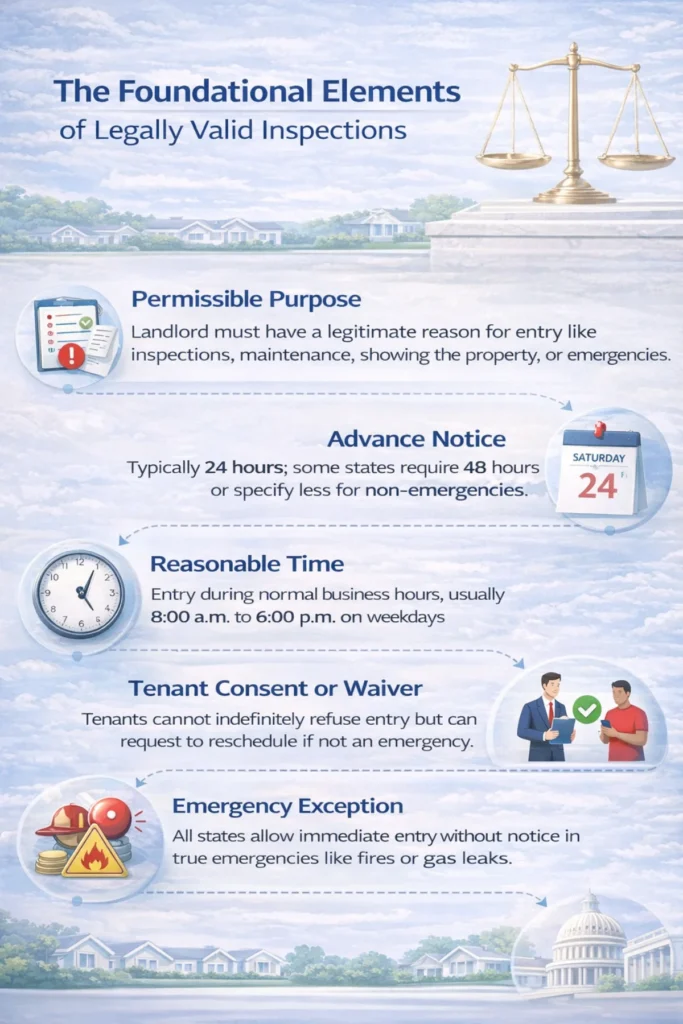
Permissible purpose. The landlord must have a legitimate reason for entry. Routine inspections, maintenance, showing the property to prospective tenants or buyers, and emergency access are universally accepted. Entering simply to check on a tenant without a stated purpose is generally not permissible.
Advance notice. Nearly every state requires some form of advance notice before a non-emergency entry. The standard is 24 hours in most states, with some requiring 48 hours and a small number allowing less in certain circumstances.
Reasonable time. Entry must occur at a reasonable time — generally understood as normal business hours, though some states define this specifically. Most states set this as between 8:00 a.m. and 6:00 p.m. on weekdays, though some extend to 8:00 p.m.
Tenant consent or waiver. In non-emergency situations, if proper notice is given and the tenant is present, they can consent to entry. If they’re not home, the landlord can generally still enter provided proper notice was given. Tenants cannot indefinitely refuse access for legitimate inspections, though they can request rescheduling.
Emergency exception. All states allow landlords to enter without notice in genuine emergencies — fire, flooding, gas leaks, or other situations where immediate entry is necessary to prevent harm or property damage.
Notice Requirements by State
The following represents the general notice requirements across all 50 states. These are drawn from state landlord-tenant statutes current as of 2026. Always verify with your state’s current law before acting.
| State | Notice Requirement | Details |
|---|---|---|
| Alabama | No specific statute | 24 hours is the generally accepted standard under common law. Written or oral notice permitted. |
| Alaska | 24 hours required | For non-emergency entry. Entry permitted between 8:00 a.m. and 10:00 p.m. Written notice required. |
| Arizona | 48 hours required | Minimum 2 days notice required for inspections. One of the more tenant-protective states on this requirement. |
| Arkansas | No specific statute | Reasonable notice, generally understood as 24 hours. Entry at reasonable times. |
| California | 24 hours written notice required | Notice must state the purpose, date, and approximate time. Oral notice permitted only in emergencies. |
| Colorado | Reasonable notice | No specific statutory period defined. 24 hours is the accepted standard. Entry at reasonable times. |
| Connecticut | Reasonable notice | Courts have generally interpreted this as 24 hours minimum. |
| Delaware | 48 hours written notice required | Minimum 2 days written notice required for inspections. |
| Florida | 12 hours required | One of the shorter notice requirement states. Notice can be oral or written. |
| Georgia | No specific statute | Reasonable notice is the standard, generally interpreted as 24 hours. |
| Hawaii | 48 hours written notice required | Entry between 8:00 a.m. and 6:00 p.m. |
| Idaho | No specific statutory notice period | Reasonable notice applies; 24 hours is the standard practice. |
| Illinois | No specific statewide statute | Local ordinances may impose specific requirements. 24 hours is the standard. |
| Indiana | Reasonable notice | No specific statutory period; 24 hours is the accepted standard. |
| Iowa | 24 hours required | Entry at reasonable times. Written or oral notice permitted. |
| Kansas | Reasonable notice | Generally interpreted as 24 hours. |
| Kentucky | 48 hours required | Minimum 2 days notice required. |
| Louisiana | No specific statutory notice period | Reasonable notice applies. |
| Maine | 24 hours required | Written notice required except in emergencies. |
| Maryland | No specific statewide statute | Reasonable notice is required; local ordinances may differ. |
| Massachusetts | No specific notice statute | Reasonable notice is required; 24 hours is standard practice. |
| Michigan | Reasonable notice | No specific statutory period. |
| Minnesota | Reasonable notice | Generally interpreted as 24 hours. |
| Mississippi | No specific notice statute | Reasonable notice applies. |
| Missouri | No specific notice statute | Reasonable notice applies. |
| Montana | 24 hours required | Minimum 24 hours notice required. |
| Nebraska | 24 hours required | Minimum 1 day notice required. |
| Nevada | 24 hours required | One of the more detailed state frameworks, with specific provisions for tenant harassment claims. |
| New Hampshire | 24 hours required | Minimum 24 hours notice required. |
| New Jersey | No specific notice statute | Reasonable notice is required; local ordinances may impose additional requirements. |
| New Mexico | 24 hours required | Minimum 24 hours notice required. |
| New York | No specific statewide statute | Reasonable notice is required. New York City has specific local rules. |
| North Carolina | No specific notice statute | Reasonable notice applies; 24 hours is standard. |
| North Dakota | 24 hours required | Minimum 24 hours notice required. |
| Ohio | 24 hours required | One of the clearer state statutes on this requirement. |
| Oklahoma | 24 hours required | Minimum 1 day notice required. |
| Oregon | 24 hours required | One of the more detailed and enforced state frameworks. |
| Pennsylvania | No specific notice statute | Reasonable notice applies. |
| Rhode Island | 48 hours required | Minimum 2 days notice required. |
| South Carolina | 24 hours required | Minimum 24 hours notice required. |
| South Dakota | 24 hours required | Minimum 24 hours notice required. |
| Tennessee | 24 hours required | Minimum 24 hours notice required. |
| Texas | No specific notice statute | Reasonable notice applies; 24 hours is standard. |
| Utah | 24 hours required | Minimum 24 hours notice required. |
| Vermont | 48 hours required | Minimum 48 hours notice required. |
| Virginia | 24 hours required | Minimum 24 hours notice required. |
| Washington | 48 hours required | One of the more detailed and tenant-protective landlord entry frameworks. |
| West Virginia | 24 hours required | Minimum 1 day notice required. |
| Wisconsin | 12 hours required | One of the shorter requirements, alongside Florida. |
| Wyoming | No specific notice statute | Reasonable notice applies. |
States with the Most Restrictive Entry Laws

A handful of states impose requirements beyond standard notice periods that property managers operating in those markets need to understand specifically.
California has the most codified rental inspection law in the country. Beyond the 24-hour written notice requirement, California law gives tenants the right to receive a pre-move-out inspection, requires landlords to provide an itemized statement of repairs needed after that inspection, and limits the circumstances under which a landlord can enter to very specific purposes.
California also requires that the notice state the exact purpose, approximate time, and date of the planned entry. Failure to comply with California’s entry statutes gives tenants a cause of action against the landlord.
Washington requires a minimum of 48 hours written notice and has detailed rules about what constitutes a valid reason for entry. Landlords in Washington must be particularly careful about frequency, entering more than once in a 30-day period for non-emergency inspections without tenant consent can be challenged.
Oregon similarly requires 24 hours notice but has detailed provisions around what happens when tenants request rescheduling and how landlords must respond. Oregon law also specifically addresses retaliatory entry — entering after a tenant has complained about habitability — as an unlawful practice.
New York City, while governed by state law on the fundamentals, layers on local tenant protection ordinances that go beyond state requirements in terms of tenant rights and remedies.
Hawaii’s 48-hour requirement and its restrictions on entry times (8:00 a.m. to 6:00 p.m.) are more restrictive than many states.
How Many Times Can a Landlord Inspect Per Year?
Most states do not set a specific limit on how many times a landlord can inspect a rental property in a given year, provided proper notice is given each time and the purpose is legitimate.
However, frequent inspections can create legal exposure in several ways. In states like California, Oregon, and Washington, a pattern of repeated inspections can be evidence of tenant harassment, which carries its own legal liability. Courts in multiple states have found that excessive entry — even with proper notice — constitutes a breach of the implied covenant of quiet enjoyment.
The practical standard most property management attorneys recommend is no more than one routine inspection every 3 months, with more frequent entry only when there is a documented maintenance reason or specific lease compliance concern.
If you’re conducting periodic inspections via a virtual inspection service, the documented nature of each inspection and the professional third-party involved generally reduces the risk of a harassment claim because the purpose and findings are clearly recorded.
What Happens If a Tenant Refuses an Inspection?
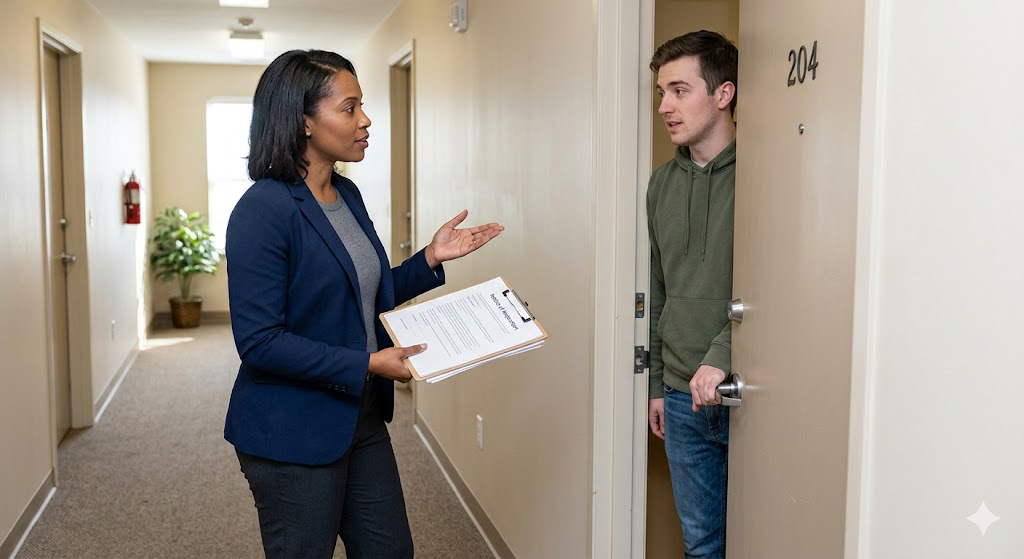
Tenants do not have an unlimited right to refuse access for a legitimate, properly noticed inspection. However, how you handle a refusal matters significantly.
If a tenant refuses access after proper notice has been given, the recommended steps are:
Document the refusal in writing immediately after it occurs, including the date, time, and how the refusal was communicated.
Send a written follow-up to the tenant citing the lease provision and applicable state law that establishes your right to entry for inspections. Give a second scheduled date with proper notice.
If refusal continues, consult your lease terms. If the lease includes a periodic inspection addendum specifying that refusal results in a fee (to cover the cost of scheduling an in-person inspection), enforce that provision.
As a last resort, depending on your state’s laws, repeated refusal of legitimate inspection requests can constitute a lease violation that may form grounds for a notice to cure. Consult an attorney before pursuing this route.
What you should not do: enter without the tenant’s knowledge after a refusal without following the legal process in your state. Self-help entry after a tenant has explicitly refused access is a significant legal risk in most jurisdictions.
The Lease Addendum That Protects You
The single most effective tool for preventing inspection access problems is a well-drafted periodic inspection lease addendum. This is a lease provision — or a separate addendum incorporated into the lease — that establishes:
The tenant’s obligation to participate in periodic inspections, including virtual inspections, as a condition of the lease.
The frequency of inspections (typically every 3 or 6 months).
The notice procedure you will follow (method and timing of notice).
What happens if the tenant refuses or fails to make the property accessible — typically a specific fee amount to cover the cost of an in-person inspection or re-inspection.
The acceptance of virtual inspections as a valid method of conducting the periodic inspection.
Resident Inspect provides a recommended periodic inspection lease addendum that property managers can download and incorporate into their lease agreements. Having this in place before the first inspection eliminates most access disputes before they start.
Free Download
Download the Free Inspection Lease Addendum
Help prevent access disputes before they start. Get Resident Inspect’s free inspection lease addendum to define inspection frequency, notice procedures, virtual inspection terms, and what happens if a resident refuses access.
Download the Free AddendumThe Emergency Entry Exception
Every state allows landlords to enter without notice in genuine emergencies. What constitutes an emergency is broadly consistent across states:
- Active fire, flooding, or gas leak
- Visible structural danger (roof collapse, foundation failure)
- A situation where waiting for notice would result in significant property damage or risk to life
What is not an emergency: a maintenance issue that’s been deferred, a noise complaint from a neighbor, a suspicion that the tenant has a pet. Emergency entry is reserved for situations where waiting for proper notice would create an unreasonable risk of harm.
If you enter under the emergency exception, document everything: why you believed it was an emergency, what you found when you entered, and what actions were taken. Notify the tenant as soon as possible after the emergency entry.
See Virtual Inspections in Action
Get a personalized demo to see how virtual inspections reduce labor, streamline compliance, and scale your property management operations.
Get Your DemoPrefer to talk? Call our team
Virtual Inspections and Legal Compliance
A common question from property managers implementing virtual inspections: do the same notice requirements apply?
Yes. The legal requirements for property inspections — notice period, permissible purpose, reasonable time — apply to virtual inspections the same way they apply to in-person inspections. What changes is the logistics. The notice you send, the timing of the inspection, and the documentation you produce all follow the same legal framework.
One practical advantage of virtual inspections for compliance purposes: the scheduling process creates a natural documentation trail. When your inspection service sends the tenant a scheduling request, confirmation, and reminders, those communications serve as evidence of proper notice.
The time-stamped inspection report documents the inspection date and findings. The paper trail that compliance requires is built into the process.
Frequently Asked Questions: Rental Property Inspection Laws
Do I have to give notice for a move-in inspection?
Move-in inspections are typically conducted at the time of key handover, when the tenant is present and participating. In this context, the tenant is consenting to and participating in the inspection, which eliminates the notice concern. However, if you need to access the property before the tenant’s lease start date to document condition, standard entry notice rules apply.
Can a tenant change the date of a scheduled inspection?
Yes, tenants can request to reschedule an inspection. Whether you’re legally required to accommodate that request depends on your state. In general, a reasonable one-time rescheduling request should be accommodated and documented. If a tenant is repeatedly requesting rescheduling in a pattern that’s preventing inspections from occurring, document each request and consult your lease terms.
What if I discover a lease violation during an inspection?
Document it thoroughly with photos and written notes. After the inspection, send the tenant a formal written notice of the violation citing the specific lease provision. Give a reasonable cure period as defined by your lease and state law. Follow your state’s process for lease violations — don’t take action before providing proper notice and opportunity to cure.
Can a landlord inspect a property before move-out?
Yes. A pre-move-out inspection — where the tenant is shown the areas of concern while they still have time to remedy them — is required by law in California and recommended in most states. It gives tenants the opportunity to address issues before their deposit is at risk and reduces disputes. Standard notice requirements apply.
Does a tenant have the right to be present during an inspection?
Most states do not require the tenant to be present during an inspection, as long as proper notice was given. Some states give tenants the right to request to be present. As a practical matter, tenant-present inspections produce better documentation and reduce disputes about what was or wasn’t found. Resident Inspect’s virtual inspection model requires tenant participation by design — which is one of the reasons the reports are so defensible.
Summary
Rental property inspection law is one of the areas where property managers most frequently create unintentional legal exposure — not because they’re acting in bad faith, but because the rules vary by state and the consequences of getting it wrong are real.
The framework is consistent: give proper written notice, have a legitimate purpose, enter at a reasonable time, and document everything. The specific details — how much notice, what format, what frequency is reasonable — vary by state and should be verified for every market you operate in.
The lease addendum is your best protection. Clear documentation of every inspection is your second best. A consistent, professional inspection program — whether conducted in person or through a virtual inspection service — is what makes both defensible.
Resident Inspect operates in all 50 states and handles inspection scheduling, tenant communication, and documentation in full compliance with state notice requirements. If you’re managing properties across multiple states and want a consistent inspection program that stays on the right side of the law everywhere you operate, get started at residentinspect.com.