Aaron Cooper
Founder & Chief Executive Officer, Resident Inspect
📍 Jacksonville, FL
Aaron Cooper is a seasoned property technology entrepreneur and inspection industry expert. As the Founder and CEO of Resident Inspect, he leads the development of intelligent inspection platforms that empower landlords, property managers, and investors to streamline digital inspections and ensure compliance.
At A Glance
If you’re still driving to every periodic inspection, you’re spending money you don’t need to spend and time you don’t have to give.
Virtual property inspections — conducted via live video call between a trained inspector and the tenant — have become one of the most practical efficiency gains available to property managers today. They eliminate windshield time, reduce no-shows, maintain professional documentation quality, and cost a fraction of what traditional in-person inspections run.
This guide covers everything: how virtual inspections work, what they can and can’t replace, how they compare to in-person and self-inspection alternatives, what to look for in a provider, and how to implement them across your portfolio.
Table of Contents
- What Is a Virtual Property Inspection?
- How Virtual Property Inspections Work (Step by Step)
- What Virtual Inspections Can Replace — and What They Can’t
- Virtual Inspections vs. In-Person Inspections: The Real Cost Comparison
- The Documentation Advantage
- Legal Defensibility of Virtual Inspections
- What to Look For in a Virtual Inspection Service
- How to Implement Virtual Inspections in Your Portfolio
- Frequently Asked Questions
- Summary
What Is a Virtual Property Inspection?
A virtual property inspection is a live, real-time inspection conducted over video call. A trained property inspector connects with the tenant via their smartphone camera and guides them through the property — directing what to show, when to zoom in, and what areas require closer examination.
Unlike a tenant self-inspection (where the tenant records a video on their own and submits it), a virtual inspection is inspector-led. The tenant is a participant, not the one in control. The inspector determines what gets documented, asks follow-up questions, and captures high-resolution photos in real time.
The result is a comprehensive, time-stamped inspection report — typically with more photos and more consistent documentation than most in-person inspections produce.
Key Distinction
Inspector-Led vs. Tenant-Led: Why Control Matters
Not all “virtual” inspections are created equal. The difference between a guided inspection and a tenant-submitted video directly impacts documentation quality, consistency, and liability.
Inspector-Led Virtual Inspection
Structured, guided in real time, and controlled by a trained professional. Every key area is documented, and nothing is left to interpretation.
Tenant Self-Inspection
Unstructured and dependent on the tenant. Key details are often missed, angles vary, and documentation can be inconsistent or incomplete.
The value of a virtual inspection is not just the format — it is the professional control of the process. That control is what creates reliable, defensible documentation.
Bottom Line:
Virtual does not mean hands-off — the most effective inspections are still led, directed, and verified by a professional.
How Virtual Property Inspections Work (Step by Step)
The process varies slightly by provider, but a professional virtual inspection service follows a structure like this:
Step 1: Inspection is requested. The property manager submits the property for inspection — typically through their property management software or a direct request to the service.
Step 2: Tenant scheduling. The inspection service contacts the tenant directly, coordinates scheduling around the tenant’s availability, and confirms the appointment. Reminders are sent via email, text, and phone.
Step 3: Pre-inspection preparation. The tenant receives clear instructions on what to expect — what areas they’ll walk through, what to have accessible, and what the process looks like. This dramatically reduces incomplete or rushed inspections.
Step 4: The live inspection. At the scheduled time, the inspector connects with the tenant via video call. The inspector guides the tenant room by room, directs them to zoom in on specific items, open cabinets, test appliances, and show areas of concern. High-resolution photos are captured throughout.
Step 5: Report generation. Immediately after the inspection, the inspector reviews the footage and documentation and generates a comprehensive, branded report. The report is sent directly to the property manager — typically within 24 hours.
Step 6: Follow-up. If issues are identified, the property manager receives recommendations for in-person follow-up where needed (maintenance concerns, significant damage, etc.).
The entire inspection typically takes 20–45 minutes depending on property size, compared to 1–3 hours for a traditional in-person inspection when you factor in travel.

What Virtual Property Inspections Can Replace — and What They Can’t
Virtual inspections are not a universal replacement for every in-person visit. Understanding where they work and where they don’t is important for building a reliable inspection program. It also helps to clear up some common myths about virtual rental inspections before you start.
What virtual inspections handle well:
Periodic routine inspections are the strongest use case. The goal of a periodic inspection is lease compliance verification, safety checks, and maintenance identification — all of which a trained inspector can document thoroughly via live video. The majority of property management companies using virtual inspections deploy them almost exclusively for periodic walkthroughs.
Move-out pre-inspections work well virtually when the goal is a general condition assessment before the tenant vacates. A live walk-through gives the property manager early visibility into what to expect at final turnover.
Initial condition documentation for remote properties is an area where virtual inspections add significant value. If you’re acquiring a property in a market you don’t operate in physically, a virtual inspection can establish a baseline condition record before committing to management.
Where in-person visits remain necessary:
Move-in inspections at the start of a tenancy are best conducted in person when possible. This is the single most legally significant inspection in the tenancy — it’s the document you’ll rely on if a security deposit dispute goes to court, and a face-to-face walkthrough with the tenant signing off carries more weight than a video record alone.
Active maintenance and repair follow-up requires physical presence. If a virtual inspection identifies a potential roof issue, plumbing leak, or HVAC problem, an in-person visit for the actual repair and assessment is still necessary.
Complex damage assessment where cost estimation is needed — flooring replacement, countertop damage, structural concerns — is better handled in person.
The practical approach most professional property managers use: virtual inspections for periodic walkthroughs, in-person for move-in, in-person for move-out, and in-person for any maintenance requiring hands-on assessment. Building that mix is easier when your rental property inspection services cover the full range rather than a single inspection type.
Virtual Property Inspections vs. In-Person Inspections: The Real Cost Comparison
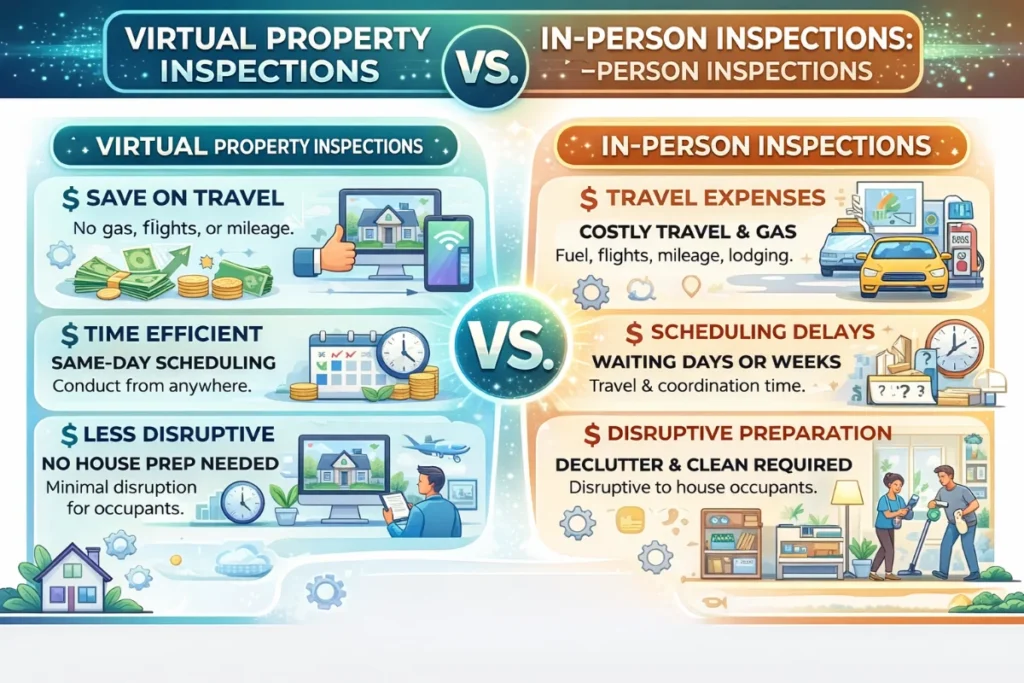
The economics of in-person inspections are worse than most property managers realize until they do the math.
The average in-person inspection, when you factor in drive time, the inspection itself, report completion, and any follow-up coordination, costs property managers upwards of $75 per property. For managers carrying 100 properties and conducting periodic inspections every 6 months, that’s $15,000 per year in inspection overhead — and that assumes no no-shows, no traffic, and no scheduling back-and-forth.
Third-party in-person inspection services typically charge $100–$150 per visit, which doesn’t solve the cost problem — it just shifts the labor.
Virtual inspections through a professional service typically run 60% less than traditional methods. At scale, the savings compound quickly. A 200-property portfolio inspected every 6 months generates 400 periodic inspections per year. The difference between $125 per in-person visit and $50 per virtual inspection is $30,000 annually — enough to hire a part-time staff member or fund a significant marketing budget. Rates vary by portfolio size and inspection volume, so see current pricing to run the math against your own numbers.
Beyond direct cost, virtual inspections eliminate the hidden costs: no-show rescheduling, mileage, vehicle wear, and the opportunity cost of a property manager’s time spent in traffic rather than managing owner relationships or growing the portfolio.
Operational Insight
Where Inspection Time Actually Goes — And Why It Matters
Most inspection costs are not tied to the inspection itself — they are tied to everything surrounding it. Travel, coordination, reporting, and follow-up quietly consume hours that could otherwise be spent on revenue-generating activity.
A single inspection often represents 60–90 minutes of total workload when accounting for drive time, documentation, and communication — not just the walkthrough itself.
Multiply that across an entire portfolio, and inspections become one of the most time-intensive operational tasks — especially as you scale past 100+ doors.
Virtual inspection models compress that workload significantly, removing travel and reducing coordination — allowing teams to handle more inspections without adding headcount.
The real advantage is not just cost reduction — it is time reallocation. Every hour saved can be redirected toward leasing, owner communication, or portfolio growth.
Bottom Line:
As portfolios grow, efficiency becomes more valuable than effort. The teams that scale the fastest are the ones that remove operational drag — not just reduce expenses.
Virtual Property Inspections vs. Tenant Self-Inspections: Why the Distinction Matters
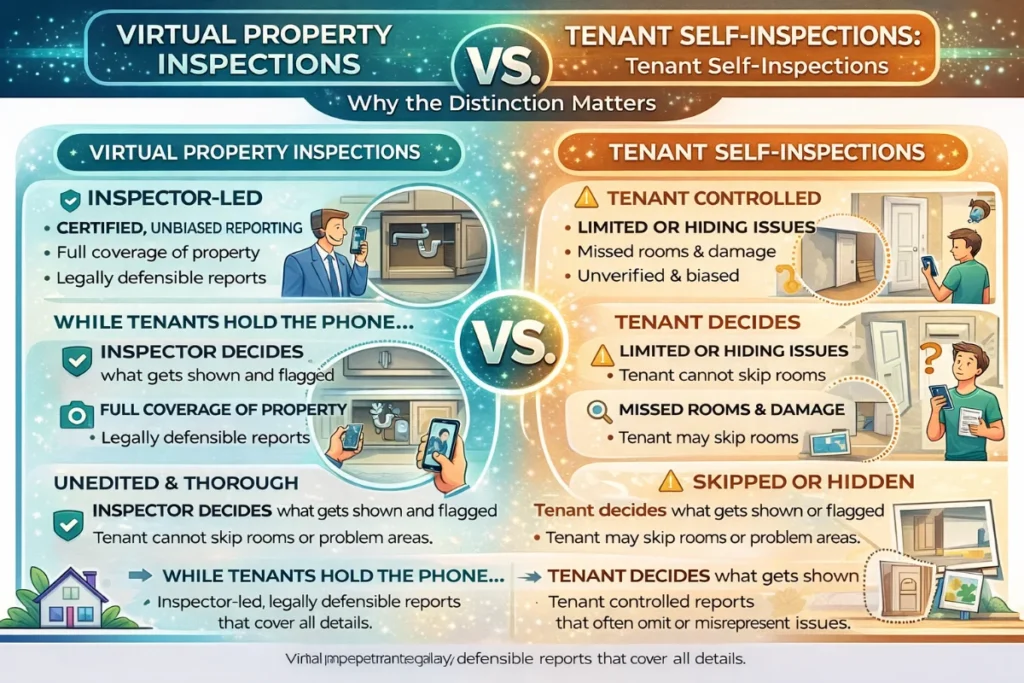
When virtual inspections are mentioned, some property managers confuse them with tenant self-inspections — where the tenant records their own video or fills out a form and submits it independently. These are not the same thing, and the difference matters significantly.
Tenant self-inspections place the tenant in full control of what gets documented. In practice, this means issues get missed — sometimes accidentally, sometimes deliberately. Unauthorized pets, wall damage, missing fixtures, and entire rooms (attics, garages, crawl spaces) are routinely absent from tenant-submitted reports. Photos are sometimes edited. Damage is photographed from unflattering angles or not at all.
A professional virtual inspection is inspector-led. The tenant holds the phone. The inspector decides what gets shown, what gets photographed, and what gets flagged. The tenant cannot skip rooms, avoid problem areas, or control the documentation. The inspector asks them to open the cabinet under the sink. The inspector asks them to run the dishwasher. The inspector asks them to zoom in on the wall behind the door.
This distinction is the reason virtual inspections produce legally defensible reports while tenant self-inspections often don’t. For the full breakdown, see our comparison of virtual inspections vs. tenant self-inspections.
The Documentation Advantage of Virtual Property Inspections
One of the most underappreciated benefits of professional virtual inspections is documentation consistency.
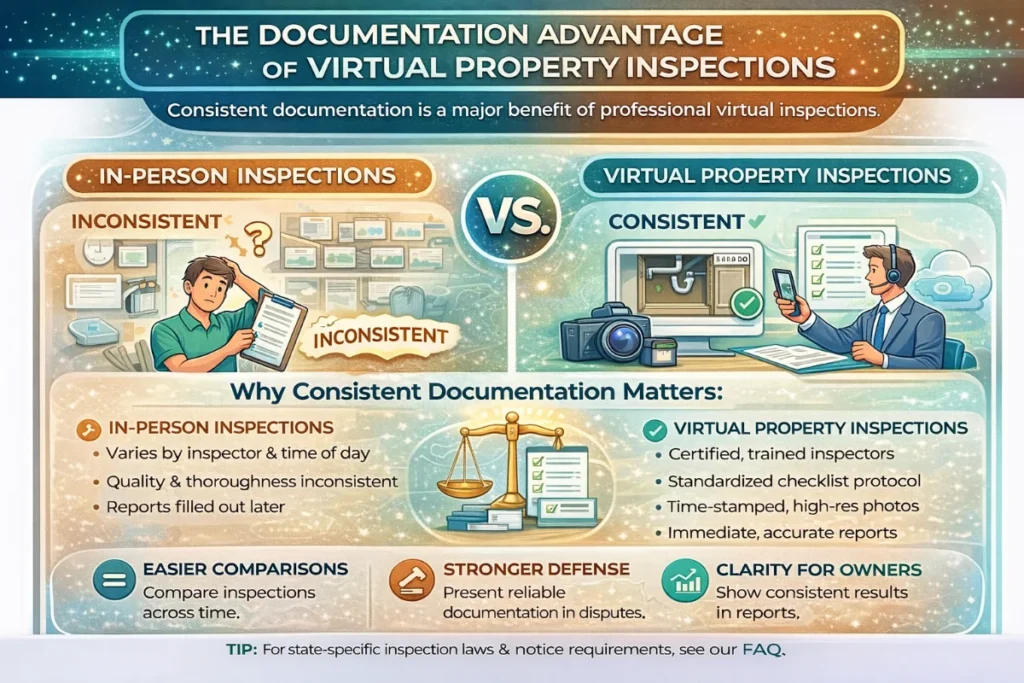
In-person inspections vary enormously in quality depending on who conducts them, how tired they are, how rushed the day is, and whether they’re juggling other tasks. A property manager conducting 8 inspections in a day will document the 8th inspection very differently from the first.
Professional virtual inspectors follow a consistent checklist protocol on every inspection, every time. The same areas are covered. The same photos are taken. The same report format is produced. That consistency matters when you’re comparing inspection reports across time, presenting documentation in a dispute, or reporting to an owner.
High-resolution, time-stamped photos captured during the inspection are part of the record. The live video session itself can serve as additional documentation. The report is completed during or immediately after the inspection, eliminating the memory gaps and documentation shortcuts that happen when reports are filled in hours or days later.
Legal Defensibility of Virtual Property Inspections
A common question from property managers evaluating virtual inspections: will this hold up?
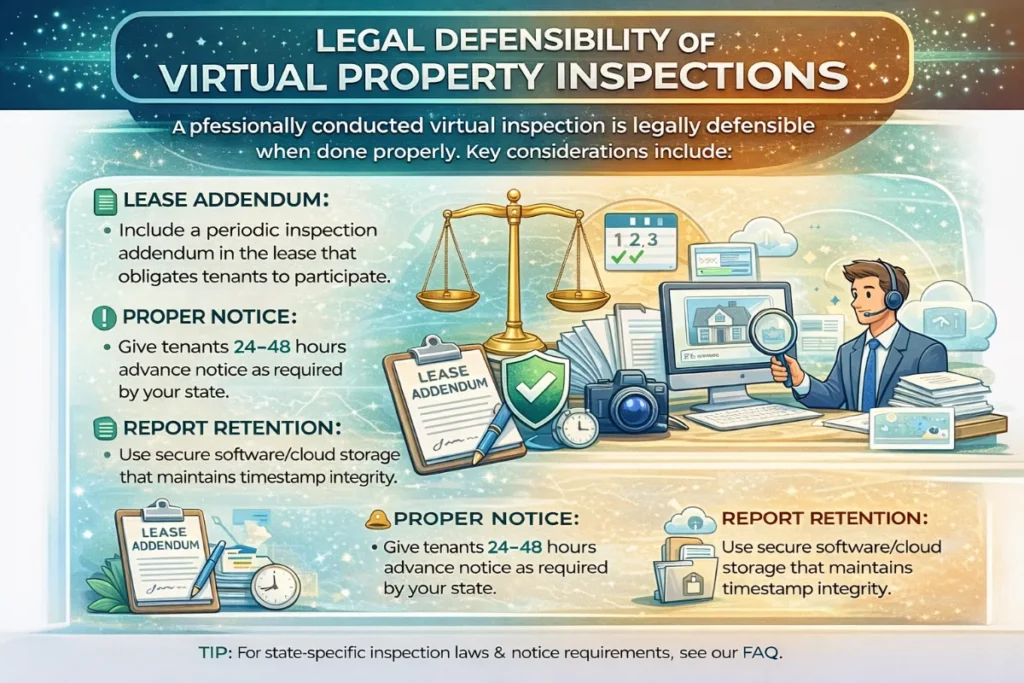
The short answer is yes — in most jurisdictions, a professionally conducted virtual inspection with a trained third-party inspector, documented with time-stamped photos and a formal report, is legally defensible. In many cases it’s more defensible than an in-person inspection conducted by the property manager themselves, because the third-party inspector has no financial stake in the outcome.
A few considerations to have in order:
Lease addendum. Your lease should include a periodic inspection addendum stating the tenant’s obligation to participate in inspections, including virtual ones, and specifying what happens if they refuse. Resident Inspect provides a recommended lease addendum for this purpose.
Proper notice. Virtual inspections require the same advance notice as in-person inspections — typically 24–48 hours, depending on your state. Notice requirements don’t change because the inspection is conducted remotely.
Report retention. Store inspection reports — including photos — in a system that preserves their timestamp integrity. Reports stored in your property management software or a secure cloud system are far more defensible than PDFs emailed to a folder.
For state-specific inspection laws and notice requirements, see our FAQ.
Legal Perspective
Built for Documentation That Holds Up
In disputes, the strength of an inspection is not based on how it was conducted — it is based on how well it was documented. Courts and mediators rely on clear, consistent, and verifiable evidence.
Virtual inspections produce time-stamped, standardized reports with consistent photo documentation — reducing gaps that often weaken traditional inspection records.
Consistency across every inspection
Because inspections follow a guided workflow, each report captures the same areas, angles, and details — creating uniform records across your entire portfolio.
Clear audit trail
Live inspections create a verifiable timeline of events, including when the inspection occurred and what was documented — strengthening your position in any claim or dispute.
Reduced subjectivity
Real-time guidance minimizes missed areas and inconsistent reporting, helping ensure that documentation reflects the true condition of the property.
Bottom Line:
The most defensible inspection is the one that is consistent, complete, and verifiable — and that is where virtual inspections excel.
What to Look For in a Virtual Property Inspection Service
Not all virtual inspection providers are equal. Here’s what separates a professional service from a basic video call solution:
Inspector training and accountability. The inspection is only as good as the inspector conducting it. Look for a service that employs trained inspectors who follow a defined protocol — not a platform that simply connects you to an unvetted contractor.
Live, real-time inspection. The gold standard is a live video call where the inspector guides the tenant in real time. Asynchronous video submissions (where the tenant records and submits on their own) don’t provide the oversight that makes virtual inspections defensible.
Customizable templates. Your properties are not all the same. A 1-bedroom condo has different inspection requirements than a 4-bedroom single-family home. Look for a service that allows you to define inspection priorities and customize what gets documented.
Branded reports. If you’re providing inspection reports to owners, they should look like they came from your company — not a third-party vendor. Fully branded reports maintain your professional image.
Property management software integration. The inspection workflow should connect to what you’re already using. Services that integrate with AppFolio, Propertyware, Buildium, Rentvine, and Rent Manager eliminate manual report entry and keep your inspection history where it belongs.
Tenant scheduling and communication. The service should handle all tenant outreach, scheduling, and reminders on your behalf. If you’re still coordinating inspection logistics yourself, you’re not getting the efficiency benefit.
Nationwide coverage. If your portfolio spans multiple markets or you manage properties remotely, your inspection service needs to operate everywhere you do ours is available nationwide, in all 50 states.
Our virtual inspection software was built specifically around these requirements by a property manager who spent over a decade frustrated by everything the traditional inspection model gets wrong.
How to Implement Virtual Property Inspections in Your Portfolio
Execution Advantage
Why Virtual Inspections Are Easier to Adopt Than You Think
The biggest misconception about virtual inspections is that they require new systems, new training, or a major operational shift. In reality, most teams integrate them seamlessly into their existing workflows with minimal disruption.
No overhaul required
Virtual inspections layer into your current process — not replace it. Leasing, maintenance coordination, and owner communication remain unchanged.
Faster team adoption
Most property management teams are fully comfortable with the workflow after just a handful of inspections, especially when reports and documentation are standardized.
Immediate operational relief
Removing travel and scheduling friction frees up bandwidth almost instantly — allowing managers to focus on higher-value activities without waiting months to see impact.
Key Takeaway:
The transition is not about changing how you manage properties — it is about removing inefficiencies from a process you are already doing.
Transitioning to virtual periodic inspections doesn’t require a complete overhaul of your inspection program. Most property management companies implement virtual inspections in phases:
Phase 1: Start with new leases. For all new tenancies, include the periodic inspection lease addendum and conduct your first periodic inspection virtually at the 3-month mark. Use this phase to get comfortable with the report format and workflow.
Phase 2: Roll out to low-complexity properties. Single-family homes and straightforward multi-family units are the easiest to inspect virtually. Build your confidence with these before moving to larger or more complex properties.
Phase 3: Convert your full periodic inspection calendar. Once you’ve completed 20–30 virtual inspections and have a feel for the workflow, convert your entire periodic inspection schedule to virtual. Retain in-person visits only for move-in, move-out, and active maintenance.
Phase 4: Systemize. Work with your virtual inspection provider to set up automated inspection triggers through your property management software so inspections are requested on schedule without manual intervention.
See Virtual Inspections in Action
Get a personalized demo to discover how virtual inspections can save time, cut labor hours, and boost property management efficiency.
Get Your DemoPrefer to talk? Call our team.
Frequently Asked Questions
What do tenants think about virtual inspections?
Most tenants respond positively to virtual inspections once they understand the process. The flexibility of scheduling — including evenings and weekends — removes one of the biggest friction points. Tenants don’t have to take time off work or rearrange their day for a two-hour arrival window. The average virtual inspection takes 20–30 minutes and can be done whenever is convenient for the tenant.
Does a tenant have to participate in a virtual inspection?
Whether a tenant is legally required to participate depends on your lease terms and local law. A periodic inspection lease addendum that requires participation — and specifies a fee for refusal — is the strongest way to ensure compliance. In practice, when tenants understand the process and have flexible scheduling options, refusals are rare.
Can virtual inspections be used for move-in documentation?
Yes, though most professional property managers still prefer in-person move-in inspections because of the legal significance of the move-in report. Virtual move-in inspections are a viable option for remote properties where in-person access isn’t practical, provided both the property manager and tenant review and sign the report.
What happens if there’s no cell service or the internet connection is poor during the inspection?
A reliable cell signal is sufficient for most virtual inspections — full broadband internet is not required. If connectivity is genuinely unavailable (very rural properties, certain basement units), a hybrid approach is used: virtual inspection with the tenant for accessible areas, plus an in-person follow-up for areas that couldn’t be adequately documented.
How are virtual inspection reports delivered?
Professional virtual inspection services deliver a complete, branded report directly to the property manager — typically within 24 hours of the inspection. Reports include time-stamped photos, condition notes by area, and any flagged maintenance items or lease compliance concerns.
Are virtual inspections legal everywhere in the United States?
Virtual inspections conducted with proper notice and tenant participation are legal in all 50 states. The legal requirements for inspections — notice period, frequency limits, permissible purposes — apply equally to virtual and in-person inspections. What changes is the logistics, not the legal framework.
Summary
Virtual property inspections represent one of the most impactful operational changes available to property management companies today. They reduce inspection costs by up to 60%, eliminate windshield time, improve documentation consistency, and produce professionally defensible reports — without sacrificing inspection quality.
For periodic inspections specifically, the case for virtual is difficult to argue against. The cost savings are real. The documentation is often better. The tenant experience is smoother. And the time saved compounds across every inspection in your portfolio.
The property managers who will own their markets over the next decade are the ones building scalable, systemized operations today. Virtual inspections are one of the clearest ways to do that.
Resident Inspect handles your periodic inspections via live video — tenant scheduling, reminders, the full walkthrough, and a branded report delivered directly to you. No travel. No no-shows. Available in all 50 states. Get started at residentinspect.com.