
Determining Your Rental Property Inspection Cost in 2026

Aaron Cooper
Founder & Chief Executive Officer, Resident Inspect
📍 Jacksonville, FL
Aaron Cooper is a seasoned property technology entrepreneur and inspection industry expert. As the Founder and CEO of Resident Inspect, he leads the development of intelligent inspection platforms that empower landlords, property managers, and investors to streamline digital inspections and ensure compliance.
In This Guide
- How Much Does a Rental Property Inspection Cost? In-House vs. Third-Party vs. Virtual
- Why Inspection Costs Are Harder to Calculate Than They Look
- In-House Inspection Cost Breakdown
- Third-Party In-Person Inspection Service Cost
- Virtual Inspection Service Cost
- The Full Cost Comparison at Scale
- What You Get for the Cost Difference
- When In-House Inspections Still Make Sense
- How to Calculate Your Current Inspection Cost
- Frequently Asked Questions
- Summary
In-House vs. Third-Party vs. Virtual Inspections
In-House Inspections
Inspections performed by your internal team — typically property managers or maintenance staff. While this gives you full control, it also carries the highest hidden cost due to labor, scheduling, drive time, and opportunity cost. Every inspection pulls your team away from revenue-generating activities.
Third-Party In-Person Inspections
Inspections outsourced to a vendor who physically visits the property. This removes the burden from your team but comes at a higher per-inspection cost. Scheduling constraints, availability, and geographic coverage can also impact efficiency and turnaround time.
Virtual Inspections
Inspector-led inspections conducted over a live video call, where the tenant walks the property while a trained professional directs the process. This eliminates travel time, reduces cost per inspection, and increases scheduling flexibility — while still delivering consistent, time-stamped documentation and reporting.
Key takeaway: The difference is not just cost — it is how efficiently your team operates. The more time your team spends driving and inspecting, the less time they spend leasing, managing, and growing your portfolio.
How Much Does a Rental Property Inspection Cost? In-House vs. Third-Party vs. Virtual
Most property managers underestimate what their inspections actually cost. Not because they’re careless with money — but because the real cost of an in-house inspection is spread across categories that don’t show up together on any single line item.
When you add it up honestly — labor, mileage, no-shows, rescheduling, report time, and the opportunity cost of pulling a skilled property manager off revenue-generating work for half a day — the number is consistently higher than most operators expect.
This post breaks down what rental property inspections actually cost across three delivery models: in-house inspections conducted by your own staff, third-party in-person inspection services, and virtual inspection services. The goal is to give you a clear-eyed picture of the numbers so you can make the right decision for your portfolio.
Why Rental Property Inspection Costs Are Harder to Calculate Than They Look
A property manager who drives to a property, spends 45 minutes walking through it, takes photos, and writes a report doesn’t hand you an invoice at the end. That makes it easy to mentally classify the inspection as “free” — it was just part of the job.
But it wasn’t free. The labor, the vehicle, the fuel, the time blocked on the calendar, and every other inspection that didn’t get done while that one was happening all have real costs. The only question is whether you’re measuring them.
This matters especially at scale. A property manager overseeing 100 properties who conducts periodic inspections twice a year is running 200 inspections annually. At a realistic all-in cost of $75 to $100 per in-house inspection, that’s $15,000 to $20,000 per year in inspection overhead — most of which is invisible on the books.
In-House Rental Property Inspection Cost Breakdown
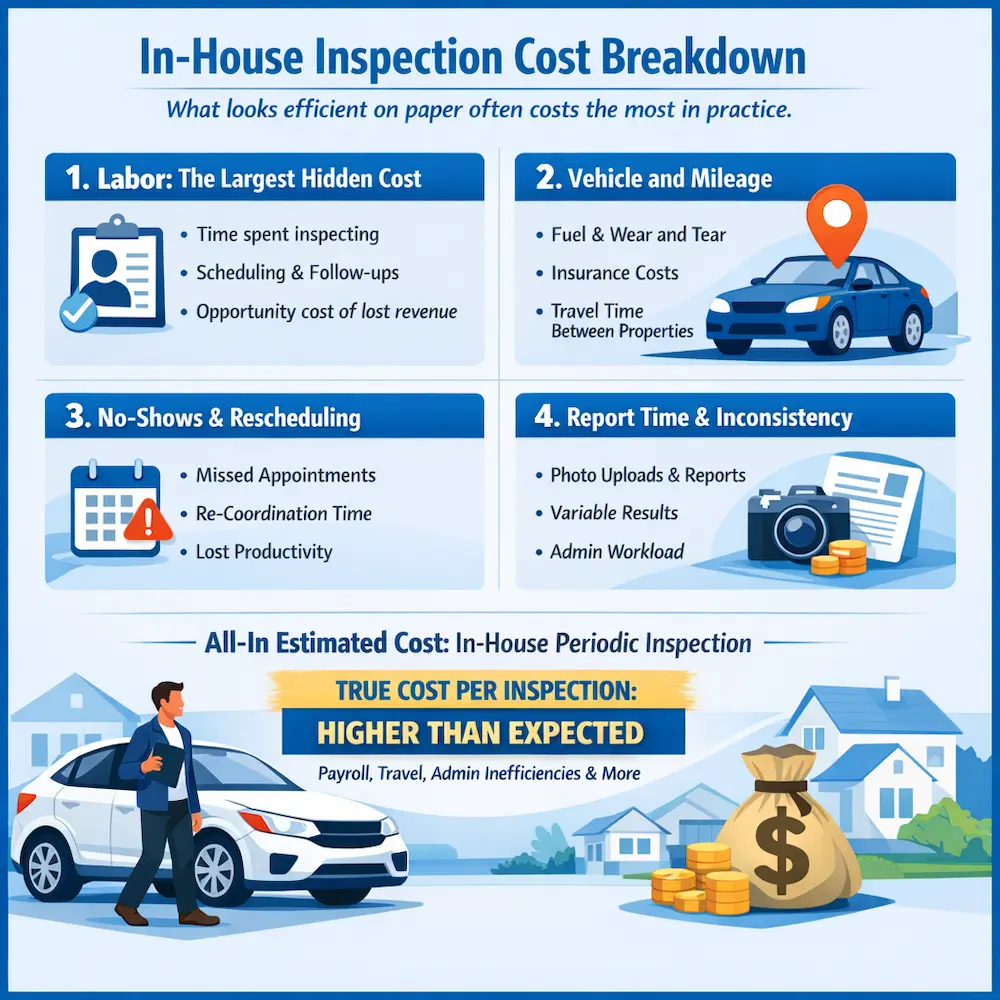
In-house inspections are the default model for most smaller and mid-size property management companies. A staff member — often the property manager themselves — handles the scheduling, drives to the property, conducts the inspection, and generates the report.
Here is what that actually costs, broken down:
Labor: The Largest Hidden Cost
A property manager earning $50,000 per year costs roughly $24 per hour in direct compensation before benefits, payroll taxes, or overhead. A senior property manager or operations lead earning $65,000 costs approximately $31 per hour.
A single in-house periodic inspection typically consumes:
- 15–30 minutes of scheduling and pre-inspection coordination
- 20–45 minutes of drive time each way (varies significantly by market and property density)
- 30–60 minutes for the inspection itself
- 20–40 minutes for report completion and photo organization
Total time per inspection: 1.5 to 3.5 hours, with 2 hours being a reasonable average for a well-run operation in a mid-density market.
At $24–$31 per hour, the labor cost alone is $48 to $108 per inspection — before a single other expense is added.
Vehicle and Mileage
The IRS standard mileage rate for 2025 is $0.70 per mile. A round trip of 20 miles (not unusual in suburban or rural markets) adds $14 per inspection. For property managers averaging 30-mile round trips across a mixed portfolio, mileage alone adds $21 per inspection.
Annual vehicle wear, insurance, and depreciation allocated to inspection-related mileage add meaningful additional cost that most operators don’t track.
No-Shows and Rescheduling
Industry data consistently shows that tenant no-show rates for in-person inspections run between 15% and 25% for portfolios without a formal tenant communication and reminder process. A 20% no-show rate means that for every 5 inspections scheduled, 1 results in a wasted trip.
If the average in-house inspection costs $75 in time and mileage, a 20% no-show rate effectively adds $15 to the average cost of every inspection that does get completed — because the cost of the failed trip gets distributed across the successful ones.
Report Time and Quality Inconsistency
Reports completed in the field or immediately after an inspection are generally more thorough than reports filled in at the end of a long inspection day. But the reality for most in-house inspection programs is that report completion is deferred — photos are organized later, notes are filled in from memory, and the quality of documentation degrades as the volume of inspections per day increases.
This isn’t a criticism of property managers. It’s an acknowledgment that in-house inspections don’t have a dedicated documentation workflow — and the cost shows up later, when a security deposit dispute has weak documentation supporting it.
All-In Estimated Cost: In-House Periodic Inspection
Conservative estimate (urban market, dense portfolio, experienced staff): $55–$75 per inspection Realistic estimate (suburban market, average driving, 2 staff hours): $75–$100 per inspection High estimate (rural or dispersed portfolio, longer drives, frequent no-shows): $100–$150+ per inspection
Third-Party In-Person Rental Property Inspection Service Cost
Some property management companies outsource inspections to third-party in-person inspection services — typically contractors or inspection firms that conduct walkthroughs on their behalf. This is usually to reduce liability and stay compliant with state law.

The benefit is that the property manager’s time is freed from the inspection itself. The drawbacks are cost and quality control.
Typical third-party in-person inspection rates in 2025 range from $100 to $175 per inspection for a standard single-family home. Multi-family units and larger properties command higher rates. Some markets with limited inspection service availability push rates even higher.
These fees typically cover the inspection and a basic report. Fully branded reports, customized checklists, and integration with property management software are often add-on services or not available at all.
At $125 per inspection as a midpoint estimate, a 100-property portfolio conducting semi-annual periodic inspections spends $25,000 per year on inspection services — plus the coordination overhead that still falls on the property manager’s plate.
Third-party in-person inspection services solve the time problem. They don’t solve the cost problem.
Virtual Inspection Service Cost
Professional virtual inspection services — where a trained inspector conducts the walkthrough via live video call with the tenant — represent a fundamentally different cost structure.
See Our Complete Virtual Property Inspection Guide
Because there is no travel involved and inspectors can conduct significantly more inspections per day than in-person inspectors, the economics of virtual inspection services are dramatically more favorable.
Resident Inspect’s pricing is transparent and significantly below both in-house and third-party in-person alternatives. Property managers using virtual inspection services typically spend 60% less per inspection compared to in-house costs and 50–60% less compared to third-party in-person rates.
At a representative rate of $45–$65 per virtual inspection:
A 100-property portfolio conducting semi-annual inspections: $9,000–$13,000 per year Compared to in-house at $75 per inspection: $15,000 per year — a savings of $2,000–$6,000 Compared to third-party in-person at $125 per inspection: $25,000 per year — a savings of $12,000–$16,000
At 200 properties, those savings double. At 300 properties, they become significant enough to fund additional staff, marketing, or owner-facing services.
Beyond the direct per-inspection savings, virtual inspections eliminate the indirect costs that in-house inspections carry: no mileage, no vehicle wear, no no-show wasted trips, and no report-quality degradation from inspection fatigue.
See Virtual Inspections in Action
Get a personalized demo to discover how virtual inspections can save time, cut labor hours, and boost property management efficiency.
Get Your DemoPrefer to talk? Call our team.
The Full Cost Comparison at Scale
Here’s what the numbers look like across three portfolio sizes at semi-annual periodic inspection frequency:
50-Property Portfolio (100 inspections/year)
In-house at $80/inspection: $8,000/year Third-party in-person at $125/inspection: $12,500/year Virtual at $55/inspection: $5,500/year Annual savings vs. in-house: $2,500 Annual savings vs. third-party: $7,000
100-Property Portfolio (200 inspections/year)
In-house at $80/inspection: $16,000/year Third-party in-person at $125/inspection: $25,000/year Virtual at $55/inspection: $11,000/year Annual savings vs. in-house: $5,000 Annual savings vs. third-party: $14,000
250-Property Portfolio (500 inspections/year)
In-house at $80/inspection: $40,000/year Third-party in-person at $125/inspection: $62,500/year Virtual at $55/inspection: $27,500/year Annual savings vs. in-house: $12,500 Annual savings vs. third-party: $35,000
At 250 properties, the difference between virtual and third-party in-person inspection services is $35,000 per year. That is a full-time staff salary. It is a significant marketing budget. It is the difference between a company that is operationally constrained and one that has room to grow.
The Full Cost Comparison at Scale
Here’s what the numbers look like across three portfolio sizes at semi-annual periodic inspection frequency:
At 250 properties, the difference between virtual and third-party in-person inspection services is $35,000 per year.
That is a full-time staff salary. It is a significant marketing budget. It is the difference between a company that is operationally constrained and one that has room to grow.
What You Get for the Cost Difference
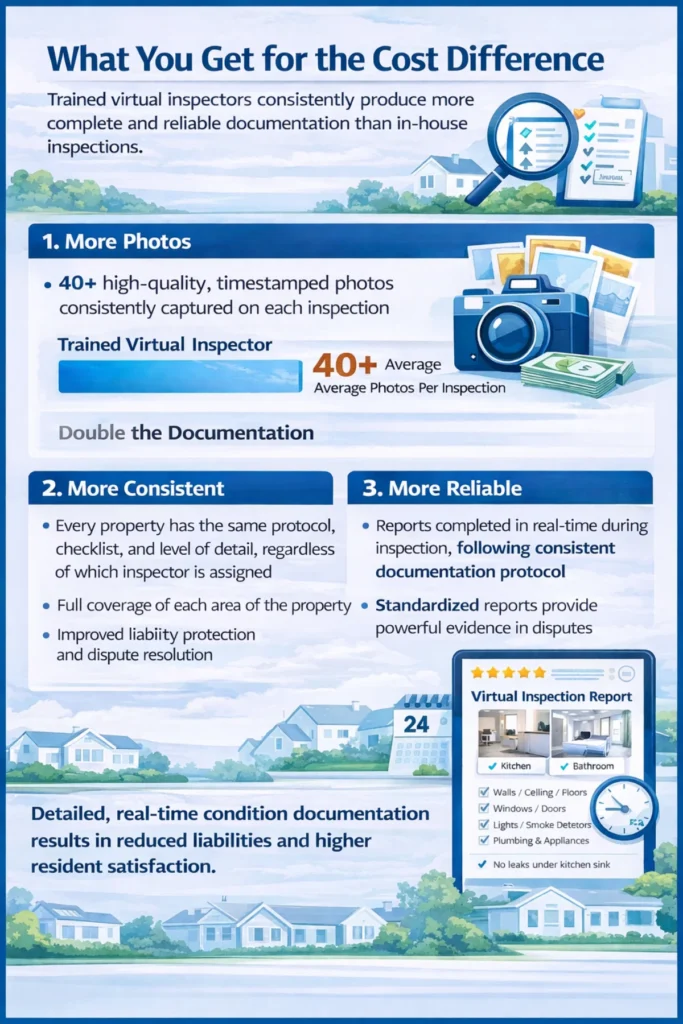
The cost comparison above would be straightforward if virtual inspections produced lower-quality documentation than in-person alternatives. But that isn’t what the data shows.
Professional virtual inspections conducted by a trained, third-party inspector with a defined protocol consistently produce more photos, more consistent documentation, and more reliable coverage than in-house inspections conducted by property managers juggling a full schedule. The inspector’s only job during the inspection is the inspection.
Reports are completed during or immediately after the inspection — not at the end of an 8-inspection day. Photos are captured in real time with a consistent standard. The same areas are covered on every property. The same checklist is followed every time.
This documentation consistency has direct financial value beyond the per-inspection cost. When a security deposit dispute arises, and you have a detailed, timestamped virtual inspection report with 40 photos — compared to a sparse in-house report completed from memory — the quality of documentation is not equivalent, and the outcome of the dispute often reflects that.
When In-House Inspections Still Make Sense
In-house inspections are not always the wrong choice. There are situations where keeping inspections internal is the right call:
Move-in inspections for high-value properties where owner relationships require direct staff involvement. Some owners expect their property manager to personally conduct the move-in walkthrough, and that relationship value is real.
Move-out inspections where security deposit deductions are anticipated. When you expect a contentious move-out, having your own staff conduct the inspection — with the tenant present where possible — gives you direct control over the documentation process.
Small portfolios where the volume of inspections doesn’t justify a formal third-party system. If you manage 15 properties, the operational overhead of setting up a virtual inspection workflow may not be worth it compared to doing inspections yourself.
Properties with documented access or compliance history that requires a more hands-on approach.
The practical model most property management companies land on: virtual inspections for periodic walkthroughs across the standard portfolio, in-house or in-person for move-in, move-out, and high-complexity situations.
Rental Property Inspection Cost Calculator
Property Inspection Cost Calculator
Find out what your inspections are actually costing you per year.
Your Results
Results are estimates. Actual costs may vary based on your specific operation.
How to Calculate Your Current Rental Property Inspection Cost
If you want to know what your inspections are actually costing before making any changes, here is a straightforward calculation:
Step 1: Count your total inspections per year. Include all periodic inspections, move-in inspections, and move-out inspections.
Step 2: Estimate average time per inspection. Include scheduling time, drive time both ways, the inspection itself, and report completion. Be honest — most property managers underestimate this.
Step 3: Multiply by your effective hourly labor cost. Use total compensation including benefits and payroll taxes, divided by annual hours worked. Don’t use base salary alone.
Step 4: Add mileage cost. Multiply average round-trip miles per inspection by the IRS mileage rate ($0.70 for 2025).
Step 5: Add a no-show cost factor. If your no-show rate is 20%, multiply your per-inspection cost by 1.25 to account for the wasted trips that are built into your average.
Step 6: Add any direct costs. Inspection software subscriptions, report tools, or administrative support time.
Total annual inspection cost divided by total inspections completed equals your true cost per inspection. For most property management companies running this calculation for the first time, the result is higher than expected.
How to Calculate Your Current Inspection Cost
If you want to know what your inspections are actually costing before making any changes, here is a straightforward calculation:
Include all periodic inspections, move-in inspections, and move-out inspections.
Include scheduling time, drive time both ways, the inspection itself, and report completion. Be honest — most property managers underestimate this.
Use total compensation including benefits and payroll taxes, divided by annual hours worked. Don’t use base salary alone.
Multiply average round-trip miles per inspection by the IRS mileage rate ($0.70 for 2025).
If your no-show rate is 20%, multiply your per-inspection cost by 1.25 to account for the wasted trips built into your average.
Include inspection software subscriptions, report tools, or administrative support time.
Formula: Total annual inspection cost divided by total inspections completed equals your true cost per inspection.
For most property management companies running this calculation for the first time, the result is higher than expected.
Frequently Asked Questions
How much does a move-in inspection cost compared to a periodic inspection?
Move-in inspections are typically more involved than periodic inspections — more items to document, the tenant is present and signing off, and the stakes of the documentation are higher. In-house move-in inspections cost more in time than periodic inspections for the same property. Third-party in-person services often charge a premium for move-in inspections. Virtual inspection services can conduct move-in inspections at a rate comparable to periodic inspections, though many property managers still prefer in-person move-ins for high-value properties.
Is the cheapest inspection option always the best one?
No. The right inspection option is the one that delivers defensible documentation at a cost that makes operational sense for your portfolio. A $25 tenant self-inspection that produces unusable documentation is not cheaper than a $55 virtual inspection that produces a legally defensible report — it’s more expensive, because the cost of a security deposit dispute you can’t win is far higher than the inspection itself.
Do virtual inspections cost less because they’re lower quality?
No. The cost advantage of virtual inspections comes from the elimination of travel — not from reduced inspection quality or shorter inspection time. A professional virtual inspection conducted by a trained inspector following a defined protocol produces more consistent documentation than most in-house inspections, at significantly lower cost.
What is included in a virtual inspection service fee?
A professional virtual inspection service fee typically includes tenant scheduling and all communications, inspection reminders, the live video inspection itself, photo capture, report generation, and delivery of the completed branded report to the property manager. Resident Inspect includes all of these in a single flat fee with no hidden add-ons.
Can I negotiate lower rates for high-volume inspection programs?
Yes. If your portfolio generates a consistent volume of inspections, most professional virtual inspection services including Resident Inspect are willing to discuss volume pricing. The operational predictability of a high-volume client is valuable, and that value is often reflected in the pricing.
See our other Frequently Asked Questions
Summary of Rental Property Inspection Cost
The real cost of rental property inspections is higher than most property managers think — and the gap between in-house, third-party, and virtual inspection models is larger than most realize.
At $75–$100 per in-house inspection and $100–$175 per third-party in-person inspection, the annual inspection overhead for a 100-property portfolio runs $15,000 to $25,000 per year. Virtual inspection services cut that cost by 50–60% while producing more consistent, more defensible documentation.
The math is not complicated. The question is whether your current inspection program is built around what’s always been done — or around what actually makes operational and financial sense for the portfolio you’re running today.
Resident Inspect handles periodic inspections via live video at a fraction of the cost of in-person alternatives. Tenant scheduling, reminders, the inspection, and a branded report delivered directly to you. No travel. No no-shows. Available in all 50 states. Get your inspection cost quote at residentinspect.com.