
Virtual vs. Tenant vs. AI Inspections: What Property Managers Need to Know

Aaron Cooper
Founder & Chief Executive Officer, Resident Inspect
📍 Jacksonville, FL
Aaron Cooper is a seasoned property technology entrepreneur and inspection industry expert. As the Founder and CEO of Resident Inspect, and #1 Rental Home Inspector. He leads the development of intelligent inspection platforms that empower landlords, property managers, and investors to streamline digital inspections and ensure compliance.
Table of Contents
- What Is a Tenant Self-Inspection?
- What Is an AI Property Inspection?
- What Is a Guided Virtual Inspection?
- Why the Difference Matters
- Tenant Self-Inspections: Pros and Cons
- AI Inspections: Pros and Cons
- Guided Virtual Inspections: Pros and Cons
- Side-by-Side Comparison
- The Problem with Letting the Tenant or the Data Control the Inspection
- Why Guided Virtual Inspections Create More Accountability
- Are Guided Virtual Inspections Better Than Tenant Self-Inspections or AI Inspections?
- Are Guided Virtual Inspections Better Than In-Person Inspections?
- When Tenant Self-Inspections May Be Enough
- When AI Inspections May Be Enough
- When Guided Virtual Inspections Make the Most Sense
- The Strongest Inspection Process Is Human-Guided Technology
- Why Property Managers Choose Resident Inspect
- Final Thoughts
Routine rental property inspections are a critical part of protecting rental homes, communicating with owners, and identifying issues before they become larger problems.
But for many property management companies, inspections are also one of the most difficult tasks to complete consistently.
In-person inspections take time. They require scheduling, driving, coordinating access, taking photos, writing reports, and following up with owners or staff. As portfolios grow, the inspection process can become expensive, inconsistent, and hard to scale.
That is why many property managers start looking for more efficient inspection options.
Three of the most common alternatives to traditional in-person inspections are:
- Tenant self-inspections
- AI-assisted inspections
- Guided virtual inspections
At first, these options may sound similar. Each one can help a property manager gather information from inside an occupied rental property without sending someone to the home in person.
But they are very different inspection methods.
The biggest difference is simple:
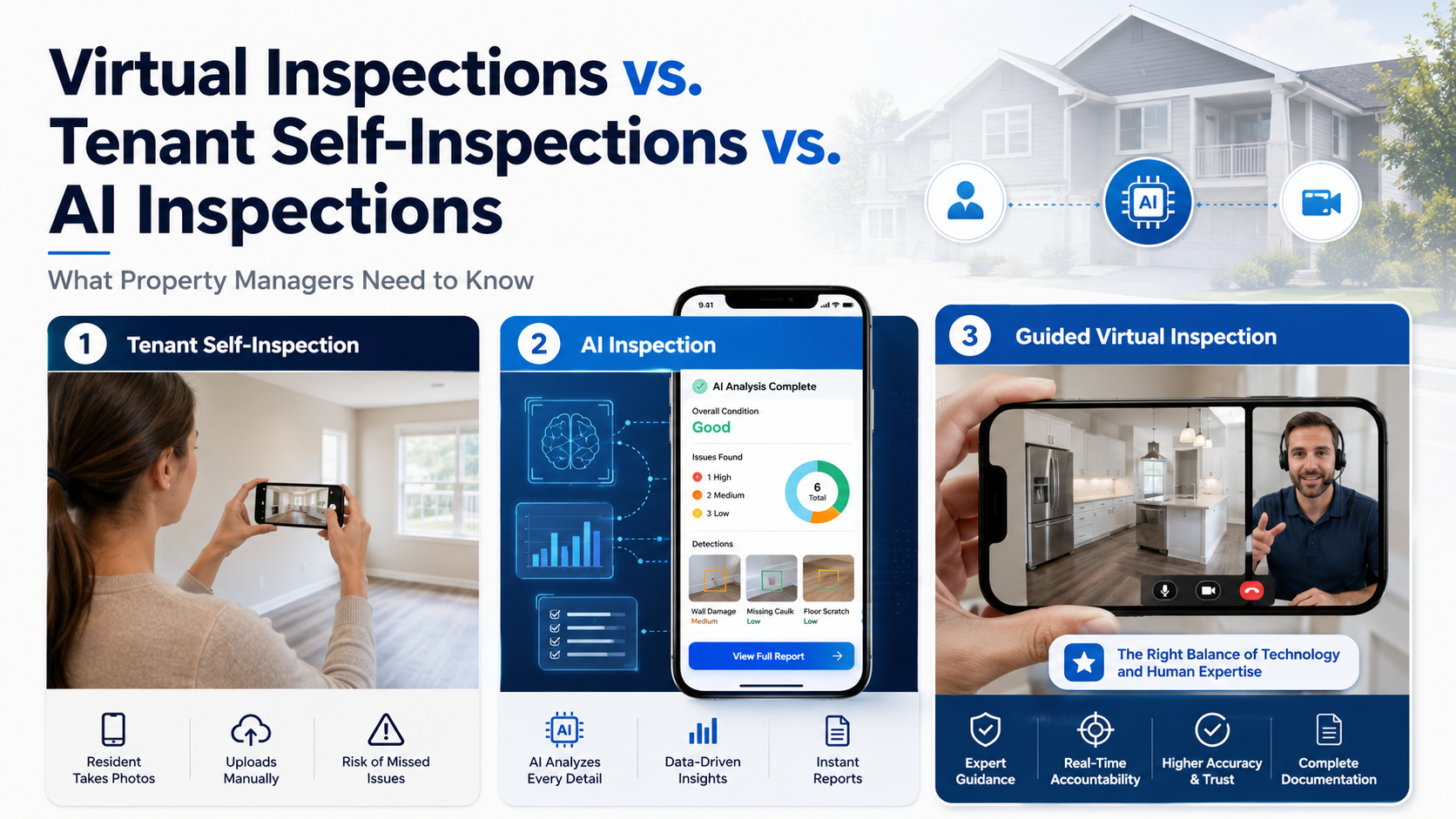
Tenant self-inspections rely on the resident. AI inspections rely on submitted data. Guided virtual inspections rely on a trained inspector leading the process in real time.
That difference has a major impact on consistency, accountability, report quality, and trust.
What Is a Tenant Self-Inspection?
A tenant self-inspection is an inspection completed by the resident without a property manager, inspector, or third-party professional guiding the process in real time.
Typically, the property manager sends the tenant a checklist, form, app link, or set of instructions. The tenant is asked to walk through the home, take photos, answer questions, and submit the information back to the management company.
Tenant self-inspections are often used because they are inexpensive and easy to deploy.
They can be useful for very basic check-ins, such as confirming occupancy, collecting a few photos, or asking a resident to provide quick documentation of a specific item.
But tenant self-inspections also have a major limitation: the tenant is responsible for inspecting the property.
That creates several challenges.
The tenant may not understand what to look for. They may miss important details. They may take unclear photos. They may skip areas. They may misunderstand the instructions. In some cases, they may avoid documenting problems they do not want the property manager to see.
Even when the tenant is honest and cooperative, the final result can still be inconsistent.
What Is an AI Property Inspection?
AI property inspection tools use artificial intelligence to help review, organize, analyze, or generate inspection documentation.
Depending on the platform, AI may help identify possible issues in photos, classify room types, organize images, summarize inspection findings, detect inconsistencies, or speed up report writing.
AI can be a powerful tool in the inspection process.
For property managers, AI may help reduce administrative work, make reports easier to produce, and create more consistent formatting across inspection records.
But AI inspections also have an important limitation: AI can only analyze the information it receives.
If the resident skips a room, submits poor-quality photos, avoids showing damage, or provides incomplete information, AI may still produce a polished report based on incomplete documentation.
That means AI can improve the reporting process, but it does not automatically solve the inspection process.
The key question is not just whether AI can analyze photos.
The better question is: who is controlling what gets captured in the first place?
If the inspection is tenant-led, AI may make the final report faster or cleaner, but the resident may still control what gets submitted.
What Is a Guided Virtual Inspection?
A guided virtual inspection is a live remote inspection conducted by a trained inspection professional using live video technology. To learn more about how this process works, visit our page on What Are Virtual Rental Property Inspections.
The resident is physically inside the property, but they are not performing the inspection on their own. Instead, they join a live video call with an inspector who guides them through the home in real time.
The inspector directs the resident where to go, what to show, what photos are needed, and when additional documentation is required.
With Resident Inspect, the resident provides access through video, but the inspection is led by a trained third-party inspection professional.
This creates a more structured and accountable process than a tenant self-inspection or an AI-only inspection that depends entirely on submitted photos and responses.
The resident is not expected to know what to inspect. They do not decide what should be documented. They simply help provide live access to the property while the inspector controls the inspection.
Why the Difference Matters
Property managers do not just need photos.
They need reliable documentation.
They need to know that the right areas were reviewed, the inspection followed a consistent process, and the report can be trusted when communicating with owners, residents, vendors, or internal team members.
That is where tenant self-inspections and AI-only inspections can fall short.
A tenant may submit photos, but the property manager still has to wonder:
- Did they show every required area?
- Were the photos taken clearly?
- Did they skip damage or maintenance concerns?
- Did they understand what they were supposed to document?
- Is the report complete enough to share with the owner?
- Will the team need to follow up for more information?
AI may help review or organize the submitted information, but it may not know what was skipped, hidden, rushed, or misunderstood during the inspection.
Guided virtual inspections reduce those concerns because the inspection is not left entirely to the resident or to automated analysis after the fact.
A trained inspector leads the process live and can request better angles, additional photos, closer views, or clarification during the inspection.
That real-time guidance makes a major difference.
Tenant Self-Inspections: Pros and Cons
Tenant self-inspections can have a place in property management, especially for low-risk situations or quick check-ins.
But property managers should understand both the advantages and the limitations before relying on them for routine rental inspections.
Pros of tenant self-inspections
Tenant self-inspections can be: low cost, easy to send, convenient for the resident, useful for basic documentation, helpful for simple follow-up questions, faster than scheduling an in-person visit, and simple to deploy across many properties.
For example, if a property manager needs a quick photo of a smoke detector, an HVAC filter, or a minor maintenance item, a tenant-submitted photo may be enough.
Cons of tenant self-inspections
The problem is that tenant self-inspections are only as good as the tenant’s effort, honesty, attention to detail, and understanding of the instructions.
Common issues include: incomplete photos, poor lighting, blurry images, missing rooms or areas, skipped damage, inconsistent responses, delayed submissions, lack of accountability, and extra follow-up for the property management team.
Tenant self-inspections can also create trust issues. Even if most residents are honest, the property manager is still relying on the person living in the home to document the condition of the home. That is not always the best structure when the goal is objective property documentation.
Trust does not end with the tenant either. The property owner, the ultimate client, may question why the tenant is handling this when they are paying for a property manager. Who is the professional responsible for the property, the tenant or the manager? In many cases tenant self inspections are not fully disclosed to property owners which often leads to distrust and broken relationships. Proper disclosure and full understanding is essential in property management.
AI Inspections: Pros and Cons
AI inspection tools can be valuable, especially when they are used to support a structured inspection process.
They can help property managers process information faster and create more consistent inspection records.
But AI should not be confused with professional oversight.
AI can assist with the documentation, but it may not control the inspection itself.
Pros of AI inspections
AI inspection tools may help property managers: organize inspection photos faster, identify possible visible issues in images, classify rooms or inspection categories, speed up report creation, improve report formatting consistency, reduce repetitive administrative work, flag missing or unusual information, support large-scale inspection workflows, and make inspection review more efficient.
AI can be especially useful when there is a large amount of inspection data to sort, label, summarize, or review.
Used properly, AI can make the inspection process more efficient.
Cons of AI inspections
The biggest limitation of AI inspections is that AI depends on the information submitted into the system.
If the source information is incomplete, the AI output may be incomplete too.
Common limitations include: AI may analyze only the photos it receives, skipped rooms may go unnoticed, poor photos can lead to poor conclusions, context may be missing, the resident may still control what gets submitted, AI may flag issues without understanding the full situation, AI may miss subtle concerns that require human judgment, and a polished AI-generated report can create a false sense of completeness.
AI can make inspection documentation faster, but it does not automatically make an inspection accurate, complete, or accountable.
That is why property managers should ask an important question before relying on AI inspections: Is AI supporting a professional inspection process, or is AI simply organizing whatever the resident submitted? Those are very different things.
Guided Virtual Inspections: Pros and Cons
Guided virtual inspections are designed to solve many of the problems created by tenant self-inspections and AI-only inspection workflows while still avoiding the cost and travel time of traditional in-person inspections.
Pros of guided virtual inspections
Guided virtual inspections can provide: real-time inspector control, more consistent documentation, better photo direction, professional inspection reports, less travel time, lower inspection costs, easier scheduling, better scalability, more accountability than tenant self-inspections, and more human oversight than AI-only inspections.
Because the inspection is live, the inspector can address issues immediately. It is also far more personal and a higher level of customer service. Property management is a “people industry” and it should always be that way regardless of our technological advances.
If a photo is unclear, the inspector can ask for another one. If lighting is poor, the inspector can ask the resident to turn on lights or move closer. If an area is missed, the inspector can redirect the resident.
That is a major advantage over reviewing a self-inspection or AI-generated report after the fact and realizing key information is missing.
Cons of guided virtual inspections
Guided virtual inspections are not perfect for every situation.
They still require resident participation. The resident needs to be available at the scheduled time, have a smartphone, and be able to walk through the property.
They also may not be the best option for serious damage, complex maintenance diagnosis, safety concerns, legal disputes, or situations that require physical testing.
But for routine occupied rental property inspections, guided virtual inspections can offer a strong balance of cost, convenience, documentation, and accountability.
Side-by-Side Comparison
| Inspection Method | Tenant Self-Inspection | AI Inspection | Guided Virtual Inspection |
|---|---|---|---|
| Who controls the inspection? | Tenant | Usually depends on submitted data | Trained inspector |
| Who decides what to document? | Tenant | Usually tenant, staff, or system prompts | Inspector |
| Is the inspection live? | Usually no | Usually no | Yes |
| Can unclear photos be corrected immediately? | Usually no | Usually no | Yes |
| Can missing areas be redirected in real time? | No | No | Yes |
| Can it speed up reporting? | Sometimes | Yes | Yes |
| Is the report professionally prepared? | Usually no | Sometimes | Yes |
| Is it convenient for the resident? | Yes | Yes | Yes |
| Is it lower cost than in-person? | Yes | Usually yes | Yes |
| Does it provide human judgment? | No | Limited | Yes |
| Is it more accountable than tenant self-inspection? | No | Sometimes | Yes |
| Best use case | Basic check-ins | Organizing and analyzing inspection data | Routine rental property inspections |
| Main limitation | Tenant controls the process | AI depends on the quality and completeness of submitted data | Requires resident participation |
The table shows the key distinction clearly.
Tenant self-inspections may be convenient, but the resident controls the process.
AI inspections may improve speed and organization, but AI depends on the quality and completeness of the information submitted.
Guided virtual inspections provide more structure, consistency, and control because a trained inspector leads the inspection in real time.
The Problem with Letting the Tenant or the Data Control the Inspection
Most residents are not trying to create problems.
But that does not mean they are qualified to inspect the property.
A resident may not know what property managers need to see. They may not understand the importance of clear photos. They may overlook early warning signs of maintenance issues. They may skip closets, ceilings, floors, exterior areas, or less convenient spaces.
There is also a natural conflict of interest.
The resident lives in the home. If there is damage, unauthorized pets, poor housekeeping, lease compliance issues, or unreported maintenance concerns, the resident may not be eager to document those items.
AI does not fully remove that concern if the AI is reviewing information submitted by the resident.
If the resident controls what gets captured, AI may simply make incomplete documentation look more organized.
This does not mean every tenant self-inspection or AI inspection is unreliable.
But it does mean property managers should be cautious about using tenant-controlled or AI-only processes as a substitute for a professional inspection process.
For routine inspection programs, consistency matters.
Owners expect reliable documentation. Property managers need information they can trust. Internal teams need reports that are complete and easy to review.
A guided virtual inspection gives the resident a role in the process without giving them control over the process.
Why Guided Virtual Inspections Create More Accountability
Guided virtual inspections create accountability because the resident is not left alone to decide what gets documented, and the inspection is not based only on after-the-fact analysis of submitted photos.
During a live inspection, the inspector can guide the resident through specific areas, including: entry areas, living spaces, kitchens, bathrooms, bedrooms, closets, flooring, walls and ceilings, appliances, plumbing fixtures, HVAC-related areas, exterior areas when applicable, and specific owner or manager concerns.
The inspector can ask follow-up questions, request closer views, and make sure the inspection follows a consistent process.
This creates a better record for the property manager.
It also creates a better experience for the resident because they do not have to figure out what the property manager wants. They simply follow the inspector’s guidance during the appointment.
Are Guided Virtual Inspections Better Than Tenant Self-Inspections or AI Inspections?
For routine rental property inspections, guided virtual inspections are usually a stronger option than tenant self-inspections or AI-only inspections.
Tenant self-inspections may work for simple, low-risk check-ins.
AI inspections may work well for organizing, analyzing, or speeding up inspection documentation.
But when a property manager needs reliable documentation, consistent reports, and better accountability, a guided virtual inspection is often the better fit.
The reason is simple.
A tenant self-inspection depends heavily on the tenant.
An AI inspection depends heavily on the information submitted.
A guided virtual inspection depends on a trained inspection process.
That distinction is important for property managers who need to protect owner assets, document property condition, and maintain a scalable inspection program.
Are Guided Virtual Inspections Better Than In-Person Inspections?
Not always.
In-person inspections are still important in certain situations. If there is major damage, a serious maintenance issue, a safety concern, or a legal dispute, an in-person inspection may be necessary.
But not every routine inspection requires someone to drive to the property.
For many occupied rental homes, the purpose of a routine inspection is to document visible condition, identify obvious concerns, check for lease compliance issues, and give owners confidence that the property is being monitored.
Guided virtual inspections can often accomplish those goals more efficiently and at a lower cost than traditional in-person inspections.
The best inspection program may use multiple methods: tenant self-inspections for very basic check-ins, AI tools to help organize and review inspection documentation, guided virtual inspections for routine rental property inspections, and in-person inspections for high-risk or complex situations.
This gives property managers a more flexible and cost-effective inspection strategy.
When Tenant Self-Inspections May Be Enough
Tenant self-inspections are not always bad.
They can be useful for simple situations where the risk is low and the information needed is limited.
Tenant self-inspections may be enough when you need: a quick photo of one specific item, confirmation that a minor issue was addressed, a simple resident-submitted update, a basic occupancy check, or a low-priority follow-up item.
But they are usually not the best option when you need a complete routine inspection report.
If the inspection will be shared with an owner, used for documentation, or relied on by your team, a guided virtual inspection is usually a better choice.
When AI Inspections May Be Enough
AI inspection tools can be helpful when the property manager already has good documentation and needs help organizing or reviewing it.
AI inspections may be useful when you need: faster report creation, photo organization, basic issue flagging, consistent report formatting, support reviewing large volumes of inspection data, a second layer of administrative review, or assistance identifying missing or unusual information.
AI is strongest when it supports a good inspection process.
It is weaker when it replaces the inspection process entirely.
If AI is reviewing photos from a tenant-led inspection, the same underlying problem may remain: the tenant still controls what was submitted.
When Guided Virtual Inspections Make the Most Sense
Guided virtual inspections are especially useful when property managers need a repeatable process for routine occupied inspections.
They are a strong fit for: periodic rental home inspections, owner-requested condition checks, lease compliance reviews, post-maintenance verification, move-in follow-up documentation, move-out follow-up documentation, properties outside your normal service area, large portfolios that need scalable inspection coverage, property managers who want to reduce drive time and staff workload, property managers who want more accountability than tenant self-inspections, and property managers who want human oversight instead of AI-only reporting.
For these use cases, guided virtual inspections can provide the right balance of professionalism, convenience, cost savings, and accountability.
The Strongest Inspection Process Is Human-Guided Technology
The inspection conversation should not be framed as people versus technology.
Technology is valuable. AI is valuable. Remote inspections are valuable.
The question is how the technology is used.
If technology simply allows a resident to submit photos on their own, the property manager may still be relying on a tenant-controlled inspection.
If AI simply organizes whatever the resident submitted, the final report may look cleaner without solving the underlying accountability problem.
But when technology is combined with trained human guidance, property managers get a stronger process.
That is the value of guided virtual inspections.
A trained inspector leads the inspection in real time, while technology makes the process faster, more convenient, and easier to scale.
For routine rental property inspections, human-guided technology gives property managers a practical middle ground between traditional in-person inspections, tenant self-inspections, and AI-only inspection tools.
Why Property Managers Choose Resident Inspect
Resident Inspect was built to help property managers complete routine rental inspections more efficiently without relying on tenant self-inspections or AI-only inspection workflows.
Our process combines live video technology, trained inspection professionals, resident scheduling support, high-resolution photo documentation, and professional reporting.
That means your team can complete more inspections without sending staff across town, depending on residents to inspect the property themselves, or relying only on automated analysis after the fact.
Resident Inspect helps property managers: reduce inspection costs, save staff time, improve inspection consistency, avoid tenant-led self-inspections, add human oversight to the remote inspection process, provide owners with professional reports, scale routine inspection programs, and keep better visibility across the portfolio.
The result is a more efficient inspection process with more accountability than tenant self-inspections, more human judgment than AI-only inspections, and less operational burden than traditional in-person inspections.
Final Thoughts
Tenant self-inspections, AI inspections, and guided virtual inspections may all help property managers gather information remotely, but they are not the same.
Tenant self-inspections put the resident in control.
AI inspections depend on the quality and completeness of the submitted data.
Guided virtual inspections put a trained inspector in control of the process.
For property managers, that difference matters.
If your company needs a simple photo from a resident, a tenant self-inspection may be enough.
If your company needs help organizing inspection data or speeding up report creation, AI tools may be helpful.
But if you need a professional, repeatable, and accountable process for routine rental property inspections, guided virtual inspections are often the stronger option.
Resident Inspect gives property managers the efficiency of remote inspections without leaving the inspection up to the tenant or relying only on automated analysis.
Want to see how a guided virtual inspection works?