
Are Virtual Rental Property Inspections as Good as In-Person Inspections?

Aaron Cooper
Founder & Chief Executive Officer, Resident Inspect
📍 Jacksonville, FL
Aaron Cooper is a seasoned property technology entrepreneur and inspection industry expert. As the Founder and CEO of Resident Inspect, and #1 Rental Home Inspector. He leads the development of intelligent inspection platforms that empower landlords, property managers, and investors to streamline digital inspections and ensure compliance.
Table of Contents
- What Is an In-Person Rental Property Inspection?
- What Is a Guided Virtual Rental Property Inspection?
- The Real Question: What Is the Goal of the Inspection?
- When In-Person Inspections Are Better
- When Virtual Inspections Are a Strong Fit
- Virtual Inspections vs. In-Person Inspections: Pros and Cons
- Pros of In-Person Inspections
- Cons of In-Person Inspections
- Pros of Guided Virtual Inspections
- Cons of Guided Virtual Inspections
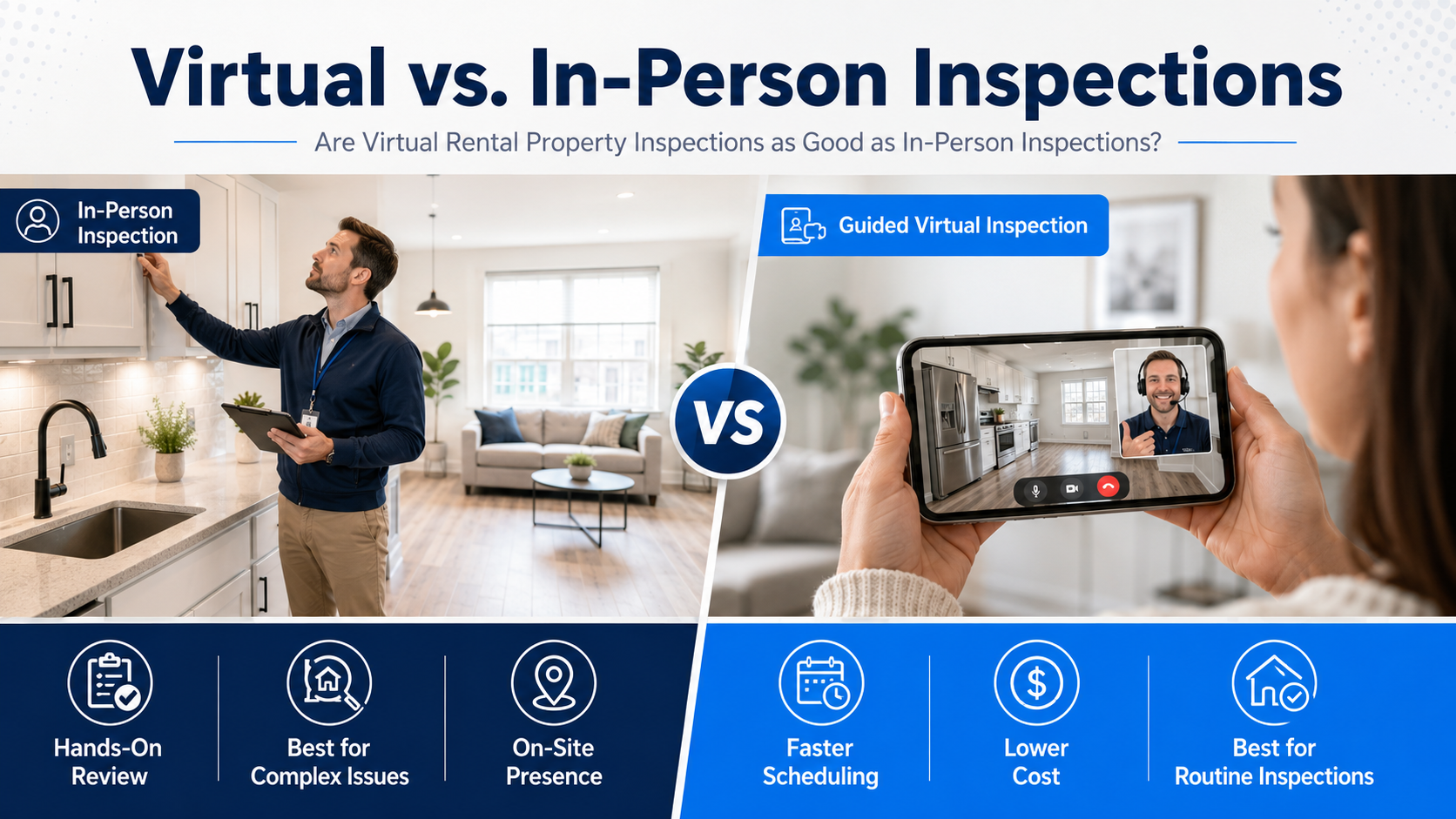
- Side-by-Side Comparison
- The Best Inspection Strategy: Use Each Method for the Right Situation
- Do Virtual Inspections Save Money Compared to In-Person Inspections?
- Are Virtual Inspections More Convenient for Residents?
- Are Virtual Inspection Reports Good Enough for Owners?
- Common Misconceptions About Virtual vs. In-Person Inspections
- When a Virtual Inspection Should Lead to an In-Person Follow-Up
- Why Property Managers Choose Resident Inspect
- Final Thoughts
For many property managers, routine rental property inspections are necessary but difficult to complete consistently.
Inspections help protect owner assets, document property condition, identify visible concerns, and confirm that residents are caring for the home. But traditional in-person inspections can also be time-consuming, expensive, and hard to scale across a growing portfolio.
That is why more property management companies are considering virtual rental property inspections.
But one question usually comes up early: Are virtual inspections as good as in-person inspections?
The honest answer is: it depends on the purpose of the inspection.
Virtual inspections are not the right fit for every situation. There are times when an in-person inspection is still necessary. But for many routine occupied rental property inspections, guided virtual inspections can provide the visibility, documentation, and accountability property managers need while reducing travel time, scheduling friction, and overall inspection costs.
The key is understanding when each method makes sense.
What Is an In-Person Rental Property Inspection?
An in-person rental property inspection is the traditional inspection method most property managers are familiar with.
A property manager, inspector, field staff member, maintenance technician, or third-party vendor physically visits the rental home to walk through the property, document condition, take photos, and identify visible issues.
In-person inspections can be valuable because the inspector is physically present. They can walk the property directly, look closely at areas of concern, test certain items when appropriate, and make judgment calls based on what they see in person.
For high-risk situations, physical presence can be important.
But in-person inspections also come with operational challenges.
They require scheduling, driving, parking, access coordination, waiting on residents, taking photos, writing reports, uploading documentation, and following up after the visit. For property managers with large portfolios, those steps can consume a significant amount of staff time.
What Is a Guided Virtual Rental Property Inspection?
A guided virtual rental property inspection is a live remote inspection conducted through video technology. For a full explanation of how this process works, visit our page on What Are Virtual Rental Property Inspections.
The resident is physically inside the property and joins the inspection from a smartphone. A trained inspection professional connects by live video and guides the resident through the home in real time.
The inspector directs where the resident should go, what areas should be shown, when closer views are needed, and what documentation should be captured.
With Resident Inspect, the resident is not responsible for inspecting the property on their own. The resident provides access through video, while a trained third-party inspector leads the inspection process.
That distinction matters.
A guided virtual inspection is not the same as a tenant self-inspection. It is a live inspection process led by a professional, using technology to remove the need for drive time and onsite travel.
The Real Question: What Is the Goal of the Inspection?
When comparing virtual inspections and in-person inspections, the most important question is not which method is always better.
The better question is: What is the inspection trying to accomplish?
Some inspections require physical presence. Others are primarily about visibility, documentation, and accountability.
Routine occupied rental inspections usually focus on questions like: What is the general condition of the property? Are there visible maintenance concerns? Are there obvious lease compliance issues? Are there signs of unauthorized pets, occupants, or damage? Are there issues that should be escalated for follow-up? Can the owner receive a clear update on the property condition?
For those goals, a guided virtual inspection can often be a strong fit.
But if the inspection requires physical testing, complex diagnosis, legal documentation, or a detailed hands-on review, an in-person inspection may be the better choice.
When In-Person Inspections Are Better
In-person inspections still have an important place in property management.
There are situations where sending someone to the property is the right decision.
In-person inspections may be better for: major property damage, serious maintenance concerns, safety hazards, legal or eviction-related situations, suspected abandonment, complex repair diagnosis, situations requiring physical testing, properties with significant resident conflict, move-out disputes, insurance-related documentation, and cases where the resident cannot or will not participate.
If a property has a major water leak, structural concern, fire damage, severe neglect, or a safety issue, a virtual inspection should not be treated as a complete replacement for an in-person visit.
In those situations, physical presence may be necessary.
Virtual inspections are not designed to eliminate in-person inspections entirely. They are designed to help property managers use in-person inspections more strategically.
When Virtual Inspections Are a Strong Fit
Guided virtual inspections are especially useful for routine occupied rental property inspections.
These inspections are often about documenting the general condition of the property and identifying visible concerns before they become bigger problems.
Virtual inspections are a strong fit for: routine periodic inspections, occupied property condition checks, owner-requested updates, lease compliance reviews, post-maintenance verification, move-in follow-up documentation, move-out follow-up documentation, properties outside the normal service area, large portfolios that need scalable inspection coverage, and situations where scheduling speed matters.
For these types of inspections, property managers usually do not need someone to physically touch every item in the home.
They need clear visibility, organized documentation, and a reliable process for identifying issues that need attention.
A guided virtual inspection can provide that while reducing the cost and time burden of sending staff across town.
Virtual Inspections vs. In-Person Inspections: Pros and Cons
Both inspection methods have advantages and limitations. The right choice depends on the situation.
Pros of In-Person Inspections
In-person inspections provide physical access to the property. This can be useful when the inspector needs to look closely at a problem, test something, verify a repair, or make judgment calls that require being physically onsite.
Advantages of in-person inspections include: physical presence at the property, ability to inspect areas directly, ability to test certain items when appropriate, strong option for high-risk or complex issues, useful for legal or dispute-related situations, helpful when resident participation is limited, and more control over where the inspector walks and what they see.
Cons of In-Person Inspections
The downside of in-person inspections is not usually the inspection itself. The downside is everything required to make the inspection happen.
Common limitations of in-person inspections include: drive time, mileage costs, scheduling delays, staff availability issues, waiting on residents, rescheduling missed appointments, limited inspection capacity, higher labor cost, more administrative follow-up, and difficulty scaling across a large portfolio.
For property managers, these costs add up quickly. A 30-minute inspection may require far more than 30 minutes of staff time once travel, scheduling, documentation, and reporting are included.
Pros of Guided Virtual Inspections
Guided virtual inspections help property managers complete routine inspections more efficiently. They remove many of the operational burdens of in-person inspections while still keeping a trained inspector involved in the process.
Advantages of guided virtual inspections include: no drive time, lower inspection costs, faster scheduling, flexible appointment options, reduced staff workload, professional inspection reports, real-time inspector guidance, better consistency than tenant self-inspections, easier scalability across large portfolios, convenient experience for residents, and useful for properties outside normal service areas.
Because the inspection is live, the inspector can request additional views, better lighting, closer photos, or clarification during the appointment. That makes guided virtual inspections much stronger than asking a tenant to complete a self-inspection alone.
Cons of Guided Virtual Inspections
Virtual inspections are not perfect for every situation. They rely on resident participation and video access. The resident needs a smartphone, a working connection, and the ability to walk through the property during the scheduled appointment.
Common limitations of guided virtual inspections include: requires resident participation, depends on video connection quality, not ideal for complex maintenance diagnosis, not ideal for serious safety issues, not a full replacement for hands-on testing, may require follow-up if an issue needs physical inspection, and not the best fit when the resident refuses access.
These limitations are important to acknowledge. A credible virtual inspection process should not claim to replace every in-person visit. Instead, guided virtual inspections should be used where they make the most sense: routine documentation, general condition checks, and scalable inspection programs.
Side-by-Side Comparison
| Category | In-Person Inspection | Guided Virtual Inspection |
|---|---|---|
| Physical presence | Yes | No |
| Live inspection process | Yes | Yes |
| Professional oversight | Yes | Yes |
| Requires drive time | Yes | No |
| Requires resident participation | Sometimes | Yes |
| Good for routine inspections | Yes | Yes |
| Good for major damage | Yes | Sometimes as a first look, but may require follow-up |
| Good for complex diagnosis | Yes | Limited |
| Easy to scale across a large portfolio | Often difficult | Yes |
| Cost efficiency | Lower for high-risk cases, higher for routine visits | Strong for routine inspections |
| Convenience for residents | Varies | Often higher |
| Best use case | High-risk, complex, or hands-on situations | Routine occupied rental inspections |
The best inspection method is not always one or the other. For many property management companies, the strongest approach is to use both.
The Best Inspection Strategy: Use Each Method for the Right Situation
Virtual inspections and in-person inspections should not be treated as competitors in every situation. They are different tools.
A smart inspection program uses each method where it performs best.
For example: use guided virtual inspections for routine occupied inspections, owner-requested updates, and post-maintenance verification when a visual check is enough. Use in-person inspections for serious damage, safety concerns, or legal matters, and when physical testing or hands-on review is required.
This helps property managers reduce unnecessary field visits while still escalating serious situations when needed.
That is where virtual inspections can create real operational value. They do not eliminate in-person inspections. They reduce the number of routine inspections that require someone to physically drive to the property.
Do Virtual Inspections Save Money Compared to In-Person Inspections?
For routine rental property inspections, virtual inspections can create meaningful savings.
The cost of an in-person inspection includes more than the time spent inside the home. It also includes: scheduling time, travel time, mileage, waiting on residents, rescheduling missed appointments, photo organization, report preparation, staff follow-up, and administrative coordination.
Virtual inspections reduce or eliminate many of those costs.
Because the inspection is completed remotely, the inspection professional does not need to drive from property to property. That makes it easier to complete inspections faster, cover larger geographic areas, and reduce internal staff workload.
For property managers with growing portfolios, this can make routine inspection programs more affordable and easier to maintain.
Are Virtual Inspections More Convenient for Residents?
Often, yes.
In-person inspections usually require a resident to provide access during a specific window or accept someone entering the property.
Virtual inspections can be scheduled more flexibly because the resident joins from their phone and walks through the property during the appointment.
This can make inspections feel less invasive and easier to coordinate.
When residents have more convenient scheduling options, property managers may have fewer delays, fewer missed appointments, and better participation.
Convenience matters because even the best inspection process fails if appointments are difficult to complete.
Are Virtual Inspection Reports Good Enough for Owners?
For routine inspection purposes, a professional virtual inspection report can provide owners with the visibility they need.
Owners usually want to know: Is the property being monitored? Are there visible issues? Is the resident taking reasonable care of the home? Are there maintenance concerns that need attention? Is there clear documentation if questions come up later?
A guided virtual inspection can produce organized documentation with photos, notes, and a clear inspection summary.
For many owners, the quality and consistency of the report matter more than whether someone physically drove to the property.
The key is that the report should be professional, organized, and based on a consistent inspection process.
Common Misconceptions About Virtual vs. In-Person Inspections
Misconception 1: “Virtual inspections are just tenant self-inspections.”
A guided virtual inspection is not the same as a tenant self-inspection. In a tenant self-inspection, the resident completes the inspection alone. In a guided virtual inspection, a trained inspector leads the process live while the resident provides access through video. The resident does not decide what to inspect. The inspector does.
Misconception 2: “Virtual inspections are always less accurate.”
Virtual inspections are different from in-person inspections, but that does not mean they are always less useful. For routine documentation, visible condition checks, and lease compliance reviews, guided virtual inspections can provide the visibility property managers need. For complex or high-risk issues, in-person inspections may still be better.
Misconception 3: “If virtual inspections work, in-person inspections are unnecessary.”
This is not true. In-person inspections still matter. The goal is not to eliminate them completely. The goal is to use them where they are most needed and stop spending unnecessary time on routine visits that can be handled virtually.
Misconception 4: “Residents can just hide things during a virtual inspection.”
No inspection method is perfect. But guided virtual inspections create more accountability than tenant self-inspections because a trained inspector directs the resident in real time. The inspector can request specific views, closer photos, better lighting, and additional documentation during the appointment.
Misconception 5: “Owners will not accept virtual inspection reports.”
Owners typically care about clear documentation, consistent reporting, and knowing their property is being monitored. A professional inspection report can provide that visibility, especially for routine property checks.
When a Virtual Inspection Should Lead to an In-Person Follow-Up
A virtual inspection can also be used as a first layer of review.
If the guided virtual inspection identifies a serious concern, the property manager can escalate the issue and schedule an in-person visit, maintenance evaluation, or vendor follow-up.
This can be an efficient approach because it helps property managers avoid sending staff to every property unnecessarily while still identifying which properties need more attention.
Examples that may require follow-up include: significant water damage, active leaks, electrical concerns, safety hazards, major property damage, possible unauthorized occupancy, severe cleanliness or habitability concerns, and maintenance items that require diagnosis.
In this way, virtual inspections can help property managers triage their portfolio more effectively.
Why Property Managers Choose Resident Inspect
Resident Inspect was built to help property managers complete routine rental property inspections more efficiently.
Our process combines live video technology, trained inspection professionals, resident scheduling support, high-resolution photo documentation, and professional reporting.
With Resident Inspect, the resident does not complete the inspection alone. A trained inspection professional leads the process in real time while the resident provides access through video.
Resident Inspect helps property managers: reduce unnecessary drive time, lower routine inspection costs, save staff time, improve inspection consistency, avoid tenant-led self-inspections, provide owners with professional reports, scale routine inspection programs, and maintain better visibility across the portfolio.
For property managers who need an efficient alternative to routine in-person inspections, guided virtual inspections can provide a practical solution.
Final Thoughts
So, are virtual rental property inspections as good as in-person inspections?
For some situations, no. When physical testing, complex diagnosis, legal documentation, or serious damage is involved, an in-person inspection may be the right choice.
But for many routine occupied rental inspections, guided virtual inspections can provide the documentation, visibility, and accountability property managers need at a lower cost and with less operational burden.
The goal is not to replace every in-person inspection. The goal is to stop using in-person visits for every inspection when a guided virtual inspection can accomplish the routine documentation more efficiently.
Resident Inspect gives property managers a better way to complete routine rental inspections without relying on tenant self-inspections or unnecessary field visits.
Want to see what a guided virtual inspection report looks like?