
Virtual Inspections vs. AI Inspections: What Property Managers Need to Know

Aaron Cooper
Founder & Chief Executive Officer, Resident Inspect
📍 Jacksonville, FL
Aaron Cooper is a seasoned property technology entrepreneur and inspection industry expert. As the Founder and CEO of Resident Inspect, and #1 Rental Home Inspector. He leads the development of intelligent inspection platforms that empower landlords, property managers, and investors to streamline digital inspections and ensure compliance.
Table of Contents
- What Is an AI Property Inspection?
- What Is a Guided Virtual Inspection?
- The Main Difference: Analysis vs. Control
- AI Inspections: Pros and Cons
- Guided Virtual Inspections: Pros and Cons
- Side-by-Side Comparison
- Why AI Alone May Not Solve the Accountability Problem
- The Better Question: Who Is Guiding the Inspection?
- The Best Use of AI in Property Inspections
- Why Guided Virtual Inspections Work Well for Routine Rental Properties
- When AI Inspections May Be Enough
- When Guided Virtual Inspections Are the Better Fit
- Human-Guided Technology: The Stronger Inspection Model
- Why Property Managers Choose Resident Inspect
- Final Thoughts
Artificial intelligence is changing the way many industries collect, organize, and review information. Property management is no exception.
Today, more property managers are seeing tools that promise faster inspection reports, automated photo analysis, AI-generated summaries, and streamlined inspection workflows.
That technology can be helpful.
But when it comes to rental property inspections, there is an important question property managers need to ask:
Is AI actually inspecting the property, or is it simply analyzing the information someone else submitted?
That distinction matters.
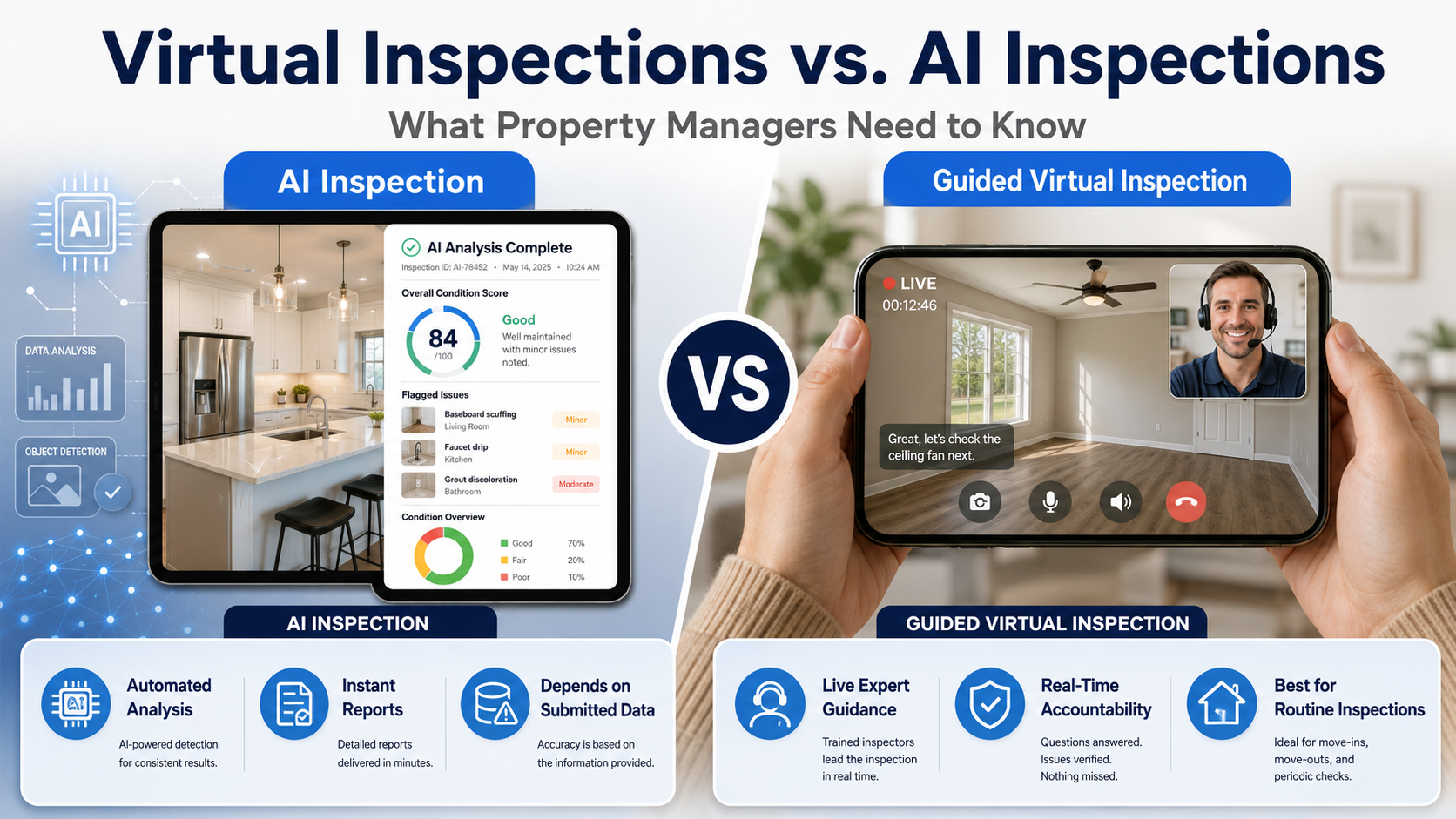
AI inspection tools and guided virtual inspections can both improve efficiency, but they solve different problems. AI can help review, organize, and summarize inspection information. Guided virtual inspections help control how that information is captured in the first place.
For routine rental property inspections, that difference can have a major impact on accuracy, accountability, and trust.
What Is an AI Property Inspection?
An AI property inspection uses artificial intelligence to assist with some part of the inspection process.
Depending on the platform, AI may help:
- Analyze inspection photos
- Identify possible visible issues
- Organize images by room or category
- Generate inspection summaries
- Flag missing or inconsistent information
- Speed up report writing
- Standardize report formatting
- Reduce manual review time
AI can be especially useful when a property manager has a large number of photos, notes, or reports to process.
Instead of manually sorting every image or writing every summary from scratch, AI can help make the inspection review process faster and more efficient.
That is valuable.
But AI inspections also have a significant limitation.
AI can only analyze the information it receives.
If the photos are incomplete, unclear, misleading, or missing important areas, AI may still produce a polished report based on incomplete information.
What Is a Guided Virtual Inspection?
A guided virtual inspection is a live remote inspection led by a trained inspection professional. To learn more about how this process works, visit our page on What Are Virtual Rental Property Inspections.
The resident is physically inside the rental property and joins the inspection by live video from a smartphone. The inspector is remote, but they guide the resident through the home in real time.
The inspector directs where the resident should go, what areas need to be shown, what photos should be captured, and when additional views are needed.
With Resident Inspect, the resident is not responsible for inspecting the property on their own. The resident provides access through video, while a trained inspector controls the inspection process.
That real-time guidance is the key difference.
A guided virtual inspection does not just help process inspection information after it has been submitted. It helps make sure the right information is captured during the inspection.
The Main Difference: Analysis vs. Control
AI inspections and guided virtual inspections are often discussed as if they are competing versions of the same thing.
But they are not exactly the same.
AI is strongest at analyzing information.
Guided virtual inspections are strongest at controlling the inspection process.
That difference matters because a rental inspection is only as good as the information captured.
If the resident skips a room, avoids showing damage, submits blurry photos, or misunderstands the instructions, AI may not know what was missed. It may analyze the images provided, but it cannot always know what was left out.
A trained inspector on a live virtual inspection can respond in real time.
If something is unclear, the inspector can ask for a closer view. If a room was missed, the inspector can redirect the resident. If a photo is too dark, the inspector can request better lighting. If an issue needs more context, the inspector can ask follow-up questions during the inspection.
That is the difference between reviewing submitted information and guiding the inspection as it happens.
AI Inspections: Pros and Cons
AI inspection tools can be useful, especially when they are used to support a structured inspection process.
They can reduce repetitive work, organize information faster, and help property managers review inspection documentation more efficiently.
But AI should not be confused with professional inspection oversight.
Pros of AI inspections
AI inspection tools may help property managers:
- Speed up report creation
- Organize inspection photos
- Identify possible visible issues
- Improve report consistency
- Flag missing or unusual information
- Reduce administrative workload
- Process large volumes of inspection data
- Create summaries from photos or notes
- Support internal quality control
For property management companies with large portfolios, these benefits can be meaningful. AI can make inspection workflows faster and more scalable.
Cons of AI inspections
The biggest limitation of AI inspections is that AI depends on the quality and completeness of the data it receives.
If the inspection information is incomplete, AI may not be able to fix that problem.
Common limitations include:
- AI may only analyze submitted photos
- Skipped rooms may go unnoticed
- Poor-quality photos can lead to poor conclusions
- Context may be missing
- The resident may still control what gets submitted
- AI may flag issues without understanding the full situation
- A clean AI-generated report may create a false sense of completeness
- Staff may still need to review and verify the results
AI can improve the inspection workflow, but it does not automatically make the inspection complete, accurate, or accountable. That is why property managers should be careful about relying on AI-only inspection workflows for routine property documentation.
Guided Virtual Inspections: Pros and Cons
Guided virtual inspections are designed to give property managers a more accountable remote inspection process.
They use technology to reduce the cost and inconvenience of in-person inspections, but they keep a trained inspection professional involved in real time.
Pros of guided virtual inspections
Guided virtual inspections can help property managers:
- Reduce drive time and mileage
- Lower inspection costs
- Complete routine inspections faster
- Improve scheduling flexibility
- Create more consistent documentation
- Avoid tenant-led self-inspections
- Capture better photos during the inspection
- Ask follow-up questions in real time
- Provide professional inspection reports
- Scale routine inspection programs more efficiently
Because the inspection is live, missing or unclear information can often be corrected before the inspection ends. That is a major advantage over reviewing a report later and realizing key photos or details were never captured. For a full breakdown of how virtual inspections can reduce costs and save staff time, see our guide: How Virtual Rental Inspections Save Property Managers Time and Money.
Cons of guided virtual inspections
Guided virtual inspections are not the right fit for every situation.
They still require resident participation. The resident needs to be available, have a smartphone, and be able to walk through the property during the scheduled inspection.
Guided virtual inspections may also not be the best choice for serious damage, complex maintenance diagnosis, safety concerns, legal disputes, or situations that require physical testing. For a closer look at when each method performs best, see: Are Virtual Rental Property Inspections as Good as In-Person Inspections?
But for routine occupied rental property inspections, guided virtual inspections can provide a strong balance of efficiency, cost savings, documentation, and accountability.
Side-by-Side Comparison
| Category | AI Inspection | Guided Virtual Inspection |
|---|---|---|
| Main function | Analyzes, organizes, or summarizes submitted information | Guides the inspection live in real time |
| Who controls what gets captured? | Often resident, staff, or system prompts | Trained inspector |
| Is the inspection live? | Usually no | Yes |
| Can missing areas be corrected in real time? | Usually no | Yes |
| Can unclear photos be corrected immediately? | Usually no | Yes |
| Can it speed up report creation? | Yes | Yes |
| Does it provide human judgment during the inspection? | Limited or no | Yes |
| Does it reduce travel time? | Yes | Yes |
| Does it require resident participation? | Often yes | Yes |
| Main strength | Faster analysis and reporting | More accountable remote inspection process |
| Main limitation | Depends on submitted data | Requires a scheduled live inspection |
| Best use case | Organizing or reviewing inspection data | Routine occupied rental property inspections |
Both methods can create efficiency. But guided virtual inspections provide something AI-only inspections may not: real-time human direction during the inspection itself.
Why AI Alone May Not Solve the Accountability Problem
One of the biggest challenges in rental property inspections is not simply creating a report. It is making sure the report is based on complete and reliable documentation.
AI may help write or organize a report, but it may not know whether the source information was complete.
For example:
- If a resident skips a bedroom, AI may not know what was missed.
- If a closet is never opened, AI may not know it was excluded.
- If damage is outside the frame of the photo, AI may not detect it.
- If a resident submits only the cleanest angles, AI may still generate a professional-looking report.
- If lighting is poor, AI may not accurately interpret the condition.
This does not mean AI is not useful. It means AI should be used carefully.
For property managers, the most important part of an inspection is not just the final report. It is the process used to create that report. A polished report is only valuable if the inspection process behind it is reliable.
The Better Question: Who Is Guiding the Inspection?
When evaluating inspection technology, property managers should not only ask: “Does this tool use AI?”
They should also ask: Who is guiding the inspection while the property is being documented?
That question gets to the heart of the issue.
If the resident is guiding themselves, the property manager may still be relying on a tenant-controlled process.
If AI is reviewing only what the resident submitted, the software may be analyzing incomplete information.
If a trained inspector is guiding the resident live, the inspection process becomes more structured, consistent, and accountable.
That is the value of guided virtual inspections. They combine the convenience of remote technology with the oversight of a trained inspection professional.
The Best Use of AI in Property Inspections
AI can be valuable when it supports a strong inspection process.
For example, AI may help:
- Review large volumes of inspection data
- Organize photos after an inspection
- Flag potential concerns for human review
- Speed up report preparation
- Improve internal quality control
- Identify patterns across a portfolio
Those uses can make property management teams more efficient. But AI is strongest when it supports human judgment, not when it replaces the inspection process entirely.
For routine rental inspections, the strongest model is often not AI-only. It is human-guided technology. That means technology helps make the process faster and more scalable, while a trained professional still controls the inspection and applies judgment where needed.
Why Guided Virtual Inspections Work Well for Routine Rental Properties
Routine rental property inspections usually have a clear goal.
Property managers want to:
- Document the general condition of the property
- Identify visible concerns
- Check for lease compliance issues
- Confirm the property is being maintained
- Provide owners with useful documentation
- Catch small issues before they become larger problems
- Maintain visibility across the portfolio
For these goals, guided virtual inspections can be a strong fit. They do not require drive time, they reduce scheduling friction, and they produce professional documentation. To understand what routine inspections actually cost across different delivery models, see: How Much Does a Rental Property Inspection Cost in 2026.
At the same time, they avoid one of the biggest weaknesses of tenant-led or AI-only workflows: lack of real-time human oversight.
A trained inspector can guide the inspection, request specific views, and make sure the process follows a consistent standard. That makes guided virtual inspections especially useful for routine occupied rental properties.
When AI Inspections May Be Enough
AI inspection tools may be enough when the property manager already has reliable documentation and needs help organizing, summarizing, or reviewing it.
AI may be useful for:
- Sorting photos
- Drafting report summaries
- Flagging possible issues
- Creating consistent report formats
- Reviewing large amounts of documentation
- Supporting internal quality control
AI may also be helpful when paired with a professional inspection process. But AI-only inspections may not be enough when the property manager needs confidence that the right areas were actually inspected and documented.
If the concern is accountability, control, or completeness, guided virtual inspections are usually stronger.
When Guided Virtual Inspections Are the Better Fit
Guided virtual inspections are usually the better fit when a property manager needs a repeatable process for routine rental inspections.
They are especially useful for:
- Periodic rental home inspections
- Occupied property condition checks
- Owner-requested updates
- Lease compliance reviews
- Post-maintenance verification
- Move-in follow-up documentation
- Move-out follow-up documentation
- Properties outside the normal service area
- Large portfolios that need scalable inspection coverage
- Teams trying to reduce drive time and staff workload
In these situations, the property manager does not just need faster reporting. They need a better inspection process. That is where guided virtual inspections can provide more value than AI-only workflows. For a side-by-side breakdown of how virtual and in-person inspections compare across different scenarios, see: Are Virtual Rental Property Inspections as Good as In-Person Inspections?
Human-Guided Technology: The Stronger Inspection Model
The future of rental property inspections is not simply manual inspections or artificial intelligence. It is a smarter combination of people, process, and technology.
AI can help make inspection workflows more efficient. Virtual inspection technology can remove unnecessary drive time. But trained human oversight still matters.
For property managers, the strongest process is one where technology makes inspections easier to complete, while a trained inspector still guides the documentation and applies judgment during the inspection.
That is the model Resident Inspect was built around. We use technology to make routine inspections faster, more convenient, and easier to scale, but the inspection itself is guided by a trained professional. That gives property managers the efficiency of remote inspections without relying only on automated analysis.
Why Property Managers Choose Resident Inspect
Resident Inspect helps property managers complete routine rental property inspections through a live, guided virtual process.
Our inspections are not tenant self-inspections, and they are not AI-only reports based on whatever information happens to be submitted.
With Resident Inspect, a trained inspection professional leads the inspection in real time. The resident provides access through live video, and the inspector directs the process, captures documentation, and prepares a professional report.
Resident Inspect helps property managers:
- Reduce inspection costs
- Save staff time
- Avoid unnecessary drive time
- Improve inspection consistency
- Add human oversight to remote inspections
- Avoid relying only on tenant-submitted photos
- Provide owners with professional reports
- Scale routine inspection programs
- Maintain better visibility across the portfolio
For property managers who want efficiency without giving up accountability, guided virtual inspections offer a practical solution.
Final Thoughts
AI inspection tools can be helpful. They can organize information, speed up reporting, and support property management teams as they handle more inspection data.
But AI does not automatically make an inspection complete, accurate, or accountable. AI depends on the information it receives. Guided virtual inspections focus on the process used to capture that information.
For routine rental property inspections, that difference matters.
AI may help improve the report. A guided virtual inspection helps improve the inspection.
Resident Inspect gives property managers the efficiency of remote inspection technology with the accountability of a trained human-led process.
Want to see how a guided virtual inspection compares to an AI-only inspection workflow?