
How Virtual Rental Inspections Save Property Managers Time and Money

Aaron Cooper
Founder & Chief Executive Officer, Resident Inspect
📍 Jacksonville, FL
Aaron Cooper is a seasoned property technology entrepreneur and inspection industry expert. As the Founder and CEO of Resident Inspect, and #1 Rental Home Inspector. He leads the development of intelligent inspection platforms that empower landlords, property managers, and investors to streamline digital inspections and ensure compliance.
Table of Contents
- What Is a Virtual Rental Inspection?
- The Hidden Cost of Traditional In-Person Inspections
- Why Routine Inspections Become Hard to Scale
- How Virtual Rental Inspections Save Time
- How Virtual Rental Inspections Save Money
- Virtual Inspections vs. In-Person Inspections: Cost and Time Comparison
- The Value of Reducing Drive Time
- How Virtual Inspections Improve Owner Communication
- How Virtual Inspections Improve the Resident Experience
- Why Guided Virtual Inspections Are More Efficient Than Tenant Self-Inspections
- Why Guided Virtual Inspections Are Efficient Without Losing Professionalism
- When Virtual Inspections Make the Most Sense
- When In-Person Inspections May Still Be Needed
- How Virtual Inspections Help Property Managers Grow
- Why Property Managers Choose Resident Inspect
- Final Thoughts
Routine rental property inspections are necessary, but they can also be one of the most time-consuming parts of property management.
Property managers need inspections to protect owner assets, document property condition, identify visible concerns, verify lease compliance, and maintain consistent visibility across the portfolio. Property Management Outsourcing is becoming more common as companies grow.
But the traditional inspection process can quickly become expensive. The cost is not just the time spent inside the property. It is the scheduling, driving, waiting, coordinating access, taking photos, organizing documentation, preparing reports, following up with residents, and communicating findings to owners.
For one property, that may not seem like much. Across hundreds of properties, it becomes a major operational burden.
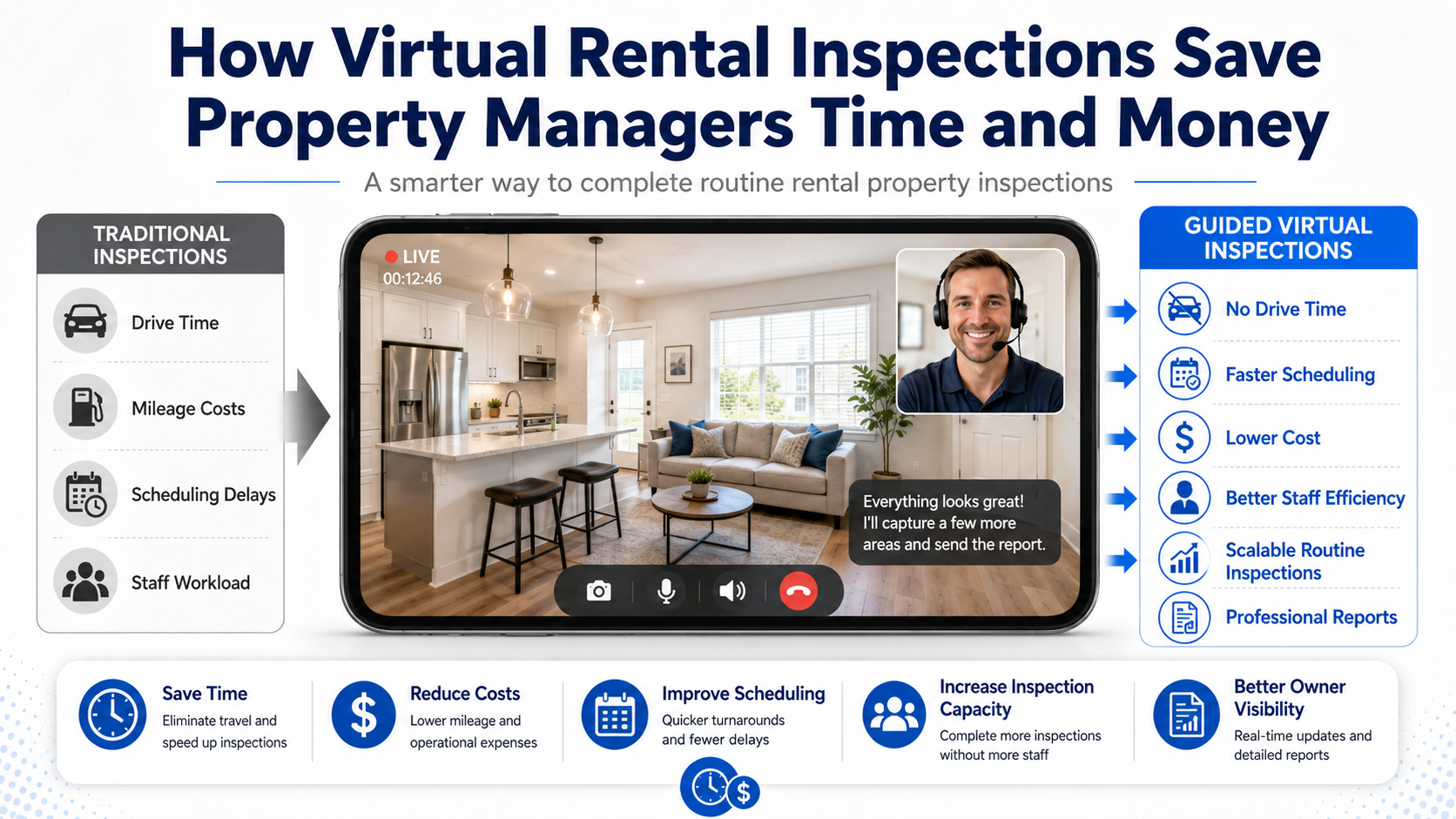
That is why more property management companies are using guided virtual rental inspections to complete routine inspections more efficiently. Virtual inspections can help property managers save time, reduce costs, improve scheduling, complete more inspections, and keep owners better informed without sending staff to every property in person.
What Is a Virtual Rental Inspection?
A virtual rental inspection is a remote inspection of a rental property completed using live video technology. To understand exactly how this works, visit our page on What Are Virtual Rental Property Inspections.
With a guided virtual inspection, the resident is physically inside the home and joins the appointment from a smartphone. A trained inspection professional connects by live video and guides the resident through the property in real time.
The resident provides access to the property, but they are not responsible for inspecting the property on their own. The inspector leads the process. They direct the resident where to go, what areas to show, when closer views are needed, and what documentation should be captured.
This makes guided virtual inspections different from tenant self-inspections. A tenant self-inspection places the responsibility on the resident. A guided virtual inspection keeps a trained inspection professional in control while still avoiding the travel time and cost of an in-person visit.
For more details on how this process works compared to other inspection methods, see our guide: Virtual Inspections vs. Tenant Self-Inspections vs. AI Inspections: What Property Managers Need to Know.
The Hidden Cost of Traditional In-Person Inspections
When property managers think about inspection costs, they often focus on the inspection appointment itself. But the real cost of in-person inspections includes much more than the walkthrough.
A typical in-person inspection may include:
- Scheduling the appointment
- Confirming access with the resident
- Driving to the property
- Parking or gaining entry
- Waiting on the resident
- Rescheduling if the appointment is missed
- Walking the property
- Taking photos
- Uploading and organizing images
- Writing notes
- Preparing the report
- Communicating findings to the owner or internal team
- Creating follow-up tasks for maintenance or lease concerns
Even if the onsite inspection only takes 20 or 30 minutes, the total time involved can be much higher. Travel time alone can turn a short inspection into a major time commitment.
For a detailed breakdown of what inspections actually cost across different models, see our guide: How Much Does a Rental Property Inspection Cost in 2026.
Why Routine Inspections Become Hard to Scale
Property management companies grow by building repeatable systems. But traditional in-person inspections are difficult to scale because they depend heavily on geography, staff availability, resident access, and drive time.
As the portfolio grows, routine inspections can start to fall behind. That can lead to several problems:
- Properties may go too long without being inspected
- Owners may not receive regular condition updates
- Small issues may go unnoticed
- Staff may become overwhelmed
- Inspection quality may vary from person to person
- Reports may be delayed or inconsistent
- Teams may avoid scheduling inspections because they take too much time
Virtual inspections help solve this problem by making routine inspections easier to schedule, complete, document, and scale. For a deeper look at scaling inspection programs efficiently, read: How to Scale Property Inspections Without Hiring More Staff.
How Virtual Rental Inspections Save Time
Virtual inspections save time by removing much of the logistical work that makes traditional inspections inefficient. They do not eliminate the need for professional oversight. Instead, they remove the unnecessary travel and coordination burden from routine inspection work.
1. Less time spent driving
Drive time is one of the biggest hidden costs of in-person inspections. A property manager or inspector may spend more time driving between properties than actually inspecting them. Even a short drive adds up when multiplied across dozens or hundreds of inspections.
Guided virtual inspections eliminate drive time for routine inspections. Instead of sending someone across town, the inspector connects remotely by live video. The resident provides access through their smartphone, and the inspection can be completed without anyone traveling to the property. This allows more inspections to be completed in less time.
2. Faster scheduling
Scheduling in-person inspections can be difficult because it requires coordinating staff availability, resident availability, travel routes, and access windows. Virtual inspections simplify the scheduling process. Because the inspection is remote, there is more flexibility in appointment times. Residents may also find the process easier because they do not have to coordinate with someone physically arriving at the property.
3. Fewer wasted trips
Missed appointments are costly. If a resident forgets an appointment or is unavailable when the inspector arrives, the property manager may lose the appointment time, drive time, mileage, and the opportunity to inspect another property. A missed virtual inspection is still inconvenient, but the wasted cost is much lower because no one traveled to the property. For tips on reducing inspection no-shows, see: Inspection No-Shows: How to Reduce Missed Appointments.
4. More efficient documentation
Traditional inspections often require the inspector to take photos onsite, return to the office or log into software, upload images, organize them, write notes, and prepare the report. With a structured virtual inspection process, the documentation can be captured more efficiently during the appointment. The inspector knows what needs to be documented and can request specific views in real time.
5. Less follow-up after the inspection
Incomplete inspection documentation creates more work. If photos are missing, blurry, or unclear, the property manager may need to contact the resident again, request additional images, or schedule another visit. Guided virtual inspections reduce that problem because a trained inspector is directing the process live. The inspector can identify missing information during the appointment and correct it immediately. That saves time for the property management team after the inspection is complete.
How Virtual Rental Inspections Save Money
Saving time is only part of the benefit. For property managers, time savings often translate directly into cost savings. When routine inspections require less staff time, less travel, less mileage, and less follow-up, the overall cost of the inspection program decreases.
1. Lower labor costs
In-person inspections are labor-intensive. Staff time is spent coordinating, traveling, inspecting, documenting, reporting, and following up. Guided virtual inspections reduce the labor burden by removing much of the travel and onsite coordination from routine inspections. This allows internal teams to spend less time on low-value logistics and more time on higher-value work.
2. Reduced mileage and travel expenses
Every in-person inspection creates travel costs. Those costs may include fuel, mileage reimbursement, vehicle wear, route planning, and lost productivity while staff are on the road. Virtual inspections reduce or eliminate those costs for routine inspection work. This is especially valuable for property managers who cover a wide geographic area or manage properties that are spread out across multiple neighborhoods, cities, or markets.
3. Better use of staff time
Property management teams are often stretched thin. When staff members spend hours driving to routine inspections, they have less time for owner communication, resident service, maintenance coordination, leasing, renewals, and business development. Virtual inspections help free up staff capacity. That does not mean inspections become less important. It means the inspection process becomes more efficient so the team can focus on work that requires their attention most.
4. Fewer delayed inspections
When inspections are expensive or inconvenient, they are easier to postpone. Postponed inspections can create risk. Small maintenance issues may become larger problems. Owners may feel uninformed. Residents may assume no one is checking on the property. Lease compliance concerns may go unnoticed. By making routine inspections easier and more cost-effective, virtual inspections help property managers maintain a more consistent inspection schedule. Consistency can reduce risk and improve owner confidence.
5. Increased inspection capacity without adding field staff
As a property management company grows, inspection volume increases. With a traditional in-person model, growth may require additional field staff, more vendors, or more time from already busy team members. Virtual inspections can increase inspection capacity without immediately adding more field personnel. Because inspections are completed remotely, a trained inspector can complete more routine inspections with less wasted time between appointments. This makes the inspection program easier to scale.
Virtual Inspections vs. In-Person Inspections: Cost and Time Comparison
In-person inspections still have an important place in property management. They are often the right choice for serious damage, safety concerns, complex maintenance diagnosis, legal issues, or situations where physical testing is required.
But not every routine inspection requires someone to physically drive to the property. For a full comparison of how virtual and in-person inspections stack up, see: Are Virtual Rental Property Inspections as Good as In-Person Inspections?
| Category | Traditional In-Person Inspection | Guided Virtual Inspection |
|---|---|---|
| Drive time | Required | Not required |
| Mileage cost | Usually required | Usually eliminated |
| Scheduling flexibility | More limited | More flexible |
| Missed appointment cost | Higher because of travel time | Lower because no travel occurred |
| Staff capacity | Limited by geography and travel | Easier to scale remotely |
| Best use case | Complex or high-risk issues | Routine occupied inspections |
| Cost efficiency | Often expensive for routine checks | Strong for routine inspections |
| Resident convenience | Varies | Often easier to coordinate |
| Report consistency | Depends on inspector and process | More standardized with a guided process |
The best inspection strategy is not always virtual or in-person. The best strategy is using each method where it makes the most sense. Virtual inspections are ideal for routine inspections. In-person inspections should be reserved for situations where physical presence is truly needed.
The Value of Reducing Drive Time
Drive time may be the single biggest reason virtual inspections save money. Consider how much time is lost when a staff member has to drive between properties throughout the day.
Even if each inspection is close by, time is still spent: planning routes, driving between appointments, dealing with traffic, finding parking, waiting for access, and returning to the office or moving to the next property. This time does not create value for the owner, resident, or property management company. It is simply the cost of getting someone physically to the property.
Virtual inspections remove that wasted time for routine inspection work. That allows property managers to spend more time on documentation, communication, and issue resolution instead of travel.
How Virtual Inspections Improve Owner Communication
Owners want to know their property is being monitored. They want clear documentation, organized reports, and confidence that their property manager is staying ahead of issues.
Virtual inspections can improve owner communication by helping property managers complete inspections more consistently and provide professional reports more efficiently. When inspections are easier to complete, owners can receive more timely updates. That can strengthen trust.
Instead of saying inspections are delayed because the team is busy, property managers can maintain a consistent inspection schedule and provide owners with the visibility they expect. For many owners, the quality and consistency of the report matter more than whether someone physically drove to the property for a routine inspection.
How Virtual Inspections Improve the Resident Experience
Residents are an important part of the inspection process. A difficult inspection process can create frustration, delays, and missed appointments. Guided virtual inspections can make the process more convenient for residents because they participate from their phone during a scheduled appointment.
They do not have to wait for someone to arrive during a long window. They do not have to coordinate physical access in the same way. They can be guided through the inspection step by step by a trained professional. A better resident experience can lead to better participation, fewer delays, and more completed inspections.
For tips on preparing residents for inspections, see: How to Prepare Tenants for a Property Inspection.
Why Guided Virtual Inspections Are More Efficient Than Tenant Self-Inspections
Tenant self-inspections may appear inexpensive, but they can create hidden costs. When tenants are asked to inspect the property themselves, they may submit incomplete photos, miss important areas, misunderstand the instructions, or delay completing the task. That creates more follow-up for the property manager.
The team may need to review the submission, identify missing information, contact the resident, request additional photos, and piece together a report. Guided virtual inspections reduce those issues by keeping a trained inspector in control of the process. The resident provides access, but the inspector leads the inspection.
This improves consistency, reduces missing information, and helps create a more professional report. That is why guided virtual inspections can save more time than tenant self-inspections, even if self-inspections seem cheaper upfront. For a full comparison, see: Virtual Inspections vs. Tenant Self-Inspections vs. AI Inspections.
Why Guided Virtual Inspections Are Efficient Without Losing Professionalism
The best inspection process is not just the cheapest process. Property managers need efficiency, but they also need professionalism. They need documentation that owners can trust. They need a process residents can understand. They need reports that are useful to the team.
Guided virtual inspections provide a practical balance. They use technology to remove unnecessary travel and reduce inspection costs, but they keep a trained inspection professional involved in the process. That human guidance helps maintain quality while still improving efficiency.
This is especially important because property management is a service business. The goal is not just to collect data from a property. The goal is to protect the property, serve the owner, communicate clearly with the resident, and give the property management team reliable information.
When Virtual Inspections Make the Most Sense
Virtual rental inspections are especially useful for routine occupied inspections. They are a strong fit for:
- Routine periodic rental inspections
- Occupied property condition checks
- Owner-requested updates
- Lease compliance reviews
- Post-maintenance verification
- Move-in follow-up documentation
- Move-out follow-up documentation
- Properties outside your normal service area
- Large portfolios that need scalable inspection coverage
- Teams trying to reduce drive time and staff workload
These are the types of inspections where property managers often need reliable visibility, not necessarily hands-on testing. For those situations, guided virtual inspections can save significant time and money.
When In-Person Inspections May Still Be Needed
Virtual inspections are not the answer for every situation. In-person inspections may still be needed for:
- Major property damage
- Serious safety concerns
- Complex maintenance diagnosis
- Legal or eviction-related issues
- Physical testing
- Insurance-related documentation
- Situations where the resident cannot participate
- High-risk properties that require onsite review
A strong inspection program uses both methods. Virtual inspections are used for routine documentation. In-person inspections are reserved for situations where physical presence is necessary. This allows property managers to reduce unnecessary field visits while still responding properly to serious concerns.
How Virtual Inspections Help Property Managers Grow
Growth creates complexity. As a property management company adds more doors, the inspection workload increases. If the company relies only on in-person inspections, growth can create pressure to hire more staff, add vendors, or delay inspection programs.
Virtual inspections help property managers grow more efficiently by making routine inspections easier to scale. They allow teams to maintain visibility across the portfolio without multiplying drive time and field workload at the same rate. This can support growth while keeping operations leaner and more consistent.
For property managers who want to increase door count without overwhelming their team, guided virtual inspections can be a valuable operational tool. For more on scaling your inspection program, read: How to Scale Property Inspections Without Hiring More Staff.
Why Property Managers Choose Resident Inspect
Resident Inspect helps property managers complete routine rental property inspections through a live, guided virtual process. Our inspections are not tenant self-inspections.
With Resident Inspect, a trained inspection professional leads the inspection in real time. The resident provides access through live video, and the inspector directs the process, captures documentation, and prepares a professional report.
Resident Inspect helps property managers:
- Save time on routine inspections
- Reduce unnecessary drive time
- Lower inspection costs
- Improve inspection consistency
- Avoid tenant-led self-inspections
- Increase inspection capacity
- Provide owners with professional reports
- Improve resident convenience
- Maintain better visibility across the portfolio
- Scale inspection programs more efficiently
For property managers who want to complete routine inspections without draining staff time or increasing field workload, guided virtual inspections offer a practical solution.
Final Thoughts
Virtual rental inspections save property managers time and money by reducing drive time, improving scheduling, lowering routine inspection costs, and making documentation more efficient. They help property managers complete more inspections with less operational friction.
They also help teams preserve staff capacity, improve owner communication, create a better resident experience, and scale inspection programs more consistently. In-person inspections still matter, especially for high-risk or complex situations.
But routine inspections do not always require someone to physically drive to the property. Guided virtual inspections give property managers a more efficient way to complete routine rental inspections while maintaining professional oversight and reliable documentation.
Want to see how guided virtual inspections can help your team save time and reduce inspection costs?
Related Articles
- Are Virtual Rental Property Inspections as Good as In-Person Inspections?
- Virtual Inspections vs. Tenant Self-Inspections vs. AI Inspections
- Virtual Inspections vs. AI Inspections: What Property Managers Need to Know
- How to Scale Property Inspections Without Hiring More Staff
- How Much Does a Rental Property Inspection Cost in 2026
- How to Prepare Tenants for a Property Inspection