Rental property inspections are changing fast, and property management is following the same wave of AI, drones, and smart home sensors reshaping the rest of real estate. Resident Inspect’s approach sits right at the front of that shift with live, guided virtual inspections built specifically for property managers and landlords.
That’s exactly why Resident Inspect exists. Founder Aaron Cooper saw the frustration firsthand and built a system that eliminates wasted time, cuts costs, and actually improves the inspection process.
So how does it work? And more importantly, how much time and money can you actually save? Let’s break it down.

- Traditional inspections are outdated, expensive, and a logistical nightmare.
Property managers waste time and money driving to properties, dealing with no-shows, and handling scheduling headaches. Virtual inspections eliminate travel, reduce costs, and streamline operations. - Hidden inspection costs add up fast.
Lost time, mileage, insurance, and rescheduling costs make traditional inspections far more expensive than they seem, without even thinking about staff costs or third-party inspectors. Switching to virtual inspections means saving thousands every year. - Resident Inspect makes inspections seamless, consistent, and more reliable.
Unlike self-guided apps, every virtual inspection is conducted live by a trained professional, ensuring nothing gets missed and tenants can’t “accidentally” skip problem areas. - The financial savings are massive.
For a property manager handling 300 doors, switching to virtual inspections can save $20,000–$33,000 per year, which is money that can be reinvested into growth, staffing, or better technology. - Virtual inspections aren’t just about saving money – they save time too.
Traditional inspections waste hundreds of hours per year on travel, admin, and waiting around. Virtual inspections cut the process down from 1.5 hours to 30 minutes, freeing up months of staff time annually. - Tenants actually prefer virtual inspections.
Ninety-seven percent of tenants say they’d rather do a virtual inspection than have a stranger in their home. Fewer scheduling conflicts, less stress, and more flexibility mean fewer tenant complaints and smoother operations for property managers. - Virtual inspections protect property managers from legal disputes.
Time-stamped, geo-located, video-documented reports mean no more “he said, she said” arguments over property conditions. If a tenant claims they reported an issue, there’s video proof of exactly what was covered in the inspection.
AI-assisted reporting is becoming more common. Instead of an inspector typing up notes after the fact, AI tools can help structure inspection findings into organized reports, flag inconsistencies, and speed up turnaround between the inspection and the report landing in a property manager’s inbox.
Predictive maintenance flags are another shift. Rather than treating each inspection as a one-off snapshot, some platforms are starting to compare inspection data over time to flag issues before they become expensive repairs, a leaky fixture that’s been mentioned twice, for example, or wear patterns that tend to precede bigger problems.
Smart home and IoT sensor data is also entering the picture. Moisture sensors, smart thermostats, and connected smoke detectors can feed ongoing condition data into a property’s file, supplementing scheduled inspections with a more continuous view of a unit’s condition.
Where does live, guided video fit into all of this? It’s the foundation these tools build on. AI-assisted reporting and predictive maintenance are only as good as the inspection data feeding them, and a trained inspector guiding a tenant through a structured, live process produces more consistent, complete documentation than a self-guided photo dump ever could. As the technology around inspections keeps evolving, that guided, human-verified core is what keeps the data trustworthy.
Lost time

Mileage & vehicle costs
Gas isn’t free, and neither is wear and tear on company or personal vehicles. The less time you can spend on the road, the more you’ll save in vehicle maintenance, which for larger teams can add up fast.
Locked doors
Insurance & liability risks
Every mile driven increases the risk of an accident, meaning higher insurance costs for your company. You can’t have an auto accident if you don’t drive anywhere, right?

Resident Inspect Eliminates These Costs
With virtual inspections, there’s zero travel time. No mileage. No insurance concerns. You don’t need to do anything because we handle it for you. And if a tenant doesn’t show? We’ve lost a few minutes, not an hour and a half, so rescheduling is no big deal.
“It’s a no-brainer, why waste an hour driving when you can do an inspection from your office in 20 minutes?”
Resident Inspect isn’t some self-guided app where tenants snap a few photos and call it a day. That’s been tried before, and the results are… inconsistent at best.
Here’s how it actually works:
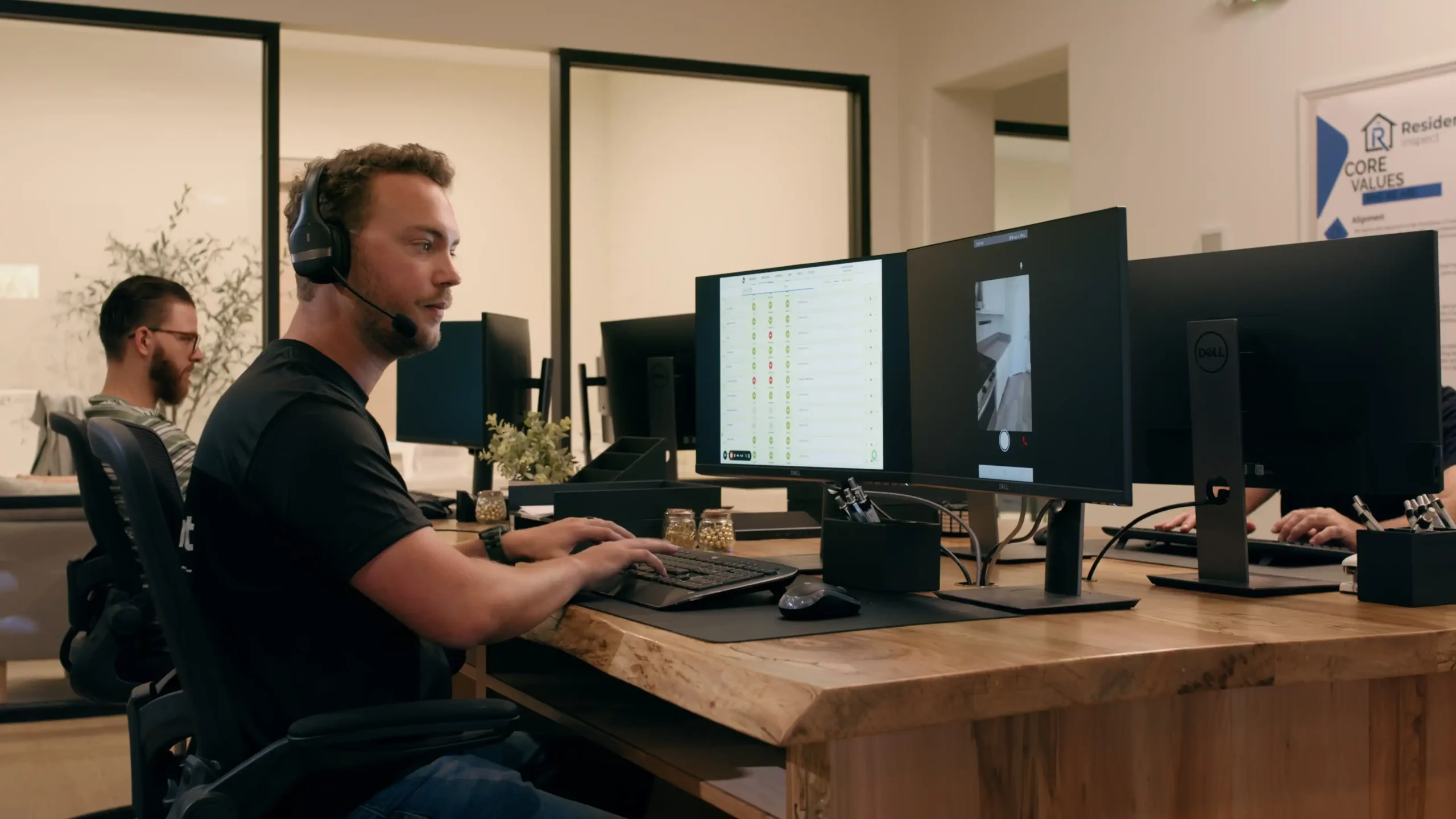
Live, guided video inspections
A trained inspector directs the tenant through the process in real time. They’ll tell them to show the cooker, inside the cupboards, and can ask the tenant to give a closer look.

No more tenant excuses

Set protocols
The inspection follows a strict checklist that we agree with the property manager to ensure consistency. It’s impossible to miss anything as the inspector is working through a standardized process one step at a time.
Real inspectors, not tenants
This ensures quality and accountability without the need for a property manager to physically step foot inside.
Are virtual rental inspections as accurate as in-person ones?
Yes. Every Resident Inspect inspection follows a live, guided video process with a trained inspector directing the tenant, so nothing gets skipped. Unlike self-guided apps, the tenant isn’t in control of what gets shown, which removes the inconsistency that comes with in-person visits.
“Tenants don’t always know what to look for… That’s why a trained inspector guiding them makes all the difference.”
Want to see how it works? Book a free demo with Resident Inspect today.
Let’s talk numbers. Before launching, we conducted extensive market research to find out exactly how much property managers were spending on inspections – and how much they could save by switching to virtual.
After running the calculations, we found:
- Traditional in-house inspections cost $70–$90 each when you factor in:
- Staff wages
- Payroll taxes & benefits
- Admin time for scheduling & rescheduling
- Travel costs (fuel, mileage reimbursements, wear and tear on company vehicles)
- Unproductive downtime from no-shows and last-minute cancellations
- Third-party inspectors cost even more, typically starting at $100 per visit, with some charging even higher fees for properties in remote locations or urgent inspections.
- Resident Inspect’s virtual inspections are significantly less costly at just $45 per inspection, with no travel, no wasted time, and no overhead staffing costs.

A cost-saving case study
Based on 2026 pricing, here’s what the numbers look like for a property management company handling 300 doors, with two inspections per year per property, that’s 600 inspections annually.
- At $80 per in-house inspection, that’s $48,000 per year.
- At $100 per third-party inspection, that’s $60,000 per year.
- At $45 per virtual inspection, you’d spend just $27,000 per year.

That’s a savings of $20,000–$33,000 per year – without cutting corners on compliance or quality, and in some cases actually improving inspection quality.
Where Does That Money Go Instead?
Property managers rarely get the luxury of extra cash sitting around. If you can free up $20K–$30K annually, where could you reinvest it?
Maybe you can hire additional staff to grow your business as you’re no longer sinking money into travel costs.
Maybe you can boost your marketing and lead generation with more resources to attract new property owners, meaning even more doors under management.
Or you could invest in better technology, upgrading your property management software, implementing AI tools, or improving customer service processes.

But It’s About Time Too
Time is money, and traditional inspections waste hours every week.
Let’s say your in-house team spends 1.5 hours per inspection, including:
- Driving to the property
- Conducting the inspection
- Returning to the office
- Logging reports and sending follow-ups

“We surveyed other management companies and across the board, the biggest frustration was wasted time – whether it was no-shows, traffic, or waiting for tenants. With virtual inspections, none of that happens.”
The Bottom Line
Cutting costs on inspections doesn’t mean cutting quality. Virtual inspections provide the same level of documentation, compliance, and oversight, or better, at a fraction of the price.
And the best part? You can try it for free.
Tenants hate inspections. And being real, we kinda understand why…
No one likes the idea of a stranger walking through their home, taking photos, and making notes. It feels invasive. And if you’ve ever had to coordinate an inspection, you know the drill:
- Tenants cancel at the last minute,
- They “forget” and aren’t home, or
- They complain about the timing – because, of course, your 2 p.m. Tuesday slot isn’t exactly convenient for someone with a job, is it?
For property managers, this means frustration, wasted time, and delays. Rescheduling inspections, handling tenant complaints, and dealing with access issues make what should be a simple process feel like pulling teeth.
Less Hassle, Happier Tenants
Resident Inspect eliminates these problems. With live virtual inspections, tenants no longer have to deal with the stress of a stranger in their home, and property managers don’t have to chase them down to get the job done. Here’s why it works better for everyone:
We have Tenant-Friendly Scheduling – We don’t offer rigid daytime slots. Evening and weekend inspections are now an option, so tenants don’t have to rearrange their work schedules.
Our Inspections Are Less Invasive – Instead of feeling like their personal space is being invaded, tenants can walk through their home with their phone, showing only what’s needed.
Our Inspections Get Higher Attendance Rates – With virtual inspections, if the tenant misses their appointment it’s easy to reschedule without wasting anyone’s time.
Tenants Actually Like This
There’s a difference between making inspections more convenient and making tenants actually prefer them. But the numbers speak for themselves.
According to Resident Inspect’s latest data:
- 97% of tenants say they prefer virtual inspections over in-person ones.
- 4.85 out of 5 stars is the average rating from tenants on the inspection process.
And the remaining 3% weren’t against virtual inspections, they just didn’t have a preference.
That means zero tenants actively disliked our process. That’s pretty outstanding!
Happier Tenants Means Fewer Complaints For You
When tenants are frustrated with inspections, property managers hear about it. Complaints pile up about unreasonable scheduling, privacy concerns, or just general inconvenience. And if a tenant feels like they’re being disrupted too often, it can impact their decision to renew their lease, and finding a new tenant is expensive too.

By making inspections easier and less stressful, you cut down on unnecessary friction between tenants and your management team. Fewer complaints mean fewer headaches – and fewer headaches mean more time to focus on profit-building tasks instead of playing referee.
A Better Experience for Everyone
Switching to virtual inspections improves the tenant experience. And when tenants are happy, property managers benefit from:
- Fewer disputes over inspection timing.
- Less pushback when scheduling inspections.
- Higher tenant retention rates, since the rental process feels less disruptive.
When tenants win, property managers win.
Ready to experience the difference?
A tenant insists they reported a leak months ago, and now there’s water damage. They’re furious. Maybe even taking legal action. Your records? Incomplete. The last inspection? Rushed because your field agent was running behind. Suddenly, you’re in a blame game with no way to prove what actually happened.
Why Traditional Inspections Leave You Exposed
Inconsistent inspections means compliance risks.
Do virtual rental inspections hold up for compliance and legal disputes?
Yes. Every inspection is time-stamped, geo-located, and video-recorded, creating a clear record of exactly what was covered and when. If a tenant claims an issue was never reported, there’s video proof showing whether it was checked and whether it was there to see, which removes the ambiguity that comes with relying on memory or handwritten notes.
Virtual Inspections Make Compliance Foolproof
Resident Inspect solves these issues by turning every inspection into a time-stamped, geo-located, video-recorded process that leaves no room for dispute.

Tenants can’t claim “You Never Checked That”
Since inspections are conducted live over video, everything is recorded and time-stamped, proving exactly what was covered and that the tenant was there to see it.
Tenants Can’t Play the “I Forgot to Mention It” Card
High Accuracy, Lower Liability
Virtual inspections are structured and guided by trained professionals, ensuring nothing gets skipped due to oversight or distraction. Unlike in-person visits where tenants can steer conversations away from problem areas, Resident Inspect’s process systematically checks every key location, reducing the chance of missed issues leading to major repairs later.

A Backup Plan for When Things Go Wrong
If a tenant files a complaint or legal dispute, having a digital inspection record protects you. Instead of relying on memory or handwritten notes, you have video proof of the property’s condition on a specific date. No ambiguity. No missing details. Just clear, verifiable evidence.
“Property managers hate doing inspections. Nobody enjoys walking through someone else’s home with a clipboard. But compliance matters, and we make sure nothing gets missed.”
Resident Inspect’s inspections safeguard property managers from unnecessary liability.
Skipping an inspection or missing details can cost you thousands. Why risk it?
Concern #1: “Virtual inspections aren’t as thorough as in-person ones.”
A Standardized Process Means No Missed Steps – Every Resident Inspect inspection follows the same structured process, ensuring that key areas aren’t skipped. Traditional inspections? They’re as good as the person doing them. If they’re distracted, rushed, or forgetful, things get overlooked.
Less Tenant Interference – In-person inspections can be awkward. Tenants make small talk, steer conversations away from problem areas, or subtly position themselves to block the view of damage. Virtual inspections remove these distractions – inspectors stay on track, ensuring nothing is ignored.
Video Documentation – Instead of handwritten notes and hurried photos, everything is recorded in real-time. If something looks questionable, it’s documented instantly, leaving no room for uncertainty later.
Concern #2: “What if the tenant hides something?”
This is a valid concern – but one that applies just as much to in-person inspections. If a tenant wants to hide damage, they’ll do it whether someone is physically there or not.
But virtual inspections actually make it harder for tenants to pull this off.
Guided Inspections Means No “Accidental” Omissions – Our inspectors direct the tenant exactly where to go and what to show. There’s no casually avoiding the mold spot behind the fridge.
Consistency vs. Trusting the Tenant’s Lead – With traditional inspections, the tenant naturally controls the flow – leading an inspector where they want them to go first, filling time with chit-chat, and subtly steering attention away from problem areas. A structured virtual process prevents this – they go where we tell them.
Field Inspections Aren’t a Magic Wand – Even in-person inspections rely on visibility. If damage is hidden under furniture, behind doors, or stashed in a closet, a field inspector won’t find it either. Virtual inspections don’t create a new problem – they just don’t pretend this problem doesn’t exist.
Bottom line: If a tenant is going to hide damage, they’ll do it no matter what. Virtual inspections actually make it harder – not easier – to manipulate the process.
Concern #3: “I just don’t like change.”
This is the real one, isn’t it? For some, the hesitation isn’t about logistics – it’s about comfort. Change feels risky. But every major industry shift – from online rent payments to cloud-based management software – was once “new” too.
Remember When Online Rent Payments Were “Too Risky”? – Now, 75% of renters expect the option to pay online (National Multifamily Housing Council). The companies that adapted early got ahead.
Property Management Is Moving Digital – Like It or Not – The industry is already shifting to automated communication, digital leasing, and AI-driven maintenance requests. Virtual inspections are part of this natural evolution.
The Companies That Adapt Always Come Out Ahead – The best property managers don’t resist change – they use it to gain an edge. Those who switched to online tenant applications, automated lease renewals, and AI-driven maintenance tracking are now running more efficient, scalable businesses.
Bottom line: Virtual inspections are where the industry is heading. Getting ahead of the curve now puts you in a stronger position for the future.
Still Unsure? Try It for Free.
We get it – change takes time. That’s why Resident Inspect offers 5 free inspections, so you can see the process in action with zero commitment.
You have nothing to lose – and a more efficient, cost-saving system to gain.
As AI, predictive maintenance, and smart home data continue reshaping what’s possible in rental inspections, live guided video remains the reliable foundation all of it builds on, and Resident Inspect is built around that foundation today.
- Are virtual rental inspections as accurate as in person ones?
Yes. Every Resident Inspect inspection follows a live, guided video process with a trained inspector directing the tenant, so nothing gets skipped. Unlike self guided apps, the tenant isn’t in control of what gets shown, which removes the inconsistency that comes with in person visits. - Do virtual rental inspections hold up for compliance and legal disputes?
Yes. Each inspection is time stamped, geo located, and video recorded, creating a clear record of the property’s condition on a specific date. If a tenant claims an issue was never reported, there’s video proof of exactly what was covered during the inspection. - Are virtual inspections less thorough than in person inspections?
No, they’re often more thorough. A standardized process means no steps get missed regardless of who’s conducting the inspection, and tenants can’t steer the inspector away from problem areas the way they sometimes can in person. - What if a tenant tries to hide damage during a virtual inspection?
It’s harder to do than in person. The inspector directs the tenant exactly where to go and what to show, so there’s no casually skipping a damaged area. In person inspections face the same risk since anything hidden under furniture or behind doors goes unnoticed either way. - How much can a property management company save by switching to virtual inspections?
For a company handling 300 doors with two inspections a year, switching from in house or third party inspections to virtual can save between $20,000 and $33,000 annually, based on Resident Inspect’s 2026 pricing. - Do tenants actually prefer virtual inspections?
Yes. Ninety seven percent of tenants say they prefer virtual inspections over in person ones, with an average rating of 4.85 out of 5 for the process.