
How to Scale Property Inspections Without Hiring More Staff (2026 Guide)

Aaron Cooper
Founder & Chief Executive Officer, Resident Inspect
📍 Jacksonville, FL
Aaron Cooper is a seasoned property technology entrepreneur and inspection industry expert. As the Founder and CEO of Resident Inspect, he leads the development of intelligent inspection platforms that empower landlords, property managers, and investors to streamline digital inspections and ensure compliance.
Snapshot
Inspections don’t have to be the ceiling that limits how far your property management company can grow. They become the ceiling when the inspection model doesn’t scale, when adding properties means adding proportional inspection hours in a linear relationship that has no leverage.
Breaking that relationship takes four changes: building a systemized process that can be run consistently without depending on any individual, delegating inspection execution off the primary property manager’s plate, automating the trigger, scheduling, and reporting workflow so inspections run without manual intervention at each step, and shifting periodic inspections from in-person to virtual so the format itself doesn’t impose a geographic and time constraint that grows with your portfolio.
The property management companies growing efficiently past 150, 200, and 300 doors are not doing it by working harder or hiring faster. They’re doing it by building inspection operations that scale, and putting that infrastructure in place before they desperately need it.
Table of Contents
- How to Scale Property Inspections Without Hiring More Staff
- Why Inspections Don’t Scale Under the Traditional Model
- The Scaling Framework: Four Levers
- What the Scaled Inspection System Looks Like in Practice
- Implementation Sequence: How to Get There
- Common Objections and Honest Answers
- Frequently Asked Questions
How to Scale Property Inspections Without Hiring More Staff
At some point in the growth of every property management company, inspections become the constraint.
Not leasing. Not maintenance coordination. Not accounting. Inspections, the periodic walkthroughs that need to happen on schedule across every property in the portfolio, become the operational ceiling that slows everything else down.
It usually surfaces around 75 to 100 properties. The property manager who was handling everything starts running out of hours. Inspection schedules slip. Reports get filed late or incompletely. No-shows pile up. The periodic inspection program that was running fine at 40 doors is visibly struggling at 90, and there are another 30 in the pipeline.
The instinctive response is to hire. Add a staff member dedicated to inspections. Or promote someone internally and pull them off other work. Either way, headcount goes up, overhead goes up, and the margin on those additional doors shrinks before they’ve made any profit.
There is a better path. To scale property inspections in property management without scaling headcount, you have to rethink how inspections are structured, systemized, and delivered. Not just add more people to a broken process. This guide covers exactly how to do that.
Why Inspections Don’t Scale Under the Traditional Model
The traditional in-house inspection model has a basic scalability problem: it is almost entirely time-linear. Every additional inspection requires a roughly proportional additional investment of staff time. Double the portfolio and you roughly double the inspection hours required. There is no leverage, no efficiency gain at volume, and no way to grow the portfolio without growing the inspection workload at about the same rate.
Here is what makes the traditional model so resistant to scaling:
Each inspection requires a dedicated travel block. In a 50-property portfolio concentrated in a single market, a property manager might cluster 4 to 5 inspections in a day and keep the travel time manageable. At 150 properties spread across a wider geography, clustering gets harder, drive times between properties go up, and the number of inspections per day actually drops as the portfolio grows. The math works against you.
Scheduling is a labor-intensive process that doesn’t compress at volume. Coordinating 20 inspection appointments a month takes a lot less than half the time of coordinating 200. The back-and-forth with tenants, the rescheduling, the reminder calls, each one takes roughly the same amount of time regardless of how many others are happening at the same time. Scheduling overhead scales linearly with volume.
Report quality drops under volume pressure. A property manager inspecting 3 properties in a day produces better reports than one inspecting 7. Physical exhaustion, time pressure, and the mental load of remembering details across multiple properties all hurt documentation quality. The documentation that matters most, the inspection records that protect you in a security deposit dispute, gets worse exactly as the portfolio grows and the stakes go up.
The model has no leverage points. Unlike leasing, where technology and process improvements can dramatically expand output per staff member, the traditional in-house inspection model offers no natural leverage. You can clean up scheduling, improve reporting tools, and tighten the communication process. But at the end of the day, someone still has to drive to every property.
The Scaling Framework: Four Levers
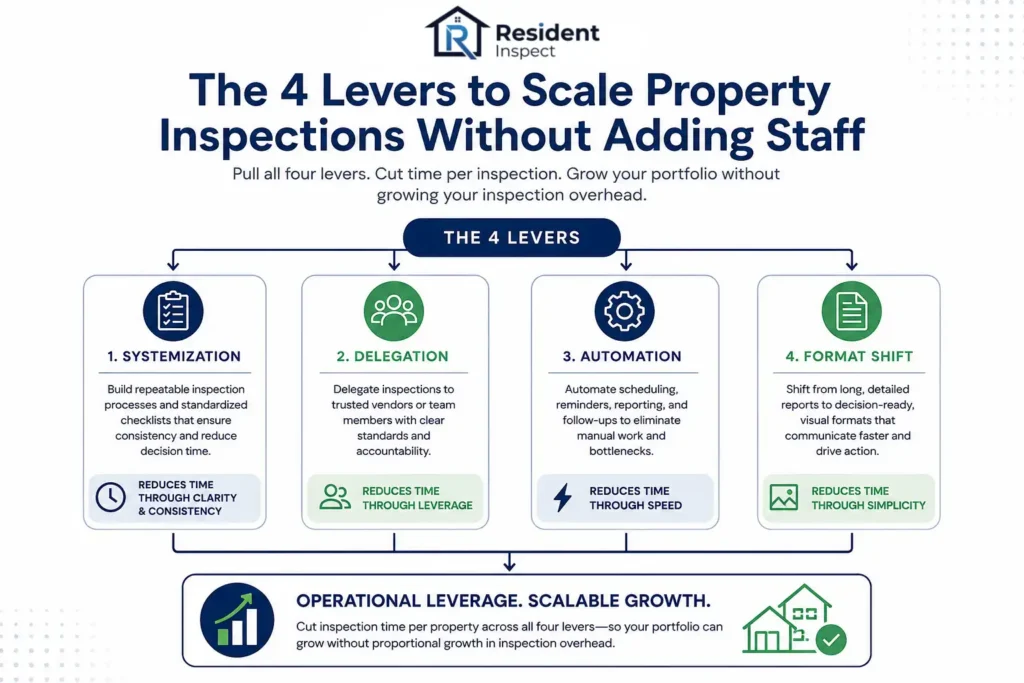
To scale property inspections without adding staff, you have to pull four specific levers, not just one. Property managers who try to solve the scaling problem by pulling only one lever (usually technology) find that the other constraints reassert themselves quickly.
The four levers are: systemization, delegation, automation, and format shift. Each one cuts the time cost of inspections per property. Together they create the operational leverage that lets a portfolio grow without proportional growth in inspection overhead.
Lever 1: Systemization — Build the Process Once, Run It Everywhere
The first scaling problem most growing property management companies face is not volume. It is inconsistency. Every inspection happens slightly differently. Different checklists, different photo standards, different report formats, different notice procedures. What works when one person manages the whole process falls apart when a second person gets involved, because the process was never documented. It lived in the original person’s head.
Systemization means building the inspection process into a documented, repeatable standard that anyone can follow and that produces the same results regardless of who runs it.
The components of a systemized property management inspection system:
A standardized inspection checklist. One checklist for periodic inspections. One for move-in. One for move-out. Not “a checklist we use most of the time.” The checklist. Documented, formatted, and used the same way across every property in the portfolio. The checklist is what makes sure an inspector covering for a sick colleague produces the same documentation standard as the inspector who normally handles that area.
A defined photo protocol. How many photos per room. What angles. What specific items need close-up documentation. What pre-existing conditions need extra photos. This doesn’t have to be a 20-page manual. A one-page photo standard with examples is enough. But it needs to exist and be followed.
A standardized notice procedure. What channel. What timing. What language. What the reminder sequence looks like. Not a general policy that each property manager reads differently. A specific, documented sequence that produces the same tenant communication experience on every property.
A defined report format. What the inspection report looks like. How conditions are described. What categories are used. How photos are attached and labeled. A report format that stays consistent across every inspection makes the comparison between move-in and move-out reports easy and makes any dispute documentation clean.
Once these four components are documented, the process can be run by anyone trained on it. That includes inspection-specific staff, third-party contractors, or a virtual inspection service. Without documentation, you are not scaling a system. You are cloning a person, which is slower, more expensive, and less reliable.
Lever 2: Delegation — Move Inspections Off the Property Manager’s Plate
In most property management companies below 75 to 100 properties, the property manager runs inspections. They know the properties, they know the tenants, and it’s simply faster to do it themselves than to explain the process to someone else.
This changes at scale. A property manager running their own inspections at 150 properties is burning 25 to 35 percent of their total working hours on inspection logistics and execution alone. That is capacity that could be generating new management agreements, building owner relationships, and handling the leasing and maintenance functions that actually grow the business.
Delegation, moving inspections off the primary property manager’s plate, is the second lever. It has two forms:
Internal delegation means training a junior staff member, an administrative coordinator, or a dedicated inspection specialist to run and document inspections under the standardized system. This adds cost (the staff member’s time) but frees the property manager for higher-leverage work. The key is that the systemization from Lever 1 has to come first. You cannot effectively delegate a process that isn’t documented.
External delegation means outsourcing property inspections to a third-party service. That can be a traditional in-person inspection company or, more efficiently, a virtual inspection service. External delegation removes the inspection execution from your payroll entirely. You pay per inspection rather than carrying fixed labor cost. You get consistent, professional documentation without using any staff time beyond submitting the inspection request and reviewing the report.
External delegation to a virtual inspection service is the highest-leverage form of delegation available to growing property management companies. The inspection execution, tenant scheduling, communication, and reporting all move off your plate. Your team reviews completed reports. That is the entire interaction.
Lever 3: Automation – Eliminate the Manual Touchpoints
In a traditional inspection program, every individual inspection involves multiple manual touchpoints. Identifying that an inspection is due. Scheduling the tenant. Sending the notice. Following up on non-responses. Confirming the appointment. Completing the inspection. Entering the report. Following up on any items identified.
At 50 properties, this is manageable. At 150, the manual coordination overhead is a serious time drain. At 300, it is unsustainable without dedicated staff.
Automation cuts out or dramatically reduces the manual touchpoints by connecting your property management software to an inspection workflow that triggers, schedules, reminds, and follows up without needing staff intervention at each step.
The inspection automation stack for a scaling property management company looks like this:
Inspection triggers in your PMS. Most major property management platforms (AppFolio, Propertyware, Buildium, Rentvine, Rent Manager) can pull a report of properties due for inspection based on the last inspection date. Some can automatically flag properties approaching the inspection interval. This trigger removes the manual process of figuring out which properties need inspections. The system tells you.
Automated inspection requests. When a property is flagged for inspection, the request should flow automatically to the inspection service or the inspection scheduler. It shouldn’t sit in a queue waiting for a property manager to manually start it. This is doable through PMS integrations with inspection services or through workflow automation tools like LeadSimple that connect the trigger to the action.
Automated tenant communication. The scheduling process (initial contact, scheduling options, confirmation, reminders) should run without staff involvement. A virtual inspection service that handles all tenant scheduling removes this entirely. An internal process can be partially automated through your PMS communication tools or a third-party communication platform.
Automated report delivery. When an inspection is complete, the report should land directly in the property manager’s queue. Not emailed to an inbox that someone manually processes and files. Integration between the inspection service and the PMS keeps inspection records in the tenant file where they belong.
The automation goal is to cut the staff touchpoints per inspection from 6 to 8 manual steps down to 1 to 2: submit the request and review the completed report. Everything in between (scheduling, reminders, execution, documentation, delivery) runs without staff intervention.
This is doable today with the right combination of property management software, inspection service, and workflow tools. It is not a future state. It is how the most efficiently run property management companies are operating right now.
Get our Rental Inspection Checklist.
Lever 4: Format Shift – Replace In-Person with Virtual for Periodic Inspections
The three levers above (systemization, delegation, automation) make inspections more efficient regardless of format. But they still operate inside the constraint of the in-person inspection model for periodic walkthroughs. The fourth lever removes that constraint entirely.
Shifting periodic inspections from in-person to virtual is the single highest-impact change available to a growing property management company. The mechanics of why this matters for property inspection efficiency are specific:
Virtual inspections have no geographic constraint. An in-person inspection in a property 45 minutes away burns 90 minutes of travel time plus the inspection itself. A virtual inspection in a property 45 minutes away takes the same 25 minutes as one across the street. As your portfolio spreads geographically (which it does as you grow) the travel constraint compounds. Virtual inspections make geography irrelevant.
Virtual inspections kill the scheduling window problem. In-person inspections require a property manager’s calendar to be blocked for travel, the inspection, and return. Virtual inspections require the inspector’s time, not the property manager’s. Multiple virtual inspections can run at the same time across different inspectors without any coordination overhead on the property management side.
Virtual inspections scale without headcount. An in-person inspection program scales by adding inspectors, each of whom can physically be in one place at a time. A virtual inspection service scales by routing additional inspection volume through existing inspector capacity. The service absorbs growth without forcing you to hire proportionally.
Virtual inspections kill the no-show rescheduling cycle. As covered in our post on reducing inspection no-shows, virtual inspections produce dramatically higher tenant cooperation rates because scheduling is tenant-friendly and the format is less intrusive. Fewer no-shows mean fewer rescheduling cycles, fewer wasted blocks, and a cleaner inspection calendar.
For a property management company at 100 properties thinking about how to handle growth to 200, the format shift from in-person to virtual for periodic inspections is the decision that changes the trajectory of how inspection overhead scales with portfolio size. At 100 properties with in-person periodic inspections, you’re already feeling the constraint. At 200 properties with virtual periodic inspections and the automation infrastructure described above, you’re running more inspections with roughly the same staff time per inspection as you had at 50 properties.
What the Scaled Inspection System Looks Like in Practice
Pulling all four levers produces an inspection operation that looks fundamentally different from the traditional model. Here is what it looks like for a property management company managing 200 properties:
Inspection triggers: The PMS generates a weekly report of properties approaching their 6-month inspection interval. This report flows automatically to the inspection service queue.
The virtual inspection service receives the request and contacts the tenant directly to schedule the appointment. The property manager is not involved in the scheduling process.
The service sends reminders to the tenant at 7 days, 3 days, 1 day, and the morning of the inspection. No-show rates run below 5 percent.
The inspection is done by a trained inspector via live video call with the tenant. The inspector follows the standardized checklist and photo protocol. The property manager is not involved in the inspection execution.
The completed branded report (with timestamped photos and condition notes) gets delivered to the property manager’s queue within 24 hours. The property manager reviews it in 10 to 15 minutes, flags any action items for the maintenance or leasing team, and files it in the tenant record.
Total property manager time per inspection: 10 to 15 minutes. Total inspection time from trigger to report: 5 to 10 business days. Total inspections completed per month at 200 properties with semi-annual frequency: about 33. Total monthly property manager time for 33 inspections: about 6 to 8 hours, roughly one day per month.
Compare this to the traditional in-house model at 200 properties: 33 inspections per month at 2 to 3 hours per inspection equals 66 to 99 hours per month, two and a half full working weeks, in inspection logistics, travel, execution, and reporting. For a team of two or three property managers, this is a serious operational burden. For a solo operator or small team, it is a ceiling that blocks growth.
The scaled model doesn’t just cut inspection time. It removes inspections as the constraint on growth. With 10 to 15 minutes of property manager involvement per inspection, adding another 50 properties to the portfolio adds roughly 1 to 2 additional hours of monthly inspection-related work. Growth becomes operationally viable in a way it simply isn’t under the traditional model.
Implementation Sequence: How to Get There
| Step | Action | What It Does |
|---|---|---|
| 1 | Document your current process | Reveals the time-eating steps and inconsistencies you need to fix. You can’t systemize what you haven’t observed. |
| 2 | Build the standard documents | Create your inspection checklists, photo protocol, notice templates, and report format. Takes 2 to 4 hours and forms the foundation. |
| 3 | Roll out the periodic inspection lease addendum | Add to all new leases and renewals. Sets inspection frequency, notice procedure, and acceptance of virtual inspections. |
| 4 | Pilot virtual inspections on 10 to 15 properties | Get comfortable with the report format, scheduling process, and tenant response before full rollout. |
| 5 | Integrate with your PMS | Connect inspection requests and report delivery to your software. Resident Inspect integrates with AppFolio, Propertyware, Buildium, Rentvine, and Rent Manager. |
| 6 | Convert all periodic inspections to virtual | Switch the full periodic calendar to virtual. Keep in-person for move-in, move-out, and situations needing physical presence. |
| 7 | Build the automation triggers | Automate so properties approaching their inspection interval generate a request without manual identification. Inspections become a background process. |
Making the switch from a traditional inspection model to a scaled virtual system doesn’t require doing everything at once. The sequence that works for most property management companies:
Step 1: Document your current process. Before changing anything, write down what you’re actually doing, from how you spot properties due for inspection through how you file the completed report. This documentation reveals the specific steps that are eating up time and creating inconsistency. You cannot systemize what you haven’t observed.
Step 2: Build the standard documents. Create your standardized inspection checklists, photo protocol, notice templates, and report format. These don’t have to be elaborate. They have to be written down, internally consistent, and actually used. This step usually takes 2 to 4 hours and produces the foundation everything else builds on.
Step 3: Roll out the periodic inspection lease addendum. For all new leases and upcoming renewals, add the periodic inspection addendum that establishes the inspection frequency, notice procedure, and acceptance of virtual inspections. This kicks in gradually as new leases get signed, but it sets the expectation for the tenants who will be part of your scaled inspection program.
Step 4: Pilot virtual inspections on 10 to 15 properties. Before flipping the entire periodic inspection calendar, run a pilot with a defined subset of properties. This lets you get comfortable with the report format, the scheduling process, and how tenants respond to the virtual format before rolling it out at scale.
Step 5: Integrate with your PMS. Work with your virtual inspection service to connect the inspection request and report delivery workflow to your property management software. Resident Inspect integrates directly with AppFolio, Propertyware, Buildium, Rentvine, and Rent Manager. Getting this integration in place before full rollout makes sure the automation infrastructure is working when volume picks up.
Step 6: Convert all periodic inspections to virtual. Once the pilot shows the quality and efficiency of the virtual format, convert the full periodic inspection calendar. Keep in-person visits for move-in, move-out, and any situation that needs physical presence.
Step 7: Build the automation triggers. Work with your PMS and workflow tools to automate the inspection trigger, so properties approaching their inspection interval automatically generate a request without manual identification. This is the final piece that pulls inspections out of the active attention of your team and turns them into a background process that runs reliably without intervention.
Common Objections and Honest Answers
“Our owners expect us to personally inspect every property.”
Some owners do. For those relationships, in-person inspection visits from your team may be part of what you’re delivering, and that’s a legitimate service decision. But for most owners, what they actually want is documentation that their property is being monitored, maintained, and professionally managed. A detailed virtual inspection report with 50 timestamped photos and a condition summary delivered every 6 months meets that expectation better than an in-house inspection that produces a 2-page checklist.
When presenting virtual inspections to owners, frame them around the professionalism of the documentation and the third-party accountability of an independent inspector. Not around the cost savings. The cost savings are real, but owner communication should focus on quality and consistency, not on what you’re not spending.
“What if something is missed that an in-person inspector would catch?”
A professionally trained virtual inspector following a defined protocol will catch the vast majority of what an in-person inspector catches for routine periodic inspections. There are specific areas where in-person has an advantage: physical access to concealed spaces, hands-on damage assessment, structural evaluation. These are not what periodic inspections are primarily about. They are about lease compliance verification, safety checks, and maintenance identification, all of which virtual handles at a professional standard. Save in-person visits for situations that genuinely require them: move-in, move-out, active maintenance assessment.
“Our tenants won’t cooperate with virtual inspections.”
The data says otherwise. Tenant participation rates for virtual inspections run by a professional service with flexible scheduling consistently run above 95 percent, higher than most in-person periodic inspection programs. The format is less intrusive, the scheduling is more convenient, and the communication process managed by the inspection service is more thorough than what most property managers do internally. Tenants who are difficult about in-person inspections are often more cooperative with virtual ones.
“We’re not big enough to need this yet.”
The best time to build the scaled inspection system is before you need it. Not after you’re already buried in volume. The property management companies that grow efficiently through 100, 200, and 300 properties are the ones that built scalable operational systems at 50 and 75 properties. The ones that wait until they’re overwhelmed to build those systems spend 12 to 18 months catching up while growth stalls or quality drops.
At what portfolio size does scaling inspections become critical?
Most property managers feel the inspection constraint hard around 75 to 100 properties. The earliest practical point to put a scaled virtual inspection system in place is around 40 to 50 properties, before the constraint becomes a crisis. Building the systemization, delegation, and automation infrastructure early makes growth through 100, 200, and beyond a lot smoother.
How much does transitioning to virtual inspections save at different portfolio sizes?
At 100 properties with semi-annual periodic inspections, switching from in-house at $80 per inspection to virtual at $55 per inspection saves about $5,000 per year in direct inspection costs, plus 15 to 20 hours of monthly staff time. At 250 properties the direct cost savings approach $12,500 annually and the staff time recovered exceeds 30 hours per month. The staff time recovered is usually worth more than the direct cost savings.
Can I scale inspections without switching to virtual?
Yes, but with serious limitations. Delegating in-person inspections to internal staff or a third-party in-person service scales the execution but doesn’t fix the geographic constraint, the scheduling overhead, or the fixed cost per inspection that doesn’t compress at volume. You can build a larger in-person inspection operation, but the cost and complexity grow with the portfolio. Virtual inspections are the format shift that makes inspection operations genuinely scalable.
How do I handle the transition conversation with existing tenants?
Frame the virtual inspection as an upgrade to the tenant experience, not a cost-cutting move. “We’re switching to a more flexible inspection process that works around your schedule” is accurate and positive. Give clear information about how the virtual inspection works, what tenants need, and how long it takes. For most tenants, the response is positive. They’re trading a multi-hour in-person window for a 25-minute video call on a schedule they chose. The periodic inspection addendum signed at the next renewal locks in the expectation going forward.
What if a property requires an in-person follow-up after a virtual inspection?
This is expected and built into a well-designed hybrid inspection program. Virtual periodic inspections identify issues like maintenance concerns, damage, and lease compliance problems. When a virtual inspection flags something that needs physical assessment, an in-person follow-up gets scheduled. The virtual inspection does not get rid of in-person visits. It cuts their frequency and makes sure in-person visits happen when they’re specifically needed rather than as the default for every routine periodic walkthrough.
See Virtual Inspections in Action
Get a personalized demo to discover how virtual inspections can save time, cut labor hours, and boost property management efficiency.
Get Your DemoPrefer to talk? Call our team.