A documentation problem that inspectors run into constantly
Few compliance issues generate as much friction, confusion, and legal risk for property managers as emotional support animal requests. Part of the problem is structural: the demand for ESA letters created an entire cottage industry of websites that will issue one after a brief online questionnaire and a payment, with no meaningful evaluation of the person’s actual condition. Tenants sometimes use these services specifically to get around a no-pets policy or a pet deposit, which puts property managers in the uncomfortable position of trying to tell a legitimate accommodation request apart from a letter purchased to dodge a pet fee, without running afoul of fair housing law in the process.
Getting this wrong in either direction carries real consequences. Reject a legitimate accommodation request and a property manager risks a Fair Housing Act complaint and potential liability. Accept every letter without any verification and a no-pets or limited-pet policy becomes effectively unenforceable, while legitimate pet policy revenue and liability protections erode across the portfolio. The right approach sits in the middle: a consistent, documented verification process built on the actual federal framework, not on instinct or an informal gut check.
The core legal framework for ESA accommodation requests comes from the federal Fair Housing Act and regulations enforced by the HUD Office of Fair Housing and Equal Opportunity, which applies nationwide. A growing number of states have also passed their own laws addressing fraudulent ESA letters specifically, and those state laws differ in scope and penalty. Property managers should treat the federal framework as the floor and check for state-specific rules on top of it.
The federal framework: Fair Housing Act and HUD guidance
As clarified in the ADA National Network guidance on service animals versus other assistance animals, emotional support animals are not covered by the Americans with Disabilities Act (ADA), which applies a narrower definition limited to trained service dogs (and in limited cases, miniature horses) and permits only two specific verification questions with no documentation requirement at all. ESAs instead fall under the Fair Housing Act (FHA) as a category of assistance animal that housing providers, including rental property owners and managers, may be required to reasonably accommodate as an exception to otherwise valid no-pets or pet-restriction policies. That federal baseline sits alongside state-level Fair Housing and inspection laws, which govern how and when a manager can enter a unit to verify what is actually there.
HUD’s guidance on evaluating these requests, most notably HUD’s 2020 guidance on assessing assistance animal accommodation requests, lays out a framework that balances tenant rights against a housing provider’s legitimate interest in verifying that a request is genuine:
- If the disability and disability-related need for the animal are both obvious or already known, a housing provider generally cannot request any additional documentation at all. The accommodation should simply be granted.
- If the disability or the disability-related need is not obvious, the housing provider may request reliable documentation that the tenant has a disability and that the animal provides some type of disability-related assistance or emotional support.
- Acceptable documentation typically comes from a licensed healthcare or mental health professional who has actual, individualized knowledge of the tenant’s condition, not a one-time online form processed by a service the tenant has no ongoing relationship with.
- A housing provider cannot require a specific certification, registration, ID card, or training documentation for an ESA, because none of these exist as an official or legally required credential at the federal level, no matter what a website selling them claims.
- A housing provider cannot ask for the specific diagnosis or detailed medical records. The documentation needs to establish the existence of a disability and the disability-related need for the animal, not the tenant’s full medical history.
Despite how convincingly many ESA letter websites present themselves, there is no government-run or legally recognized national registry, certification, or ID program for emotional support animals. A housing provider that is told a certificate or registry listing proves anything beyond what’s printed on it is being misled, and a provider shouldn’t require one as part of a verification process, because doing so isn’t consistent with HUD guidance.
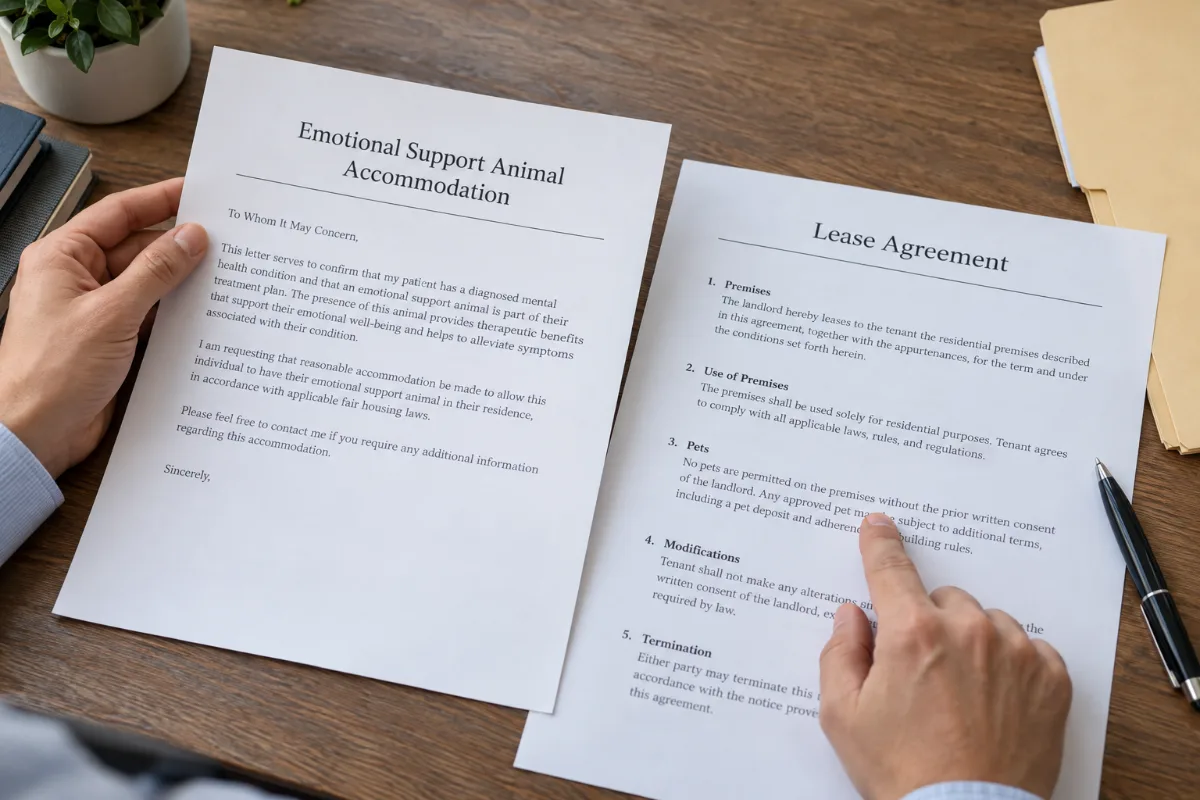
Red flags that are worth a closer look, without jumping to denial
HUD’s own guidance specifically acknowledges that some online services generate letters “with little or no inquiry” into whether the person actually has a disability-related need, and encourages housing providers to treat documentation from such sources with appropriate skepticism while still following the proper request process. In practice, the signs that most often distinguish a questionable letter from a legitimate one include:
- No individualized assessment. The letter reads like a template that could apply to any tenant and any animal, with no detail specific to the tenant’s actual circumstances.
- No real provider relationship. The letter comes from a provider the tenant has never spoken with beyond a short online questionnaire, with no evidence of an actual evaluation, telehealth visit, or ongoing relationship.
- Suspicious timing. The letter was obtained immediately after a pet policy violation notice, a pet deposit demand, or a lease renewal where a no-pets clause came up.
- Out-of-state licensing with no explanation. The provider is licensed in a state with no apparent connection to the tenant, and there’s no indication of a legitimate telehealth relationship that would explain it.
- Generic or inconsistent animal description. The letter doesn’t match the actual animal in type, breed, or basic description, or refers to the animal in oddly generic terms.
None of these signs alone proves a letter is fraudulent, and a property manager should never deny an accommodation request outright based on suspicion. What they justify is following up through the normal documentation request process, which HUD guidance explicitly allows when a provided letter doesn’t establish reliable documentation of a disability-related need. Timing is a good example: a letter that arrives days after a lease violation notice warrants a documentation follow-up, not an automatic denial.
Verifying documentation is about confirming a legitimate accommodation request before or at move-in. Enforcing lease terms (cleanliness, damage, number of animals matching what was approved) is a separate, ongoing matter that belongs in routine inspections. Mixing the two, for example treating a documentation question as a lease violation, increases fair housing risk unnecessarily.
What routine inspections should actually check
Once an ESA accommodation has been properly granted, the inspection process has a narrower, more practical role than evaluating the original documentation:
- Confirm the animal present matches what was approved. The same general type and, ideally, the same specific animal that was documented in the accommodation file, not an additional or substituted animal never disclosed.
- Note property damage or sanitation issues related to the animal. An accommodation doesn’t waive a tenant’s responsibility for damage the animal causes; it waives the no-pets restriction and any related pet fee, not the lease’s general condition and cleanliness standards.
- Flag any animal present with no accommodation on file. If an inspection turns up an animal in a no-pets unit with no documentation on record at all, the right next step is inviting the tenant to submit a request through the standard accommodation process, not treating it as an automatic lease violation.
- Avoid asking intrusive questions during the inspection itself. Inspectors should not use a routine visit to interrogate a tenant about their disability or the animal’s role; that conversation, if it’s needed at all, belongs in the formal accommodation review, generally handled by someone trained in fair housing compliance rather than a field inspector.
Building these specific checks into a consistent, documented inspection process keeps the inspection focused on what it should actually verify, animal presence and lease compliance, while keeping the more legally sensitive documentation review in the hands of whoever manages accommodation requests for the portfolio.

Why state rules add another layer worth tracking
Beyond the federal Fair Housing Act framework, a growing number of states have passed their own laws specifically addressing fraudulent ESA and service animal claims, generally making it a civil or criminal offense to knowingly misrepresent a pet as an assistance animal, and in some cases placing new requirements on the healthcare providers who issue ESA letters. These laws are not uniform, they don’t exist in every state, and the specific penalties and provider requirements differ from one state to the next. For a property manager operating in multiple states, that means the federal HUD framework sets the baseline verification process everywhere, while state-specific fraud laws may offer an additional avenue worth knowing about in the states where a portfolio operates, confirmed with local counsel rather than assumed to apply nationwide.
Getting the process right at scale
For a property manager handling accommodation requests and inspections across a large or multi-state portfolio, keeping the documentation review, the inspection checklist, and the state-specific legal variations straight is a real operational lift. Mishandling even one request, in either direction, carries outsized legal risk relative to almost any other single inspection finding. Working with a dedicated inspection and compliance partner helps keep the inspection side of this process standardized and well documented across every property, while the accommodation decision itself stays where it belongs, with trained staff and legal counsel.
Resident Inspect helps property managers run consistent, well-documented inspections that support fair housing compliance, including clear records of approved accommodations and any animal-related lease issues. Talk to us about building this into your inspection program.
This article provides general information for property managers and is not legal advice. Fair Housing Act obligations, HUD guidance interpretation, and state laws addressing fraudulent assistance animal documentation vary and change over time. Always confirm current requirements and review any accommodation denial or enforcement action with qualified local legal counsel before acting.
Frequently Asked Questions
Is an emotional support animal the same thing as a service animal?
No, and the distinction matters legally. Under the Americans with Disabilities Act (ADA), a service animal is specifically a dog (or in limited cases a miniature horse) individually trained to perform a task related to a person’s disability, and ADA rules allow only two narrow verification questions, no documentation requirement. An emotional support animal (ESA) provides comfort through its presence but isn’t trained to perform a specific task, and ESAs are not covered by the ADA at all. ESAs are instead addressed under the Fair Housing Act as a category of assistance animal that housing providers may need to reasonably accommodate, which is a different legal framework with different documentation rules than apply to service animals.
What can a property manager legally ask for when a tenant requests an ESA accommodation?
If the disability and the disability-related need for the animal are not obvious or already known, HUD guidance allows a housing provider to request reliable documentation of both: that the person has a disability, and that the animal provides some type of disability-related assistance or emotional support. This is typically a letter from a licensed healthcare or mental health professional with actual knowledge of the tenant’s condition. What a property manager generally cannot require is details about the specific diagnosis, extensive medical records, or a specific certification or registration, since no such official registry or certification exists under federal law.
How can a property manager tell if an ESA letter is likely fraudulent?
HUD’s own guidance flags several red flags worth taking seriously: a letter from an online service the tenant has never met or spoken with in any meaningful way, a letter that doesn’t reference any individualized assessment of the tenant’s condition, a generic template that could apply to any pet or any tenant, a provider licensed only in a state unrelated to where the tenant lives with no evidence of a telehealth relationship, or a letter obtained the same day a lease or pet policy issue arose. None of these alone proves fraud, but a letter showing several of these signs is worth following up on through the normal accommodation request process rather than accepting it without question.
Can a property manager deny an ESA accommodation if they suspect the letter is fake?
A property manager shouldn’t deny a request outright based on suspicion alone, but HUD guidance does permit asking for additional reliable documentation when the letter itself raises legitimate questions about its reliability, such as coming from a source with no apparent individualized knowledge of the tenant’s condition. The safer path is to follow a documented verification process, request additional information through the proper channel, and consult legal counsel before denying an accommodation request, since wrongful denial carries significant fair housing liability exposure.
Do any states have laws specifically targeting fake ESA letters?
Yes, and this is a growing area of state-level legislation, though it is not uniform nationwide. A number of states have passed laws in recent years that penalize knowingly misrepresenting a pet as a service animal or emotional support animal, and some states have also placed new requirements on healthcare providers who write ESA letters, such as requiring an established relationship with the patient before issuing one. Because these laws vary significantly by state and continue to change, property managers operating across multiple states should not assume one state’s rule on ESA letter fraud applies everywhere, and should confirm current state-specific rules with local counsel.
Should ESA verification happen during a routine inspection or only at move-in?
Both matter, but for different reasons. The accommodation request and documentation review should happen through a formal process before or at move-in, following the Fair Housing Act framework. Routine inspections play a different, complementary role: confirming that an animal present in the unit actually matches what was approved (same type and generally same animal), noting any property damage or lease compliance issues related to the animal, and flagging situations where an animal is present in the unit with no accommodation request on file at all, which should be addressed through the standard request process rather than through enforcement first.